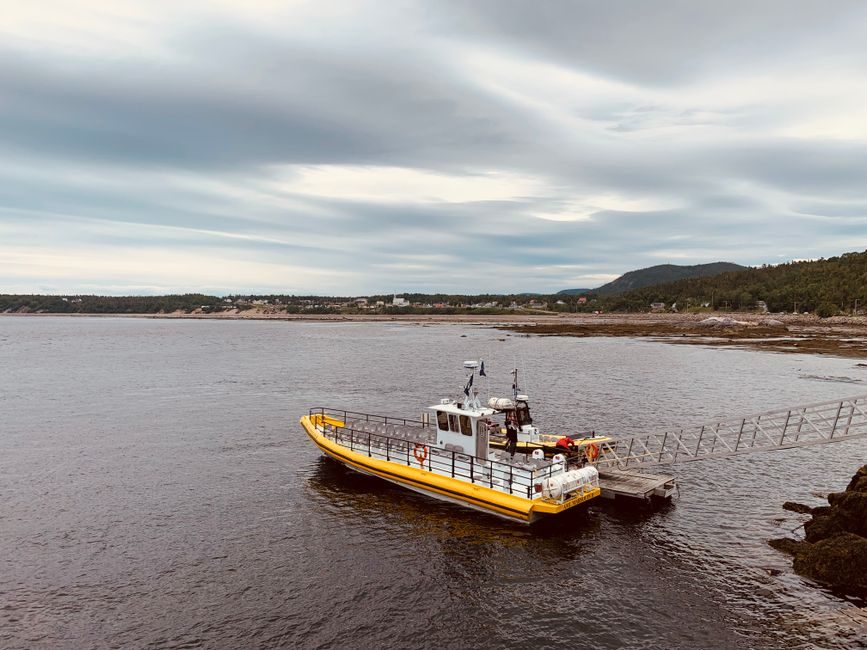
Salt-laden air, heeling decks, and confined shipyard lanes dictate a different aerial work platform than a warehouse scissor lift; the working envelope is 8-28 m, the corrosion package must be marine-grade, and the chassis has to handle uneven, oily ground [S1][S2].
Offshore and dockyard access is dominated by three platform types — articulating booms, telescopic booms, and rough-terrain scissor lifts — supplied globally by Chinese OEM clusters in Hangzhou, Hefei, Yangzhou, and Chongqing alongside European and North American brands [S1][S2][S3][S4][S5][S6].
Why a standard MEWP fails at the quay
Chloride-induced pitting attacks standard EN 10025 S235JR chassis steel in under 18 months in tidal splash zones, which is why marine-spec builds start with hot-dip galvanizing to ISO 1461 with a typical zinc coating mass of 85-140 μm [S1].
Electrical enclosures that survive on shore commonly meet IP54; marine-rated cabs and control boxes lift to IP65/IP66 with sealed cable glands, and breaker panels are typically relocated above the expected green-water line on jack-up or platform builds [S2]. Critical fasteners in the splash zone are 316L stainless per ASTM A276, while structural pins remain 42CrMo with grease-ported bosses so they can be re-lubricated between shifts [S1].
Working envelope vs. ship geometry
Platform height selection is governed by the ship face: harbor work boats sit under 12 m, Panamax bulk carriers top out near 18-20 m to the main deck, and Capesize or large naval hulls push 24-28 m at the bulwark, so the 12 m, 16 m, 20 m, and 24 m tiers are the marine-relevant breakpoints [S1][S2].
Reach is the second number that matters: an articulating boom with 8-12 m horizontal outreach clears lifeboat davits and accommodation block overhangs, while a straight telescopic boom with 14-18 m outreach is the better tool for painting freeboard plates along a flat hull side [S2]. For interior engine-room and hold work — where the access is through a hatch, not over the side — a compact vertical mast lift with a 6-10 m platform height and a stowed footprint under 1.2 m × 0.9 m remains the practical pick [S3]. A broader primer on the four decision gates is laid out in How to Choose an Aerial Work Platform: Height, Load, Terrain, Power, which complements the marine filters below.
Chassis, tyres and outrigger behaviour on deck plates
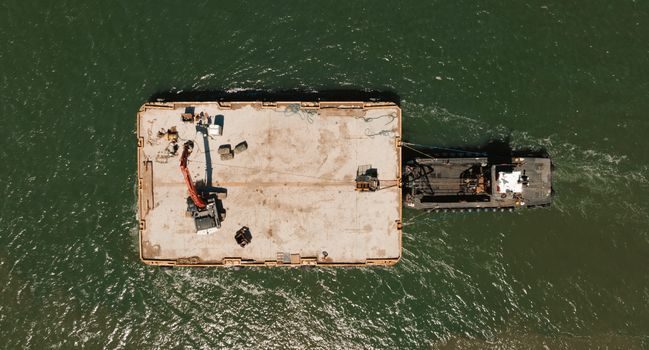
Deck plating is rarely flat: stiffener spacing of 600-800 mm and weld beads force a smaller tyre footprint and a longer wheelbase, which is why marine-spec rough-terrain scissor lifts typically run 26×12-12 solid polyurethane or foam-filled tyres instead of pneumatic rubber [S2][S4].
Outrigger pad loadings are the usual cause of deck damage claims: a 16 m articulating boom at full outreach can impose 80-120 kN per outrigger, so marine deploys either spreader plates rated to 200 kN, or they switch to a truck-mounted platform whose outriggers can be set inside the deck stiffener span [S2]. For work over water — fender painting, hull inspection from a barge — a truck-mounted aerial work truck with hydraulic levelling becomes the right tool, and the aerial work truck class covers this exact duty cycle.
Power and hydraulics for marine duty
Diesel is still the default at unprotected yards, with common engine displacements in the 2.5-3.5 L range meeting EU Stage V / US EPA Tier 4 Final on emission-controlled ports; battery-electric platforms built around 48 V or 80 V LiFePO4 packs with 200-400 Ah capacity are now standard inside covered dry-dock halls and on board vessels where exhaust is unacceptable [S1][S4].
Hydraulic fluid choice is a hidden marine spec: synthetic ester (HEES) or biologically degradable vegetable-oil (HETG) fluids are increasingly specified inside ISO 12944 C5-M environments because a pinhole leak will not black-list the bilge, and seals are upgraded from NBR to FKM or HNBR to keep viscosity stable across the -10 °C to +60 °C operating window typical of North Sea and Gulf duty [S2]. The working envelope itself — a suspended platform — is a separate category reserved for hull-side work where the platform hangs from a crane or davit, not for the deck-level access this article is centred on.
Selection criteria — articulating boom vs. telescopic boom vs. rough-terrain scissor
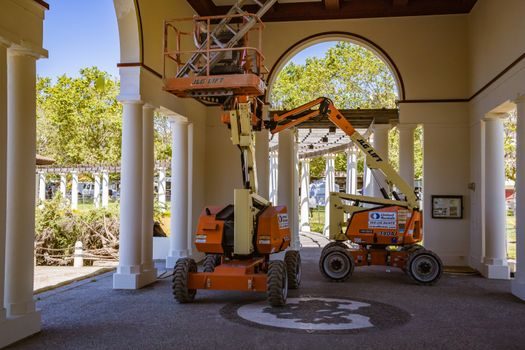
For a typical shipyard, the comparison collapses to four decision criteria: working height, outreach, stowed weight, and price band. Articulating booms (12-20 m, 6-10 m outreach, 6-9 t) are the most flexible on congested quays; telescopic booms (16-28 m, 10-18 m outreach, 8-14 t) win on flat hull-face productivity; rough-terrain scissor lifts (10-18 m, near-zero outreach, 4-7 t) win on cost per square metre painted [S1][S2][S4].
For a clean comparison, lining the three families up against the four marine-relevant decision criteria makes the trade-off explicit: working height runs 12-20 m / 16-28 m / 10-18 m, horizontal outreach runs 6-10 m / 10-18 m / under 1 m, stowed weight runs 6-9 t / 8-14 t / 4-7 t, and indicative FOB-China price per unit runs USD 18-35 k / 35-80 k / 12-25 k respectively [S1][S2][S4]. Articulating and telescopic booms in this band are widely listed by Hangzhou Sivge and Holdwell-style OEM catalogues that publish full model codes and platform-capacity plates in the 230-450 kg range [S1][S2].
Who it is for — and who it is not for
This marine-spec envelope suits commercial shipyards, naval repair docks, offshore wind O&M bases, and cruise-terminal maintenance crews whose work height stays under 28 m and whose site power is 50/60 Hz single- or three-phase [S1][S2]. It does not suit heavy-lift dry-dock block work above 30 m, which crosses into crane territory, and it is the wrong tool for in-water hull cleaning below the waterline, which uses ROVs and dive spreads [S2].
For pure shipboard interior access — engine rooms, cargo holds, accommodation ladders — a compact vertical mast with a 6-10 m lift and a sub-1.2 m × 0.9 m footprint is the right answer rather than a boom; the broader aerial work platform family covers both the boom and the mast sub-classes, and the mast builds are typically offered by dedicated specialists such as HYNEE that publish platform capacities in the 150-200 kg band with single-person cages [S3].
Sourcing reality in 2026
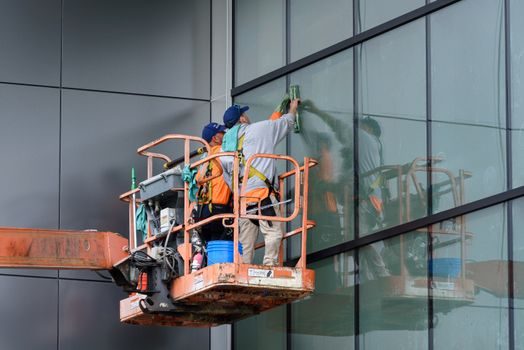
Made-in-China listings for 2026 cluster around four manufacturing hubs: Hangzhou (Sivge and adjacent boom-lift plants, founded 1995-2005) for articulating and telescopic booms, Hefei (Yamei and adjacent scissor-lift clusters) for electric and rough-terrain scissor lifts, Yangzhou (Yixiang and special-vehicle plants) for truck-mounted platforms, and Chongqing for trading-company consolidators offering mixed OEM brands with 10-30 SKU product lines [S1][S4][S5][S6].
The verifiable signal for the next sourcing cycle: confirmed new model-code releases from the Hefei scissor cluster in mid-2026 are expected to push electric scissor platform heights into the 16-18 m band with 80 V LiFePO4 drive, while Hangzhou boom plants are publishing updated Stage V diesel packages for European-port buyers [S1][S4]. Hold on procurement decisions that require 2026-07-05-current emissions certification, and confirm the engine dataplate per unit, because Tier 4 Final / Stage V labelling is still inconsistent across the Chongqing trading-company consolidators [S2][S6].