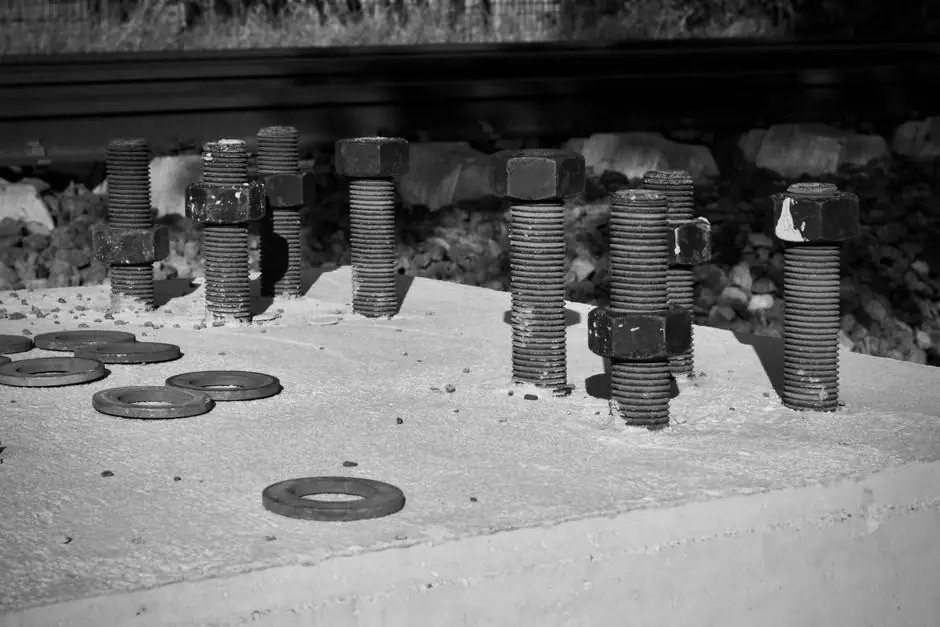
Above-grade truck scale foundations rely on cast-in-place embed plates with welded headed studs or rebar, because the cured concrete fully encases the anchorage and lifts shear and tension capacity well above what post-installed wedge bolts deliver on the same pier footprint [S1]. On a typical pier-only layout, the spec calls for 3/4 in. diameter anchor bolts drilled at install time, with cover and projection set to the scale drawing, not the deck drawing [S3].
Load cell base plates sit flush on the cured pier and are anchored with expansion wedge anchor bolts at a minimum of 3/4 in. x 7 in., per a published steel platform truck scale engineering specification [S5]. Stock pre-fab embed plates for non-scale construction run 5 in. x 5 in. at 3/8 in. thickness with four 1/2 in. diameter x 3-1/2 in. studs welded to the back, weighing about 3.6 lb each in low-carbon plain-finish steel [S6].
Embed Plate vs Base Plate: When Each One Earns the Spec
An embed plate is a cast-in-place steel plate with headed studs, deformed bars, or anchor bolts welded to its back face, dropped into the formwork before the pour so the concrete cures around the anchorage [S1]. A base plate is welded to the bottom of a column or load cell and sits on top of cured concrete, typically on non-shrink grout, then gets fastened down with post-installed wedge or sleeve anchors [S1][S2]. The two are not interchangeable: embed plates win on shear and tension capacity because the steel is fully encased, while base plates win on jobsites where pier dimensions drifted and you need field tolerance [S1].
For a truck scale on a pier-only foundation, the load cell base plate is the typical post-installed interface, while the weighbridge module anchor points frequently run as cast-in-place embed plates tied to the pier rebar cage [S3][S5]. Engineers writing a foundation vehicle spec for an above-grade or floating-slab scale should match the anchorage type to the pier pour sequence, not the deck delivery date.
Anatomy of a Truck Scale Embed Plate Assembly
A workable truck scale embed assembly stacks four components: the face plate that bolts or welds to the weighbridge or load cell stand, the headed studs or Nelson studs welded to the back, the tie rebar that locks the plate into the pier mat, and the anchor bolts that are either cast in or drilled at install [S1][S2][S4]. The 5 in. x 5 in. x 3/8 in. plate with four 1/2 in. studs is the common stock item for light-duty embed work [S6]; heavier scale piers normally step up to 1/2 in. or 5/8 in. plate with 5/8 in. or 3/4 in. studs to match the load cell uplift.
Anchor bolt diameter is the most spec-sensitive number. A pier-only truck scale drawing calls out 3/4 in. diameter anchor bolts drilled at the time of installation, with embedment depth and concrete cover noted on the same sheet as the rebar schedule [S3]. The published steel platform scale engineering spec reinforces that floor: load cell base plates shall be flush mounted to the concrete piers and anchored using expansion wedge anchor bolts at a minimum of 3/4 in. x 7 in. [S5]. That 7 in. length is the wedge-anchor minimum embedment; field drilling into a 12 in. or thicker pier is the usual way to clear it without spalling the corner [S5].
Cast-in-Place vs Post-Installed: Capacity and Field Reality
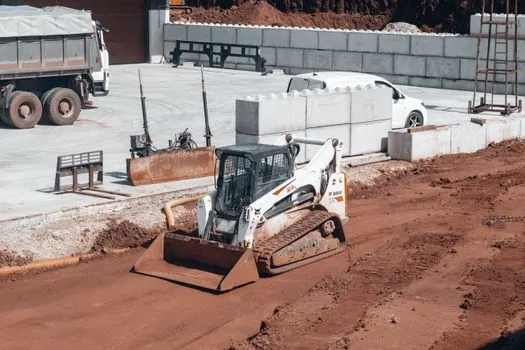
Cast-in-place embed anchors are locked into position by the curing concrete, so their shear and tension capacity is set by the steel stud area, concrete compressive strength, and edge distance, not by the expansion force of a wedge sleeve [S1][S2]. Post-installed mechanical anchors (wedge, sleeve, screw, leadwood) develop capacity by expanding or undercutting the concrete around a drilled hole, which works on dry interior piers but introduces hole-cleanliness and hammer-drill tolerance as field variables [S2].
For a chemical anchor alternative on retrofit piers, designers pick bonded anchors when edge distance is tight or the concrete is cracked, since adhesive spreads load over a longer bond zone than a wedge point [S2]. On new truck scale piers, the spec nearly always comes down on the cast-in-place side for the load cell stands, with the load cell base plate left as a post-installed bolt-up so the scale can be set, shimmed, and grouted after pier cure [S3][S5].
The rebar tie itself is what turns an embed plate from a loose chock into a structural node. Field practice is to either drive rebar pins into a pre-cast pad footing set to the embed location, or to wire the plate studs directly into the pier mat before the pour, then pour the pier around the whole cage [S4]. Welding studs to the rebar is fine if the stud is a recognized shear connector; tying with wire is fine for positioning but does not transfer load.
Selection Criteria: Plate Size, Stud Count, Material, and Finish
Four decision criteria separate an adequate embed plate from one that cracks the pier corner on first impact load: [S2]
1. Plate thickness and area. A 3/8 in. plate on a 5 in. x 5 in. footprint is acceptable for non-structural embeds and light stand connections [S6]. For truck scale load cell stands carrying 50 ton CLC and DTA ratings, plate thickness should step to 1/2 in. minimum and footprint to 8 in. x 8 in. or larger, so prying action under uplift does not bend the plate and pop the anchors [S1][S5].
2. Stud diameter and length. The 1/2 in. diameter x 3-1/2 in. long stud is the common 4-stud stock pattern [S6]. Scale piers normally need 5/8 in. or 3/4 in. studs at 4 in. to 6 in. length to develop the wedge-anchor-equivalent tension capacity in cast-in-place form [S1][S5].
3. Material and finish. Low-carbon plain-finish steel is fine for dry, interior pier pours [S6]. Outdoor piers, salt-belt sites, or any location with chloride exposure warrant hot-dip galvanizing to match the weighbridge finish, and the stud weld must be made before galvanizing, with the plate regalvanized over the weld, or the stud must be stainless [S7].
4. Anchor bolt type at the load cell. A 3/4 in. x 7 in. expansion wedge anchor is the published minimum for steel platform truck scale load cell base plates [S5]. Adhesive anchors of the same diameter generally out-pull wedge anchors in cracked concrete but cost more per hole and require cure time before set [S2].
Failure Modes and Field Fixes
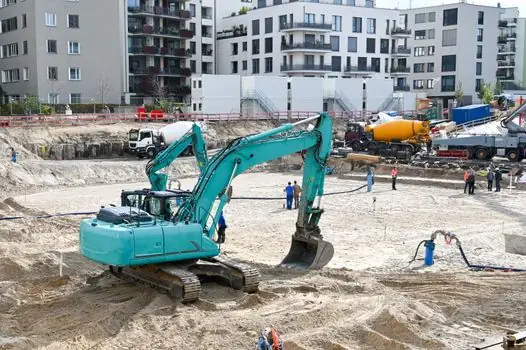
Three failure modes show up on real truck scale pier jobs. First, anchor too close to a pier edge causes concrete breakout before the steel stud yields; ACI 318 Appendix D rules govern this, and the fix is to deepen the embed or move the plate back from the corner. Second, plate too thin for the load causes prying, which bends the plate and pops the anchor head; the fix is to thicken the plate or add a stiffener [S1]. Third, rust at the stud-to-rebar tie comes from wet-setting the plate after the pour instead of casting it in; the cure is to position the plate in the formwork and tie the rebar to the studs before the pour, not after [S4].
Expansion anchor creep under sustained load is a fourth, slower mode that hits wedge-anchored load cell base plates in warm piers. If the scale sees continuous near-capacity loading and the pier sits above 30 C ambient, spec a wedge anchor one diameter up, or switch to a chemical anchor for the same hole size, to cut sustained-load creep [S2][S5].
Standards and Reference Specs in Play
The weighbridge itself is built to ASTM A36 structural steel and welded to AWS D1.1, with NTEP Class IIIL and 10,000 divisions per NIST Handbook 44 governing the legal-for-trade side [S5]. The pier-side anchors and embed plates are governed by ACI 318 Chapter 17 (formerly Appendix D) for cast-in-place and post-installed anchorage, and by ACI 117 for the pier concrete tolerances that the embed sits on. Anchor bolt steel typically comes from ASTM F1554 grades 36, 55, or 105, with grade 36 covering the common 3/4 in. truck scale anchor [S5].
Welded headed studs used as shear connectors on embed plates are produced to AWS D1.1 Type B studs, with the diameter and length chosen to develop the required tension and shear capacity in the cast-in-place condition [S1][S2]. Where the embed plate doubles as a hold-down for a construction machinery and equipment stand or jacking point, the same stud rules apply but the plate also has to resist local bending under the jack foot, which usually forces a thicker plate than the stock 3/8 in. pattern [S1][S6].
Field Sequence That Prevents Rework
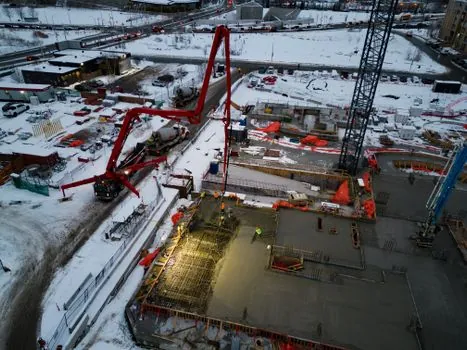
Pour sequence decides which anchorage type actually works. Step 1, set the pier rebar cage with the embed plates wired to the verticals at the correct elevation and orientation, studs pointing into the form, face plate flush to the form face. Step 2, pour and vibrate the pier, then check that no embed shifted during the pour. Step 3, after cure, set the load cell base plates on non-shrink grout, drill the 3/4 in. holes for the wedge anchors at the marked locations, blow the dust out, and torque to the anchor manufacturer's value [S3][S5]. Step 4, set the weighbridge modules, torque all load cell bolts, and verify the weighbridge r factor and span deflection ratio before calibration [S5].
Skipping the grout bed under the load cell base plate is the most common field shortcut that later shows up as a soft corner under heavy trucks. The grout is not cosmetic; it transfers the full cell reaction into the pier over the plate footprint, not at the bolt line [S1][S5].
Related Reading From the Spec Channel
For rebar prep on the mat that gets tied into these embed plates, the 135 degree seismic hook bending on a rebar bender walkthrough covers the machine gates and mandrel sizing that determine whether a hook clears an embed plate stud. For a broader procurement lens on cement-adjacent specs that come with a truck scale pour, the cement-adjacent procurement and engineering signal pack from 2026-10-09 ties together two product tiers and one peer-reviewed UCS model relevant to the pier mix design. [S5]
Track these two signals on the next pour: (1) the embed plate drawing notes whether stud welding happens before or after galvanizing, because mixed practice is the top source of early stud corrosion; (2) the load cell base plate spec names the anchor type, diameter, embedment depth, and torque value, all four, because missing any one of those is what triggers field drilling at the wrong depth and a pier corner spall.