
Selection of a laser distance meter for tunnel construction is not a single product decision but a four-gate filter on declared range, accuracy tolerance, laser safety class, and IP rating, because underground sites impose dust, humidity, low light, and shock loads that reject consumer-grade handhelds within weeks [S2].
Tunnel work covers three distinct jobs: face distance and overbreak checks on a 5-50 m scale, segment lining and convergence monitoring on a 0.5-200 m scale, and TBM-embedded profiling on a continuous 3-30 Hz update rate, each pointing to a different hardware class [S4].
Handheld Phase-Shift Units: 5-150 m for Face and Lining Layout
Handheld phase-shift meters dominate the 0.05-150 m tunnel-layout segment and rely on modulating a continuous laser beam against the reflected return to derive distance by phase difference, with typical accuracy of ±1.5-2.0 mm at the cheap end and ±1.0 mm once the unit passes the $200 mark [S2].
A 50 m digital handheld retails for roughly $22 on the consumer channel as of mid-2025, while a Leica DISTO X3-class industrial handheld sells around $250 and is the de-facto benchmark for tunnel face, rib spacing, and invert checks where IP65 housing and a 2 m drop rating are mandatory [S2]. The Bosch GLM165-40 Blaze Pro publishes a 165 ft (50 m) range with ±1/16 in accuracy, which is the typical spec for short-range tunnel mapping, and the MILESEEY S50 green-beam unit extends handheld reach to 400 ft (120 m) at 635 nm under 1 mW for longer cross-section walks [S3].
Fixed Time-of-Flight Sensors: 200-2,500 m for Profile and Convergence
Fixed time-of-flight (ToF) units move from construction site to industrial integration, and the RIEGL LD05e-A series spans 2 m to 2,500 m with 20 mm precision and a narrow infrared beam, packaged in lightweight aluminium housing for harsh industrial sites including tunnel profiling and convergence monitoring [S1].
The LD05e-A10 and LD05e-A30 variants are configured for three operating modes, High Penetration Mode (multi-pulse averaging, lowest data rate, longest range through dust/rain), Fast Mode, and High Speed Mode for clean targets, with up to four simultaneous target distances per laser shot via digital echo digitisation, a feature that directly supports layered convergence monitoring in wet or dusty headings [S1]. Short IR pulses plus narrow beam divergence give the LD05e-A series strong interference immunity and allow measurement on almost any surface regardless of angle of incidence, which matters when the target is wet shotcrete or rusted steel rib [S1].
Embedded Modules for TBM and Continuous Monitoring: 3-30 Hz, IP54/IP67
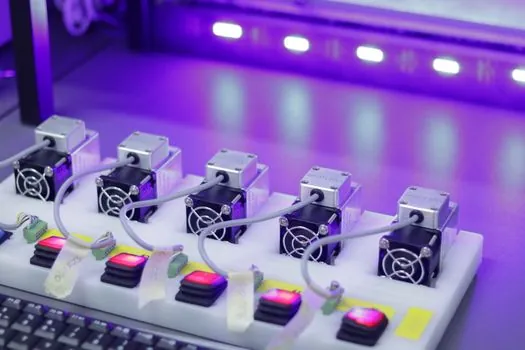
Embedded laser distance modules are the third class and differ from both handhelds and fixed sensors in form factor: they are compact, board-level sensor heads with serial or fieldbus output designed to mount inside a TBM guidance system or on a rail-guided scanner [S4].
Industrial tunnel modules typically publish a 0.03-200 m measurement range, 1-3 mm accuracy, and 3-30 Hz measuring frequency, in an IP54/IP67-rated enclosure that handles dust, humidity, and vibration, which matches TBM and rotary-scanner integration requirements for real-time profile and convergence feedback [S4]. In a metro tunnel project in Southeast Asia, modules integrated into the TBM guidance system provided real-time feedback on distance to the tunnel wall and face and operated reliably in low-light, high-dust conditions, a direct demonstration that the sensor, not the handheld, is the right hardware class for continuous excavation control [S4].
Laser Class and Tunnel-Site Compliance
Handheld units ship as Class 2 (visible, 1 mW CW) by default, which is eye-safe for accidental glances of under 0.25 s and is the legal default for construction sites in most jurisdictions, making them the right pick for face checks, rib spacing, and lining layout [S2].
Class 3R units at 5 mW or less appear on long-range models and require nominal operator briefing but no PPE, while Class 3B and Class 4 pulsed rangefinders (the 1,500 m plus survey instruments) demand laser-controlled areas, interlocks, and OD-rated eyewear, a category jump rather than a price jump [S2]. Specifying a Class 3B or higher unit onto an active tunnel heading without the controlled-area paperwork is the most common compliance miss in 2024-2026 project audits, because shift handover, multi-contractor crews, and parallel mucking operations all expand the controlled area faster than the paperwork [S2].
IP Rating, Shock, and Operating Temperature in Tunnel Air
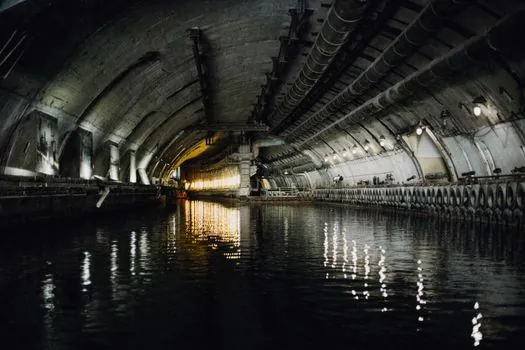
IP54 is the entry threshold for tunnel dust and splash, and IP65 plus a 2 m drop rating is the practical floor for any handheld that will be carried on a vibrating locomotive or passed between surveyor and face crew, which is why industrial handhelds such as the DISTO X3, Bosch GLM 120i C, and Stabila LD 520 cluster at IP65 [S2].
Embedded modules for TBM and rail-scanner duty should sit at IP65 or higher to survive water inflow and drill-muck spray, and fixed ToF sensors in aluminium housings extend the working-temperature envelope well beyond the 23-104 °F handheld window, though datasheet values are application-specific per configuration [S1][S4]. Johnson Level LDM100 handhelds ship at IP54 with 1 m drop and 0.185 lb mass, which is acceptable on a finished station cavern but is too fragile for an active heading where rib scaling and conveyor motion are routine [S1].
Selection Comparison: Three Hardware Classes Against Five Tunnel Criteria
Across the three classes, the dominant decision drivers are range to target, required accuracy, environment severity, mounting format, and laser class, and the table below lines up the typical spec for each class on those five gates. [S1]
Handheld phase-shift units cover 0.05-150 m at ±1.0-2.0 mm in an IP54-IP65, 2 m-drop-rated housing with a Class 2 laser and AAA or Li-ion power, which fits face distance, rib spacing, and lining layout at the lowest cost [S2]. Fixed ToF sensors such as the RIEGL LD05e-A10/A30 cover 2-2,500 m at 20 mm in an aluminium industrial housing with 24 V supply and serial or fieldbus output, with three operating modes for dust, rain, and clean targets, which fits cross-section profiling and long-range convergence monitoring [S1]. Embedded modules cover 0.03-200 m at 1-3 mm in an IP54/IP67 board-level package at 3-30 Hz, which fits TBM guidance, rotary scanner profiling, and segment lining alignment [S4].
Who Tunnel Hardware Is and Is Not For
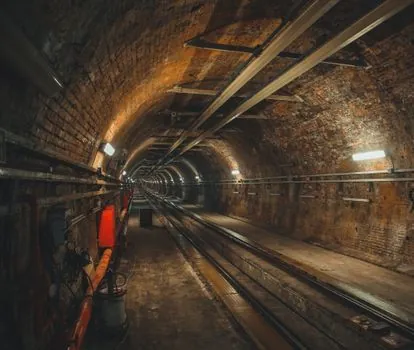
Handheld phase-shift units are for surveyors, shift engineers, and lining crews who need fast, single-shot distances on accessible targets, but they are not for continuous unattended monitoring, where battery life and operator presence become limiting factors [S2][S4].
Fixed ToF sensors are for permanent or semi-permanent installation on cross-section scanners, convergence arrays, and portal monitoring where 24 V supply, serial or fieldbus output, and aluminium housing are available, and they are not for handheld one-shot duties where the 2-2,500 m range is wasted and the housing is awkward [S1]. Embedded modules are for TBM OEMs, rotary-scanner integrators, and automated monitoring system builders who need board-level sensors with 3-30 Hz update rates and digital output, and they are not for surveyors who want a self-contained point-and-shoot tool [S4].
Limits, Failure Modes, and Field Realities
Phase-shift accuracy drifts in bright LED lighting and on glossy wet shotcrete because the modulated carrier SNR falls, and the same tool that publishes ±1.5 mm at 20 m can drift to ±3-4 mm at the far end of its range, which is why datasheet tolerance should be read at the actual working distance rather than at the headline spec [S2].
Pulsed ToF units at 1,000-3,000 m quote ±0.5-1 m, which is order-of-magnitude looser than a handheld in absolute terms but smaller in ppm terms because the absolute distance is two-to-three decades longer, and operators must not apply short-range tolerance expectations to long-range readings [S2]. Handhelds lose line of sight against dark rock, blast smoke, and water spray, so any tunnel SOP should pair the laser reading with a steel-tape or total-station check at every ring or at a defined interval, a point repeated across professional roundups of laser distance measurers [S3][S5]. The MILESEEY 229 ft digital tape with electronic angle sensor and ±0.3° angle accuracy is one example of a hybrid tool that bridges short-range layout and angle capture inside the tunnel envelope [S3].
Sourcing and the 2026 Catalog
Handheld tunnel meters are widely stocked through general construction-tool channels, with the 50 m tier near $22, the 100 m industrial handheld near $250, and pulsed long-range instruments climbing into four-figure territory as of mid-2025 [S2].
Industrial laser distance meters from makers such as RODER, with the ASTech LDM40 (LDM42) for millimetric precision over short and medium distances and the LDM300 (LDM301) for long range and speed measurement with analog, serial, and fieldbus interfaces, are the typical European-sourced fixed-sensor tier for tunnel profiling and conveyor position feedback [S6]. For related selection on duct and HVAC layouts, see the HVAC laser distance meter spec map, and for outdoor road-maintenance use the road maintenance laser distance meter spec map covers the same four-gate filter under different environmental load. Watch the InnoTrans 2026 tunnel-instrument showcase in Berlin (22-25 Sep 2026, Hall 5.2) for new fixed ToF entries aimed at tunnel profiling [S1].
Component reference pages worth checking: laser distance sensor, and construction tools.
See also our earlier report, HVAC Laser Distance Meter Specs: Range, Accuracy, IP for Duct Layout.