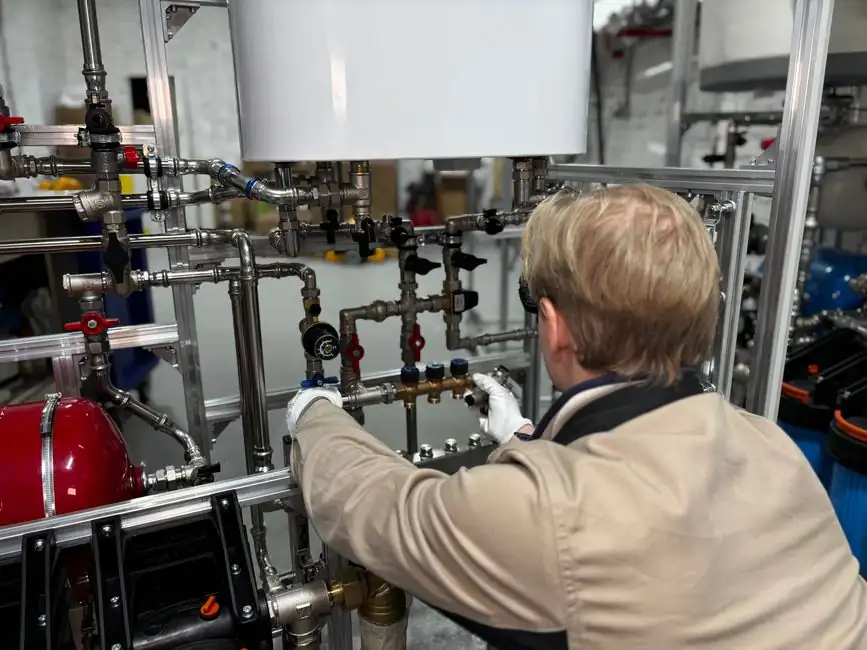
A plumbing-installation laser distance meter should be specified as a four-gate filter: 30-50 m range, ±1.5 mm typical accuracy, Class 2 eye-safe laser, and IP54 minimum ingress protection, with Pythagorean indirect mode for unreachable stack heights.
Plumbing rough-in demands three distance tasks that tape handles poorly: ceiling-to-floor stack runs in 2.4-3.0 m rooms, long horizontal drain runs across a slab, and offset measurements around fixtures. Each task collapses to one trigger pull on a laser distance meter that pairs indirect mode with a stable reference point, instead of a helper holding the other end of a sagging tape.
Range Bands Mapped to Plumbing Tasks
Handheld phase-shift meters dominate the 0.05-50 m segment and rely on modulating a continuous laser beam against the reflected return to derive distance by phase difference, with typical accuracy of ±1.5-2.0 mm at the cheap end and ±1.0 mm once the unit passes the $200 mark [S2]. A plumbing rough-in rarely needs more than 30 m on a single beam, but the 50 m headroom keeps the tool useful for commercial drainage runs across a basement slab, where single spans can stretch past 20 m before manholes.
Industrial phase-shift meters (Leica DISTO X3, Bosch GLM 120i C, Stabila LD 520) stretch the same technology to 100-150 m and package it in IP65 housings rated for a 2 m drop onto concrete [S2]. For a single-family or light-commercial plumbing contractor, that headroom is over-spec; for a mechanical contractor running site drainage across a hospital or warehouse, it is the correct tool. Match the range band to the longest single-beam task, not the average room dimension, and the meter will not run out of reach on the worst day of the job.
Accuracy Tolerance: ±1.5 mm Is the Practical Floor
Three tolerance tiers are visible in the public catalog: entry-level 50 m units publish ±2.0 mm typical accuracy, which is acceptable for room dimensions and cabinet fit-out but accumulates visibly across a 20 m run; mid-tier industrial handhelds push ±1.0 mm, which is the threshold below which surveyors, facade contractors, and steel fabricators will accept the reading without a steel-tape check [S2]. For plumbing layout on a 200 mm slab tolerance, ±1.5 mm is the practical floor and is the spec most mid-range pro units meet out of the box [S2].
For a drywall crew laying out 12-foot sheets, a pocket measure with ±1/4 inch accuracy at 32 feet is enough, but the same tool will frustrate a survey crew pulling dimensions across a parking lot [S3]. Plumbing sits between those two: 1/4 inch (±6 mm) is loose enough to put a cleanout in the wrong stud bay on a long offset, while ±1.5 mm is tight enough to keep a trap arm inside its code-allowed slope. Read the accuracy line on the datasheet, not the brochure adjective, and verify whether the spec is "typical" or "maximum" because many vendors publish the better number first [S2].
Laser Class and Jobsite Legality for Plumbing Crews
Handheld units ship as Class 2 (visible, 1 mW CW) by default, which is eye-safe for accidental glances of under 0.25 s and is the legal default for construction sites in most jurisdictions [S2]. For a plumber walking a job site, a Class 2 laser distance sensor handheld requires no PPE, no controlled area, and no briefing paperwork, which is why the entire mid-range consumer and prosumer catalog sits at Class 2.
Class 3R units (≤5 mW) appear on long-range models and require nominal operator briefing but no PPE; Class 3B and Class 4 pulsed rangefinders (the 1,500 m plus survey instruments) demand laser-controlled areas, interlocks, and OD-rated eyewear, a category jump rather than a price jump [S2]. Specifying a Class 3B or higher unit onto an active construction site without the controlled-area paperwork is a common compliance miss in 2024-2026 project audits, and a plumber never needs that class of instrument for stack, drain, or vent layout. Stay at Class 2 and the tool is interchangeable with the rest of the trades on site.
IP Rating, Drop Survival, and Wet-Trench Reality
The AEG LMG 50 carries IP54 water and dust protection, and the Fluke 417D is IP54 rated and 1-metre drop tested, so both can survive dusty or light-rain exterior work [S1]. For a plumber working in a damp crawl space, a half-flooded mechanical room, or a wet trench during a tie-in, IP54 is the minimum that keeps dust out of the optics and resists splashing from any direction; IP65 is the safer pick on a site where the meter rides a truck bed.
Rugged meters survive drop tests from 2 meters, carry dust and water protection, and keep measuring after a season of hard use; the housing and the electronics matter more than the chip inside, because a meter that dies after one drop costs more than a premium meter that survives a hundred [S4][S5]. The Ryobi RBLDM20, by contrast, is described for home/indoor use with a backlit display and a low-battery indicator, not a published IP rating, and belongs on the office shelf rather than in the truck [S1]. A plumber who drops tools in crawl spaces should treat any unit without a stated IP rating as indoor-only and price the replacement cost into the first fall.
Indirect Mode, Reference Point, and Offset Plumbing
Indirect (Pythagorean) measurement computes heights and widths you cannot reach, which is exactly the geometry a plumber needs when the ceiling stack is 2.7 m up and the tape hook will not sit flat on the pipe [S4]. Two or three Pythagorean readings back-calculate the inaccessible leg, and on a mid-range pro unit the math lives in firmware so the operator reads the offset directly in millimetres or inches.
The AEG LMG 50 supports exactly three reference points, back, front, or back-end pin, and that choice is the single most common source of an offset error on a plumbing takeoff [S1]. A back reference reads from the rear edge of the tool, a front reference from the emitter window, and a back-end pin from an extending pin that drops into a corner; the same beam under the same switch press yields three different numbers. Pin the reference point in the crew's standard operating procedure, write it on the field book header, and the next estimator will not have to guess which edge the number came from.
Comparison: Pocket vs Mid-Range vs Pro for Plumbing
The plumbing contractor sits between the residential remodeler and the site surveyor, and the tool tier should match the longest single beam, the worst environment, and the tolerance the local inspector enforces [S3]. The pocket class (55 ft / 17 m, ±1/4 in, IP-none, $20-30) covers a single bath remodel in a dry interior; the mid-range class (65-100 ft / 20-30 m, ±1/8 in / ±3 mm, IP54, $40-100) is the working pro tier for residential and light commercial plumbing; the pro layout class (165+ ft / 50+ m, ±1/16 in / ±1.5 mm, IP65, 2 m drop, $100+) covers commercial drainage and site work [S3][S4].
Three mid-range candidates visible in the 2026 catalog: a 50 m digital laser distance meter retails for roughly $22 on the consumer channel as of mid-2025, while a Leica DISTO X3-class industrial unit sells around $250 and 3.5-5,000 m pulsed industrial rangefinders climb into four-figure territory [S2]. The Bosch GLM 20 stretches to 65 feet with ±1/8 inch accuracy, costs about $40, and often drops to $30 during holiday sales [S3]. The EAGLINE EGL195C adds Bluetooth data export at 195 ft (60 m) range and sits in the mid-range pro band; the Fluke 417D trades Bluetooth for an IP54, 1 m drop-tested housing at 40 m / 131 ft range and is the safer field pick [S1][S6].
When the Spec Is Wrong: Failure Modes and Limits
Beam clearance is the single most-overlooked installation rule. A 0.1 mm precision LDM still gives garbage if the beam grazes a fixture, a cable tray, or a steam plume within 200 mm of the target [S1]. On a plumbing rough-in the most common culprits are ductwork crossing the ceiling cavity, PEX manifolds blocking the line to a stack, and the plumber's own body when the tool is braced against a stud; walk the beam path with a flashlight before pulling a critical measurement, and any object that breaks the line will break the reading [S1].
Field conditions shift accuracy more than the spec sheet admits: a laser beam reflects cleanly off drywall, paint, and masonry, but dark fabrics, bare metal, and glossy black surfaces scatter it, and bare copper or chrome on a plumbing trim will under-read or refuse to lock [S4]. A 1/16 inch rating may be validated at shorter distances, with the tolerance widening at the far end of the range, especially in bright sunlight, where the laser spot becomes hard to see against light-colored concrete [S3][S4]. When the target is a polished chrome supply stub-out, tape the wall behind it with a piece of matte painter's tape and let the beam lock on the matte surface instead of the chrome.
When to Escalate: Pipe Layout Beyond a Handheld
A handheld laser distance meter earns its keep on plumbing layout where one person has to pull distances that a tape cannot reach alone: room dimensions, ceiling heights, stack and vent rough-in, and long horizontal drain runs across a slab [S3][S7]. For elevation work across a building, a rotary laser with a receiver extends the working range past 1,000 ft and replaces the water level on a grade rod, which is the right tool when the offset spans more than one floor or one slab pour [S5].
For coordinated MEP layout, point-to-point lasers project alignment the whole team can see, which cuts the back-and-forth that eats a layout morning and pairs naturally with a laser level for the vertical datum a plumber needs on a stack [S5]. Hand off the distance work to a laser distance meter and the elevation work to a rotary with receiver, and the two readings reconcile on the same drawing without a second trip. When the measurement drops below 6 feet into a tight corner, or the target is bare copper that will not reflect, keep the tape in the bag; no handheld beats a 1 m steel rule against a chrome stub-out.
Track the next two signals in the 2026 catalog: a mid-range IP65 handheld with Bluetooth export landing in the $80-100 band, and a 100 m class 2 unit with a green beam showing up in the prosumer channel at under $150. Either move would reset the cost-per-plumber-floor for handheld ranging.
Related analysis: XPS Board Selection Map for Renovation Projects.