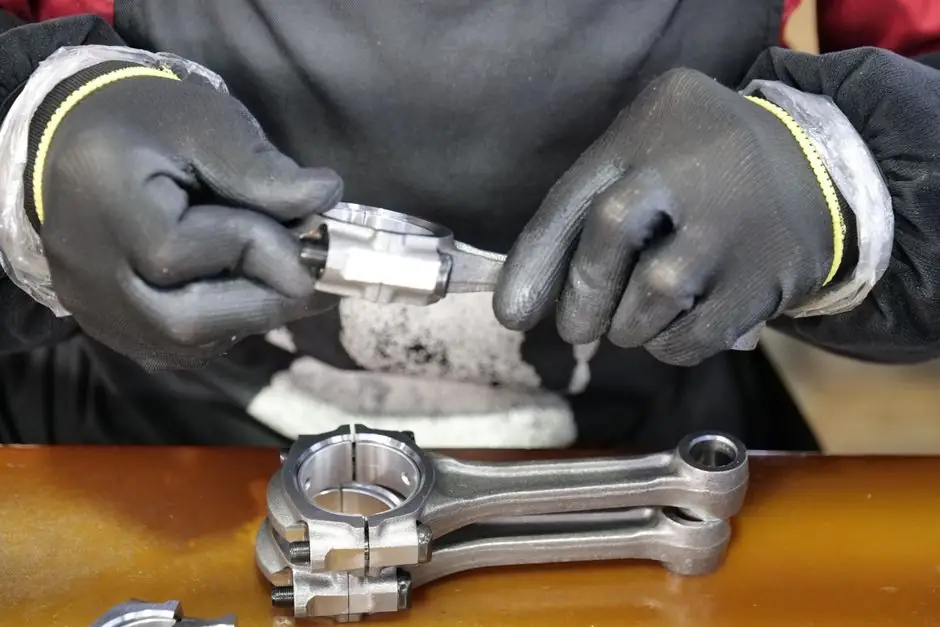
A turbine flow meter converts fluid velocity into rotor speed, with the inlet flow straightening turbulence and improving the velocity profile before the fluid reaches the rotor blades [S1][S4].
The assembly is used for clean liquid and gas service, with commercial designs combining a 316 stainless steel body, a replaceable rotor and shaft, a pickup sensor, and selected straightening hardware [S2][S4][S5].
How the Straightener and Rotor Work Together
Fluid entering through the inlet straightener has its turbulent flow pattern reduced and its velocity profile improved before it reaches the turbine blades [S4]. This conditioning is essential because turbine rotation depends on the fluid approaching the rotor with a repeatable flow pattern, not merely on the presence of fluid in the pipe [S1][S4].
The multi-bladed rotor sits across the flow stream and rotates at a speed proportional to volumetric flow rate [S1][S3]. A pickup detects each blade passage and produces a pulse, so the output frequency represents flow rate and can also be used for totalization [S4].
Pickup technologies include reluctance, inductance, capacitive, Hall-effect, gear, and magnetic arrangements [S1]. A magnetic sensor detects embedded rotor magnets and can provide an NPN or PNP pulse, while a flow computer can convert the pulse train into a scaled flow rate or accumulated volume [S3].
Core Mechanical Components
The body contains the rotor, whose diameter is slightly smaller than the metering chamber bore, together with rotor supports and bearings that constrain the shaft while allowing low-friction rotation [S1]. One commercial construction specifies 316 stainless steel for the flowmeter body and rotor supports, with 17.4 PH stainless steel among the rotor material options [S2].
The FTB-1400 construction uses a 316 stainless steel body, CD4MCU stainless steel rotor, 316 stainless steel rotor support and bearings, and a tungsten carbide rotor shaft [S4]. The GT-TW configuration also specifies a 316 stainless steel body and flow straightener, stainless steel rotor, tungsten carbide shaft, and 316 stainless steel rotor support [S5].
A typical GT-TW repair kit contains retaining rings, the flow straightener, and the rotor assembly, allowing the complete internal set to be renewed rather than replacing the whole meter [S5]. The same series states that rotor replacement takes 2–3 minutes, which makes access design and replaceable internals important parts of service planning [S5].
Materials, Limits, and Service Selection
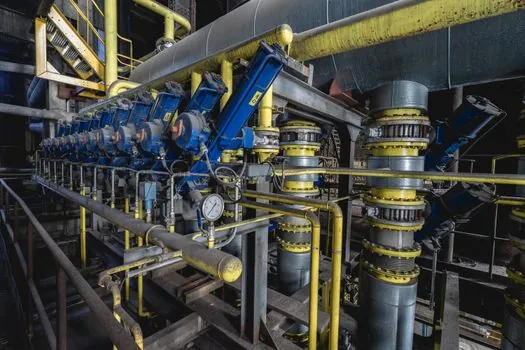
Material selection begins with the measured fluid and its corrosivity, because compatible wetted materials protect the rotor, shaft, bearings, and seals from deterioration that can reduce meter accuracy [S4].
The GT-TW flow ranges are 5–50 gal/min and 40–400 gal/min, with working pressure up to 5,000 psi, 300-micron filtration, and the same ±1% accuracy and ±0.1% repeatability specifications [S5]. These figures apply to that documented configuration and should not be transferred automatically to other turbine meters or sizes.
Straightener and Installation Requirements
A straightener does not replace adequate upstream piping. The inlet flow straightener reduces the fluid's turbulent flow pattern and improves its velocity profile before the fluid passes through the turbine blades [S4].
Modified upstream and downstream straighteners can improve metering accuracy by conditioning flow on both sides of the measuring section [S6]. The GT-TW repair-kit description includes a flow straightener with the rotor, and the meter has NPT end connections [S5].
A turbine flow meter is therefore not simply a rotor placed between flanges. The straightener, rotor, shaft, support, bearings, chamber, pickup, and line configuration act as one measurement system, and changes to any one component can affect calibration, repeatability, or service life [S1][S4][S5].
Turbine, Magnetic, and Other Meter Choices

Turbine meters are suited to clean, non-corrosive liquids and gases, with established uses in chemical processing, water treatment, pharmaceuticals, aerospace, cryogenic service, and custody transfer [S1][S3]. A magnetic or optical sensor detects each blade's passage and typically provides an NPN or PNP frequency output [S3].
A magnetic flowmeter requires a conductive liquid and uses magnetic excitation rather than a mechanical rotor, while a turbine meter responds to fluid velocity and can measure gases as well as liquids [S1][S3]. An ultrasonic flowmeter uses ultrasonic transit timing and has no turbine bearings or rotor to wear, but its construction and installation requirements differ from the straightener-and-rotor arrangement described here [S1].
For dirty, abrasive, or particulate-laden service, turbine construction presents an added risk because particles and mechanical wear affect the rotor, shaft, and bearings [S1][S4]. The FTB-1400 recommends an upstream strainer when small particles are present, and its documented filtration recommendation is 300 microns [S4][S5].
Pulse Output, Calibration, and Maintenance Checks
One blade passage produces one discrete volume indication, and the number of pulses per unit volume defines the meter K-factor [S1]. The GT-TW published K-factors are 900 pulses/gal for the 5–50 gal/min size and 45 pulses/gal for the 40–400 gal/min size, with each meter supplied with its own calibration sheet [S5].
Inductive and reluctance pickups can produce low-level signals, with low-flow pulse voltage potentially around 20 mV peak-to-peak, so the pickup-to-preamplifier distance should remain short [S1]. Hall-effect devices can generate a square-wave output from small embedded magnets, while capacitive sensing uses an amplitude-modulated RF signal [S1].
Severe pulsation and mechanical vibration affect accuracy and shorten meter life [S4]. Service checks should therefore include verification of the straightener condition, rotor movement, pickup output, and calibration against the installed flow range, rather than treating a visible display alone as proof that the internal assembly is healthy [S4][S5].
Engineering Decision Points for Rotor Assemblies
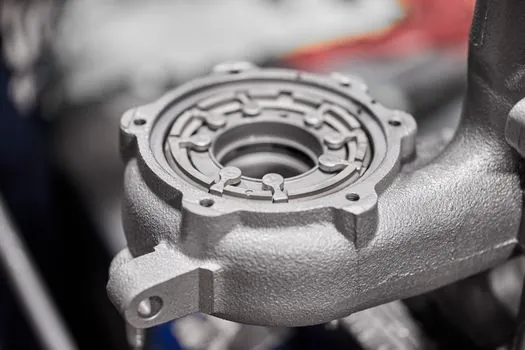
Specify the straightener and rotor assembly around four decision criteria: fluid compatibility, flow range, pressure and temperature limits, and maintainability. A 316 stainless steel body and tungsten carbide shaft suit demanding liquid service in documented designs, while polymer bodies, PVDF blades, Viton seals, and Kalrez seals address selected corrosive applications [S2][S3][S4].
The comparison is direct: a metallic turbine assembly offers a steel body, replaceable internals, and a documented 5,000 psi capability in the GT-TW design, but it requires attention to filtration, vibration, and rotor wear; a polymer-based design can improve chemical compatibility, but its allowable pressure, temperature, and mechanical limits must come from the selected model rather than a generic construction claim [S3][S5].
For a deeper assessment of pressure-related installation, review the guidance on turbine flow meter back pressure and cavitation control. The next verifiable checks are the installed upstream and downstream straight runs, fluid-to-material compatibility, particle filtration, pickup signal integrity, and confirmation that the calibration K-factor matches the actual rotor and flow range [S4][S5].