
The core spec for any warehouse THC station is ISO 13851:2012 Type IIIC, which forces both palm buttons to close within 0.5 s of each other and requires a complete release before the next cycle, with monitoring handled by a safety relay rather than a standard PLC [S1].
That 0.5 s simultaneity window, the PLd / Category 3 minimum logic per ISO 13849-1, and the dual-channel NC contact wiring are the three non-negotiables. Anything else is a safeguarding hole, not a control system, and warehouse presses, balers, and stretch wrappers all sit inside the same risk envelope when the operator's hands are inside the danger zone.
What ISO 13851 actually demands on the control station
ISO 13851:2012 Type IIIC requires the two actuators to be pressed within 0.5 s of each other, held throughout the hazardous motion, and fully released before a new stroke can be initiated, which is the rule that blocks the classic wedge-with-tape bypass on a press or baler [S1].
Standard PLC digital inputs are not safety-rated because outputs can fail short-circuit and silently defeat the safety function, so a dedicated safety monitoring relay such as the Schneider XPSMC, Banner SA1D, or AutomationDirect PNOZ family is mandatory [S1]. The relay enforces the timing, monitors both channels, and switches a force-guided output set, typically 3 safety contacts plus 1 auxiliary, with a response time at or below 20 ms on 24 VDC, 110 VAC, or 230 VAC supply variants [S1].
For a working spec of the broader control logic that wraps around this station, see the process control and PLC control reference pages, which cover how the safety relay hands off to the machine PLC.
Where THC legitimately applies in a warehouse
Two-hand control is the right call when a single operator must place hands inside a hazard zone to feed, align, or retrieve a part during a powered stroke, which in warehouse operations maps cleanly to baling presses, cardboard shear stations, and stretch-wrapping fixtures for non-standard pallet footprints [S1].
THC is not a substitute for perimeter guarding on conveyors, ASRS shuttles, or order-picking aisles, where light curtains, area scanners, or access control interlocks are the correct architecture, and adding THC to those cells just slows cycle time without reducing risk. It also does not replace e-stops; the THC logic only governs cycle initiation, while a hardwired e-stop chain on the safety contactors remains mandatory per ISO 13850.
Compared with the oil and gas sibling application, the warehouse case is dominated by light-duty mechanical hazards, not high-energy process fluids, so the relay spec (PLd, Cat 3, 0.5 s) stays the same while the mechanical interface shifts from valve actuators to press rams. The Two-Hand Control Selection for Oil and Gas Facilities spec map is a useful contrast for engineers who spec both duty classes.
Hardware build for a compliant warehouse THC station
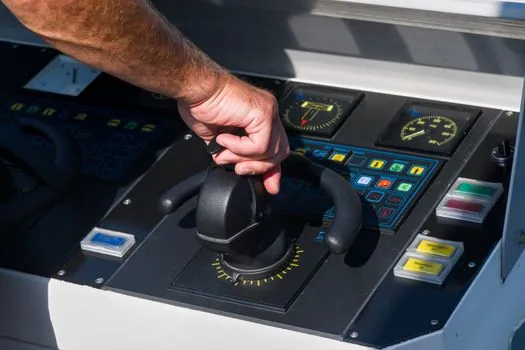
A compliant station has three blocks: a safety monitoring relay, two mechanically separate palm buttons with positive-opening NC safety contacts at IP67, and a safety-rated machine interface (safety contactor or safe drive enable) at Cat 3 / PLd minimum [S1].
Wiring rule: each pushbutton lands on its own safety-rated input channel, never in series into a single PLC input, because a series pair cannot detect a wedged button and the operator then defeats the safeguard with one hand [S1]. The relay's force-guided output contacts then drop power to the safety contactor within ≤20 ms of any fault or release event, and the contactor's auxiliary is read back by the relay as the EDM (external device monitoring) loop to catch welded contacts [S1].
Options compared: safety relay vs safety PLC vs standard PLC + software
Three architectures show up in warehouse THC retrofit quotes, and they are not equivalent under ISO 13851 and ISO 13849-1. [S1]
Standalone safety relay (Schneider XPSMC, Banner SA1D, AutomationDirect PNOZ): dedicated THC firmware, fixed 0.5 s simultaneity, PLd / Cat 3, ≤20 ms response, 24 VDC coil, force-guided outputs, lowest cost per station, no programming changes possible without re-validation.
Safety PLC slice (Allen-Bradley GuardLogix, Siemens F-CPU, ABB AC500-S): THC implemented in certified function blocks, PLd or PLe selectable, same dual-channel wiring, easier to integrate with line-level control valve and drive sequencing, higher panel cost and longer validation cycle.
Standard PLC with software timing check: not safety-rated, fails to meet ISO 13851 because the CPU and outputs are not fault-tolerant in the safety sense, and is explicitly listed as a prohibited configuration in vendor guidance [S1].
For warehouse operations the standalone relay wins on cost and validation speed for one or two stations; the safety PLC pays off only when the cell already runs a safety PLC and the THC block is one of several safety functions on the same machine.
Failure modes and audit pitfalls to design out
The four recurring audit findings on warehouse THC stations are: buttons wired in series into one PLC input, buttons landed on non-safety PLC inputs, software-only timing implemented in the line PLC, and a single pushbutton carrying two parallel contacts [S1].
Each of these defeats simultaneity verification, lets one contact weld shut without detection, or both, and any one of them downgrades the station from Cat 3 / PLd to effectively Category 1 or no category at all. Button spacing also gets flagged: the physical control station must prevent one-hand operation by elbow, knee, or by sliding a wedge between the actuator and the housing, which is why OSHA's two-hand control guidance and ISO 13851 both fix minimum separation distances around the panel layout [S1].
For sites that also spec a tethered control cable run between the station and the panel, keep the THC pair on a shielded, twisted dual-channel run and separate it from VFD power cabling by at least 150 mm to avoid the common-mode noise trips that masquerade as button-release faults.
Sourcing, standards, and what's verifiable on the panel nameplate
On the relay nameplate, the audit-checkable marks are ISO 13849-1 performance level (PLd minimum), category (Cat 3 minimum), the 0.5 s simultaneity figure, the ≤20 ms response time, and a TÜV, UL, or BG certificate number that traces back to the THC function block, not just the generic relay approval [S1].
On the pushbutton side, look for positive-opening NC contacts (the IEC 60947-5-1 symbol on the datasheet), IP67 sealing, and a mechanical life rating in the 1 million to 10 million operations range, which matches the duty cycle of a busy warehouse baler running one stroke every 8 to 15 s. Pair the relay's certificate to the contactor's certificate, and the contactor's certificate to the drive's STO (safe torque off) input, so the safety chain reads as one linked PLd chain on the SISTEMA or PAScalc calculation rather than three independent approvals.
Gartner projects that half of all new warehouses in developed markets will run as human-optional, automation-first facilities by 2030 [S3], which means more cells will land on safety PLCs over time, but the standalone relay will keep dominating retrofit and single-station work. Track two signals through 2026 and 2027: safety-relay firmware releases adding IIIC variants for existing Cat 3 boxes (vendor release notes), and any revision to ISO 13851 itself (ISO project portal), since the 0.5 s window and the wedging-prevention language are the load-bearing clauses for every warehouse THC spec.