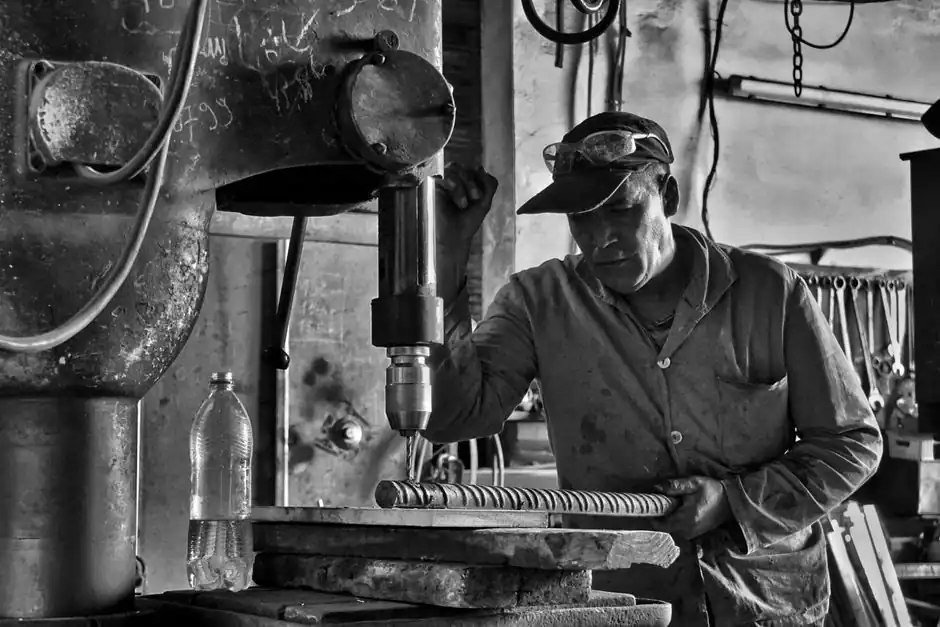
Low gear on a two-speed percussion drill cuts the no-load RPM roughly by a factor of three (commonly 0-450 RPM low versus 0-1,500 RPM high) and roughly triples the available stall torque at the spindle, which is the operating window where large-diameter masonry and metal bits stay on-center instead of skating across the workpiece [S2][S4].
For 16-25 mm bits in concrete, structural steel, and thick hardwood, low gear is not optional: high gear will stall the motor, burn the bit's cutting edges, and risk clutch kickback to the operator's wrist [S2][S4].
Why Low Gear Exists: Torque and Speed Trade-Off
Low gear multiplies gear reduction between the motor and the spindle, trading rotational speed for twisting force at roughly constant input power, so a 20 V brushless drill that delivers 0-2,000 RPM and 60 Nm in low gear typically spins at 0-650 RPM with close to three times the stall torque in high gear's 0-2,000 RPM range [S1][S2].
The mechanical reason is simple: a two-stage planetary or spur gearbox in low gear has a higher overall reduction ratio, and torque out equals torque in multiplied by the ratio minus frictional losses, which is why low gear is also the gear that gives percussion impact work its rated impact energy per blow [S3][S4].
Large-Bit Operating Window: Diameter, Material, RPM
For 12-25 mm bits in concrete, low gear is typically held to 400-700 RPM with torque at 50 Nm or higher; for 16-22 mm bits in mild steel, target 250-450 RPM with steady feed pressure and cutting oil; for 25-40 mm auger bits in hardwood, 200-400 RPM is the safe band [S2].
Pushing a large bit in high gear is the most common cause of bit seizing in the workpiece, which then transfers full motor stall torque to the operator's wrist through the grip; the clutch collar set to a low number and low gear selected together are the two controls that cap that energy before it reaches the hand [S4].
Comparing the Two Gear Settings Side by Side
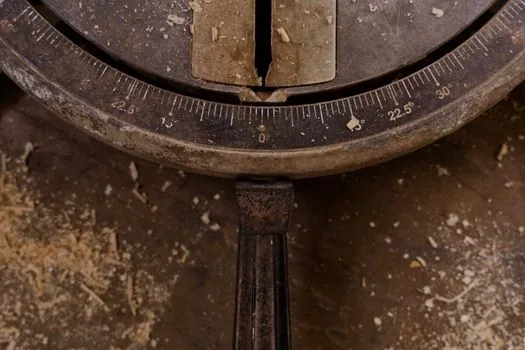
Direct comparison for a typical 18-20 V brushless percussion drill: low gear (gear 1) gives 0-450 RPM no-load and roughly 60-80 Nm stall torque, suited to bits 12 mm and larger, dense materials, hammer mode, and hole saws; high gear (gear 2) gives 0-1,500-2,000 RPM no-load and 20-30 Nm stall torque, suited to bits under 10 mm, softwood, metal sheet, and driving fasteners [S1][S2][S4].
Concretely: a 25 mm auger through 50 mm hardwood needs low gear plus the drill-icon on the clutch collar, not a low number, because the drill position disables the slip clutch and sends full torque to the bit; a 6 mm twist bit through 1.5 mm sheet steel is the opposite case, high gear and a mid clutch setting [S4].
What the Gearbox Looks Like Inside
The low-gear path is a parallel-axis or planetary gear set with a higher reduction ratio than the high-gear path, and the gear-change lever mechanically locks one of the two ratios while disengaging the other; this is the same architecture disclosed in EP2062694A1 (Black & Decker, priority 2007-11-21), where a low-gear-only clutch mode feeds the high-reduction path directly to the output spindle [S3].
Replacement two-speed reducer boxes for 12 V cordless drills (metal gears, polymer housing, two-speed detent) are catalog items in their own right, confirming that the two-ratio transmission is treated as a field-serviceable subassembly rather than a sealed motor block [S5].
Failure Modes and Limits of Low Gear
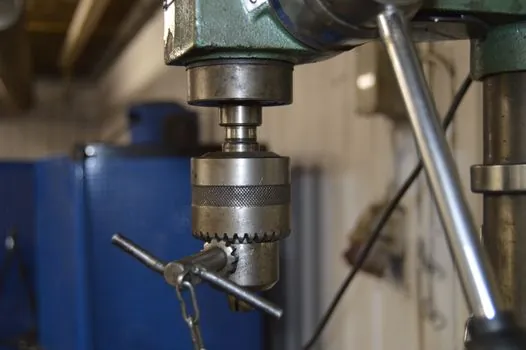
Low gear does not save a dull bit: the cutting edges still have to clear swarf, and forcing feed pressure past the bit's self-feed rate just stalls the motor, trips thermal protection on brushless controllers, and overheats the gearbox lubricant [S2][S4].
Continuous low-gear, high-torque operation also loads the gearbox bearings and the chuck's jaw mechanism more than high-gear light work, which is why duty-cycle ratings on industrial percussion drills derate the low-gear output to roughly 50-70 percent of the high-gear rated on-time for a given ambient temperature [S1].
Standards, Sourcing, and Reading a Spec Sheet
No single ISO or IEC standard dictates two-speed drill gearing ratios, but EN 60745-1 (hand-held motor tools, general safety) and EN 60745-2-1 (drill specific) define the stall-torque and kickback test conditions that any CE-marked two-speed percussion drill must meet, which is why published low-gear torque figures cluster within a tight band across brands [S4].
When reading a spec sheet, the numbers to compare for large-bit work are: low-gear no-load RPM (lower is stronger), maximum stall torque in low gear (higher is better), chuck capacity (10 mm keyless or 13 mm keyless for bits above 10 mm shank), and impact energy per blow for hammer mode (typically 1.5-3.0 J for 18 V class); cordless models from DEWALT, RIDGID, Makita, Festool, Metabo, and Bosch all publish these in the same units, so cross-brand comparison is direct [S1].
Decision Rules for Specifying or Buying
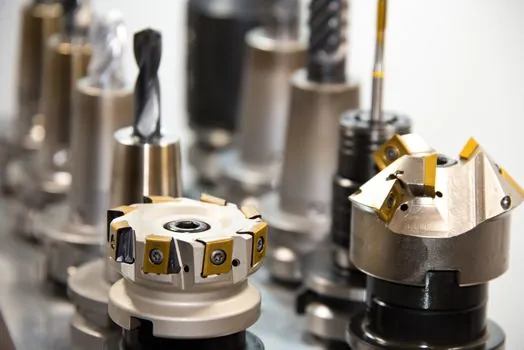
For 18-20 V cordless percussion drills specified for site work with bits up to 25 mm, require a published low-gear torque of 60 Nm or higher, a low-gear no-load speed no greater than 500 RPM, a 13 mm keyless chuck with carbide jaw inserts, and a clutch collar that includes a drill-icon position that disables slip for hole-saw and auger work [S1][S4].
For 12 V class drills limited to 10 mm bits in wood and light metal, the two-speed gearbox is still useful for screw-driving clutch control, but low gear's torque headroom is the smaller of the two and the two-hand control discipline matters more for safe high-torque binds than for raw gearing; for any drill driving a bit above its rated capacity, the binding energy should be considered before the gearing.
For shop work where the tool is dedicated to one task, a single-speed gearbox with a higher ratio can deliver more low-end torque than a two-speed unit of the same motor, but it loses the high-gear range needed for small bits and fastener driving, which is the trade-off the two-speed architecture exists to bridge [S3][S5].
The next nodes worth tracking are the 2026 brushless motor controller firmware revisions that limit low-gear stall current to protect gearbox bearings, and the 18 V platform shift to higher torque cells (typically 21700-format) that push low-gear stall torque above 100 Nm on flagship models from DEWALT, Milwaukee, and Makita; both are visible on OEM spec sheets as incremental low-gear torque gains year over year without a chassis change [S1].
For the relevant spec sheets and selection criteria, see impact drill.
This topic is covered further in Modbus to MQTT Gateway for Cloud Data Publishing: 2026 Spec Reference.