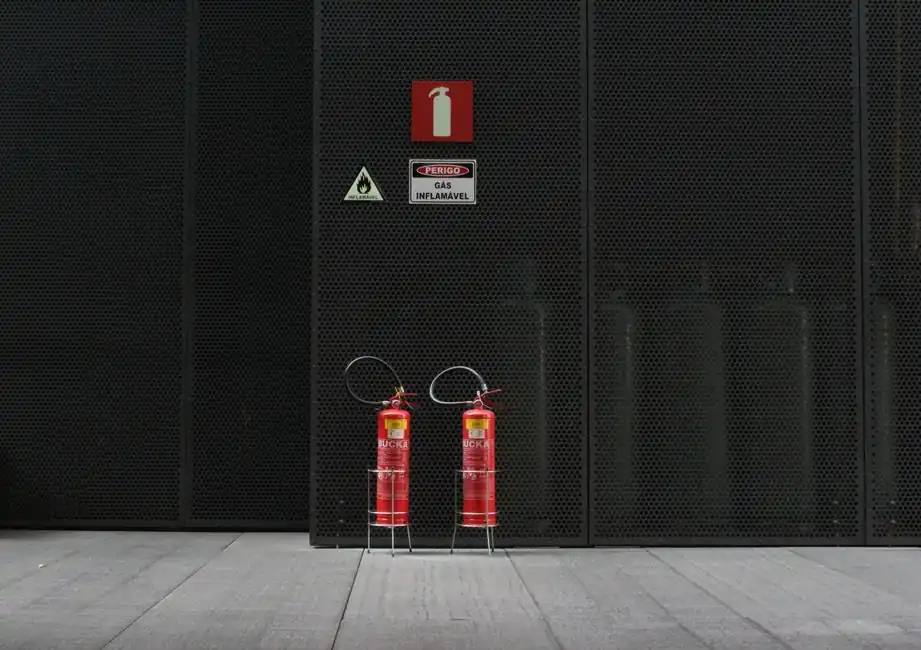
Commercial occupancies in the U.S. are required to carry portable extinguishers that bear the UL Listed mark and meet a minimum 2A:10BC rating under Oregon Fire Code, with the 5 lb multipurpose dry-chemical unit cited as the typical minimum [S2]. OSHA's construction rule 29 CFR 1926.150(c)(1)(i) reinforces the 2A threshold at one extinguisher per 3,000 ft² of protected area, with travel distance capped at 100 ft [S3].
Four UL construction standards govern portable units by chemistry, and one universal rating standard governs fire-test performance: UL 154 (CO2), UL 299 (dry chemical, including Class D dry powder), UL 2129 (halocarbon clean agents such as Halotron 1), and UL 711 (the cross-chemistry rating method producing 2A:10BC, 5BC, 10BC labels) [S4]. Canadian equivalents are CAN/ULC-S504, S503, and S508. NFPA 10 layers on top of the UL Listing with installation, inspection, and maintenance intervals, including a 6-year internal maintenance cycle and hydrostatic test intervals of 5 or 12 years depending on the agent [S5].
UL 711, 154, 299, 2129: which standard actually fires the rating
UL 711 is the rating method that produces the alphanumeric string on the nameplate; UL 154, 299, and 2129 are the construction-and-performance standards for the three major agent families, and an extinguisher earns the UL Listed mark only when both the type standard and UL 711 are satisfied [S4]. A 2A:10BC dry-chemical unit, for example, is built to UL 299 and rated by UL 711, while a 5BC CO2 unit is built to UL 154 and rated under the same UL 711 protocol.
Specifiers reading cut sheets should confirm both the type standard (UL 154 / 299 / 2129) and the UL 711 fire-test rating on the data plate, because the construction standard controls agent compatibility, temperature limits, and pressure-vessel testing, while UL 711 controls the numeric rating [S4][S9]. The ANSI/UL prefix on technical documents indicates the standard has been approved by the American National Standards Institute; products in the field are still labeled simply "UL Listed" [S4].
For a side-by-side read of dry-chemical and CO2 construction rules, see UL 299 vs UL 154 dry chemical and CO2 extinguisher listing standards.
NFPA 10 placement rules: 75 ft travel, 5 ft mounting, visible signage
NFPA 10 caps travel distance to the nearest extinguisher at 75 ft for most Class A and Class B light-hazard occupancies, and the Oregon Fire Code and most U.S. jurisdictions adopt that 75 ft figure as the de-facto commercial benchmark [S2][S10]. Mounting height is set with the top of the extinguisher no more than 5 ft (60 in) above the floor and the bottom at least 4 in above the floor, so the operating handle stays inside the 3.5-5 ft reach band where an average adult can grab and pull the pin without stooping [S2].
Visibility is enforced both by code and by the inspector's eye: extinguisher locations must be unobstructed, marked with signage, and never hidden behind stock, doors, or décor, and blocked units are treated as a non-conformance during the annual service walk [S6]. NFPA 10 also requires Class K extinguishers within 30 ft of commercial cooking appliances that handle solid fuels, oils, or fats, a separate placement loop that runs in parallel to the 75 ft rule [S2].
For owner/operator walk-throughs, the practical placement checklist is: 2A:10BC minimum, 75 ft travel, 5 ft mount height, signage overhead, and an unobstructed line of sight, with the same checklist duplicated in the fire safety reference for general occupancy coverage.
Class selection by hazard: A, B, C, D, K side by side
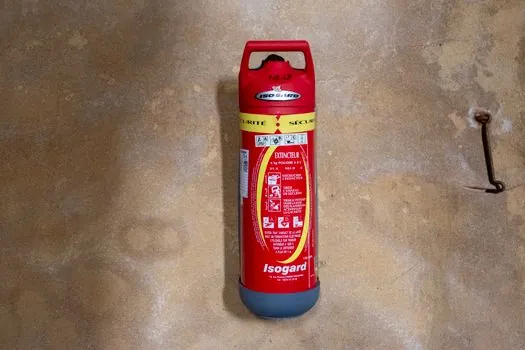
Class A covers ordinary combustibles (wood, paper, cloth, trash), Class B flammable liquids and gases, Class C energized electrical equipment, Class D combustible metals, and Class K cooking-oil fires; a 2A:10BC multipurpose dry-chemical extinguisher is rated for A, B, and C simultaneously, which is why NFPA 10 permits a single unit to cover most light-hazard commercial spaces [S5][S8]. Class D requires a dedicated dry-powder agent matched to the specific metal (sodium, magnesium, lithium, titanium), because ABC dry chemical reacts violently with some reactive metals.
Class K wet-chemical extinguishers are required for commercial kitchens and are typically deployed in addition to, not in place of, the 2A:10BC floor units, with the 30 ft placement rule for cooking appliances being a hard NFPA 10 line item [S2]. High-hazard Class B areas such as a paint mixing room, a solvent drum station, or a fleet fueling island step the rating up to 10BC or larger and shorten the travel distance; OSHA 1926.150(c)(1)(vi) requires a 10B extinguisher within 50 ft of any point where more than 5 gal of flammable/combustible liquid or 5 lb of flammable gas is in use on a construction jobsite [S3].
For facility managers deciding which standard cylinder to spec into a multi-use corridor, the practical rule of thumb is: 2A:10BC for general office and mercantile, 10BC for mechanical and storage rooms, Class K within 30 ft of fryers and grills, and Class D units staged at fixed distance from any lithium battery charging cabinet or metal-machining cell.
Inspection, service, and hydrostatic test intervals
NFPA 10 mandates a monthly visual check (gauge in the green, pin and tamper seal intact, no visible damage or corrosion), an annual service by a certified technician, and a 6-year internal maintenance procedure for stored-pressure and cartridge-operated dry-chemical units [S5]. Hydrostatic testing is required at 12-year intervals for most dry-chemical and wet-chemical units and 5-year intervals for CO2 cylinders, with the date stamped on the cylinder shoulder so the next interval is auditable in the field [S5].
OSHA 1926.150(c)(1)(viii) cross-references NFPA 10A-1970 for inspection and maintenance on construction sites and 1926.150(c)(1)(vii) explicitly prohibits carbon tetrachloride and other toxic vaporizing-liquid extinguishers, a holdover rule that removes several legacy hardware options from any compliant spec [S3]. For DOT-regulated fleets, monthly visual checks are paired with annual service that includes a weight verification to confirm the CO2 or dry-chemical charge is still inside tolerance [S4].
For operators of large commercial portfolios, the 6-year internal maintenance and 12-year hydrostatic schedule is the calendar that drives replacement budget, because a unit that fails hydrostatic test is permanently out of service and must be retired and recycled as a pressure vessel.
Vehicle, jobsite, and specialty overlays: DOT, OSHA, and special-hazard units
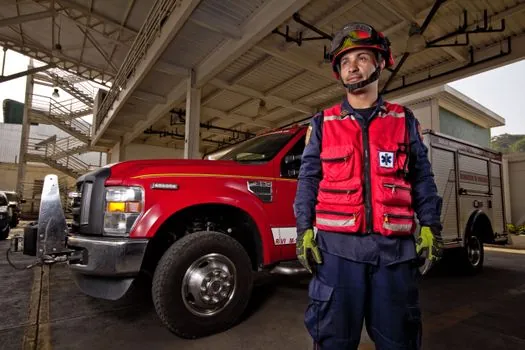
Commercial motor vehicles fall under 49 CFR §393.95, which requires either one 5BC extinguisher or two 4BC units (10BC minimum for any vehicle carrying placarded hazmat), with the unit UL rated, readily accessible, and securely mounted so it does not become a projectile in a hard brake event [S4]. A separate 49 CFR §173.309 rule governs extinguishers themselves when they are shipped as hazardous materials, a detail that hits distributors and rechargers more than end users.
OSHA 1926.150 layers a parallel rule set for construction sites that adds a 100 ft travel cap, one 2A extinguisher per floor with at least one adjacent to each stairway in multistory buildings, and a 10B extinguisher within 50 ft of flammable-liquid or flammable-gas use points [S3]. Carbon tetrachloride and other toxic vaporizing-liquid extinguishers are explicitly prohibited on those jobsites, and any extinguisher used to meet the rule must be listed or approved by a nationally recognized testing laboratory, which in practice means UL or FM [S3].
Owner/operators integrating portable extinguishers into a broader life-safety package typically cross-reference the fire extinguisher, fire door, and fire hydrant reference pages to verify that suppression, compartmentation, and water supply are spec'd as a system rather than as three independent purchases.
Specification checklist for a compliant commercial install
A spec-ready commercial extinguisher package should list, line by line: (1) UL Listed mark plus the type standard (UL 154, 299, or 2129) and the UL 711 fire-test rating printed on the nameplate; (2) agent chemistry matched to the hazard (ABC dry chemical for general, CO2 for electrical, wet chemical for cooking, dry powder for combustible metals); (3) minimum rating 2A:10BC for general light-hazard occupancies, stepped up to 10BC or larger in mechanical, flammable-liquid, or spray-booth areas; (4) mounting hardware and signage compliant with NFPA 10 visibility rules, top of extinguisher no more than 5 ft above the floor, bottom at least 4 in above the floor; (5) placement plan with 75 ft travel distance, with Class K units inside 30 ft of cooking appliances and 10BC units inside 50 ft of flammable-liquid use; (6) inspection, service, and hydrostatic record folder ready for the AHJ walk-through [S2][S3][S4][S5][S6].
Special-hazard overlays that do not fit on the standard line item, including Class D for metal-dust collection, Class K for commercial kitchens, and DOT-compliant kits for fleet vehicles, should be called out as separate line items so the AHJ can audit each overlay against its own rule set [S2][S4].
Limitations, failure modes, and what the UL mark does not cover
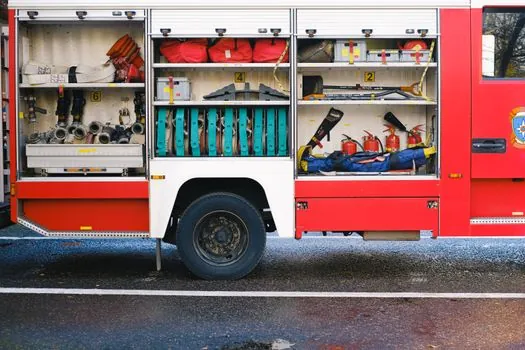
The UL Listed mark certifies that a representative sample of the model passed the construction and fire-test protocol at the time of manufacture, but it does not certify that a specific cylinder in service today is still in spec; that is what the annual service and hydrostatic records prove [S1][S5]. A unit can be UL Listed, fully charged, and still fail the inspector's walk if it is blocked by storage, mounted above 5 ft, missing signage, or past its hydrostatic retest date.
UL 154, 299, and 2129 cover construction and mechanical integrity but explicitly do not cover fire-test performance, which is the role of UL 711; a spec that lists only the type standard without the UL 711 rating is incomplete, and a spec that lists only the rating without the type standard is also incomplete [S4]. The familiar 2A:10BC number is the fire-test rating, while the agent family and construction details live in the type standard, and both have to be on the same nameplate to be code-compliant.