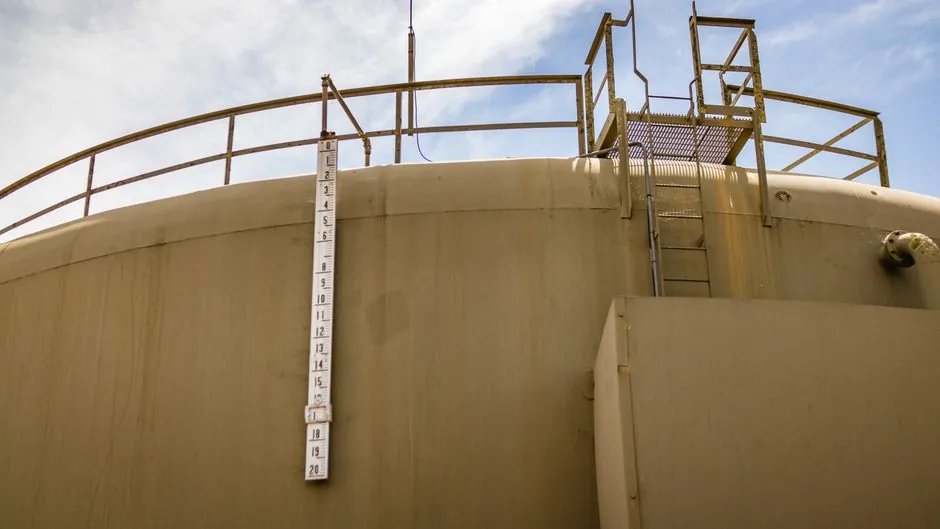
An ultrasonic level meter sends short pulses in the 35-70 kHz band from a transducer to the product surface, then times the return echo to derive level, with the pulse travelling at the speed of sound through the gas above the medium [S1].
Non-contact acoustic measurement avoids corrosion, coating, and contamination of the sensor, which is why the technology is standard for wastewater, weak acids, slurries, and bulk solids in vessels from 0.25 m up to 25 m tall [S1][S3].
Transducer frequency and measuring range
Higher-frequency transducers are paired with short-range, high-resolution liquid duty; lower-frequency, larger-diaphragm units are paired with bulk solids and longer ranges [S1]. The Yokogawa SON60Y family splits this into three blocks: SON 61Y (0.25-5 m liquid / 0.25-2 m bulk solid), SON 62Y (0.4-8 m / 0.4-3.5 m), and SON 63Y (0.6-15 m / 0.6-7 m), all with a stated accuracy of +/- 10 mm [S1].
For tall open-channel or silo duty, the KOBOLD NUS-4 extends the envelope to 25 m for liquids and 10 m for solids, with a 5-7 degree beam at -3 dB to keep the echo valid in narrow vessels with internal obstructions [S3]. A narrower beam is the single most useful spec to compare when the silo has agitators, ladders, or uneven walls, because stray reflections are the dominant failure mode in the field.
Process temperature, pressure, and wetted materials
Process temperature is the first hard limit to check. Standard PVDF- or PP-faced ultrasonic transducers on the NUS-4 are rated to 90 C and 3 bar abs, which covers most water, effluent, and chemical-tank service but excludes steam, hot oil, and CIP loops above 90 C [S3].
For higher temperatures the SON60Y SON 61Y version is rated -40 to +200 C with a process-pressure window of -2 to +2 bar (-20 to +200 kPa), which is the right device for hot condensate, edible-oil cookers, and asphalt-style duty [S1]. The larger SON 62Y and SON 63Y versions derate to -40 to +80 C and -0.2 to +2 bar, so a buyer who copies a 25 m range spec without re-reading the temperature line will overspec a hot-service job or underspec a cold one. Wetted material of construction (PP, PVDF, or PTFE-faced) must also match chemical compatibility; this is where an ultrasonic flowmeter spec sheet shares the same logic of wetted vs non-wetted material selection.
Output, power, and hazardous-area certification
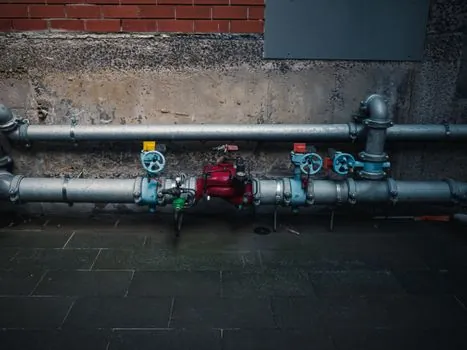
Two-wire 4-20 mA loop-powered designs with 12-36 V DC supply dominate the category; the NUS-4 adds a relay output for high/low alarm and an optional pluggable LCD programming module, which keeps installation cost down for retrofits in tank farms [S3]. HART communication is available on most modern units via a modem such as the HARTCOM referenced in the NUS-4 documentation, sitting on top of the same 4-20 mA loop without disturbing it [S3].
For Zone 1 gas-Ex and Zone 21 dust-Ex service, Ex-certified variants of the SON60Y family are offered with approvals matched to the application class, and the same body of standards (IEC 60079 series for Ex protection, plus ATEX 2014/34/EU in Europe) governs selection [S1]. A buyer who only sees "Ex version" on a data sheet should still confirm the exact marking string (e.g. Ex db IIC T6 Gb) on the nameplate, because the gas group, temperature class, and equipment protection level vary between versions and are the legally binding values for the site.
Selection logic: liquid duty, bulk solid duty, and open-channel flow
Match the technology to the medium, not the other way around. For clean to mildly aerated liquids in vented tanks below 15 m and below 80 C, a SON 62Y or SON 63Y class unit (40-70 kHz range) is the cost-effective default [S1]. For aggressive acids, effluents, or adhesive/coating media where wetted contact is unacceptable, a PVDF-faced NUS-4 at 90 C / 3 bar covers most chemical-plant tanks, and the non-contact principle eliminates coating as a failure mode [S3].
For bulk solids in silos with uneven walls, dust, or angles of repose above 30 degrees, drop to a lower-frequency, larger-diaphragm transducer and verify the 5-7 degree beam angle, because powder echo strength is the limiting factor and a wider beam will read the silo wall instead of the surface [S3]. For open-channel flow measurement in flumes or weirs, an ultrasonic flowmeter or a level-to-flow conversion on a non-contact sensor such as the NUS-4 is the standard solution, with the lookup table for the primary device entered at commissioning [S3]. A buyer who tries to use a high-frequency liquid-only unit in a dusty clinker silo will lose the echo on every fill cycle; conversely, a low-frequency bulk-solid unit on a small batching tank will over-read near the blanking distance.
Installation, dead band, and known failure modes

Every ultrasonic level meter has a near-field "blanking distance" of typically 0.25-0.6 m below the transducer face where echo logic is suppressed, and the SON 61Y, SON 62Y, and SON 63Y state minimums of 0.25 m, 0.4 m, and 0.6 m respectively [S1]. Mounting the transducer too close to the maximum fill line, or inside a stilling well narrower than the beam, causes the unit to lock onto its own ring-down or a near-field reflection instead of the product surface.
Foam, heavy vapour, and temperature gradients in the gas space refract the beam and shorten the effective range; derating the nominal 25 m figure by 30-50% in saturated steam or thick foam is normal practice, and a radar level meter should be evaluated where these conditions are continuous. Condensation on the transducer face, build-up of conductive dust, and misalignment of the sensor by more than 3 degrees from vertical are the three most common field failures, all of which can be checked with a portable sound level meter during commissioning to confirm acoustic energy output. Mechanical linear guide or crossed-roller guide hardware is not part of the sensor itself, but the same vibration-isolation thinking applies when mounting the transducer on a structure that flexes with the plant.
Standards, customs, and procurement notes for 2026
Ex-area certification under the IEC 60079 family (with ATEX 2014/34/EU in the EU, IECEx in APAC and the Middle East, and NEC Class/Div in North America) is the baseline compliance expectation; the SON60Y series offers ATEX/IECEx variants for both gas-Ex and dust-Ex zones [S1]. Material compliance for wetted parts (PP, PVDF) typically requires a 3.1 material certificate per EN 10204 for chemical-plant orders, and buyers should request this at quote stage rather than after delivery.
On the import side, ultrasonic level meters are usually declared under HS code 9030.40 (other instruments for measurement of electrical quantities, in the tariff schedule reviewed) or adjacent 9028/9029 codes, with an MFN duty of 0% and VAT of 13% shown in the China customs dataset for 2026; the general tariff for some neighbouring codes sits at 20-35%, so confirming the exact 10-digit code at the time of shipment avoids surprise duty at the border [S2]. A 13% export tax rebate also applies, which affects the landed-cost math when sourcing from Chinese OEMs. For related process-side decisions such as complementary temperature instrumentation, the comparison in the Thermocouple vs RTD selection guide follows the same spec-first logic and is worth reading alongside this buying guide. Next signal to track: vendor release of 80 GHz hybrid ultrasonic-radar units with reduced foam sensitivity, and any tightening of IEC 60079-0 gas-group definitions affecting existing Ex variants in chemical service.