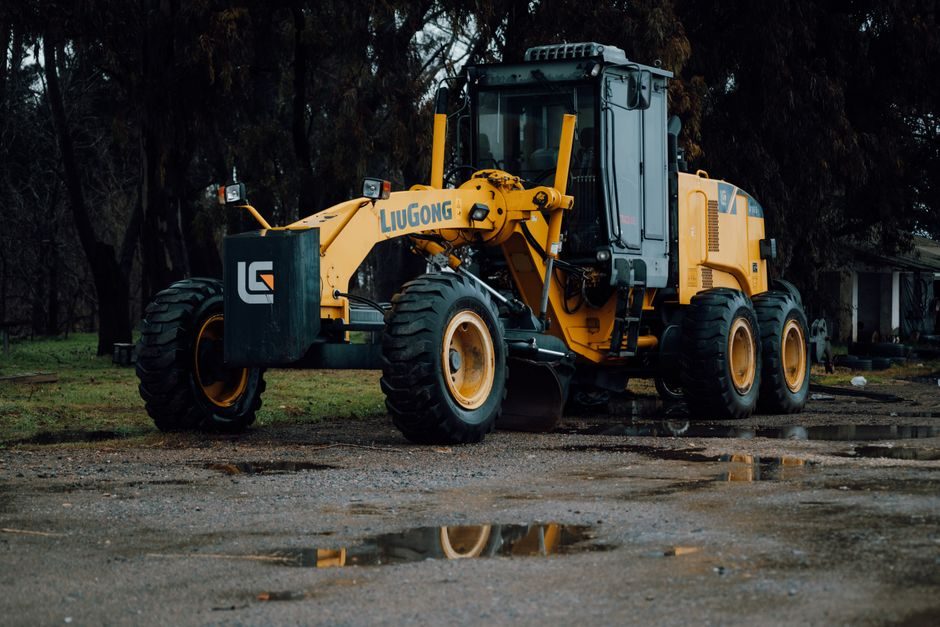
City street reconstruction, curb and gutter work, and fine-grain sub-base trimming sit firmly inside the 150-240 hp / 12-16 ft moldband envelope where most OEM motor-grader lines are densest; XCMG lists the GR165 (170 hp), GR2003, GR2153 (215 hp), and GR2405T (178 kW, ~239 hp) in this band, with FOB price ranges from $19,701 up to $600,000 depending on configuration [S3].
Cat's motor-grader catalog is positioned for the same duty envelope, advertising "precision and performance on road construction, road maintenance, site preparation, and material moving projects" across multiple size classes suited to highway, urban, and mining work [S2]. For procurement teams sizing a fleet, that band is the natural starting point before moving up to mining-class frames or down to compact units.
Operating envelope: power, moldboard, and frame size for city work
Urban projects rarely justify a mining-class frame because cycle lengths are short, machine transfer between jobs is frequent, and low-speed fine grading is the dominant mode; in this regime, a 150-240 hp prime mover with a 12-16 ft moldboard is the spec band most dealers stock [S3]. XCMG's mid-range GR2153 sits at 215 hp and the larger GR2405T at 178 kW (~239 hp), both with the hydraulic flow needed to push a full-length moldboard through dense graded aggregate [S3].
Articulation and all-wheel-drive are the differentiators that separate a true urban grader from a road-maintenance unit; an articulated AWD chassis can pivot inside a single lane closure, which is the constraint on most municipal night-shift work. Cat frames in this class carry that geometry, and XCMG's mid-range units are built around similar tandem-axle arrangements [S2][S3]. Compared with a rigid-frame mining grader — for example the dedicated mining motor grader line in the XCMG catalog — the urban units are shorter, lighter, and rated for higher road speeds between segments [S3].
Selection criteria: HP class, moldboard length, tire size, and emissions tier
The decision tree for an urban fleet buyer runs through four concrete filters: net engine power, moldboard length, tire/axle specification, and emissions tier. Power brackets the unit against the densest material it will push; a 170 hp GR165-class machine handles routine gravel-shoulder work, while a 215 hp GR2153 or 178 kW GR2405T is the right call for full-depth reclaim or sub-base trimming on arterial rebuilds [S3]. Moldboard length controls productivity per pass: a 14 ft board is the practical minimum for lane-at-a-time work, and 16 ft boards are common on the larger frames [S2].
Tire size and tandem drive determine tractive effort on wet graded aggregate; an AWD or all-wheel-drive option on the front axle is what lets the machine work in the rain without tearing the surface. Emissions tier is a procurement gate in most EU and North American cities; Stage V / Tier 4 Final aftertreatment is the default for any current-production unit in this hp class [S2]. Beyond those four filters, buyers usually also weigh dealer coverage, telematics subscription cost, and parts commonality with existing fleet — areas where the Cat and XCMG dealer footprints differ sharply [S2][S3].
Options compared: 170 hp vs 200 hp vs 240 hp class

Within the urban band, the three useful power nodes are roughly 170 hp, 200-215 hp, and 178-240 kW (~239 hp) — represented in the XCMG line by the GR165, GR2003 / GR2153, and GR2405T respectively [S3]. The 170 hp node is the cheapest entry point, with the GR165 listed at $19,701-$42,686 FOB, and suits light maintenance, gravel roads, and small subdivision work [S3].
The 200-215 hp node is the workhorse: the GR2153 lists at $68,000-$75,000 FOB, and the GR2003 at $50,000-$70,000 FOB, reflecting the productivity gain from larger displacement and stronger hydraulics [S3]. The 178 kW (~239 hp) GR2405T jumps to $500,000-$600,000 FOB — a step change tied to its size, full AWD running gear, and heavier frame rather than a linear power premium [S3]. Compared on cost per horsepower, the mid-band is the value point; compared on versatility, the 240 hp class absorbs the widest range of attachments and the heaviest moldboard loads [S2][S3].
Site-fit: who should and who should not buy a 150-240 hp grader
An urban infrastructure contractor running street rehab, utility-cut restoration, sidewalk and curb sub-base prep, and arterial resurfacing fits squarely in this segment, and the 170-215 hp units cover 80-90% of those cycles [S2]. A pure road-maintenance department doing only summer patching and snow-wing plowing can usually drop to a 130-150 hp rigid frame, while a quarry or mine operator should step up to a purpose-built mining motor grader with heavier axles and rollover protection [S3].
For project-based rental, a 200-215 hp unit is the most bookable because it covers the broadest spread of contract scopes; for municipal fleet replacement, the decision often hinges on standardisation with the units already in the yard. Fleet managers should match the new unit's controls, telematics protocol, and moldboard quick-coupler to the existing inventory to avoid two parallel parts streams [S2]. A buyer who needs the machine only for a single three-month job should rent rather than buy, because depreciation on a $500,000-class unit cannot be recovered on a short contract [S3].
Operating constraints and failure modes in city work
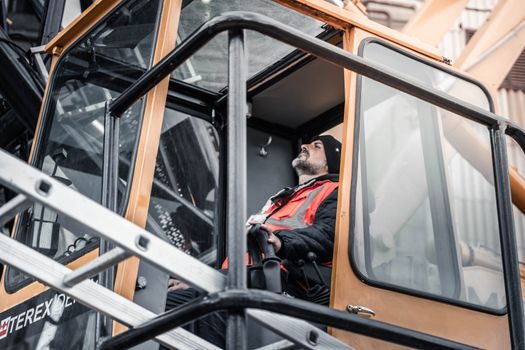
The dominant failure mode in urban grader work is not engine failure but moldboard circle-turn wear, hydraulic-hose chafe from curb contact, and tire damage from hidden rebar in utility cuts. These are routine in city work and are addressed by specifying replaceable circle teeth, abrasion-resistant hoses, and solid-tire or foam-filled options where puncture risk is high [S2].
Another constraint is low-clearance transit: a 16 ft moldboard must be lifted and pinned before the unit can pass under a 14 ft bridge, and a tall cab on a 240 hp frame can be marginal on tree-lined streets. Articulation lock, moldboard reach, and frame height should be checked against the specific route between the yard and the job before the machine is mobilised [S2]. Within XCMG's catalog, the mid-band units (GR2003 / GR2153) tend to be the most roadable, while the larger GR2405T is closer to a mining frame and is less suited to tight urban transit [S3].
Sourcing, standards, and dealer support
Procurement teams should anchor the spec sheet to ISO 7137 / ISO 20474 for earth-moving machinery safety and to the local emissions regulation (EU Stage V, US EPA Tier 4 Final, or China NR4) before evaluating price. Within the XCMG catalog, the GR165, GR2003, GR2153, and GR2405T all carry published FOB price bands that let a buyer bracket the budget without requesting a formal quote: $19,701-$42,686; $50,000-$70,000; $68,000-$75,000; and $500,000-$600,000 respectively [S3].
Dealer support is the second gate: Cat's motor-grader line is sold through a multi-state dealer network with on-site hose fabrication, fluid sampling, and Vision Link remote monitoring as listed services, and this support depth is part of the premium over Chinese-built equivalents [S2]. For a 240 hp-class unit, the buyer should confirm that the chosen dealer stocks circle assemblies, moldboard wear strips, and AWD pump parts within 24 hours; for a 170 hp unit, the bar is lower because most wearing parts are commodity items [S2][S3]. Telematics subscription cost and data-ownership terms are an emerging differentiator and should be written into the purchase order, not negotiated after delivery.
Trackable signals for the next 6-12 months: (1) the spread between the 170 hp used-equipment market and the 215 hp new-equipment FOB price — currently about $25,000-$30,000 — which sets the breakeven on a new mid-band purchase; (2) any change in the GR2405T $500,000-$600,000 FOB band, which would shift the case for stepping up from a GR2153 [S3]. Buyers should also watch for forestry and mining motor-grader spec divergence, since OEM model lines for those segments overlap with the upper end of the urban band and will influence resale values on the 178-240 kW class.
For the relevant spec sheets and selection criteria, see motor grader, ac motor, and hydraulic motor.