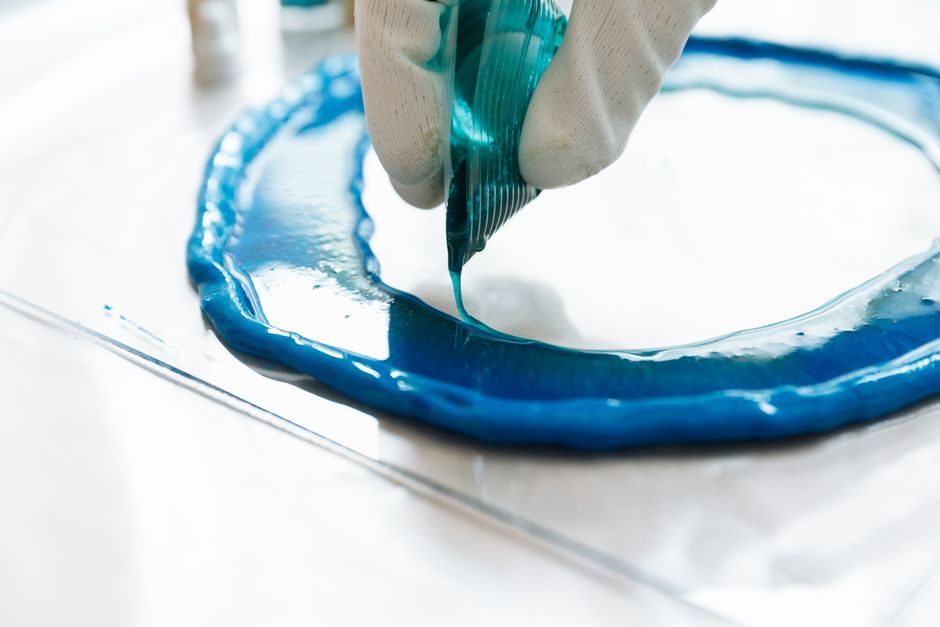
Urethane casting pours liquid polyurethane resin into silicone molds built from a master pattern — typically SLA, FDM, or CNC-machined — to deliver 10 to 1,000 parts per run with a first-inch tolerance of ±0.007" and an additional ±0.003" per subsequent inch [S3].
The process occupies a deliberate cost-and-volume band between 3D-printed prototypes and production injection molding: cheaper than hard tooling in low volumes, faster than printed parts in production-lookalike materials, and tight enough to substitute for end-use qualification builds [S2][S3].
Process Variants by Master Pattern Source
The first decision axis is how the silicone casting mold is produced, because the master pattern defines the achievable surface, tolerance, and feature size [S3]. SLA masters deliver the smoothest optical surfaces for clear or tinted resins; FDM masters cut pattern cost and lead time but transfer layer lines; CNC-machined masters hold the tightest ±0.007" first-inch tolerance and are preferred when mating features, threads, or sealing surfaces are in play [S3].
Feature-size limits sit at 0.025" minimum for embossed, engraved, and hole features across Forecast 3D's rigid material line, with supported and unsupported walls both held to 0.040" minimum [S3]. Build envelopes stretch to 90" × 65" × 40" on the largest US casting chambers, large enough to consolidate assemblies that would otherwise be printed or machined in segments [S3].
Resin Families and Property Bands
Resin selection is the second decision axis and drives mechanical, optical, and regulatory behavior; more than 50 castable polyurethanes are commercially available through service bureaus such as Forecast 3D [S3]. The four dominant families are rigid opaque, rigid clear or tinted, rigid medical-grade, and elastomeric Shore A rubbers used for overmold and in-mold inserts [S3].
Mechanical performance is tunable: in-mold fiber additives can strengthen cast parts by a factor of 10 versus neat resin, and Shore A rubber grades enable soft-touch grips, gaskets, and overmold features on rigid substrates in a single casting cycle [S3]. Hardness, color, and texture are pulled directly from the mold cavity, which means cast-in color matching and texture reproduction are repeatable part-to-part without secondary painting for many programs [S3].
Volume, Lead Time, and Cost Position
Typical lead time is 1-5 days for a prototype and 10-12 business days for production-grade cast runs, with quote turnaround as fast as 5 minutes on instant-pricing platforms such as Forecast 3D and FacFox [S3][S4]. Synectic's vertically integrated model reports a 95% reduction in design-transfer issues when prototyping and casting stay under one roof versus handing off to an outside tool shop [S2].
For volumes between roughly 25 and several hundred pieces, urethane casting undercuts injection-molded tooling cost because the silicone mold replaces hardened steel; ARRK explicitly positions the process for "small and large quantities up to a few hundred pieces" of production-like parts [S1]. Above 1,000-5,000 parts the per-piece economics flip toward injection molding as silicone mold wear and longer cure cycles erode the cost advantage [S3].
Industry Applications and Use Cases
Aerospace and consumer goods are the two end markets most frequently cited for cast-urethane prototypes, alongside automotive interior programs, medical device housings, and industrial enclosures [S2]. Synectic/Mack Prototype uses cast urethane to bridge prototype, pilot build, and low-volume production under a single program-management team before graduating parts to high-volume injection molding at a sister facility [S2].
ARRK's published case work integrates polyurethane resin with ACOMON for optical components — a high-stakes application where the cast surface must meet transmission and blemish specs that injection-molded prototype resin typically cannot [S1]. LISEN, a Chinese polyurethane products manufacturer, casts custom-colored, custom-hardness parts for industrial belts and engineered components, illustrating the same process scaled to mid-volume production rather than prototype-only runs [S5].
Comparison: Urethane Casting vs Injection Molding vs 3D Printing
Against 3D printing, urethane casting wins on material library, isotropic mechanical behavior, and cast-in color or texture; 3D printing wins on geometric freedom and one-off economics. Against injection molding, urethane casting wins on upfront cost and lead time below roughly 1,000 parts; injection molding wins on per-piece cost, cycle time, and tight tolerance repeatability above that threshold [S2][S3].
Engineers typically route a program as follows: SLA or FDM master pattern and 5-20 cast parts for design validation, 50-200 cast parts for market testing and regulatory submission, then a hard-tooled injection molding bridge once the design is frozen and volumes justify the steel tooling [S2].
Limits, Failure Modes, and Sourcing Caveats
Silicone mold life is the binding constraint: most soft tooling survives 20-50 castings before parting lines, surface texture, or dimensional drift force mold replacement, which is why service bureaus quote against 1,000-part ceilings rather than 10,000 [S3]. Wall sections under 0.040" risk short-shot defects, and features below 0.025" cannot be reliably reproduced regardless of master pattern quality [S3].
Buyers sourcing cast urethane from Chinese on-demand platforms such as FacFox should expect 1,000+ shared equipment nodes across 50+ partner facilities, which compresses lead time but adds a manual review step before any non-standard material is confirmed [S4]. For medical-grade cast parts, only ISO 13485-certified bureaus with documented resin lot traceability should be specified — a point the Forecast 3D rigid medical line explicitly addresses [S3].
Standards and Spec Discipline

No single ISO or ASTM standard governs cast-urethane parts as a category; instead, the applicable standard flows from the end-use market — biocompatibility per ISO 10993 for medical, flammability per UL 94 for enclosures, and customer-driven FAI and Cpk reporting for aerospace tier-1 suppliers [S3]. Tolerance reporting follows the first-inch-plus-additional-inch convention that Forecast 3D publishes for every rigid resin, rather than a flat ±0.005" or ±0.010" blanket spec [S3].
Trackable signals to watch through the second half of 2026: service-bureau expansion of large-chamber casting capacity (currently up to 90" × 65" × 40" at Forecast 3D), and broader availability of fiber-reinforced cast urethanes that hit the 10× strength uplift number in overmold configurations [S3].
The underlying component specifications are covered under casting ladle.