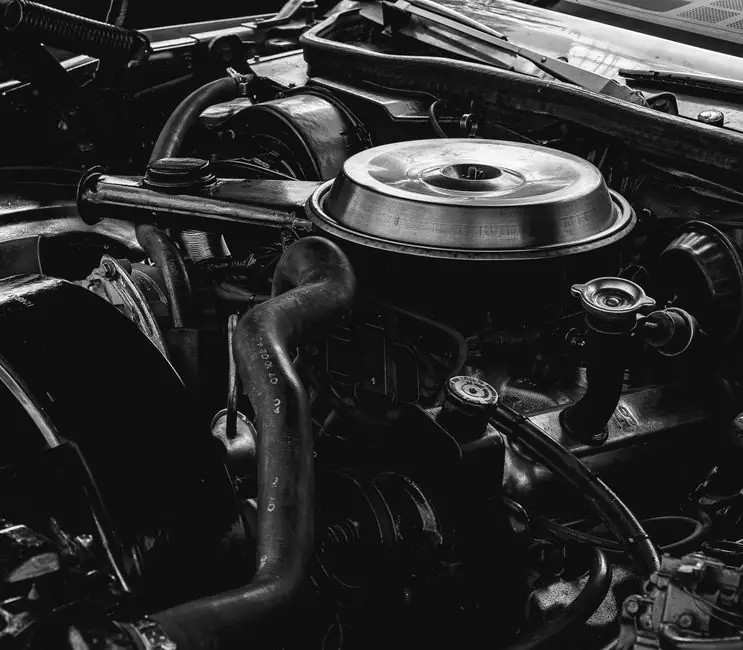
A V-belt is sized for an automotive production drive by five measurable inputs: actual horsepower at the driven shaft, operating RPM, center distance between pulleys, applied service factor (commonly 1.0 to 1.8), and a cross-section taken from the A/B/C/D/E classical set or the 3V/5V/8V narrow set [S1][S2][S3].
On an automotive assembly or component line, the same selection discipline covers both the vehicle accessory drive (alternator, water pump, power steering pump, air conditioning compressor) and the plant-side conveyor, mixer, and compressor belts, so the design procedure is reusable across the factory [S1][S4].
Cross-Section and Profile: Classical, Narrow, Cogged, Wrapped
The classical V-belt profile, in service since the 1930s, ships in six widths: A (1/2 in top width), B (21/32 in), C (7/8 in), D (1 1/4 in), E (1 1/2 in), and Z (the metric-light variant) [S2][S4]. A wider top section raises the rated horsepower per belt, which is why the larger letters are reserved for high-torque crusher, mill, and heavy conveyor service rather than light accessory drives [S2][S3].
The narrow profile (3V, 5V, 8V) uses steeper sidewalls for a stronger wedge action and higher load capacity at the same belt width, and it is the typical choice on modern automotive serpentine accessory drives where a single belt spins multiple accessories over smaller pulleys [S4]. Cogged variants cut notches into the inner faces, which lowers bending stress, runs cooler, and lets the belt wrap smaller-diameter pulleys than a smooth wrapped belt of the same section [S2][S3].
Construction is a three-layer stack: a base rubber compound for shock absorption, embedded tensile cords for strength and dimensional stability, and a textile cover for friction and contamination resistance [S2][S4]. Wrapped (covered) belts trade a small efficiency loss for longer abrasive life; cogged (raw-edge) belts recover some of that efficiency at the cost of exposed rubber on the sidewalls. For a deeper look at the V-belt family as a whole, see the V-belt profile and sizing reference.
Selection Procedure: Five Steps for an Automotive Drive
Step one captures actual horsepower, operating RPM, center distance, and pulley diameter limits, because every later choice is constrained by these four numbers [S1][S3]. Step two applies a service factor to convert actual horsepower into design horsepower: small fans and centrifugal pumps sit at 1.0 to 1.2, mixers and positive-displacement pumps at 1.1 to 1.4, and crushers, mills, and rubber calenders at 1.3 to 1.8 [S3].
Step three picks the belt section from the design-horsepower-versus-RPM table for either the classical (A through E) or the narrow (3V, 5V, 8V) family [S3][S4]. Step four runs the result through a belt-drive design program to return the nearest stock pitch length, belt speed, rated horsepower per belt, and the number of belts required for the design load [S3]. Step five, frequently skipped on automotive lines, is installation discipline: correct tension, parallel pulley alignment, and rejection of contaminated or undersized sheaves, all of which materially extend belt life [S3].
Material, Heat, and Contamination Envelope

V-belts run on a combined synthetic-and-natural-rubber matrix with embedded fibrous tensile cords, which gives the conformability needed to seat in a sheave groove and the tensile strength needed for sustained torque transfer [S2]. Heat is the dominant aging mechanism: cogged belts run cooler than wrapped belts of the same section, and exceeding the manufacturer's maximum continuous temperature rating is the most common root cause of cord-adhesion loss and sidewall cracking in automotive plant surveys [S2][S3].
Oil, ozone, and abrasive dust attack the rubber compound, so the cover compound and the inner rubber must be matched to the environment rather than chosen by section alone [S4]. Running a belt on a pulley below the manufacturer's minimum recommended diameter shortens life sharply because bending stress rises as the pulley diameter falls; this is the single most common cause of premature failure on retrofit and replacement jobs [S3].
Comparison Table: Classical vs Narrow vs Cogged vs Wrapped
The four practical choices for an automotive production belt line up against four decision criteria as follows. (1) Classical A/B/C/D/E: widest installed base, lowest unit cost, suited to legacy equipment and light-to-medium accessory loads [S4]. (2) Narrow 3V/5V/8V: higher load per unit width, steeper sidewall wedge action, preferred for modern serpentine accessory drives and compact conveyor layouts [S4]. (3) Cogged (raw-edge): better flexibility on small-diameter pulleys, lower operating temperature, slightly higher cost, exposed sidewalls sensitive to oil and dust [S2][S3]. (4) Wrapped (covered): textile cover protects against abrasion and contamination, longer service life in dusty plants, marginally lower efficiency due to the cover friction [S2].
For an automotive plant, the practical rule is: specify narrow or cogged for the engine accessory drive on the vehicle itself, and specify classical wrapped for the general-purpose conveyor, mixer, and compressor drives inside the factory, with cogged only selected where the smallest pulley diameter forces the issue.
When V-Belts Are Not the Right Answer
Where positive timing is required (camshaft drive, indexed transfer tables, synchronised conveyors), a V-belt slips under load and a timing belt or chain is the correct choice; V-belts are friction devices, not positive-engagement devices [S1]. Where the drive runs in a classified hazardous area with strict ignition-risk rules, the elastomer compound and the static-discharge behaviour must be checked against the relevant explosive-atmosphere standard, because not every V-belt compound is rated for every zone.
Where the load profile includes heavy shock, a properly designed V-belt multi-belt drive can still compete with a chain on cost, but only if the service factor and the number of belts are both engineered into the selection, not picked off a single-belt chart [S3]. For comparison against flat and chain drives, see the flat belt design reference and the chain belt duty and life reference.
Sourcing, Standards, and Failure Modes
Classical cross-sections A, B, C, D, E, and the Z metric variant are standardised in shape; metric V-belts additionally comply with ISO 4184 / DIN 2215 style designations such as SPA, SPB, SPC, which is why a European automotive plant will often reference the ISO/DIN section code rather than the letter [S2][S4]. Wrapped and cogged variants of the same section differ in rated horsepower per belt, and the design program output (rather than a single chart) is what determines the correct count of belts for a given design horsepower [S3].
The recurring failure modes on automotive production lines are: undersized sheave, misaligned pulleys, incorrect tension, oil contamination, and high ambient temperature, all five of which surface in supplier technical bulletins and in field-service data for replacement-belt programmes [S2][S3]. On the plant side, belt tensioner selection and belt conveyor drive layout interact with the belt choice and must be resolved together rather than independently, which is why most automotive OEMs publish internal V-belt selection tables that already encode their preferred service factor and section.
The next trackable signal is the autumn 2026 release of updated ISO 4184 and DIN 2215 conversion guidance from the major European V-belt manufacturers, which is expected to tighten the metric-section tolerance bands for 3V and 5V equivalent profiles. A second signal is the wider rollout of EPDM-based V-belt compounds in OEM accessory kits, which target a 20 to 30 percent longer service interval under sustained under-hood temperatures compared to standard neoprene compounds.
Related analysis: Insulated Tool Selection for Firefighting: 1,000V Rating, UL/IEC 60900 Compliance, and.