
V-ribbed (Poly-V, multi-rib) belts transmit torque from one motorized roller to as many as 20 adjacent slave rollers in a belt-driven live roller (BDLR) conveyor, with minimal rpm or torque loss per stage [S9].
Specifying engineers choose among classic V-belt, flat belt, and V-ribbed geometries; the V-ribbed format combines the small-pulley friendly contact area of a multi-rib profile with the thin cross-section needed to fit between a carrier roller and a pressure sheave, which is why it has become the dominant replacement-belt style for OEM live roller systems.
Why V-Ribbed Geometry Replaces Solid V-Belt on Modern BDLR Lines
Solid profile V-belts, classical A/B/C sections, still drive many legacy BDLR lines, and Honeywell Intelligrated installation manuals document that the belt keeps turning the rollers even when the pressure sheaves are set below correct height, a forgiving design that survives poor adjustment on legacy equipment [S1].
The V-ribbed (multi-rib, Poly-V) format flips that priority: the ribbed contact area distributes load across many thin ribs, allowing smaller wrap diameters and a thinner belt stack than a classic V-belt, which matters when pressure rollers ride directly under 1.9" or 2.5" carrier rollers in tight centers. Interroll markets its PolyVee belt specifically as antistatic V-ribbed belting for roller-to-roller and RollerDrive-to-roller drives in straight and curve sections [S6]. For a baseline on the wider conveyor roller family, see the roller conveyor reference, and for the multi-rib profile itself see ribbed belt.
Widths, Reel Lengths, and Traction Compounds Used in 2026 Service Stock
Current OEM and aftermarket sizes for V-ribbed live roller belting cluster around two widths: 45 mm (RedDrive 45, extruded, aramid-reinforced) and 77 mm (RedDrive 77, LRB-77, Kevlar/TPU composite) [S3]. Reel lengths are 656 ft for the 45 mm format and 600 or 1200 ft for the 77 mm format, matched to the long run lengths typical in distribution and fulfillment centers [S3].
Traction compounds are predominantly thermoplastic polyurethane (TPU) for abrasion resistance, with lower-durometer TPU bodies used to increase grip on the drive roller and reduce required drive tension by roughly 25% versus the older blue drive belt per Motion Conveyance data [S3]. Tensile members are aramid (Kevlar) cords in both RedDrive 77 and the Gates OEM LRB-77 product, holding proper tension across long spans and high-speed runs [S3]. Integrated V-guides are molded into the belt back, and on the LRB-77 the V-guide geometry is designed for the OEM pressure roller groove to lock tracking without external cleats [S3]. For classic sectioned V-belt options, see the V-belt page.
Drive Capacity: Rollers-per-Motorized-Roller and Package Geometry Limits
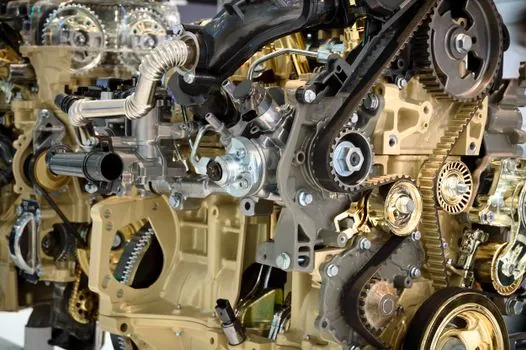
Poly-V multi-rib belts can transmit power through up to 20 slave rollers from one motorized roller while holding rpm and torque close to the drive values, per published ConveyXonic data, a much higher roller count than a flat belt typically drives without slip [S9].
Package geometry sets the lower bound: BDLR conveyors are typically rated down to about 5-inch-long packages, with roller centers of 3 in (light duty), 6 in (medium/industrial), and 8 in (medium/heavy) in the Titan model range covering 402/404/408 frames [S5]. AEC MDR variants built around a 2.5" carrier roller use poly drive belts to transmit force to adjacent rollers for heavy-weight product handling, illustrating the same principle at a larger roller diameter [S4]. Minimum package length matters because a package shorter than the roller-to-roller contact arc can bridge two rollers and skip the belt drive entirely, a failure mode that flat belt under roller does not have. For broader conveyor line context, the V-process line reference covers adjacent process layouts.
V-Ribbed vs Flat Belt vs Chain: Selection Criteria for New and Retrofit Lines
Three options show up most often in BDLR spec sheets: flat conveyor belt under the rollers, multi-rib V-ribbed belt with integrated V-guide, and round/PolyVee cord. Belt Power's catalog summarizes live roller systems as powered by v-belts, flat conveyor belts, chain, round belts, or motorized pulleys, with belted systems transmitting torque through friction between the belt and the roller shell [S2].
The decision breaks out cleanly across four criteria. Torque per roller: chain and Poly-V tie at the top, flat belt sits below. Noise: Poly-V/TPU ranks quietest, chain ranks loudest. Maintenance access: flat belt is easiest to lace and shorten in the field, chain requires link tooling, Poly-V needs the OEM-style splice press and a trained tech (RedDrive data shows 70% reduced splicing time versus legacy methods, but the toolset is still required) [S3]. Tracking under varying load: integrated V-guide Poly-V tracks best because the guide rides the pressure-roller groove, while flat belt needs snub rollers or side guides. Hytrol's 2017 guidance still holds: belt-driven live roller conveyors use v-belts or flat belts supported with controlled pressure against the bottom of the rollers, which is the structural condition all three options share [S7]. For adjacent decisions on roller supports, see the roller bearing reference.
Splicing, Tension, and Field-Service Behavior
OEM-grade Poly-V live roller belts use a prepared-end press splice rather than mechanical lacing, with RedDrive 77 reporting 30-40% higher splice strength than the OEM baseline, and a 1200 ft spool format that reduces the number of field splices on long distribution-center runs [S3]. The RedDrive 45 format uses a 120 mm long splice and can also be joined with existing OEM splicing equipment, which is why it is positioned as a drop-in replacement for the legacy blue drive belt [S3].
Tension behavior is the second service-life lever: Motion publishes 25% lower required drive tension for RedDrive 77 versus the OEM product, achieved through a lower-durometer TPU body that increases contact friction at lower pre-load [S3]. That reduced tension cuts bearing load on the motorized roller and on slave roller shafts, extending greased-for-life bearing life in continuous-run distribution-center service. Belt Power frames live roller belting as a stocked replacement item across 22 US service locations, a supply-chain fact that matters more than spec sheet numbers when a line is down [S2].
Standards, Safety, and Integration Considerations
Honeywell Intelligrated's V-belt live roller conveyor installation manual (publication 29350102, August 25, 2021) is the de facto installation reference for V-belt driven BDLR frames and documents the safety-device, lockout/tagout, and guarding requirements that any BDLR retrofit must still meet, regardless of whether the belt has been swapped from V-belt to Poly-V [S1].
Antistatic construction is a line item worth checking on PolyVee data sheets, because Interroll markets its PolyVee belt as antistatic, which is required in some ATEX-classified packaging zones for pharmaceutical and fine-chemical lines, and which the older blue drive belt did not always provide [S6]. For adjacent conveyor-density decisions, see the road roller reference. Two trackable signals to watch over the next two quarters: any new Gates TPU LRB-77 reel-length option beyond 600 and 1200 ft, and any Tier-1 conveyor OEM publishing a 30+ roller Poly-V drive test, which would push the practical roller-per-motorized-roller count past the long-standing 20-roller figure [S3][S9].
This topic is covered further in 2024-T3 vs 7075-T6: Alloy Pick by Stress Mode for Airframe Structural Parts.