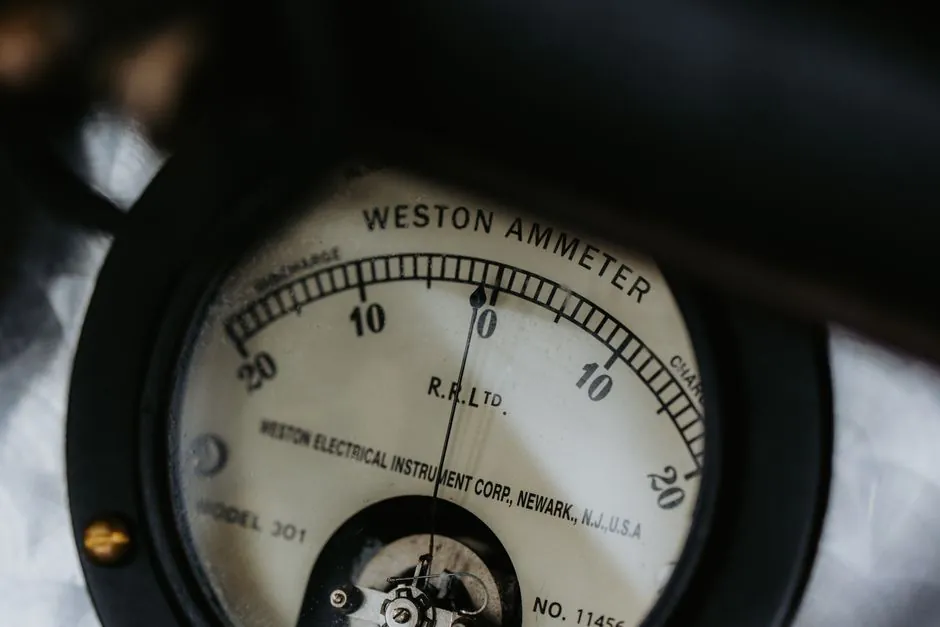
A vacuum gauge is defined as any instrument for indicating negative atmospheric pressure, covering absolute spans from roughly 10⁻¹¹ mbar up to atmospheric [S2][S3]. Selection on a single criterion, the working pressure band, decides the sensing technology because no one gauge type covers the full 14-decade span with adequate accuracy.
Engineers who skip the gas-type and contamination check, mercury vapour, condensables, corrosive vapours, often end up replacing a Pirani element within months in a wet process. The selection logic below maps each gauge family to a pressure band, gas compatibility, and the practical limits a process engineer needs to know before buying [S1].
Pressure Range Bands and the Gauge Family That Fits Each
GlobalSpec's spec taxonomy groups vacuum instruments by declared vacuum range, and the four standard bands line up with the four dominant sensing principles [S1]. The practical mapping: Bourdon and diaphragm dial gauges for 1 to 1000 mbar rough vacuum, Pirani / thermocouple for 10⁻⁴ to 1 mbar, capacitance diaphragm for 10⁻⁵ to 1000 mbar, cold-cathode (Penning / magnetron) for 10⁻⁹ to 10⁻⁴ mbar, and hot-cathode Bayard-Alpert ionisation for 10⁻¹¹ to 10⁻⁶ mbar [S1][S2].
Specifying outside the calibrated envelope is the single most common procurement error, because vendors often quote "operating range" rather than the narrower "specified accuracy" range. A Pirani tube sold to read 10⁻⁴ mbar is, in practice, only accurate to roughly ±50 percent of reading at that endpoint, a fact the vacuum gauge reference page on this site restates in plain engineering terms. Where the application spans more than three decades, combine a Pirani and a cold-cathode on a single flange, with the Pirani active above 10⁻⁴ mbar to protect the high-vacuum tube from contamination and overpressure.
Comparison: Four Main Gauge Types Against Four Decision Criteria
Set the four families against the four criteria that drive 80 percent of selections, and the choice usually resolves without a meeting.
1. Thermocouple / Pirani: 10⁻⁴ to 1 mbar range, gas-type dependent (calibrated for N₂ or air, reads low for noble gases), inexpensive (typical module cost well under the cost of a capacitance head), tolerates moderate contamination but drifts when condensable vapours coat the filament. 2. Capacitance diaphragm: 10⁻⁵ to 1000 mbar range, gas-type independent by design (true total-pressure measurement), responds in milliseconds, more expensive, fully bakeable to 150 °C in metal-sealed CF flanges [S1]. 3. Cold-cathode ionisation: 10⁻⁹ to 10⁻⁴ mbar range, no filament so more tolerant of sudden air inrush than a hot-cathode tube, magnetic field required, and accuracy depends on the gas-species correction factor (typically 1.0 for N₂, around 0.4 for argon). 4. Hot-cathode Bayard-Alpert: 10⁻¹¹ to 10⁻⁶ mbar range, gold standard for UHV, fragile on overpressure, must be degassed periodically, requires an emission-current regulator.
Cross-check the candidate against the vacuum pump page on this site, because the pump's ultimate pressure sets the lower bound the gauge must resolve. If the pump specification is 5×10⁻⁹ mbar and the gauge floor is 10⁻⁶ mbar, the measurement chain is the bottleneck, not the pump.
Gas-Type Correction and Contamination Compatibility

Pirani gauges measure thermal conductivity, and thermal conductivity varies by gas, so the indicated pressure for helium, hydrogen, or argon differs from the calibrated nitrogen reading by tens of percent [S1]. Capacitance diaphragm gauges are exempt from this error because they sense mechanical force, not thermal properties, and that gas-independence is the engineering reason semiconductor process engineers pay a 5× to 10× premium for them in load-lock applications.
Coating of the sensing element is the dominant failure mode in wet vacuum service, and replacing a Pirani every six to twelve months is cheaper than the alternative of a capacitance head only if the cost of unplanned downtime is genuinely low. The same logic applies when the vacuum generator ahead of the gauge is an ejector: backstreaming of process fluid reaches the gauge and dictates the contamination specification before it dictates the pressure range.
Connection, Output, and System Integration
Flange choice is not an accessory decision: a KF (ISO-KF) quick flange rated to roughly 10⁻⁷ mbar with an FKM O-ring is fine for laboratory rough-to-medium vacuum, while a CF (ConFlat) flange with copper gaskets is required for UHV bakeout at 200 °C or higher [S1]. Spec the flange and the gauge as a single line item; a 10⁻⁹ mbar cold-cathode on a KF-25 flange is a 10⁻⁶ mbar gauge in practice because the seal leaks orders of magnitude faster than the tube reads.
For signal output, modern installations pair the gauge with a controller offering 4 to 20 mA analog, RS-232/485, or Ethernet, and the controller's setpoint relays drive the interlock to the vacuum pump and the vacuum packaging machine process line. Specify analog output for legacy PLCs, digital for new builds, and a display module mounted at eye level near the operator station. When multiple gauges feed a single chart recorder or historian, confirm the controller supports the gauge family natively, since third-party adapters for cold-cathode and Bayard-Alpert tubes are notorious for ground-loop noise.
Who Should NOT Pick the Cheapest Pirani
Skip the low-cost Pirani if any of the following applies: the process gas is not nitrogen or air, the chamber sees condensable vapours, the operator needs better than ±20 percent of reading accuracy, or the process must log pressures below 10⁻⁴ mbar. In these cases, a capacitance diaphragm gauge pays for itself inside one year by avoiding false readings that lead to over-pumping, under-pumping, or scrapped batches. [S3]
A second group should also avoid a single-gauge architecture: any chamber that will be opened to atmosphere more than once per week, because the filament life of a Pirani or hot-cathode tube is finite and predictable, while a cold-cathode or capacitance head survives thousands of vent cycles. The selection logic for vacuum-packaging lines is detailed on the vacuum packaging machine reference page, which calls out that rough-vacuum monitoring on a food line is a different duty cycle from a semiconductor load-lock.
Procurement Spec Checklist and Sourcing Standards
A complete spec line must include: vacuum range with both operating and accuracy envelopes stated, gas calibration (default N₂), gas correction factor for the actual process gas, flange type and seal material, maximum bakeout temperature, output signal type, controller compatibility, and IP rating for the installation environment. Without these nine items, the quote-to-compare step is meaningless because two vendors' "10⁻⁹ mbar" gauges are rarely directly comparable. [S1]
For the standards trail, the relevant documents are ISO 3567 (vacuum gauges, calibration by direct comparison), AVS R/PY 0.1 to 0.3 (recommended practice on gauge performance reporting), and the AVS standard on hot-filament ionisation gauge stability. Reference any of these by number on the purchase order; vendors that cannot cite a calibration procedure against ISO 3567 should be removed from the shortlist. The vacuum gauge reference page on this site collects the standards map for downstream reading. For an adjacent process-instrument comparison, see Benchtop conductivity meter selection for laboratory QA benches or Absolute Pressure Transmitter vs Vacuum Gauge: Spec-First Selection Map.
Two signals to track over the next procurement cycle: vendor moves to integrate Pirani and cold-cathode sensors on a single CF flange (cuts flanges, cuts leak rate, cuts cost) and the slow migration of new gauge controllers to Ethernet-APL for hazardous-area process plants. Either change will reshape shortlists for late-2026 builds in semiconductor and pharmaceutical vacuum service.