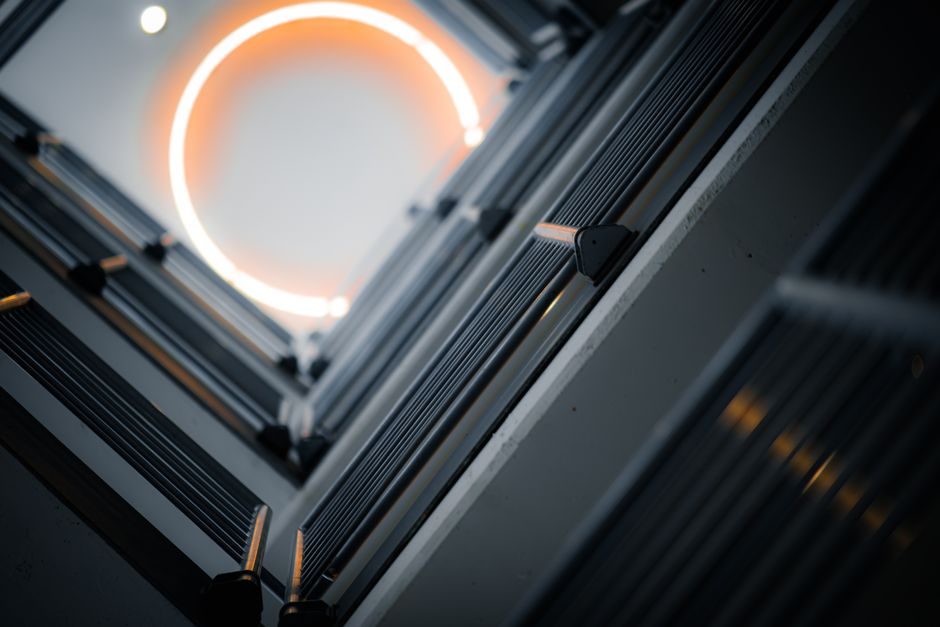
A vertical lift module is a closed steel cabinet with two columns of trays served by a single in/out elevator, and the 2026 vendor field has consolidated around four or five global names (Kardex, Modula, SSI SCHAEFER, Hänel, Ferretto) plus a long tail of regional integrators [S4].
Total cost of ownership for a single bay typically lands between €150,000 and €450,000 installed depending on height, tray count, payload class, and the depth of the WMS/ERP integration, with payback figures of 18-36 months commonly cited by end users in automotive, electronics, and MRO spares [S3][S4].
How a VLM Is Built and Why the Footprint Matters
A VLM is a self-supporting steel enclosure with a fixed front operator bay, a rear service bay, and a vertical extractor that cycles trays to a single access window on a goods-to-person basis [S4]. Standard unit heights run 3-12 m, with extended units reaching roughly 15 m where ceiling and slab permit; internal tray widths typically span 1,200-4,050 mm and depths 610-1,025 mm, with the most common cell around 3,000 × 800 mm [S3].
Floor reclaim is the headline KPI: a VLM typically compresses 700-1,000 m² of static shelving into 60-100 m² of cabinet, the figure driven by the ratio of cabinet height to floor footprint and the percentage of slots actually filled at any time [S3]. Capacity per bay is generally quoted at 30-90 tonnes total payload and 20-250 kg per tray; the dual-extractor (two-elevator) models from Kardex and Hänel handle heavier unit loads by stacking capacity into the same cabinet [S4].
Selection Criteria That Actually Move the Quote
Tray cell size, unit payload, total bay payload, bay height, and access window geometry are the five specs that change the price line on a quote more than anything else; lighting, ESD-safe trays, and clean-room rating sit below those five but still swing vendor selection [S3][S4].
Trays are normally specified by the SKU's largest bounding box plus 25-50 mm clearance, and one universal tray class rarely fits an entire SKU set — Modula publishes thousands of "combinations" of footprint and height to cover that spread [S3]. Bay height is then selected to clear the tallest SKU with a small overhead gap; overspecifying height inflates ceiling, structural, and lifting-motor cost without adding slot count in the same proportion [S3].
Total payload and unit-load rating drive the extractor, gear reducer, and counterweight sizing — the same mechanical family that linear modules and crossed roller guides inherit from general machine-tool practice, so the lifting mechanism on a heavy-duty bay reads as a precision axis rather than a forklift [S1].
VLM vs. Carousel vs. Mini-Load vs. Shuttle
The honest comparison is: VLMs win on closed-bin, low- to mid-SKU-count picking of trays and totes; horizontal carousels win on long, flat items like garments and sheets; mini-load AS/RS wins on very high SKU counts and full-pallet buffering; and shuttle systems win on deep-channel pallet or tote buffering in a footprint that needs only one face accessed [S4].
Decision criteria in plain terms: (1) SKU count under 5,000-8,000 → VLM or carousel, with VLM preferred when ceiling height is high; (2) SKU count 8,000-50,000 → mini-load AS/RS or multi-bay VLM cells; (3) full-pallet or tote-pallet buffer → shuttle, not VLM. Build cost per stored tote follows that order too, with VLMs generally above carousels and well below mini-load [S4].
VLMs are not the right answer for freezer warehouses with constant -25 °C duty, for SKU sets with more than about 25% over-size items, or for operations where the picking window needs more than one operator at a time [S3][S4].
Software and WMS/ERP Integration
Modern VLMs are useless without the WMS hook-up: the storage location, the slotting logic, the batch-pick sequencing, and the inventory sync are all owned by software, not by the cabinet [S5]. SSI SCHAEFER's WAMAS Lift & Store, for example, is positioned specifically to control one or many VLMs and to slot the SKU map against the WMS pick list [S5].
Integration depth is where 2026 quotes diverge: a basic OPC/MQTT link to a third-party WMS is the entry level; a fully API-coupled ERP, with pick-list import, replenishment trigger, and barcode validation, is the typical production spec. Kardex's product family documentation calls out modular software tiers that follow the same pattern, with the goods-to-person principle enforced at the WMS layer rather than the cabinet [S4].
Buyers should spec the API contract before signing — list the exact fields (SKU, batch, expiry, quantity, UoM, location) and the exact trigger events (pick, replen, cycle count, exception) — because retrofitting these interfaces after the cabinet is in place is one of the most common budget overruns in VLM projects [S5].
AMR Coupling: the 2026 Default
The 2026 spec that materially changes the VLM purchase is the autonomous mobile robot link, not the cabinet itself — Modula and MiR (Mobile Industrial Robots) jointly published a paired VLM-AMR cell in 2026, and this is now the reference pattern for new tenders [S1].
The mechanical interface is a single tray handoff window with a defined Y-position and height; the software interface is a discrete I/O or REST handshake that releases the tray only when the AMR has confirmed station ID. Buyers should treat this handoff as a separate line item: tray conveyor, roller deck, AMR docking target, and a wireless module on the AMR side for fleet traffic, since the VLM cabinet itself does not need its own Wi-Fi if the WMS is wired [S1][S5].
This couples neatly with the broader shift in AMR price and cost guide 2026: payload, navigation and battery levers work, where dock-to-machine hand-offs and battery swap cadence are the dominant cost levers for the mobile side, just as slot count and tray count are the dominant cost levers for the cabinet side [S1].
Who Should Buy in 2026 and Who Should Wait
Buy a VLM in 2026 if: SKU count sits under 5,000-8,000; average pick frequency is 20+ per day per SKU; ceiling clearance is 5 m or more; and the operation can commit to barcode or vision validation at the access window [S3][S4].
Wait or pick a different AS/RS class if: SKU count is volatile and likely to double inside 18 months (mini-load is more elastic); the SKU mix includes more than about 25% over-size items (shuttle or floor racking is cheaper); the site is an existing brownfield without slab strengthening — a fully loaded VLM in the 30-90 tonne class typically requires a verified slab rating before install [S3].
Buyers who only need a single VLM bay often over-spec by ordering a multi-bay cell with a shared extractor that they will never need; conversely, buyers who underestimate growth commonly pay twice because the second bay cannot share the original WMS slotting map without rework [S4][S5].
Vendor Field, Sourcing Levers, and Pitfalls
Five global brands — Kardex, Modula, SSI SCHAEFER, Hänel, Ferretto — cover most European and North American tenders, with regional integrators assembling the same mechanical components under local brand in Asia, Latin America, and the Middle East [S3][S4].
The strongest sourcing lever is competitive tender on an identical spec sheet: same bay height, same tray cell, same unit-load rating, same API contract, same SLA, with separate price lines for cabinet, software licence, integration days, and annual support. Buyers who bundle these into a single line typically lose visibility on where the 30-50% spread between vendors actually lives [S3][S4][S5].
Common pitfalls in 2026: ordering tray count by SKU count rather than by slotting turnover (low movers over-consume slots); under-specifying the access window ergonomics (height-adjustable fronts add 4-8% to the price and cut operator strain in half); and treating the VLM as a one-off cabinet rather than as part of an AS/RS class decision, where shuttle and mini-load should at least be costed side by side before the order is placed [S4][S5].
Trackable signals for the next 90 days: vendor quarterly releases on WMS API version, AMR handoff-kit availability with named AMR models, and any update to the WAMAS Lift & Store integration matrix from SSI SCHAEFER [S5].