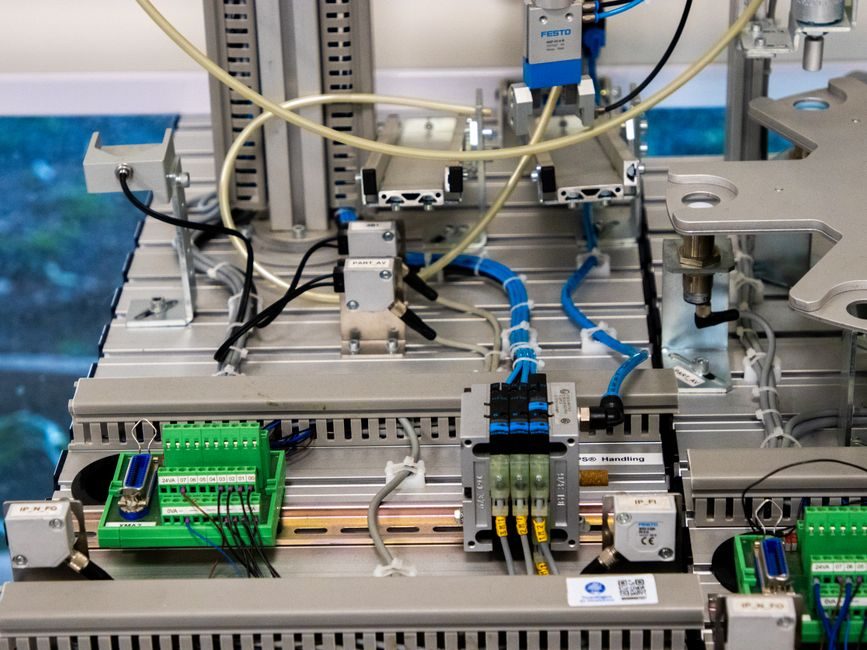
A shuttle system — sometimes called a vehicle-type AS/RS — uses self-powered carriers that run inside rack channels, lifting totes or trays between levels and handing them off to a sorting system at the aisle face. Daifuku's Shuttle Rack M, for example, is sold specifically as a multi-shuttle stacker for temporary storage, sequencing and order consolidation in distribution centres [S1].
Selection is driven by five engineering gates: SKU count, throughput target per aisle, building clear height, fire-suppression class, and shuttle vs stacker-crane economics. Buyers who run all five before issuing an RFQ typically cut 4-8 weeks off commissioning and avoid the most common capex overrun: ordering 30% more shuttles than the aisle can carry.
Gate 1 — SKU count and tote/carton geometry
Shuttle systems become attractive when an SKU count crosses roughly 5,000-10,000 lines and unit loads fit within a single tote (typically 600 x 400 mm or 650 x 450 mm footprint) [S1]. Below that, the shuttle's per-channel density is wasted; above 50,000 SKUs, a unit-load stacker crane tends to win on cube utilisation unless the SKUs split cleanly into A/B/C velocity bands.
For mixed-SKU retail or pharma distribution, projects typically run 2-4 totes deep per channel with each shuttle handling one channel at a time. Daifuku's Shuttle Rack M is built for high-density temporary storage, sequencing, and sortation buffering, and is sized around the same totes seen in European tote-pool standards [S1]. When carton dimensions vary by more than 2x, specify width-adjustable channels and confirm the shuttle's lifting carriage can pass the tallest carton corner without fouling the rack upright.
Gate 2 — Throughput per aisle, not per system
Single-aisle shuttle throughput is the figure that matters. A four-deep channel layout commonly delivers 80-160 tote presentations per hour per aisle in commissioning benchmarks; a 2-deep buffer lane can run higher because the shuttle does not need to shuffle neighbours. The system-level throughput is then the number of aisles multiplied by the per-aisle rate, minus queue losses at the lift. [S1]
For comparison, a single mast stacker crane typically delivers 25-50 unit loads per hour in pallet AS/RS service, which is why pallet rack vs AS/RS trade-offs hinge on whether you need 100 or 1,000 pallet moves per hour. Shuttle systems sit between those two — higher than crane-only, lower than a fully populated mini-load — which is exactly why they fit distribution centres in the 500-3,000 tote/hour band.
Gate 3 — Building clear height and seismic class
Clear height is the single most over-looked gate. Each shuttle level adds roughly 350-500 mm of vertical pitch when totes are 200-300 mm tall; an 8 m clear-height building with a 300 mm tote allows about 14-16 storage levels, while a 12 m clear allows 20-24 levels. Push the level count higher and the lift becomes the bottleneck, not the shuttle. [S2]
For facilities inside seismic zones (Japan, California, parts of Italy, Turkey), the rack frame, shuttle rails and the lift mast must be designed for the site-specific response coefficient. Confirm with the OEM that the shuttle braking system is rated for the seismic design event, not just normal-operating inertia. The same caution applies to a sprinkler system above the rack: ESFR or in-rack sprinklers change the minimum vertical pitch and the allowable tote mass.
Gate 4 — Fire class, battery chemistry and suppression
Most modern shuttles run on lithium-ion battery packs and charge on contact rails at the aisle ends. That puts the fire risk inside the rack, not just above it. Specify the shuttle's battery to UL 1973 (stationary) or the equivalent IEC 62619 cell standard, and require the OEM to publish the cell-level thermal-runaway containment test data. [S3]
For pharmaceutical or food storage, fire class FM Global DS 8-9 or NFPA 13 in-rack sprinkler layout usually sets the rack geometry. A shuttle system that meets those rules does not need a fire-rated enclosure; one that does not meet them forces a sprinkler density upgrade that easily costs more than the shuttle line itself. Always pass the fire class through the condition monitoring system specification — most shuttle OEMs now stream battery state-of-health, charge cycle count, and brake-wear data on a 4-20 mA or IO-Link channel.
Gate 5 — Shuttle vs stacker-crane vs AMR trade-off
The three storage-automation options line up against four decision criteria: SKU count, throughput per square metre, capex per stored tote, and order-profile volatility. A shuttle system wins on capex per tote at moderate throughput; a unit-load stacker crane wins on cube and at very high throughput per aisle; AMRs win when the warehouse layout must change every 2-3 years. [S4]
For facilities evaluating mobile robots against fixed automation, the AMR selection criteria for 2026 gate set covers similar throughput and fire-class questions but adds a fleet-software gate that does not exist on shuttle systems. In practice, large DCs run both: shuttles for the high-density storage block, AMRs for the pick face, and a machine vision system at the tote-handover to verify SKU and tote integrity before the shuttle takes it back into the rack.
Common selection failures and field fix list
Three failure modes show up repeatedly in retrofit shuttle projects. First, ordering too many shuttles per aisle: the rule of thumb is one shuttle per 8-12 channels at the design throughput, with the lift as the binding constraint. Second, mixing tote footprints within one channel — most shuttle carriages will not index a 600 mm tote on a 650 mm rail, and the workarounds cost more than the tote pool. Third, under-specifying the lift: a lift that runs at 1 m/s with a 2 t payload is fine for pallet shuttle, but undersized for a 6-deep tote buffer lane that needs 60 cycles per hour. [S5]
For buyers stepping into the wider category, the stacker crane buying guide for 2026 covers the mast, drive and class gates that overlap with the shuttle's lift and rail selection. The two are not interchangeable: a stacker crane is one crane per aisle with a lifting carriage, while a shuttle is many small vehicles sharing rails and a single lift. Knowing that distinction up front keeps the RFQ scope honest.
Verification signals to track after RFQ release
Three trackable signals confirm the selection is holding. First, the OEM's reference list: at least two sites in the same product vertical (pharma, retail, e-grocery) running for more than 12 months at the design throughput. Third, the control-system interface: OPC UA Pub/Sub or PROFINET with a published tag list, so the WMS integrator can write the shuttle interface in days, not months. [S6]
Reference project to watch: Daifuku's Shuttle Rack M deployments in Japanese and European distribution centres, which are the most documented multi-shuttle reference installs in 2024-2025 and a good benchmark for any RFQ in the 2026 capex window [S1].