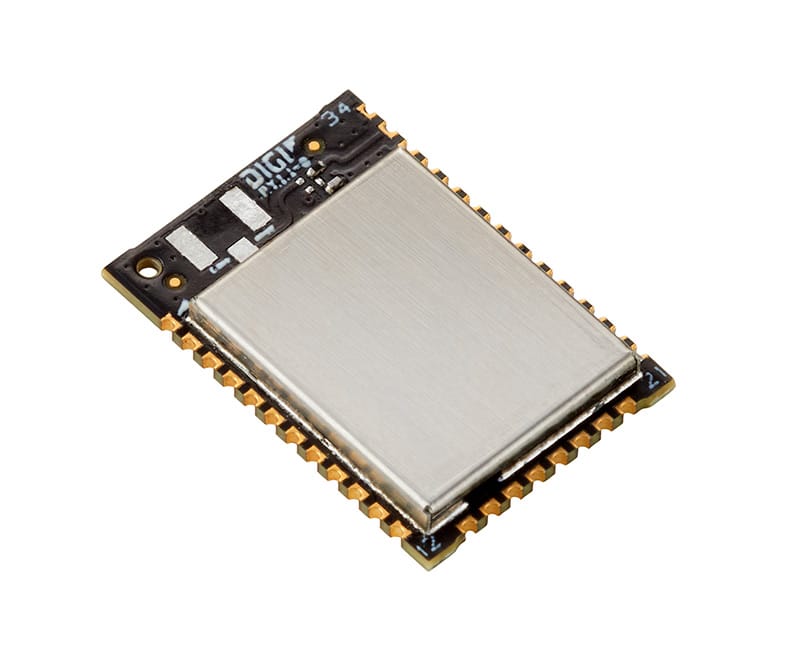
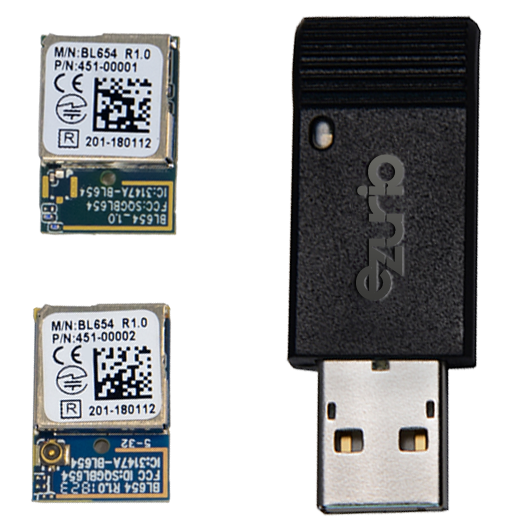
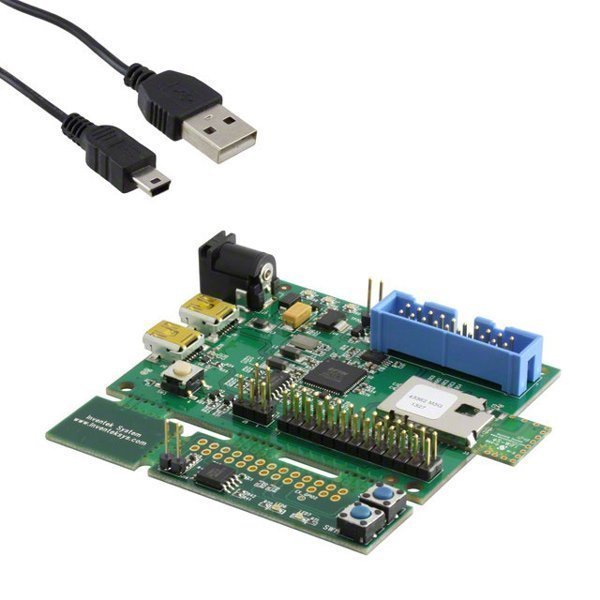
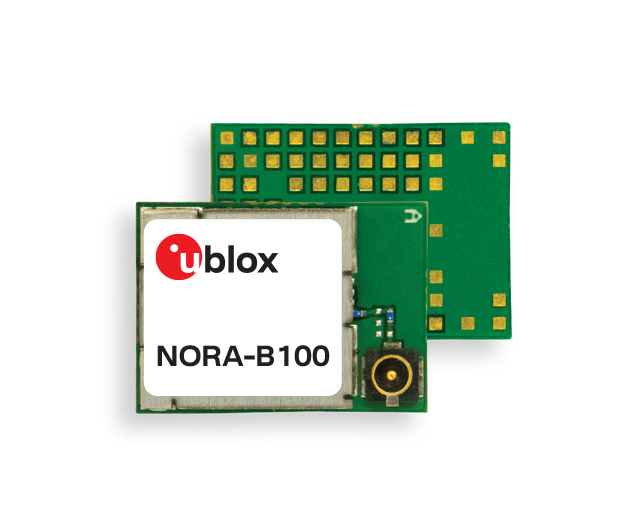
A wireless module is a certified, ready-to-integrate radio subassembly that combines an RF transceiver chip, a matching network, a crystal reference, an antenna or antenna interface, shielding, and a pre-loaded protocol stack on a single small PCB. In industrial automation it carries telemetry, sensor data, and control commands across factory floors, utility grids, and remote field sites where wiring is impractical. The category spans short-range standards such as Bluetooth Low Energy and Zigbee, long-range LPWAN such as LoRa and Wi-Fi HaLow, and wide-area cellular IoT such as NB-IoT and LTE-M.
Engineers buy modules rather than bare chips because the module already solves the hardest part of any radio design: the impedance-matched RF front end and the regulatory certification. A module typically arrives with its own FCC ID and CE test reports, so the integrator can ship a compliant product in months instead of redesigning and re-testing a transmitter from scratch.
This guide is aimed at industrial purchasing engineers and design engineers. It covers 6 chapters from RF protocol families, modulation principles, form factors and antenna options, spec-sheet decoding, to certification and selection decisions, with 7 selection FAQs and manufacturer comparisons. All parameters reference public standards including IEEE 802.15.4, the Bluetooth Core Specification, 3GPP Release 13 (NB-IoT and LTE-M), IEEE 802.11ah (Wi-Fi HaLow), and the radio regulatory frameworks FCC Part 15 and EU RED 2014/53/EU with harmonized standards EN 300 220 and EN 300 328.
Chapter 1 / 06
What is a Wireless Module
A wireless module is a board-level radio subassembly that turns a raw transceiver chip into a drop-in component an integrator can solder onto a host board and use immediately. Where a bare transceiver such as the Semtech SX1262 or a system-on-chip such as the Nordic nRF52840 is just the silicon that performs modulation and demodulation, the module surrounds that silicon with everything the radio needs to actually work in the field: an impedance-matched RF front-end network, a temperature-stable crystal oscillator, RF shielding to contain and reject interference, an antenna or an antenna connector, and firmware or a certified protocol stack already loaded into flash.
The decisive value of a module is not the convenience of fewer parts but the transfer of regulatory risk. Designing a radio front end that meets emissions limits, spurious-emission masks, and receiver-blocking requirements is among the most specialized tasks in electronics. By purchasing a pre-certified module, the integrator inherits the vendor's FCC ID and ISED certification under modular approval, and the vendor's CE and RED test evidence, instead of running a full transmitter certification campaign. For most industrial OEMs this turns a 6 to 12 month RF development cycle into a few weeks of host-board layout following the vendor integration guide.
Structurally, a wireless module contains four functional blocks: (1) the RF core, the transceiver or radio SoC that handles the physical layer; (2) the RF front end, comprising the matching network, optional power amplifier and low-noise amplifier, RF switch, and balun; (3) the timing and supply support, meaning the reference crystal, decoupling, and power regulation; and (4) the host interface, exposed as castellated or LGA pads carrying UART, SPI, I2C, USB, or a digital control bus plus GPIO. When the module also embeds the application microcontroller, the industry calls it a smart module or open module, because customer application code runs directly on the radio SoC, eliminating a separate host processor.
The history of the category tracks the history of low-power radio. Bluetooth arrived in 1999 as a cable-replacement standard; Zigbee built a low-rate mesh on IEEE 802.15.4 in 2003; Bluetooth Low Energy entered the Bluetooth 4.0 Core Specification in 2010 and reshaped battery-powered sensing. The LPWAN wave followed: Semtech commercialized LoRa chirp-spread-spectrum radios in 2013, and 3GPP standardized NB-IoT and LTE-M in Release 13 in 2016, bringing licensed-band cellular IoT to market. The Wi-Fi Alliance launched Wi-Fi HaLow on IEEE 802.11ah to extend Wi-Fi into the sub-GHz long-range space. Each wave added a module ecosystem rather than replacing the prior one.
In terms of deployment scale, the modern wireless module market is enormous and concentrated. Industry analyses place the five largest cellular module vendors, Quectel, Fibocom, Telit Cinterion, Semtech, and u-blox, at roughly three-quarters of cellular IoT module revenue. Annual shipments of short-range and LPWAN modules run into the billions of units across metering, asset tracking, building automation, and industrial monitoring. There is no universal wireless module; the engineering task is to map a given range, data-rate, power, and topology requirement onto a specific protocol and a specific certified part.
Chapter 2 / 06
Protocol Families and Topologies
The first and most consequential selection decision is the wireless protocol, because it fixes range, data rate, network topology, power profile, and whether you depend on a carrier network. Industrial modules cluster into four families: short-range personal-area radios (BLE, Zigbee, Thread), long-range LPWAN (LoRa, Wi-Fi HaLow), wide-area licensed cellular IoT (NB-IoT, LTE-M, LTE Cat-1, 5G RedCap), and local high-throughput wireless (classic Wi-Fi). The table below compares the headline engineering metrics. All figures are nominal physical-layer values; real-world throughput after protocol overhead is typically half or less.
Protocol
Band
PHY Data Rate
Typical Range
Topology
BLE (Bluetooth 5.x)
2.4 GHz
125 kbps to 2 Mbps
10 to 100 m
Star, mesh
Zigbee / 802.15.4
2.4 GHz, sub-GHz
250 kbps
10 to 100 m/hop
Mesh
LoRa / LoRaWAN
sub-GHz ISM
0.3 to 50 kbps
2 to 15 km
Star to gateway
Wi-Fi HaLow (802.11ah)
sub-1 GHz
150 kbps to 347 Mbps
up to ~1 km
Star
NB-IoT (Cat-NB1)
licensed LTE
~26 to 62 kbps
cellular wide-area
Star to base station
LTE-M (Cat-M1)
licensed LTE
up to ~1 Mbps
cellular wide-area
Star to base station
Wi-Fi (802.11 b/g/n)
2.4 / 5 GHz
11 Mbps to 600+ Mbps
10 to 100 m
Star (AP)
Bluetooth Low Energy is the dominant short-range standard for battery-powered sensing and for the smartphone-to-device link used in commissioning and diagnostics. The Bluetooth 5 generation added a 2 Mbps PHY (LE 2M) for higher throughput and two coded long-range PHYs (LE Coded S2 at 500 kbps and S8 at 125 kbps) that trade data rate for several decibels of receiver sensitivity. Bluetooth Mesh extends BLE into many-to-many lighting and building-control networks. Its strengths are ubiquity, very low standby current, and zero infrastructure cost; its limit is short range.
Zigbee, built on the IEEE 802.15.4 physical and MAC layers, is the workhorse of self-healing mesh networks in building automation, smart lighting, and utility submetering. At 2.4 GHz it defines 16 channels (channels 11 to 26, spaced 5 MHz apart) at a raw 250 kbps. Its routing nodes relay traffic, so a network can blanket a large building by hopping node to node, and it tolerates the loss of any single router. Thread is a closely related IPv6 mesh on the same 802.15.4 PHY, and both underpin the Matter smart-home ecosystem. The cost is modest per-hop range and 2.4 GHz congestion in dense Wi-Fi environments.
LoRa and LoRaWAN serve long-range, low-data telemetry over sub-GHz ISM bands (868 MHz in Europe, 915 MHz in North America). A single LoRa gateway can collect packets from thousands of battery sensors kilometers away, which makes it ideal for smart metering, agriculture, and asset tracking. The trade-off is very low throughput and duty-cycle limits in some regions. Cellular IoT (NB-IoT and LTE-M) instead leans on existing carrier infrastructure: no gateway to install, nationwide coverage, but a SIM and a recurring data subscription per device. NB-IoT targets stationary, infrequent, deep-coverage reporting (water and gas meters), while LTE-M supports mobility and tower handoff for asset and fleet tracking, with much lower latency than NB-IoT.
Chapter 3 / 06
Modulation and RF Principles
Underneath the protocol labels, only a handful of physical-layer modulation schemes are in play, and understanding them explains why each protocol behaves the way it does on range, robustness, and data rate. The four that dominate industrial modules are Gaussian frequency-shift keying (GFSK), offset quadrature phase-shift keying with direct-sequence spreading (O-QPSK / DSSS), chirp spread spectrum (CSS), and the OFDM family used by cellular and Wi-Fi. The table compares their core engineering characteristics.
Modulation
Used By
Strength
Limit
GFSK
BLE, proprietary FSK
Simple, low power
Modest sensitivity
O-QPSK + DSSS
Zigbee / 802.15.4
Interference robust
Fixed 250 kbps
CSS (chirp)
LoRa
Below-noise demod
Very low data rate
OFDM / SC-FDMA
LTE-M, Wi-Fi, 5G
High throughput
Higher power, complexity
Gaussian frequency-shift keying encodes data by shifting the carrier between two frequencies, with a Gaussian filter smoothing the transitions to narrow the occupied spectrum. BLE uses GFSK in the 2.4 GHz band, running 1 Mbps on the base LE 1M PHY and 2 Mbps on LE 2M. It is cheap to implement and frugal on current, which is why it underpins coin-cell sensors. To extend range, Bluetooth 5 added the LE Coded PHY, which still transmits at the 1M symbol rate but applies forward-error-correction coding to the payload, yielding 500 kbps (S2) or 125 kbps (S8) with roughly a 4 to 6 dB sensitivity gain and a corresponding 2 to 4 times range improvement.
Offset QPSK with direct-sequence spread spectrum is the 2.4 GHz physical layer of IEEE 802.15.4 and therefore of Zigbee and Thread. Each data symbol maps to a 32-chip pseudo-random sequence transmitted at a 2 Mchip/s chip rate, producing the standard 250 kbps user rate while spreading the energy across about 2 MHz of a 5 MHz channel. The spreading gain gives Zigbee good resistance to narrowband interference and multipath, which matters in factories crowded with Wi-Fi and Bluetooth traffic on the same band. The half-sine pulse shaping of O-QPSK keeps the signal envelope nearly constant, easing power-amplifier design.
Chirp spread spectrum is the proprietary modulation behind LoRa and the reason it reaches kilometers at milliwatt power. Each symbol is a chirp whose instantaneous frequency sweeps linearly across the channel bandwidth (commonly 125 kHz). The spreading factor, SF7 through SF12, sets the number of chips per symbol from 2^7 = 128 up to 2^12 = 4096. Higher spreading factors slow the data rate but push receiver sensitivity well below the noise floor: typical figures run near -123 dBm at SF7 and near -137 dBm at SF12 in a 125 kHz channel. Combined with a transmit power up to +22 dBm on parts such as the SX1262, this yields a link budget on the order of 160 to 170 dB, far beyond what GFSK can achieve.
OFDM and the SC-FDMA uplink of the LTE family give cellular IoT and Wi-Fi their high throughput by splitting data across many orthogonal subcarriers, which resists multipath fading and allows flexible bandwidth allocation. NB-IoT carves out a single 200 kHz narrowband within an LTE carrier and accepts low rates (roughly 26 kbps downlink, 62 kbps uplink) in exchange for deep indoor coverage and low cost. LTE-M occupies 1.4 MHz, supporting up to about 1 Mbps and millisecond-scale latency, and Wi-Fi HaLow (802.11ah) applies a down-clocked OFDM PHY in sub-1 GHz channels to span 150 kbps up to hundreds of Mbps depending on bandwidth and stream count.
Chapter 4 / 06
Form Factors, Interfaces, and Antennas
Beyond protocol and modulation, the mechanical and electrical packaging of a module determines how it integrates into a host product. Three dimensions matter: the physical form factor and mounting method, the digital host interface, and the antenna strategy. Each carries distinct cost, reliability, and certification consequences, and a mismatch here often forces a board respin late in development.
Form factor and mounting. The most common industrial format is a surface-mount module with castellated (half-via) edge pads, which solders like a large component during normal SMT reflow and needs no connector. Land-grid-array (LGA) modules place the contacts on the underside for a smaller footprint at the cost of harder rework and inspection. For socketed or field-replaceable designs, pluggable formats such as M.2, mini PCIe, and the Digi XBee 20-pin through-hole header are standard, letting an integrator swap a cellular module or upgrade a radio without reworking the main board. Solder-down formats win on cost and vibration resistance; pluggable formats win on serviceability and multi-band flexibility.
The table below summarizes the common form factors and their typical use. It is intended for initial planning; always confirm the exact land pattern, keep-out zone, and antenna-clearance requirement against the module datasheet before committing the PCB layout.
Form Factor
Mounting
Best For
Trade-off
Castellated SMD
Reflow solder
High-volume embedded
Not replaceable
LGA
Reflow solder
Smallest footprint
Hard to rework
M.2 / mini PCIe
Edge connector
Cellular, swappable
Connector cost, size
XBee 20-pin header
Through-hole socket
Field-replaceable mesh
Larger, lower density
Host interface. Modules expose their control and data path over a digital bus. UART (AT-command or transparent serial) is the simplest and most common, ideal for legacy serial equipment and cellular modems. SPI and I2C suit tighter microcontroller integration and higher transfer rates; USB appears on higher-throughput cellular and Wi-Fi modules. Smart or open modules add GPIO, ADC, and PWM so customer firmware can run on the radio SoC itself, removing a separate host MCU. The interface choice should match the host processor's available peripherals and the required data throughput; a 1 Mbps LTE-M link starved by a 9600-baud UART is a common and avoidable bottleneck.
Antenna strategy. The antenna sets effective radiated power and therefore range, and it is tightly coupled to certification. Three options exist. An integrated PCB or chip antenna is cheapest and smallest, with gain typically near 0 to 2 dBi, suited to compact short-range products. An on-board u.FL/IPEX (or MHF) connector lets the integrator attach an external whip or panel antenna for maximum gain and placement freedom, common on cellular and gateway designs. A castellated RF pin routes the radio to a trace antenna designed into the host PCB, giving cost savings at the price of host-side RF tuning. Critically, a modular FCC grant lists the specific antenna types and the maximum gain tested; fitting a higher-gain antenna than the grant covers voids the certification and can breach the legal EIRP limit, so antennas must be chosen from the approved list or the change re-tested.
Chapter 5 / 06
Key Specification Parameters
Reading a wireless module datasheet is a core skill for purchasing engineers. A single datasheet may list dozens of parameters, but only a handful drive selection: frequency band and channel plan, transmit power, receiver sensitivity, supply voltage and current, operating temperature, and the certifications held. Each is explained below, with the link budget tying several of them together.
Frequency band and channel plan. The band must be legal in every target market: 2.4 GHz is globally harmonized (so a single SKU works worldwide), while sub-GHz ISM differs by region (868 MHz in Europe, 915 MHz in North America, 779 to 787 MHz in China for some 802.15.4 deployments). Cellular modules must match the carrier's LTE bands. Mismatched bands are the single most common cause of a module passing bench testing yet failing certification or simply not connecting in the field.
Transmit power and receiver sensitivity together define the link budget, the maximum path loss the link can tolerate. Link budget equals transmit power plus transmit and receive antenna gains minus receiver sensitivity (all in dB or dBm). A LoRa part transmitting +22 dBm into a receiver rated -137 dBm yields a link budget near 159 dB before antennas, which is why it reaches kilometers; a BLE part at +4 dBm into -95 dBm yields under 100 dB and a sub-100 m range. When comparing modules, always compare sensitivity at the same data rate, because sensitivity degrades as data rate rises.
Supply voltage and current. Industrial modules commonly accept a 1.8 to 3.6 V supply to ride out battery droop. The current figures that matter for battery life are not the peak transmit current (often tens to hundreds of milliamps) but the sleep and standby current (microamps to nanoamps) and the average current weighted by duty cycle. A module with a 1 microamp deep-sleep current can run years on a coin cell if it transmits briefly and infrequently. Always model average current against the real reporting interval, not the peak.
Output and interface signals connect the module to the host. The main interface types are:
UART (transparent or AT-command): the most widespread control path, ideal for serial equipment and cellular modems; watch the baud-rate ceiling against link throughput.
SPI / I2C: tighter MCU integration and higher transfer rates for short-range radio SoCs and sensor hubs.
USB: common on high-throughput cellular and Wi-Fi modules for bulk data and firmware update.
GPIO / ADC / PWM (smart modules): let customer firmware run on the radio SoC, removing a separate host processor.
Antenna port (PCB, u.FL/IPEX, or castellated RF pad): sets radiated power and constrains the certified antenna list.
Operating temperature and environment. Industrial-grade modules specify -40 to +85 degrees Celsius (-40 to +185 degrees Fahrenheit), versus 0 to +70 degrees for commercial parts, because cabinets, outdoor enclosures, and vehicle installations swing far beyond room temperature. Look also for crystal frequency stability (often plus-or-minus 10 to 20 ppm over temperature, which affects channel accuracy on narrowband protocols), humidity and conformal-coating ratings, and vibration and shock compliance per IEC 60068-2 where the module rides on mobile or rotating equipment. These ratings, not peak data rate, usually decide whether a deployment survives 10 years in the field.
Chapter 6 / 06
Selection Decision Factors
To turn the preceding five chapters into a specific part number, follow the decision sequence below. Most selection mistakes come not from a single wrong answer but from deciding the part before nailing down the requirement, especially on certification and band coverage. These eight steps work as a fixed RFQ template.
Range, data rate, and topology: First fix the worst-case distance, the bytes per report, the reporting interval, and the node count. These three together select the protocol family: short-range BLE or Zigbee, long-range LoRa or Wi-Fi HaLow, or wide-area cellular NB-IoT or LTE-M. Decide topology (star versus mesh) before anything else.
Frequency band and regional coverage: Confirm the band is legal and supported in every target market. Choose 2.4 GHz for a single global SKU, region-specific sub-GHz for range, or carrier-matched LTE bands for cellular. Verify spectrum and duty-cycle rules per region.
Power budget: Model average current from sleep current, transmit current, and the real duty cycle, then size the battery or harvesting source. For mains-powered nodes this step is minor; for multi-year battery sensors it dominates the design.
Host interface and integration: Match the module interface (UART, SPI, I2C, USB) to the host processor and required throughput, or choose a smart module to host application code on the radio SoC and drop a separate MCU.
Form factor and antenna: Pick castellated SMD or LGA for high-volume embedded, or M.2 / mini PCIe / XBee header for field-swappable designs. Select the antenna (integrated, u.FL/IPEX external, or trace) from the module's certified list.
Certifications: Confirm the exact part carries the marks every market requires: FCC Part 15 and ISED in North America (under modular approval where possible), CE under RED 2014/53/EU with EN 300 220 (sub-GHz) or EN 300 328 (2.4 GHz) in Europe, plus regional schemes such as Japan MIC, Korea KC, and China SRRC. For cellular, add carrier and PTCRB/GCF approval.
Environment and reliability: Specify operating temperature (-40 to +85 degrees C for industrial), crystal stability, humidity and coating, and vibration and shock per IEC 60068-2 for mobile installations. Underrated environmental specs are a leading cause of field failures.
Total cost of ownership (TCO): Add unit price plus integration engineering plus certification reuse savings plus any recurring cellular data subscription plus field-service cost over the deployment life. A cellular module avoids gateway capital but adds a per-device monthly fee; a LoRa or Zigbee network avoids subscriptions but requires gateway and mesh planning.
One last commonly overlooked dimension is supply continuity and serviceability: long-term part availability and lifecycle commitment, second-source compatibility (pin-compatible alternates from another vendor), firmware update and security-patch support, and the quality of the integration documentation and reference design. These seem secondary at the purchasing stage but determine whether a 10-year product can be built and maintained. Established vendors such as Quectel, u-blox, Nordic Semiconductor, Silicon Labs, Murata, Telit Cinterion, Sierra Wireless, Digi, and Espressif publish lifecycle roadmaps and maintain certification across regions, which makes them safer choices for long-lived industrial designs.
FAQ
What is the difference between a wireless module and a transceiver chip?
A transceiver chip (such as the Semtech SX1262 or a Nordic nRF52840 SoC) is the bare silicon that handles RF modulation and demodulation. A wireless module is a complete certified subassembly that adds the matching network, crystal reference, antenna or antenna connector, shielding can, and pre-loaded firmware or protocol stack onto a small PCB. The key commercial difference is regulatory: a module typically carries its own FCC ID, ISED certification, and CE/RED test reports, so an integrator can reuse that grant under modular approval rather than re-certifying the whole product. Buying a chip means designing and certifying the RF front end yourself; buying a module shifts that burden to the vendor.
How do I choose between LoRa, Zigbee, BLE, and cellular IoT?
Map the application to range, data rate, and topology. LoRa suits long-range (2 to 15 km), low-data telemetry over sub-GHz ISM bands, with star topology to a gateway. Zigbee (IEEE 802.15.4) suits self-healing mesh networks of dozens to hundreds of nodes at 250 kbps over 2.4 GHz, typical of building automation. BLE suits short-range (under 100 m), phone-connected sensors and commissioning, with 1 to 2 Mbps PHY rates. Cellular IoT (NB-IoT, LTE-M) suits wide-area, infrastructure-free deployment where a carrier network already exists, trading a SIM and data subscription for nationwide coverage. No single protocol wins; the wedge is range times node count times power budget.
What does the LoRa spreading factor control?
The spreading factor (SF7 to SF12) sets how many chirp chips encode each symbol: SF7 uses 2^7 = 128 chips and SF12 uses 2^12 = 4096 chips. A higher SF lowers the data rate but raises receiver sensitivity and range, because the receiver can demodulate a signal further below the noise floor. Moving from SF7 to SF12 improves the link budget by roughly 15 to 20 dB, extending range several times over, at the cost of a longer time-on-air per packet. At 125 kHz bandwidth, typical sensitivities run near -123 dBm at SF7 and near -137 dBm at SF12. SF is the primary range versus throughput lever in LoRaWAN tuning.
Why does sub-GHz often outperform 2.4 GHz for range?
Lower frequencies suffer less free-space path loss and diffract around obstacles more readily, so a 868 or 915 MHz signal penetrates walls and travels farther than a 2.4 GHz signal at equal transmit power. At 2.4 GHz, indoor range is often limited to roughly 250 m line of sight, while sub-GHz LoRa or Wi-Fi HaLow can reach kilometers outdoors. The trade-offs are lower available bandwidth (so lower peak data rate) and larger antennas, since antenna size scales with wavelength. The 2.4 GHz band keeps its advantage where high throughput, small antennas, and global single-SKU operation matter more than absolute range.
What is modular approval and why does it matter?
Modular approval is an FCC and ISED route where a radio module is certified as a standalone transmitter with its own FCC ID, allowing it to be integrated into a host product without re-certifying the radio. The host manufacturer must still follow the module vendor's integration guidance, respect the tested antenna gain and trace layout, and may need a limited set of verification tests. This dramatically shortens time to market. Note that the EU is different: under the Radio Equipment Directive (RED 2014/53/EU) there is no modular approval, so the final product must carry the CE declaration and meet harmonized standards such as EN 300 220 (sub-GHz) or EN 300 328 (2.4 GHz) at the device level.
How do antenna options on a module affect range and certification?
Modules ship with three antenna strategies: an integrated PCB or chip antenna (cheapest, smallest, lowest gain near 0 to 2 dBi), an on-board u.FL/IPEX connector for an external antenna (highest flexibility and gain), or a castellated RF pad routed to a host-board trace antenna. Antenna choice directly sets effective radiated power and therefore range, but it also constrains certification: a modular FCC grant lists the specific antenna types and maximum gain tested. Using a higher-gain antenna than the grant covers voids the certification and may exceed the legal EIRP limit. Always select an antenna from the module's approved list or budget for a permissive-change re-test.
What environmental and temperature ratings do industrial modules need?
Industrial-grade wireless modules specify an extended operating temperature range of -40 to +85 degrees Celsius, versus the 0 to +70 degrees of commercial parts, because cabinets, outdoor enclosures, and engine bays swing well beyond room temperature. Look also for crystal frequency stability over temperature (often plus-or-minus 10 to 20 ppm), conformal coating or humidity ratings for condensing environments, and vibration and shock compliance per IEC 60068-2 where the module mounts on rotating or mobile equipment. Supply voltage range matters too: a 1.8 to 3.6 V module survives battery droop better than a fixed 3.3 V part. These ratings, not peak data rate, usually determine field reliability over a 10-year deployment.
Wireless Module Manufacturers
Source-backed product routes. Open a company dossier for procurement scope and cited evidence.