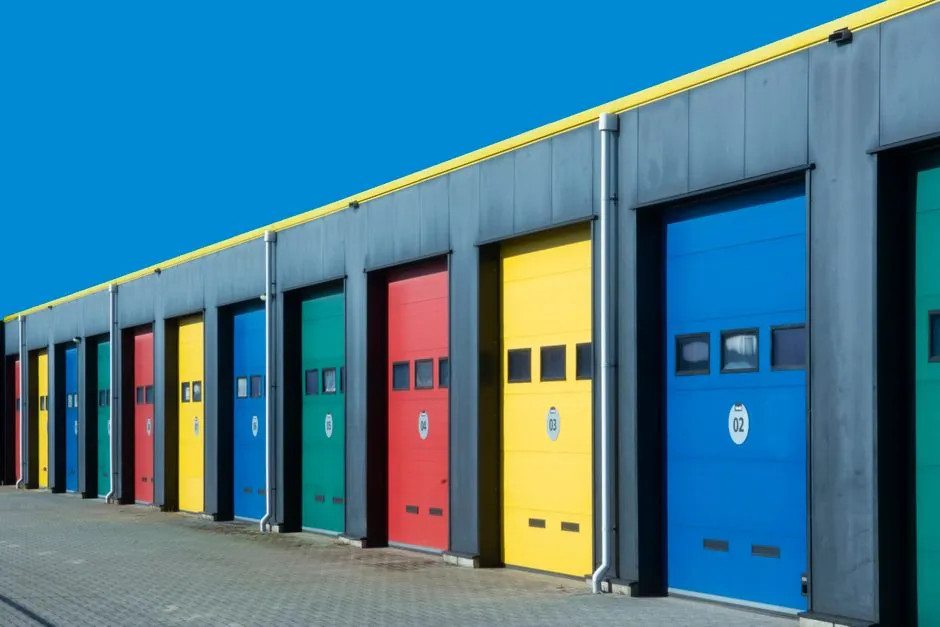
Vertical storing dock levelers park the deck and lip flush with the pit floor in the vertical position, which lets the overhead sectional door drop all the way down to the concrete, so the seal is door-to-floor rather than door-to-steel [S1][S9].
That geometry is the differentiator in cold storage, because the dominant heat-leak path at a refrigerated dock is not the insulated door panel itself but the perimeter gaps left between a stored leveler deck, the pit walls, and the underside of the door [S2][S3].
Why the Vertical Storing Geometry Seals Better
A vertical storing leveler stored in the upright position leaves the pit floor completely unobstructed, so the overhead door's bottom seal can compress against clean concrete across the full door width and against the pit side walls [S1][S9]. By contrast, a pit-style leveler, whether hydraulic, air powered, or mechanical, sits horizontally inside the pit when at rest, forcing the door to seal around a steel deck, a projecting lip, and the hinge hardware [S2][S3].
Multiple OEM sources describe the resulting air-infiltration reduction in qualitative terms: the vertical arrangement minimizes air exchange between the conditioned interior and ambient air, which is the mechanism that drives energy savings in refrigerated warehouses [S2][S3][S10]. Modern vertical units often ship with tight-sealing components and insulated barriers that further reduce air leakage, while a weatherseal kit and brush seals along the pit perimeter are still recommended add-ons for the most aggressive temperature regimes [S1][S10]. For an explainer of how perimeter door seals actually perform against a concrete floor, see the sealing washer and perimeter seal primer and the broader industrial sealing reference.
Standard Sizes, Capacities, and What They Mean for Cold Rooms
Vertical storing levelers are not a one-size product. DH Pace publishes 6 ft, 66 in, and 7 ft standard widths, 5 ft and 6 ft standard lengths, and 40,000 to 50,000 lb Comparative Industry Rating (CIR) capacities depending on the model [S1]. The deck is rated to flex up to 4 in (101 mm) under load, the hydraulic pack is driven by a 1 HP motor with overload protection, and a double-acting lip cylinder plus hydraulic fall-safe cover the safety envelope [S1].
Rite-Hite breaks the same product family into three distinct SKUs: the RHV-4100 standard vertical storing hydraulic, the RHV-5000 high-capacity vertical storing, and the RHVJ-5000 Jumbo vertical storing for high-cycle and heavier trailer weights, all hydraulic, all using the same vertical-stow principle [S5]. Standard deck widths and CIR ratings on a dock leveler spec sheet are the first numbers to lock in before comparing sealing strategy, because an undersized deck forces the door to seal across a wider exposed concrete span and weakens the very seal the geometry is supposed to deliver.
Vertical vs Pit-Style Leveler: Decision Matrix

For cold storage doors, the two architectures compare as follows on the criteria that actually drive the spec. Sealing performance: vertical storing wins, because the door closes onto a clean pit floor; pit-style levelers inherently leak around the stored deck and lip [S1][S2][S3][S9]. Sanitation and FSMA exposure: vertical storing reduces pest ingress and condensation that would otherwise frost on horizontal steel, and is the geometry Rite-Hite ties directly to FSMA-compliant sealing on its 2026-05-28 cold storage guidance [S5]. Retrofit cost and pit tolerance: pit-style levelers are cheaper to drop into an existing shallow or non-standard pit, where a vertical unit typically requires a deeper, cleaner, more accurately formed pit so the door can land flat on the floor.
Operator behavior and cycle life: vertical storing is hydraulic, uses a constant-pressure down button for controlled lowering, and includes a maintenance strut for safe under-deck inspection; pit-style levelers are also offered in hydraulic, air powered, and mechanical variants, so where compressed air or 1 HP single-phase power is not available, mechanical pit units remain a fallback [S1][S5]. Energy and compressor load: vertical storing reduces compressor runtime by cutting infiltration, with no quantified kWh figure published in the available OEM material, so claim any specific percentage saving only with measured data, not from the marketing copy [S2][S3][S10]. For context on how perimeter seal design choices ripple through adjacent storage and handling systems, the dock-leveler and storage-handling overview maps the interface points.
Who Should Specify Vertical Storing, and Who Should Stay With Pit
Vertical storing is the right call for new-build cold stores and freezer rooms where the envelope is the design driver, for FSMA-audited food and pharma docks where pest and condensation control are documented risks, and for high-cycle operations where the door is closed 70 percent of the day and infiltration is the dominant load [S3][S5][S10]. Kodiak's cold storage writeup positions it as the default for any facility where temperature regulation is the primary concern and any deviation risks product loss, quality issues, or safety hazards [S3].
Pit-style levelers remain the right call for ambient docks, for shallow-pit retrofits where deepening the pit is structurally or financially unfeasible, for sites without reliable hydraulic power where a mechanical or air-powered pit unit is the practical option, and for low-cycle docks where sealing is not the controlling design driver [S3][S5]. The Overhead Door Company and Kelley both note that traditional pit units will always leak around the deck perimeter, so where they are retained in a cold store, dock seals and shelters are mandatory add-ons rather than optional [S6][S8].
Failure Modes and Constraints Engineers Should Pre-empt

Vertical storing geometry is unforgiving of pit construction tolerance: if the pit floor is out of level or the side walls are not square, the door bottom seal will not land uniformly, and the unit reverts to leaking at the same gaps a pit leveler would have [S1][S9]. The deck's 4 in flex under load also means the leveler must be sized so the loaded truck does not over-deflect the deck and pinch the door seal, which is why the 40K to 50K CIR range is not interchangeable across trailer weights [S1].
Operationally, the leveler must be fully stowed before the door closes; a partially lowered vertical deck will block the door and damage both the seal and the lip cylinder [S5][S7]. Cold-room condensation still occurs during open-door cycles, so the design must still pair the leveler with a loading dock shelter or seal, dock blankets for the trailer interface, and heated pit approaches where frost heave is a risk [S3][S5][S6]. The Seal-Once, Park-First procedural discipline is what makes the geometry actually pay off in kWh, and Rite-Hite's 2026-05-28 piece frames that procedural gap as the primary FSMA risk in retrofitted cold stores [S5]. For facilities that also run pallet flow or case-pick operations next to the dock, the VLM tray ergonomic reference and the VLM vs vertical carousel comparison cover the picking side of the same warehouse envelope decision.
Standards, Sourcing, and What to Verify on the Submittal
There is no single cold-storage-specific federal standard that prescribes a vertical storing geometry, so the spec is built from a stack of requirements: OSHA 1910.30 around loading dock safety, FDA FSMA's sanitary transportation rule for food-grade cold chains, and the local energy code or utility rebate criteria that drive envelope performance [S3][S5]. On the submittal, lock in width, length, CIR, motor HP, lip cylinder type, fall-safe behavior, deck flex limit, weatherseal kit inclusion, and the pit dimensions the door will land on, then verify that the overhead door bottom seal and pit floor finish are compatible [S1][S5][S9].
Two trackable signals to watch through 2026: more cold storage FSMA audit findings publicly tied to dock perimeter gaps rather than insulated panel performance, which would push the market further toward vertical storing; and the appearance of utility and grant programs that explicitly fund infiltration-reduction retrofits at refrigerated docks, which would shorten the payback period on vertical retrofit projects. For engineers comparing the sealing decision to the wider spec set on the receiving dock, the sealing washer and perimeter seal primer and the storage cage and enclosure interface are useful adjacent reads.