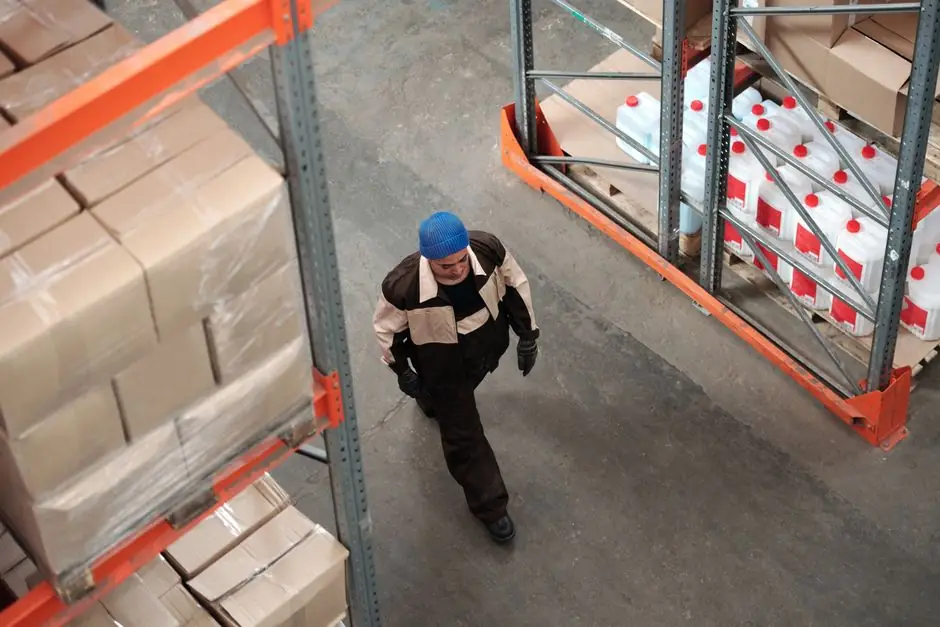
Vertical lift modules (VLMs) deliver trays to a single waist-high window via a central extractor, while vertical carousels rotate a fixed-pitch chain loop of carriers like a Ferris wheel, and horizontal carousels move bins along an oval track to a stationary operator. Across three published comparisons, VLMs scale to roughly 52 ft tower height, vertical carousels cap near 32 ft, and horizontal carousels trade ceiling height for raw picks-per-hour in podded configurations [S3][S5].
For goods-to-person picking, the dominant decision variables are SKU uniformity, ceiling clearance, payload per tray, and the number of concurrent operators the cell must feed. The same three sources frame the comparison as a choice between variable-SKU flexibility (VLM), uniform small-parts throughput (carousel), and very high volume with crane automation (mini-load AS/RS), with VLM vs carousel being the most common fork in mid-sized operations [S2][S3][S5]. A working primer on the vertical lift module category is a useful reference when sizing extraction columns and tray pitch.
Footprint, Tray Dimensions, and Density
VLM units typically span 5 to 15 ft wide by 7 to 10 ft deep, with trays ranging 4 to just over 13 ft wide by 2 to 3 ft deep and a maximum product height near 28 in; vertical carousels run 6 to 13 ft wide by just over 4 to 5 ft deep, with carriers 4 to nearly 12 ft wide by 16 to 24 in deep and product height up to 18.5 in [S4]. A standard 20 ft tall machine of either type yields roughly 5,000 to 7,000 storage locations on a 6 in x 6 in x 4 in cell grid [S4].
Vertical carousels are therefore the narrower option, with VCM depth about half that of a VLM at the same width band, which matters when integrating into a brownfield aisle with existing rack lines [S4]. VLM density is also self-optimising: optical sensors measure the tallest item on each returned tray and the system stores it in the tightest available vertical slot, eliminating fixed dead-air gaps that a carousel's chain-fixed carrier pitch cannot avoid [S3]. Manufacturers quote floor-space recovery up to roughly 90% versus static shelving once dynamic tray-height optimisation is in play [S2]. Detailed tray width, depth, and capacity bands by OEM sit in a separate reference, VLM tray dimensions by OEM, which pairs naturally with this comparison.
Height Range, Payload, and Imbalance Behaviour
VLMs are typically installed from 8 ft up to about 52 ft in commercial product lines, with some specialty towers reaching 98 ft; vertical carousels start near 7 ft and top out near 32 ft because rotating an unbalanced chain loop at greater heights becomes impractical [S3][S4]. On payload, VLM trays are commonly rated up to 2,200 lb per tray, with heavy-duty configurations above 2,000 lb, while the latest vertical carousel carriers handle up to 1,430 lb per carrier [S4][S2].
Imbalance tolerance is a real differentiator: VLM trays rest on independent side profiles so tray-to-tray weight balance across the system is irrelevant, whereas a carousel requires balanced weight distribution across the entire internal chain loop or it will bind, drift, or wear prematurely [S3]. That is why VLMs accept mixed-SKU loads of differing density and why carousels perform best when every carrier carries roughly the same mass. For facilities weighing the structural side of the install, the VLM installation floor load and ceiling height specs reference covers slab prep, seismic bracing, and clear-height headroom rules of thumb.
Throughput, Ergonomics, and Pick Guidance
A VLM serves one operator at a single access window; throughput is therefore a function of cycle time plus dual-tray pre-staging, where the next tray is fetched in the background while the operator picks the active one, cutting machine wait time by roughly 50% in well-sequenced batches [S3]. Vertical and horizontal carousels are typically grouped into pods of three to four units so one operator can pick continuously while the next unit indexes the next item into position, achieving several hundred lines per hour per operator at steady state [S5].
Ergonomically, both VLM and vertical carousel present items at waist height, but the VLM's top-down 100% open tray presentation is preferred when hoists, cranes, or overhead lifters are used to extract heavy items, while the carousel's horizontal reach into shelf slides suits totes and small bin drawers [S3]. Pick-to-light integration is supported on both: VLM bays add overhead laser pointers, LED light bars, or direction indicators on the bay frame, while carousel bays add LED light bars at the base of the picking area [S3]. Controls hardware for guard-door interlocks on the cell enclosure is generally specified to IEC 60947-5-3 for fail-safe inductive sensors, as discussed in fail-safe inductive sensors to IEC 60947-5-3 for guard door monitoring.
Cost Bands, Used Market, and Integration
New VLM units list in a band of roughly $85,000 to $250,000+ depending on height, tray size, load rating, and software; new vertical carousels list in a band of roughly $60,000 to $180,000+ with variations driven by shelf pitch, machine height, and pick-technology options [S2]. ERP and WMS integration is a common hidden adder, typically $20K to $40K on top of base VLM software, and refrigeration, fire suppression, or dual delivery windows push price further [S2].
The used market is a real cost lever: a pre-owned VLM or carousel typically resells for 40 to 60% of new, so a $120,000 new carousel can land near $65,000 used once relocation, reconfiguration, and re-licensing are absorbed [S2]. For very high-volume operations that exceed a podded carousel cell, the third option in the AS/RS family, the mini-load crane, becomes the right escalation; it carries the largest capex and longest payback but also the highest steady-state throughput per square foot [S5].
Selection Rules: When to Pick Each System
Choose a VLM when inventory is variable in height and weight, ceiling height exceeds roughly 20 ft (and ideally 25 to 52 ft), per-tray payload exceeds 1,500 lb, or top-down access with a hoist or crane is needed; dynamic tray-height measurement then recovers most of the wasted vertical air that a carousel would lock in as fixed dead space [S2][S3]. Choose a vertical carousel when SKUs are uniform small parts in bins or totes, ceiling clearance is moderate (under about 20 ft), and the operator wants a simple, compact footprint with predictable indexing between adjacent carriers [S3][S7].
Choose a horizontal carousel pod when the binding constraint is picks per hour rather than square footage, when fast movers dominate the mix, and when batch picking from an oval track keeps the operator continuously busy without idle rotation waits [S5]. Three quick disqualifiers help in practice: a VLM is the wrong pick if the operation needs more than one operator picking from the same unit at once, a vertical carousel is the wrong pick if SKUs vary in height by more than a factor of two, and a horizontal carousel is the wrong pick if ceiling height is the scarce resource. For sites that already run conveyors and need positioning feedback at the pick station or extractor axis, rotary vs linear encoder selection is a related decision.
Trackable signals for the next planning cycle: ceiling height and slab load certification of the candidate cell, current SKU height and weight distribution, target picks-per-hour per operator, and whether the WMS already exposes an API for VLM or carousel handshakes. Any of these three flipping in the next quarter should drive a re-spec, since they each directly move the VLM vs carousel decision.
The underlying component specifications are covered under linear module, and relay module.