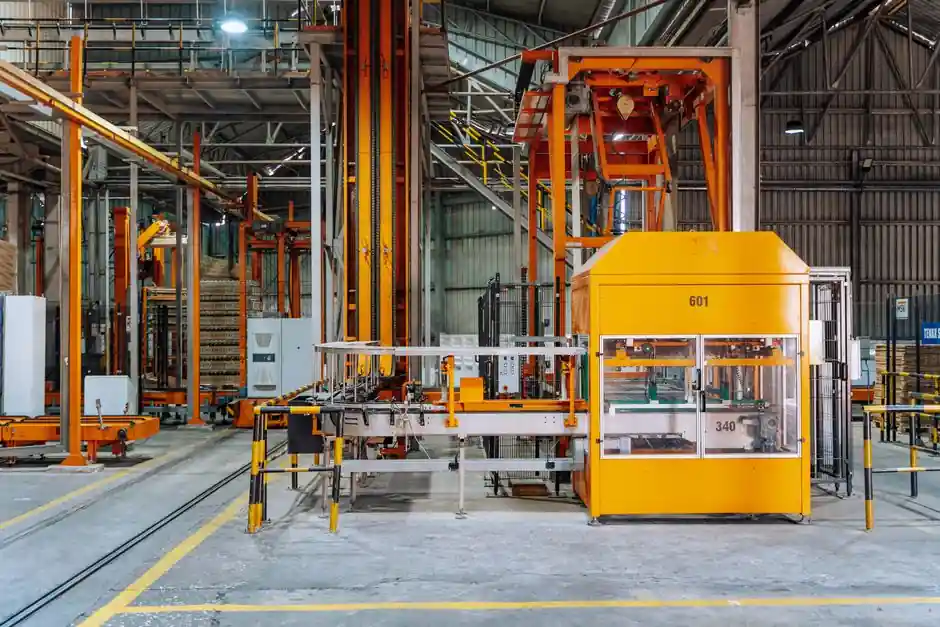
Vertical lift modules (VLMs) deliver trays to a fixed access opening rather than to the picker, so the entire ergonomic case for the technology rests on where that opening is set relative to operator body dimensions. The widely cited "golden zone" is defined as the band from belt height to shoulder height of the average individual, the band where the operator can grab or move items without stretching or bending [S1].
Industrial VLMs reclaim up to 85% of floor space versus static shelving, achieve up to 99.9% pick accuracy, and reduce pick labor by up to 67% in vendor-reported deployments, with the access opening height being the single mechanical variable that converts a dense storage box into an ergonomic workstation [S1][S3]. Tray travel, extractor cycle time, and software slotting all serve the constraint that the tray must arrive at a comfortable height for the human in front of the bay.
Anthropometric Anchor: Belt-to-Shoulder Pick Window
The pick window must be sized to the workforce, not to a single person. The 5th–95th percentile standing-population range for "waist height" (the lower bound of the golden zone) sits at roughly 800–950 mm, and shoulder height runs roughly 1,350–1,500 mm across mixed-gender industrial samples, so a single fixed opening near the middle of that band cannot fit every operator without some stoop or reach. Kardex's safety guidance repeats the principle that items within belt-to-shoulder height allow operators to "grab or move items without stretching or bending" [S1]. White Systems' engineering guide reinforces that VLMs "deliver items directly to the operator at an ergonomic access opening," framing the opening itself as a deliberate design parameter, not a side effect of the cabinet height [S3].
For mixed-population pick lines, the practical compromise is a single opening whose sill sits around 900–1,000 mm and whose upper reach limit is 1,400–1,450 mm off the floor, giving most operators a full neutral-posture pick. Outside that band, the literature on warehouse picking consistently shows increased low-back and shoulder injury rates; the VLM removes ladder climbing, but it only removes bending if the tray is delivered inside the golden zone on every cycle [S1].
Mechanical Constraint: Extractor Stroke, Cabinet Height, Tray Pitch
Inside the VLM, two columns of trays are arranged on either side of a central extractor that lifts the requested tray to the access opening [S3]. The vertical lift module is fundamentally a vertical lift module constrained by the relationship between the cabinet's total height, the extractor's stroke, and the variable pitch between trays. Modern units scale across a wide envelope; the SSI Schaefer LOGIMAT, for example, scales from 8 ft to 78 ft (about 2.4 m to 23.8 m) in 4-inch (about 100 mm) increments, with multiple units linkable to extend throughput [S8].
Because the tray pitch inside the column is dynamic rather than fixed, slotting software can place the tallest SKU once and let the system measure and remember its height on each subsequent return, compressing empty space around shorter items without re-engineering the bay [S6][S7]. That dynamic height measurement is what lets the optimizer reserve the golden zone for the operator while still packing the column above and below the access window. Vendor guides describe the access opening as a single, fixed window, so changing the pick height for a shift means changing the relationship between the extractor and the opening, typically by selecting a different VLM model or by specifying the access-opening height at order entry, not by adjusting on the fly [S3][S8].
Slotting Strategy: ABC Velocity Mapping in the Golden Zone
Tray height optimization is not just an anthropometric question, it is a slotting problem. The Modula engineering team frames warehouse slotting as the process of organising SKUs so that "fast-moving or high-turnover items" sit in the smallest possible golden zone, with fixed slotting for high-turnover parts and random slotting for low-turnover items [S5]. In a VLM, the equivalent of the "aisle" is the tray at the access window, and the software is what assigns each SKU to that tray position based on pick frequency.
When a single cabinet is paired with an order picker workflow on the warehouse floor, slotting the top-decile SKUs into the trays that the extractor serves fastest, those nearest the elevator's mid-stroke, materially shortens cycle time. Dual-tray VLM research from Georgia Southern frames this as a "picker-to-parts" optimization where the parts come to the picker, and the practical effect of slotting is to reduce the extractor's vertical travel per pick by concentrating the most active SKUs near the idle elevation of the elevator [S2]. The dual-tray configuration effectively gives the system two simultaneous golden zones, halving the per-pick wait when both pickers are at the bay [S2].
Ergonomic Failure Modes When the Window Is Misset
Specifying the wrong access-opening height shows up in two recurring injury patterns. First, an opening mounted too high forces a shoulder abduction plus cervical extension on every pick, a posture that drives rotator cuff and trapezius strain over a full shift. Second, an opening mounted too low forces lumbar flexion and a stooped reach, a posture that drives low-back disorders and is harder to compensate for with foot positioning because the operator is locked to the bay [S1]. Kardex's safety write-up explicitly contrasts VLMs with conventional shelving and ladders, noting that warehouse pickers can walk up to 12 miles per shift searching for items, the kind of cumulative travel that disappears when the tray is delivered at a neutral height [S1].
A second failure mode is the "tall load on a short window" case, where a single oversized SKU forces the operator to reach up and over the front lip of the tray. Dynamic height measurement helps: the system measures the item on insertion and adjusts the pitch around it on return, so the operator is not constantly re-reaching for an oddly stacked load [S6][S7]. This is also where the bay must be matched to the SKU mix: small-parts VLM trays and pallet-class VLM trays have very different ergonomic signatures, and the access-opening height that is neutral for a 5 kg parts tray is wrong for a 500 kg pallet [S3].
Safety Interlocks That Protect the Ergonomic Window
Hardware interlocks keep the golden-zone rule from being violated by a moving tray. Integrated light curtains across the access opening detect any obstruction and immediately stop tray travel, which is the most cited safety feature on Kardex's reference VLM, the Shuttle [S1]. Automatic shutter doors remain closed while the tray is in motion and only open when the tray is securely positioned at the opening, preventing an operator from reaching into a moving elevator while trying to "shortcut" the cycle [S1].
These interlocks are not ergonomic features on their own, but they make the ergonomic design enforceable: without the light curtain, a picker reaching into the bay to pull a tray early would defeat the height-optimization strategy and reintroduce the exact awkward postures the VLM was meant to remove [S1][S6]. The mechanical principle is that a VLM is a closed system, and the closed system is what guarantees the tray arrives at the right height every time.
Specification Checklist for a Height-Optimized VLM Bay
For a process engineer writing a spec, the key parameters are: access-opening height off the floor set to the workforce's belt-to-shoulder band (roughly 900–1,450 mm for mixed industrial populations), tray width and depth matched to the dominant SKU footprint, dynamic tray-height measurement enabled so the extractor packs around the tallest item, and slotting software configured to anchor the top decile of SKUs to the trays nearest the extractor's mid-stroke [S3][S5][S6]. Cabinet height is then a function of required storage density, with the LOGIMAT-class range of about 2.4 m to 23.8 m in roughly 100 mm increments providing a wide envelope [S8].
Confirm at FAT that the light curtain and shutter-door interlocks stop tray motion at the opening, verify the extractor's positioning tolerance at the sill (vendors typically spec ±5–10 mm at the access window), and document the golden-zone envelope in the operator training packet so the workforce understands why the opening is set where it is [S1][S3]. Related VLM tray and ceiling tradeoffs are explored in Pallet vs Small-Parts VLM tradeoffs and tray dimension ranges in VLM tray dimensions by OEM.
For component-level specifications, see cable tray.