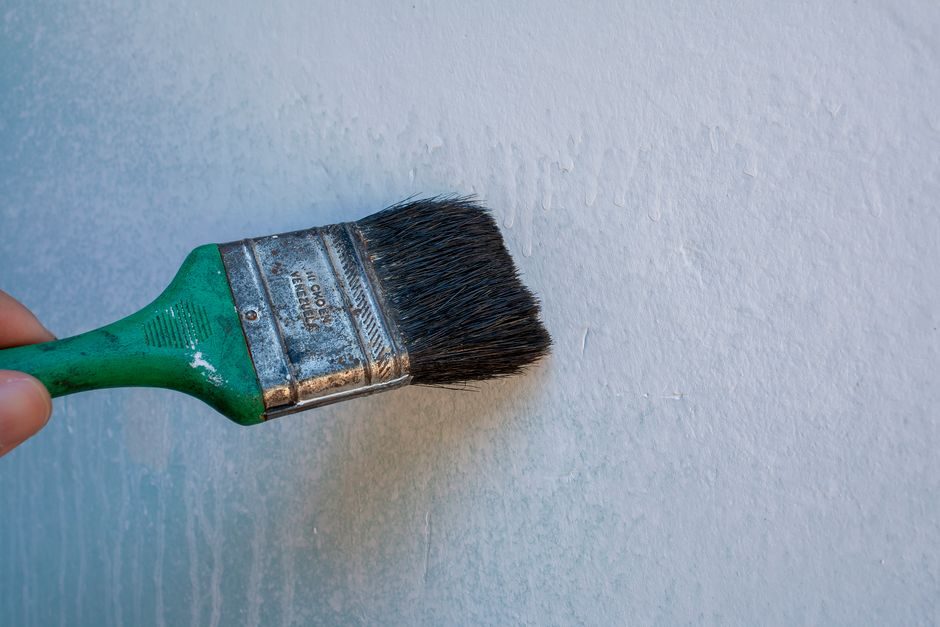
Waterproofing is the act of treating a surface to repel water, applied as a coating, membrane, or impregnating sealer [S2]. In industrial, commercial, and residential builds, the coating families split into four mechanically distinct groups: rigid cementitious slurries, polymer-modified cementitious composites, reactive liquid-applied membranes (polyurethane, polyurea, acrylic), and pre-formed sheet membranes (bituminous, modified-bitumen, EPDM, PVC, TPO) [S1].
For floor applications, the substrate — concrete, screed, tile underlayment, or steel deck — drives family selection more than brand; for below-grade walls, planter boxes, basements, and retaining structures exposed to hydrostatic pressure, Sovereign Water Control specifies waterproofing membranes as the default against water seepage, spalling, and "concrete cancer" in Perth and Western Australia civil works [S3]. A separate Chinese reference, JC/T 2428-2017 effective 2018-04-01, codifies non-curable rubber-modified asphalt waterproofing coating — a viscous paste of rubber, asphalt, and softener oil with a temperature-control agent and fillers — as the dedicated material for non-exposed building waterproofing and movement-joint detailing [S4].
Cementitious Coatings: Rigid Slurries vs Polymer-Modified Composites
Cementitious waterproofing is split into two performance tiers. Tier 1 is the rigid slurry: Portland cement, fine quartz sand, and an active waterproofing admixture (often a hydrophobic pore-blocker) mixed with water on-site and brushed or trowelled onto cured concrete; typical 2-coat application gives 1.5–3.0 mm dry film thickness, used on positive-side basement walls, water tanks, and shower pre-slopes where movement is minimal [S1].
Tier 2 is the polymer-modified cementitious coating, where an acrylic, SBR, or redispersible-powder polymer is blended with the cement matrix at 5–20% of the binder weight; the polymer phase bridges micro-cracks up to ~0.5 mm and bonds to substrates that rigid slurries cannot, including brick, block, and existing tile screeds [S1]. Tier 2 is the typical floor specification under tile in wet rooms, balconies, and planter boxes because the polymer phase tolerates thermal cycling and minor substrate movement that pure-cementitious films crack under. Both tiers are vapour-permeable — they do not stop moisture vapour transmission — and are therefore unsuitable as negative-side barriers against active hydrostatic head above ~0.5 bar without a complementary membrane [S1].
Reactive Liquid-Applied Membranes: Polyurethane, Polyurea, and Acrylic
Polyurethane waterproofing coatings are single-component moisture-cured or two-component systems applied at 1.0–2.5 mm wet film in 2–3 coats to form a seamless elastomeric film with typical elongation at break of 400–800% and tensile strength of 1.5–5.0 MPa; they dominate exposed roof, balcony, and podium-deck specifications because they tolerate pedestrian traffic and UV exposure once top-coated [S1].
Polyurea coatings spray-applied at 2–4 mm achieve gel times under 30 seconds and elongation above 300%, used on secondary-containment bunds, swimming pools, and tunnel linings where fast return-to-service and chemical resistance outweigh the cost premium [S1]. Acrylic water-based coatings sit at the low-cost end — elongation 200–400%, UV-stable, but not trafficable — and are common on exposed concrete roofs in residential and light-commercial builds. All three cure to seamless films whose thickness is verified in the field with a coating thickness gauge, and whose continuity is checked with a wet-sponge or high-voltage DC holiday detector at 100 V per 25 µm per ASTM D5162 / D5162M practice where exposure to metal substrates is in scope. The selection axis is movement tolerance: low-movement substrates tolerate rigid cementitious, while high-movement joints, pipe penetrations, and structural decks demand a polyurethane or polyurea elastomer with documented crack-bridging at the design temperature range.
Pre-Formed Membranes: Bituminous, Modified-Bitumen, EPDM, PVC, and TPO
Pre-formed waterproofing membranes are factory-made sheets welded or adhered to the substrate. The bituminous family — APP (atactic polypropylene) and SBS (styrene-butadiene-styrene) modified rolls — is the workhorse for below-grade tanking, plaza decks, and tunnel roofs; SBS remains flexible to –20 °C, APP to –10 °C, and both deliver 4–5 mm finished thickness with polyester or fiberglass reinforcement [S1].
Single-ply synthetics split into EPDM (rubber, 1.0–1.5 mm, exposed-roof and pond-lining), PVC (1.2–2.0 mm, potable-water and chemical-resistant), and TPO (1.0–1.5 mm, heat-welded, reflective). Sheet membranes require lap-welding by hot-air gun (TPO/PVC at ~400–550 °C) or torch application (SBS/APP) and depend on seam integrity more than film thickness. For movement-joint and non-exposed detailing where sheets cannot accommodate complex geometry, non-curable rubber-modified asphalt coatings per JC/T 2428-2017 are used as a complementary paste that remains viscous over the service life and absorbs cyclic joint movement without losing adhesion [S4].
Industrial and Specialty Coatings: Anti-Corrosion, Anti-Spalling, and Damp-Proofing
Industrial-grade waterproofing overlaps with industrial coating systems where the function is both water exclusion and substrate protection. Epoxy and polyurethane tank-linings are dual-purpose: 200–500 µm DFT, applied over abrasive-blast-cleaned steel to ISO 8501-1 Sa 2½, delivering waterproofing plus chemical resistance for secondary-containment bunds, clarifiers, and chemical bund walls [S1].
Silane/siloxane water-repellent impregnations are not film-formers — they penetrate 2–10 mm into concrete and brick, lining the capillary network without sealing the surface, used on façades and bridge decks where vapour permeability must be preserved. Sovereign Water Control's remedial grout systems (NOH2O, NOH3O) and crack-injection polyurethane address a different failure mode: active water ingress through structural cracks, where a coating cannot bridge a moving substrate. Specification for these specialty systems typically includes a pressure transmitter on the test rig to verify injection pressure and flow rate, especially in shaft and tunnel grouting where the operator must hold a target pressure window of 1–10 bar without rupturing the host concrete [S3].
Selection Criteria and a Four-Family Comparison
The decision matrix for any waterproofing specification rests on four criteria: substrate movement tolerance, exposure (UV, traffic, chemical), hydrostatic head, and complexity of geometry. The table below lines up the four families against these drivers using verifiable thresholds from the reference material. [S1]
Comparison — Waterproofing coating families on four decision criteria: (1) Cementitious rigid — low cost, low movement tolerance (cracks >0.2 mm), no UV, vapour-permeable, used on tanks and shower pre-slopes; (2) Polymer-modified cementitious — moderate cost, 0.5 mm crack-bridging, breathable, used on balconies, planter boxes, and tile underlay; (3) Reactive liquid-applied (PU/Polyurea/Acrylic) — moderate-to-high cost, 300–800% elongation, UV-stable with topcoat, seam-free, used on exposed roofs, podium decks, and secondary containment; (4) Pre-formed membrane (SBS/APP/EPDM/PVC/TPO) — moderate cost, factory-controlled thickness 1.0–4.0 mm, lap-welded seams, used on below-grade tanking, plaza decks, tunnels, and large flat roofs. The non-curable rubber-modified asphalt coating per JC/T 2428-2017 is a complementary material, not a family member, used at movement joints and non-exposed details where sheets cannot be terminated cleanly [S4].
Limitations, Failure Modes, and Standards Anchors
Each family has a characteristic failure mode. Cementitious coatings fail by cracking when substrate movement exceeds their tensile strain capacity — typically 0.05–0.10% for rigid, 0.2–0.5% for polymer-modified [S1]. Liquid-applied membranes fail by pinhole formation if substrate is not primed, by under-thickness application (specified WFT must be checked with a wet-film comb at each coat), and by solvent blistering in PU systems applied over damp concrete (>5% moisture content by Tramex meter).
Sheet membranes fail at laps: SBS/APP torch-applied laps must be checked with a probe, and TPO/PVC hot-air welds pulled to verify seam strength per ASTM D638 on representative coupons. Standards anchoring the field include ASTM D4258/4259/4260 for surface preparation, ASTM C836/C957 for cold-applied elastomeric membranes, and for Chinese procurement, GB/T 19250-2013 (polyurethane waterproofing coating) and JC/T 2428-2017 (non-curable rubber-modified asphalt) [S4]. Specification writing should call out substrate moisture limit, primer chemistry, WFT/DFT target with tolerance, and a test method for continuity — without those four, the warranty is unenforceable.
Trackable Signals and Where Specifications Are Headed
Two verifiable signals to watch: (1) the publication of a unified European standard under CEN/TC 361 harmonising liquid-applied waterproofing kits for roofs and decks, which would replace a patchwork of EADs and national approvals; (2) the broader specification of polyurea hybrid systems in data-centre raised-floor containment where fast return-to-service outweighs raw cost. For procurement, the industrial valve and flow meter supply chain for the solvent-handling and dosing skids that feed PU/PUR manufacturing lines follows the same movement as coating raw-material pricing, and waterproof coating tenders in mid-2026 are typically letting on a 12–18 month lead time for the polyurea grades, against 4–6 weeks for standard polyurethane. For a related angle on building-envelope total-cost modelling where rigid EPS or PU insulation meets waterproofing, the lifecycle spec map in EPS Board TCO Analysis and Polyurethane Insulation TCO shows how coating choice rolls into a 20–30 year replacement-cycle model. [S1]