Photogrammetry is well suited to large-scale measurement, while laser trackers provide precise point-by-point coordinate measurement.
The technique is best suited to large outdoor structures, terrain, construction progress, and exterior as-built records, provided good lighting, surface texture, image overlap, and ground control are available [S2][S3].
Large-Area Coverage and Capture Productivity
Photogrammetry derives 3D geometry from overlapping photographs, while a laser tracker records discrete target positions through a coordinated measurement process. Photogrammetry excels in large outdoor areas with good lighting, whereas laser scanning performs reliably in low-light or complex industrial environments and can be moved through confined areas.
For a large structure, that operating difference can determine how many site visits, camera passes, or setup locations are required. Aerial photogrammetry can generate an orthomosaic, point cloud, or surface model for terrain mapping, stockpile volumes, cut-and-fill checks, grading reviews, and exterior progress records [S3][S5].
Photo-based capture does not automatically mean lower project cost. Ground control points, image overlap, calibrated cameras, processing, and validation still consume survey effort. The equipment side is generally simpler and less expensive than laser-scanning hardware, especially for a small deployment [S4].
Accuracy Requirements Drive the Choice
Professional laser scanning is generally treated as the stronger option when dimensional accuracy must support reverse engineering, retrofit design, clash detection, or digital-twin maintenance records [S2].
Those ranges are not universal acceptance criteria. The accuracy of every finished photogrammetric dataset depends on ground control quality, camera calibration, image resolution, overlap, surface texture, lighting, and processing, and it should be tested rather than assigned solely from the capture method [S3].
Photogrammetry becomes defensible when the required tolerance is compatible with the validated site accuracy, not when it is merely close to the desired result. It is also weaker on blank walls, uniform glass façades, reflective surfaces, and other areas with few identifiable features [S4][S5].
Photogrammetry, Tracking, and Scanning Compared
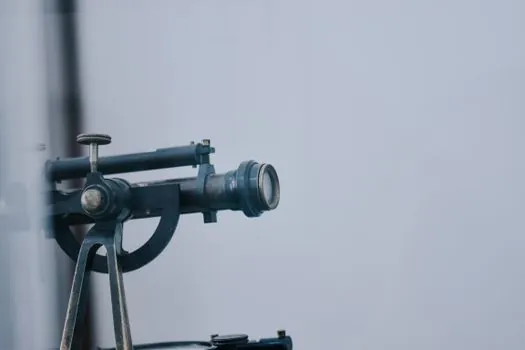
The comparison below uses four decision criteria that materially affect large-structure projects: coverage speed, geometric precision, exterior texture, and capture in poor light. [S2]
This comparison also prevents a category error: a laser tracker, a terrestrial laser scanner, and image-based photogrammetry are not interchangeable instruments. Their common output may be 3D coordinates or a point cloud, but their measurement principles and field economics differ [S1][S5].
Who Should Choose Each Measurement Method
Photogrammetry is for teams needing a rapid visual record, a textured exterior model, an earthwork dataset, or a construction progress overview rather than a tolerance-controlled mechanical inspection [S2][S3]. It also suits projects where the light commercial camera-and-software route is more accessible than scanner ownership [S4].
A laser tracker is the better fit when a limited set of critical dimensions must be measured with high confidence, such as component alignment, tooling checks, deformation points, or fit-up verification across a large structure. The related explanation of how laser trackers measure large parts in 3D details why target visibility and survey network layout determine the quality of that workflow.
A 3D scanner is more suitable than a laser tracker when the objective is dense surface capture across many visible surfaces rather than a limited set of precise reflective target points. Likewise, close-range photogrammetry can be considered for object-scale dimensional work, but it remains dependent on image overlap, texture, and controlled acquisition.
Field Conditions That Can Invalidate Either Method

Photogrammetry requires good light, enough overlap, and surfaces with visible texture; weak lighting, blur, lens distortion, featureless surfaces, and reflective materials can degrade the reconstruction [S2][S3][S5]. A drone also needs an unobstructed flight path and legally acceptable operating conditions, although no specific flight limit is established by the supplied research.
Laser measurement has its own failure modes. A tracker depends on visible targets, accurately located stations, line of sight, and registration between measurement sessions. A scanner must have adequate coverage from multiple positions to reveal hidden surfaces, and registered scans must be checked where occlusion, repetitive structure, or moving equipment affects the point cloud [S3].
Photogrammetry accuracy depends heavily on image quality, camera calibration, environmental conditions, and lighting, while laser scanning performs reliably in low-light conditions. Conversely, a bright, textured exterior is ideal for photogrammetry but may still be the wrong tool when a 10–50 mm aerial tolerance is insufficient for engineering decisions [S2][S5].
Budget, Data Products, and Hybrid Capture
Photogrammetry usually has the lower hardware-entry cost because it relies on a camera and processing software, while laser scanning carries higher equipment costs, particularly where scanner ownership is not justified [S4]. The laser tracker versus 3D scanner comparison provides a useful distinction between targeted coordinate measurement and dense surface capture.
The final deliverable can change the economic choice. Photogrammetry naturally produces color-rich point clouds, orthomosaics, and textured meshes, while active scanning is stronger for geometric detail and low-light coverage [S2][S3]. Neither method should be selected from acquisition speed alone, because control, processing, registration, and quality assurance determine whether the resulting dataset is fit for engineering use.
Hybrid capture is often the most defensible approach on large structures. Photogrammetry can cover the site envelope and exterior assets rapidly, while a tracker measures a smaller set of critical coordinates and a scanner captures dense geometry where required [S2][S5].
A practical selection test is to map every deliverable to its required accuracy, surface density, lighting condition, texture condition, and setup constraint. If the priority is broad outdoor coverage, colored records, earthworks, or progress monitoring, validate a photogrammetric dataset with suitable ground control before acceptance; if the priority is controlled dimensions or complex low-light geometry, specify laser measurement [S2][S3][S5].