A thermal imager measures the infrared radiation emitted by a target surface and converts that signal into a surface-temperature value, not a direct internal-temperature measurement.
The distinction matters in electrical inspection, predictive maintenance, process control, and human screening, where a surface hotspot, internal defect, or core-temperature estimate requires different evidence and measurement methods.
What infrared radiation reveals about a target
Thermal imaging is non-contact thermometry: the camera receives infrared radiation emitted by the target and estimates its surface temperature from the detected signal [S1]. The camera does not receive radiation from inside a component, penetrate the material, or reconstruct its hidden temperature distribution.
A practical thermal imager measures the radiation emitted by the outermost surface it can see. Reflected radiation from the surroundings and radiation transmitted through the optical path can also affect the result, so the instrument must be configured for the target material, viewing angle, distance, and operating range [S4].
That is why a thermal camera can find a hot bearing housing, an overheated cable connection, or a hot valve gland, but it cannot establish the temperature at the center of that bearing or inside the insulation. It reports what the camera sees at the surface and leaves the hidden condition to inference or another measurement method.
Why internal temperature cannot be read directly
Internal temperature is a heat-transfer condition inside a body, while infrared thermometry observes emitted radiation from the exposed surface. A hot core can remain hidden behind metal, concrete, insulation, skin, or packaging, and the observed surface may be cooler than the internal region because of conduction, convection, radiation, and thermal contact resistance. [S1]
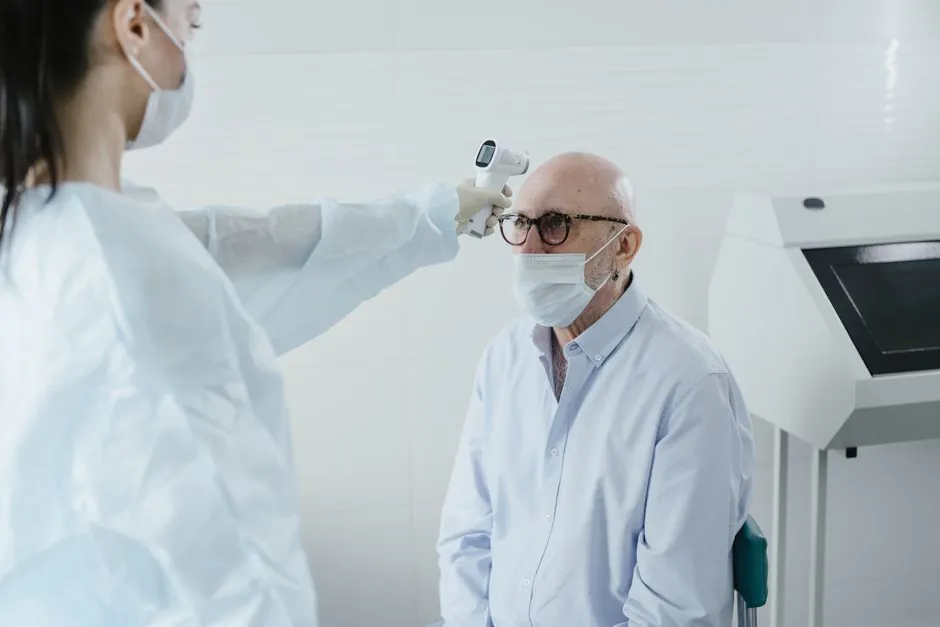
Human screening is a clear example. Non-contact infrared thermometry measures skin temperature at defined anatomical locations, and core temperature can only be assessed through an appropriate physiological relationship and operating procedure [S1]. The BIPM best-practice guide states: “The IR radiation emitted by skin can be used to determine the surface temperature of a human body,” while also warning that surface body temperature depends on several physiological and environmental factors [S4].
The same engineering distinction applies to machinery. If a motor winding is hot but its housing is only moderately warm, the camera measures the housing temperature. If a pipe is insulated, the camera measures the insulation surface, not the pipe-wall temperature. If a bearing is defective beneath a sealed housing, the thermal image may provide evidence of a developing anomaly but not an internal temperature value.
Surface versus internal measurement options

Thermal imaging, infrared thermometers, contact sensors, and embedded probes should be selected by the temperature quantity required, the access available, and the consequence of missing an internal defect. A comparison of the main options makes the engineering boundary clear. [S5]
Thermal cameras cover a broad field and reveal spatial variation, but each pixel represents a surface estimate. An infrared thermometer produces a simpler point measurement, yet it can miss critical features outside that spot [S2]. Contact sensors can be installed at defined internal or surface locations, while embedded probes provide a direct local value at the sensing point. The comparison below identifies the practical trade-off.
For an unknown internal condition, the defensible workflow is to use the thermal image to locate the anomaly, then use a contact measurement, radiometric inspection, or an equipment-specific condition model to determine what the surface observation means. A thermal camera should not be labeled an internal thermometer simply because the hotspot appears internally generated.
Measurement errors that can hide the real condition
Surface emissivity, reflected apparent temperature, distance, and viewing angle can all shift the indicated temperature. The BIPM guide treats influence quantities and measurement uncertainty as separate topics and includes field-of-view and size-of-source effects for human-temperature screening [S4]. These errors matter because a camera can display a stable number while the actual thermal condition differs substantially.
Spot devices also produce results that depend on the ratio of source size to spot size and on instrument angle [S1]. A thermal camera avoids the single-spot coverage limitation because its optics can cover a larger scene, and advanced-optics systems can detect temperatures accurately over greater distances than typical infrared thermometers [S5]. That does not turn the camera into a subsurface instrument; it changes how much surface it can map.
For equipment screening, keep camera geometry, emissivity setting, reflected-temperature setting, atmospheric effects, calibration status, and the condition of the surface under observation in the inspection record. If the coating is bare metal, oxidized, painted, wet, dusty, or wrapped, its emissivity can differ enough that identical internal faults produce different apparent surface temperatures.
Where thermal imaging works and where it fails

Thermal imagers can be used to perform traceable non-contact screening of human body temperature. Its advantage is coverage: an operator can scan many components at a safe distance and identify anomalous heat patterns before opening equipment. [S1]
It is not suited to assigning an unqualified internal temperature to a component whose interior is not visible. It also cannot reliably measure the temperature of the sun or open flame merely by pointing a standard long-wave infrared camera at them. Each camera has a specified measurement range, and the dominant radiation from the sun can lie outside the long-wave infrared passband or be blocked by sun-safety filtering [S3].
Flame temperature presents a related limitation because the wavelength carrying much of the flame energy must fall within the camera passband, and the instrument must be calibrated for that wavelength and temperature [S3]. A surface heated by a flame is easier to inspect because its temperature can fall within the camera range. This range and spectral-response discipline also applies to industrial cameras used for hot-surface inspection.
Core-temperature screening needs a complete method
A thermal image can support human core-temperature assessment, but only through a defined measurement model rather than direct imaging of the core. Screening devices should be used with a subject facing the camera, the face unobstructed, and a measurement position specified by the applicable method [S1]. Performance can fail when operator practices, asymptomatic cases, or device limitations are not distinguished.
Airport screening data illustrate why a surface-temperature screen cannot be treated as a diagnostic test: between 24 January and 17 February 2020, only 5.2% of 271 imported COVID-19 cases worldwide were detected through airport screening [S1]. The result reflects the combined limitations of skin-surface measurement, physiology, and screening operation, not a simple failure of infrared detection.
For traceable screening, calibration and use should be controlled as a system: emissivity treatment, field of view, size-of-source effect, ambient conditions, operator distance, anatomical site, and uncertainty all affect the result [S4]. A thermal image may estimate core temperature only when the device, target site, correction model, and procedure have been validated for that purpose.
Industrial interpretation and sourcing
The correct question is not “What is the internal temperature?” but “What surface observation is visible, and what internal condition does it support?” For a thermowell, the camera may reveal the external shell temperature while a temperature transmitter connected to an internal sensor provides the process value. For electrical joints, a thermographic hotspot may justify de-energized inspection rather than a claim about winding or conductor temperature. [S3]
When a single point matters, a spot infrared thermometer may be adequate if the target is large enough relative to the spot and alignment is controlled. When hotspots may be scattered across an assembly, a thermal imaging camera provides better spatial coverage. When temperature must be recorded continuously at a known location, a contact temperature sensor is usually more suitable.
Traceability also requires suitable calibration equipment, a defined measurement procedure, and an uncertainty statement. The BIPM guide dedicates sections to thermal-imager specifics, influence quantities, accuracy, uncertainty, calibration, test methods, and screening procedure, spanning a 21-page Version 2 document published in November 2021 [S4].
For any suspect internal condition, record the thermal image, radiometric values, surface condition, emissivity, distance, angle, ambient temperature, and equipment operating state, then corroborate the diagnosis with an appropriate contact, internal, or condition-based measurement. The thermal imager is a powerful surface-mapping tool, not a substitute for a sensor located inside the equipment.