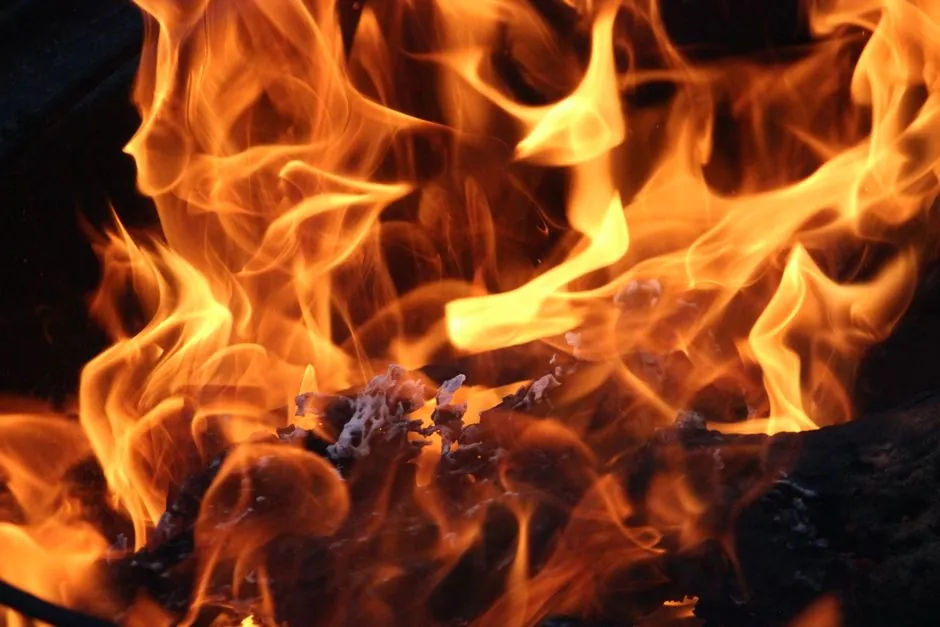
A thermal imager converts detected infrared radiation into temperature, so flame and hot gas are difficult to measure because their emission is not equivalent to that of a solid surface [S1].
The result depends on camera calibration, spectral band, target emissivity, atmospheric transmission, and whether the camera views a flame or a surface heated by it [S1][S2].
Radiation is not temperature
Infrared thermography is based on radiation emitted by an object, and the calculated temperature depends not only on measured radiation but also on internal camera calibration [S1]. Every object above absolute zero emits infrared radiation, while a thermal camera forms an image from that radiation and assigns displayed temperatures through its processing model [S1].
Infrared thermography is based on acquiring and processing infrared radiation emitted by objects, whose intensity is mainly a function of temperature.
The operating distinction is practical. A camera can measure a steel surface heated by a flame when the surface falls within the instrument’s temperature range, provided emissivity and optics are handled correctly. Measuring the flame temperature requires a camera whose passband covers the dominant flame emission and whose calibration is valid for that wavelength band and temperature range [S2].
Spectral band changes the result
A thermal camera has a specified spectral range, and a flame’s most energetic radiation may not fall inside that band [S2].
The thermal imaging camera wavelength ranges explained comparison separates detector sensitivity from the filtering choices that determine what reaches the sensor.
Spectral-band mismatch produces an error because the camera’s calibration and emissivity assumptions apply to the selected band, not to the entire thermal spectrum [S1][S2].
Emissivity changes the apparent temperature
Target emissivity has a significant effect on both emitted infrared intensity and temperature-measurement accuracy [S7]. For an opaque, diffuse surface, a mismatch between the emissivity entered into the camera and the surface’s actual emissivity changes the displayed temperature even when the detected signal is repeatable [S1].
Shiny metal is a common failure case because its low emissivity produces weak radiation and strong reflections of the surrounding environment. Applying high-emissivity tape to a low-emissivity surface can provide a more representative measurement target [S3]. The tape changes the surface condition at the measurement point, so it should be attached to the region of interest and remain within the camera’s calibration assumptions.
A flame itself does not provide a stable painted patch with known emissivity, which is one reason direct flame measurement is less controllable than surface measurement. The camera cannot distinguish all reflected and emitted contributions using a simple surface-temperature calculation. For combustion work, the target definition must state whether the requirement is flame peak temperature, gas temperature, or workpiece temperature.
Compare the measurement targets
Workpiece temperature, flame temperature, and gas temperature require different instruments and acceptance rules. The decisive criteria are the emitting medium, the camera band, calibration validity, and the physical quantity the process actually needs. [S1]
For gas analysis or composition, a gas analyzer or gas chromatograph addresses a different question. These instruments identify or quantify constituents rather than assigning a temperature to a luminous flame.
Where thermal imaging fits
Thermal imaging is well suited to non-contact inspection, two-dimensional heat-pattern comparison, and real-time scanning of stationary or moving targets [S1]. It can locate hot zones, compare relative surface temperatures, and verify heating uniformity when the surface condition and camera setup are controlled.
A temperature switch, temperature transmitter, or temperature recorder becomes more appropriate when the requirement is an alarm, a control-loop input, or a traceable temperature record from a defined sensor location. These devices do not remove the need to select the measurement method appropriate to the target.
Flame readings fail in identifiable ways
Three failure modes explain most inaccurate flame readings: band mismatch, emissivity assumptions, and an undefined target. Band mismatch occurs when the camera’s passband sees little of the dominant flame radiation [S2]. Emissivity errors arise when a low-emissivity metal or reflective component reflects a large share of the apparent signal [S3][S7].
Target ambiguity occurs when an operator labels a pixel as flame temperature even though it contains hot particles, gas radiation, or a heated background surface. Saturation adds a fourth failure mode by removing the intensity information needed for a valid temperature calculation. Calibration drift and viewing-angle changes can further affect repeatability because internal camera calibration participates in the conversion from radiation to temperature [S1].
Fire-service guidance goes further, treating thermal imaging cameras as unreliable thermometers for fire conditions and warning users not to equate a thermal image with a precise temperature measurement [S6]. That caution applies directly to industrial flame surveys: the image may reveal relative heat patterns, but the absolute temperature requires a defensible target and calibration.
Set up a defensible measurement
A defensible flame or heated-surface measurement starts by defining the quantity and location: surface temperature, flame radiation temperature, or gas temperature. Record the camera spectral range, calibration state, emissivity setting, target material, viewing distance, and atmospheric path before accepting the result [S1][S3].
For solid surfaces, use a known-emissivity reference and compare the camera reading with a contact or optical temperature standard at a controlled location. For flames, use a spectrally matched MWIR or SWIR instrument with calibration covering the expected temperature range, and account for filtering [S2]. For combustion gases, specify a method designed for the gas rather than inferring temperature from flame brightness.
Engineers selecting high-temperature equipment should treat the 650–2000 °C working range as a separate specification exercise, since wavelength response, saturation, calibration, and detector survivability must match the application. The practical answer is not that thermal imagers are universally inaccurate, but that they measure radiant energy under defined spectral and emissivity conditions, not flame or gas temperature by default.