
Warehouse buyers should anchor every wire rod order on four written-down parameters: steel grade family, finished diameter, surface and descaling state, and coil weight, because coil handling and rack loading inside a covered warehouse are governed by these four levers, not by mill brand.
Common diameter range for wire rod is 5.5–22 mm, with sizes between 5.5 and 13 mm being the most commonly used, and most warehouse-grade orders sit inside that 5.5–13 mm band because 5.5 mm coils stack efficiently on standard 1,000–1,500 kg coils and feed downstream cable wire drawing without an extra drawing pass [S5].
Diameter and Coil Weight: The Two Numbers That Set Warehouse Logistics
Carbon and certain alloy steel wire rod is defined as approximately round cross section, 5.00 mm or more, but less than 19.00 mm, in solid cross section, which is the same diameter window most mills stock for warehouse distribution [S1]. Going below 5.00 mm moves the product out of the wire rod classification and into the draw wire category, and a warehouse order below that floor will fail customs classification at port.
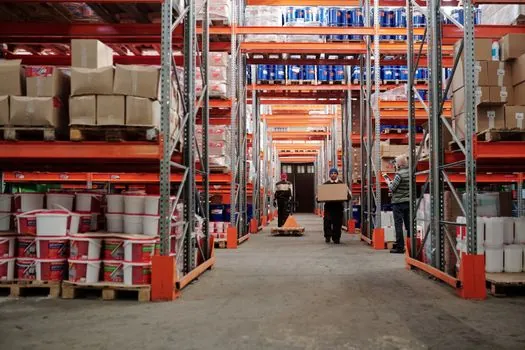
Inner coil diameter, outside diameter, and coil mass all matter for warehouse rack loading.
Buyers who need 1080 tire cord quality or higher-carbon tire bead grades must check the order note: the 2026 antidumping continuation notice explicitly enumerates 1080 tire cord, and the 5.00–19.00 mm scope, as the covered merchandise that warehouse importers must declare under the applicable HTS subheading [S2].
Grade Selection for Indoor Storage vs. Yard Storage
Indoor warehouse storage allows low-carbon AISI 1005–1018 rod for general downstream drawing, because the rod never sees standing water; the 0.06–0.20% C range gives clean cold-heading performance and weldability without a protective oil film beyond the standard mill-applied rust-preventative. [S4]
For warehouses with open yard bays or coastal humidity, the comparison shifts: low-carbon rod (C under 0.20%) corrodes visibly within 30–60 days even under tarp, while medium-carbon AISI 1030–1050 holds surface integrity longer but still needs an oiled or waxed surface. Specifying ASTM A510 grade with a verified rust-preventative film weight (typically 0.5–2.0 g/m²) is the documented control [S4].
High-carbon rod (AISI 1060–1080, 0.60–0.85% C) is harder to draw but is the only realistic warehouse pick when the destination is pre-stressed concrete wire, spring wire, or tire cord, and it is also the grade class most exposed to the active antidumping orders, which is why warehouse inventory managers should keep a copy of the 2026 continuation notice on file for customs audits [S2].
Surface, Descaling, and the Quality-Reject Rate
Three surface states are commonly offered to warehouses: hot-rolled and descaled (mechanical or acid pickling), hot-rolled black (un-descaled mill scale), and pre-coated with phosphate or soap for cold-heading. [S1]
Surface defects (seams, laps, slivers) are the single largest rejection cause at warehouse goods-in inspection. A typical acceptance gate is no defect deeper than 0.10 mm on rod below 8 mm, and no defect deeper than 0.15 mm on rod 8–13 mm, measured on a longitudinal ground sample; values outside that window drive the draw wire die wear rate up sharply.
Coil ovality and cast (camber) are the second gate: a coil with cast above 50 mm per metre will not feed an automated pay-off cleanly and the warehouse end-user will see tangles, which is why mill test certificates should report both ovality and helix height for every heat.
Antidumping and Import Duty Picture for US Warehouses
Active antidumping duty orders and a countervailing duty order on carbon and certain alloy steel wire rod from Brazil, Indonesia, Mexico, Moldova, and Trinidad and Tobago were continued on February 24, 2026, which means a US warehouse importing from those five origins must post cash deposits at the rate published in the Federal Register notice [S2].
Separate preliminary results on imports from Mexico were published on February 12, 2026, with the scope again set at 5.00 mm to less than 19.00 mm, in coils, of approximately round cross section, so the duty framework is symmetric across the five named countries rather than Mexico-specific [S1].
For warehouse buyers who want to skip the duty exposure entirely, domestic mill supply and imports from origins not on the continuation list are the two clean paths, but domestic mill lead time on non-standard diameters (under 5.5 mm or above 16 mm) commonly runs 8–14 weeks, which is the trade-off that pushes some warehouses back to imported rod with the duty factored into the landed cost model.
Decision Matrix: Which Wire Rod Goes Into a Warehouse Order
For a general-merchandise warehouse feeding a cable wire line, the default pick is AISI 1006–1018, 5.5–8.0 mm, descaled, 1,200 kg coil, with a mill test certificate per ASTM A510 and a documented rust-preventative film.
For a warehouse feeding pre-stressed concrete wire or spring wire, the pick shifts to AISI 1060–1080, 8.0–13.0 mm, in coils sized to the customer's pre-stressing bed; expect 2–4 week longer mill lead time and factor in the antidumping cash deposit if sourcing from Brazil, Indonesia, Mexico, Moldova, or Trinidad and Tobago [S2].
What Buyers Get Wrong, and the Traps to Avoid
Common misconception: treating 5.5 mm and 6.0 mm rod as interchangeable. [S1]
Common misconception: assuming "warehouse grade" is a real classification. It is not. The enforceable classifications are the AISI/SAE grade, the ASTM A510 / A510M standard, and the HTS subheading; the warehouse label is a logistics term, not a metallurgical one [S4].
For more on the renovation-side selection logic, see the parallel guide on wire rod selection for renovation projects, and for cold-storage-specific duty the cold-storage map is the natural companion piece.
Track these signals: any future Federal Register notice amending the rates for the five named origins, mill announcements on ASTM A510 revision work, and warehouse rack standardisation around 1,200 kg coils at 1,200 mm bay width, all of which will reset the cost-vs-density trade-off above.