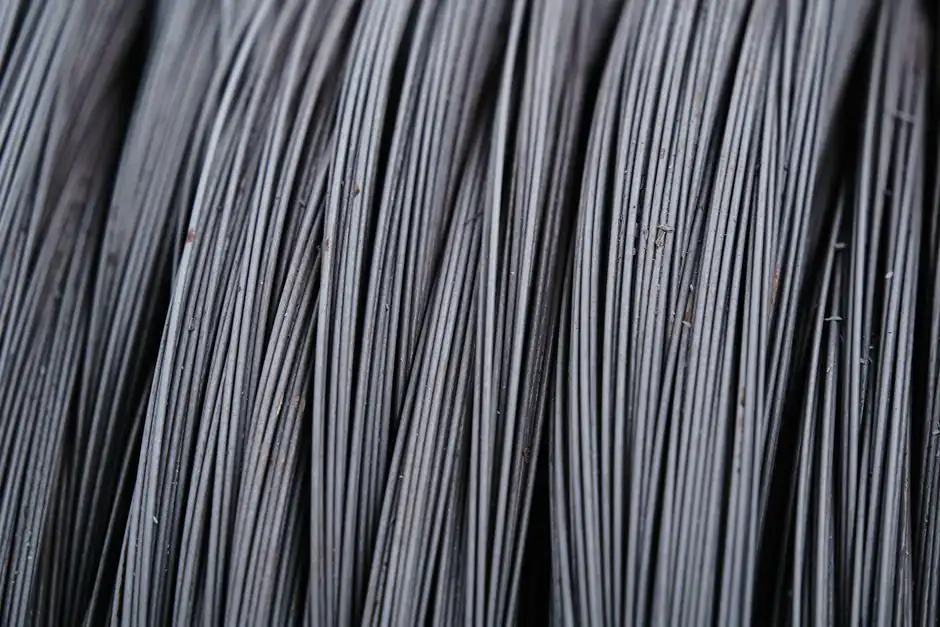
European rod mills including Elcowire now publish Low-Carbon Copper variants whose cradle-to-gate CO2 footprint is verified under ISO 14064-3 at roughly half the global standard-copper average, and that verified figure is appearing in hyperscaler RFP language for greenfield campus builds [S1].
Grade matrix: Cu-ETP, Cu-OF, Cu-DHP, and CuAg0.1
Where the rod feeds plating lines, magnet-wire enameling, or UHV-grade grounding hardware, Cu-OF (CW008A, UNS C10200) is specified, dropping residual oxygen below 10 ppm and trading roughly 1-2% IACS for a denser, void-free microstructure.
For building wiring behind the UPS, Cu-DHP (CW024A, UNS C12200) is the deoxidized alternative: phosphorus at 0.015-0.040% scavenges oxygen without the embrittlement risk, and the grade draws cleanly into 0.5-2.5 mm conductors used in cable harnesses. CuAg0.1 (CW013A, 0.08-0.12% Ag) is the soft-magnetic-adjacent choice for high-current busway, where the silver raise lifts creep resistance at sustained 80-100 °C busbar operating temperatures without measurably changing conductivity.
Diameter, temper, and mechanical targets
Standard data-center rod diameter is 8 mm for wire drawing into magnet and hookup wire, and 12.5 mm (or 14 mm in older mills) for busbar and grounding braid feedstock, both supplied in continuous coil weights of 4-5 metric tons [S1]. Elongation at break for the as-rolled (R200) temper typically lands at 30-40%, while the annealed (O60 / R220) temper reads 35-45%, depending on grain size. Tensile strength targets split cleanly: R200 (half-hard) at 200-240 MPa, R250 at 250-290 MPa, with the O-temper dropping below 220 MPa for deep-draw magnet wire.
Surface finish matters as much as bulk chemistry. A bright, scale-free surface (oxide thickness below 30 nm) is mandatory for continuous drawing to 0.10-0.30 mm enameled wire, because any copper-oxide pickup translates directly into enamel adhesion failures at 155-180 °C Class F/H insulation ratings. Out-of-round tolerance is held under 0.05 mm across the coil, since eccentricity greater than 0.1 mm drives die wear and frequent breaks on multi-wire drawing machines.
Conductivity, IACS, and the OFHC question
The IACS benchmark itself is fixed by the 1913 international annealed copper standard at 0.15328 Ω·g/m² for 100% conductivity, and modern rod lots from ISO 9001-audited mills routinely test at 101-102% IACS.
The honest engineering case for Cu-OF is hydrogen-sensitive brazing and UHV chamber hardware, not 400 V busway.
Low-carbon copper and ISO 14064-3 verification
Elcowire's Low-Carbon Copper product is reported with cradle-to-gate CO2 emissions at roughly 50% of the global standard-copper average, and that figure is verified against ISO 14064-3 principles using the GHG Protocol Product Life Cycle Accounting and Reporting Standard [S1]. The verification chain runs through a third-party auditor, with the resulting carbon footprint (CFP) and Product Carbon Footprint Declaration of Performance available per shipment.
Hyperscalers increasingly embed such verified CFPs into procurement scoring: a 1.5-2.0× price premium for verified low-carbon rod has been observed in EU data-center tenders where the buyer is bound by CSRD reporting, and the same premium is creeping into U.S. RFPs as Scope 3 supply-chain disclosures tighten. The win condition is that the carbon claim carries an audit trail, not just a marketing claim, and ISO 14064-3 with a published CFP is the current common-language format.
Quality gates, testing, and documentation
The mill test certificate (EN 10204 3.1) is the contractual artifact, and downstream cable makers refuse lots missing the 3.1 cert. [S1]
For more on how rod spec choices cascade into upstream furnace selection for downstream copper and brass products, the melting furnace selection map for hardware manufacturing walks through alloy-and-capacity gates that mirror the rod-maker's upstream decisions. Where rod is drawn into magnet wire and then wound into motors that drive data-center HVAC and UPS, a parallel thermowell cost guide covers the instrumentation side of the same plant.
Comparison: which rod grade fits which data-center use
For MV/LV power distribution and grounding: Cu-ETP (CW004A) at 8 mm, R200, 101% IACS minimum, EN 10204 3.1 cert; cost benchmark, lowest of the four. For busbar trunking in 1000-6300 A ratings: Cu-ETP at 12.5 mm, O60 temper for forming plus age-hardenable CuAg0.1 for creep-critical sections; cost benchmark, 1.05-1.10× ETP baseline. For hydrogen-sensitive brazed joints and UHV-instrumented halls: Cu-OF (CW008A) at 8 mm, O60; cost benchmark, 1.15-1.25× ETP baseline. For halogen-free building wire behind the UPS room: Cu-DHP (CW024A) at 8 mm, R220; cost benchmark, near-parity with Cu-ETP.
The decision pivots on three numbers: required conductivity, hydrogen-embrittlement risk during downstream processing, and whether the buyer can claim a verified low-carbon footprint under ISO 14064-3. Wire rod basics, including the difference between continuous-cast bar and hot-rolled rod feedstock, are catalogued on the wire rod encyclopedia page; downstream cable and wire selection and pressure transmitter pairing for the rod-mill instrumentation round out the spec chain. Next signal to watch: IEC 60228 revision commentary on conductor resistance tolerances, and any CSRD-driven update to the GHG-Protocol Product Standard's CFP addendum that would re-anchor the "low-carbon copper" benchmark.