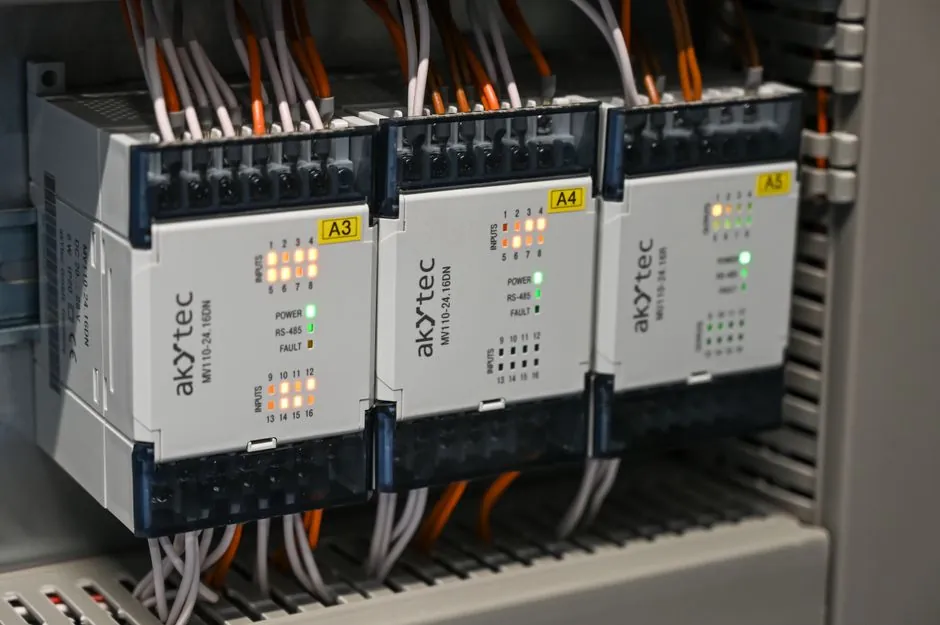
Wireless systems offer flexible, faster installation with minimal disruption and are especially useful in heritage buildings, hospitals, hotels, schools, and large commercial facilities where running new cables is difficult or undesirable [S1].
The correct fire alarm control panel architecture depends on device count, radio coverage, battery maintenance capacity, notification circuits, and whether one network must combine wired and wireless devices [S2][S4].
Architecture Options and Integration Boundary
A standard fire alarm system includes a fire alarm control panel, initiating devices, audible and visual devices, a power supply, and control relays and interface modules [S3].
Wireless systems replace the physical detection circuit with radio-frequency communication. A wireless installation still requires a central panel and an RF receiving path: one installation arrangement uses a router to receive transmissions from devices and a hard-wired connection from that router to the control panel [S7].
A hybrid system combines both communication methods within one fire alarm network. This is the practical choice when a building has an established wired backbone but extensions cross occupied spaces, historic fabric, temporary structures, or areas where conduit would create excessive disruption [S1][S2]. Wireless devices can therefore coexist with wired loops on a compatible fire alarm control panel, but device, radio, and protocol compatibility must be confirmed before procurement.
The comparison below is the core engineering distinction:
Reliability, Coverage, and Failure Modes
Wired and wireless systems have different failure signatures: wired reliability depends on cable and power continuity, while wireless reliability depends on RF coverage, interference resistance, battery condition, and communication protocol robustness [S2].
Wireless devices use radio-frequency signals to communicate with a central control panel [S4]. That redundancy does not remove the need for site survey, device placement discipline, and routine battery checks.
Physical connection remains a major operational advantage in large wired installations because it provides a direct signal and power path that does not depend on radio propagation. The principal wired weaknesses are mechanical damage, corrosion, voltage drop, and interference [S2][S5].
Wireless detectors face RF attenuation and crowded radio environments [S2].
One engineering-review document frames the reliability objective as 99.9% operational availability and response below 3 seconds from detection to alarm activation for either connectivity method [S2]. Treat that as a project-review target, not as a substitute for jurisdictional approval, a verified cause-and-effect matrix, or manufacturer-specific performance data.
Installation, Service Life, and Operating Cost

Wireless systems offer faster installation, although their equipment costs more and installation costs less [S5]. The relevant installed-cost comparison must include conduit, cable, termination, access scaffolding, ceiling work, and commissioning, not detector purchase price alone.
Battery service is the main lifetime penalty of wireless devices. Field discussion records identify repeated battery inspection and replacement as laborious work, particularly when hundreds of ceiling-mounted devices must be accessed [S5]. A permanent wireless installation therefore needs a documented battery replacement interval, stock strategy, access plan, and competent maintenance route.
Wireless does not make the whole building cable-free. Horns and strobes can still require hard-wired notification circuits, while the receiver or router path to the panel also requires a wired connection [S7][S8]. The comparison therefore belongs at the device and circuit level: wireless can remove detection-device cable without removing all notification, power, or control wiring.
Device Selection by Building Type
Wireless detection fits retrofits, heritage buildings, temporary structures, and smaller facilities where installation speed, low physical disruption, scalability, and total cost of ownership outweigh the established reliability advantage of wired systems [S2].
Wired loops are the stronger baseline for large commercial, industrial, healthcare, data-center, and critical infrastructure projects because they retain a physical connection and avoid routine battery replacement across every initiating device [S2][S5].
A hybrid layout is the correct recommendation when new work must interface with an existing fire alarm installation, provided the panel supports the required wired loop and wireless protocol. A hybrid approach is also sensible when wired circuits already serve principal building areas and wireless devices extend coverage into an annex or heritage section [S1].
For a smoke detector or heat detector, the communication choice does not remove the need to select the appropriate initiating-device type for the hazard. Temperature rise, smoke characteristics, ambient conditions, and the approved cause-and-effect arrangement determine device suitability; radio communication only changes how the device reports and receives instructions.
Interoperability, Notification, and External Interfaces
Wireless integration requires more than attaching a detector to an antenna. The control panel, radio communication protocol, frequency band, mesh or repeater arrangement, device addressing, supervision behavior, and approved installation instructions must form one compatible system [S1][S2].
Wireless systems can be integrated into monitored fire alarm services and can support building-management or IoT interfaces, but external control points still require an engineered interface and tested cause-and-effect logic [S1][S4]. The panel also provides relays or interface modules for functions such as HVAC shutdown, elevator recall, door release, and fire-suppression interface [S3].
Notification design must be reviewed independently from initiating-device communications. Audible and visual appliances include horns, strobes, bells, and voice systems [S3]. If notification appliances remain wired, the project has a mixed system even when all detection devices are wireless. This arrangement is common and valid, but the designer must not describe it as a completely wireless fire alarm system.
Do not assume that a panel with an RS-485 port, a relay, or a building-management gateway supports any wireless device presented for approval. The procurement package should define the exact interface and supported device family, then require proof of operation through the normal alarm, fault, supervision, and restoration sequences.
Standards and Acceptance Basis
Wireless fire alarm systems require the same core life-safety functions as wired systems: fire detection, occupant notification, fault supervision, and communication to the monitoring station [S1][S4]. The governing standard set depends on jurisdiction, occupancy, system type, and the products being installed.
NFPA 72 addresses wireless fire alarm networks in the United States, including mesh topology, repeaters, supervision, and timing performance. EN 54-25 covers wireless fire alarm components in Europe, including RF immunity, encryption, and battery performance. BS 5839-1 provides UK design and installation guidance, while UL 268 and UL 864 address listed fire alarm equipment in North America [S1].
These standards do not make every panel and wireless device automatically compatible. Acceptance must rest on the listed or approved configuration, jurisdiction-specific requirements, installation instructions, system acceptance testing, and the completed cause-and-effect matrix. For circuit supervision and fault visibility, the design requirements in Supervised Fire Alarm Circuit Wiring for Open and Short Detection should be reviewed alongside the wireless device acceptance procedure.
The procurement decision is straightforward: specify wired loops for large, critical, service-intensive installations; specify wireless for low-disruption retrofits, temporary areas, and small isolated extensions; specify hybrid when existing wired infrastructure and wireless coverage must operate as one supervised system.