
Select wired vibration sensors for critical, complex, or high-capital-value machinery requiring high-speed surveillance or simultaneous acquisition, and select wireless sensors for fast installation, flexibility, and low infrastructure cost in retrofits, remote assets, ships, and awkward locations [S4].
The practical distinction is measurement architecture: wired systems feed permanent sensors to a central analyser, while wireless systems transmit measurements through gateways, with deployment mode and duty cycle determining data continuity [S1][S2].
Decision criteria for sensor architecture
Choose the architecture from the diagnostic duty, not from wireless convenience. The choice between wired and wireless vibration sensors depends on factors such as the sensing technology used and whether data acquisition is continuous or based on time-based duty cycling [S1]. Wireless systems commonly use periodic or event-triggered measurements, reducing power demand and allowing larger deployments, but intermittent sampling can miss short events [S1].
A wired installation is appropriate for critical machinery, permanent protection, simultaneous acquisition, and analysis that requires FFT resolution sufficient for root-cause assessment [S2][S3]. A wireless installation fits assets without accessible wiring ports, facilities where conduit would be impractical, and programs requiring coverage of many machines without major installation projects [S2][S5].
The governing comparison is therefore: wired offers continuous data and permanent power but requires cable infrastructure; wireless offers rapid deployment and manageable scaling but introduces battery life, radio range, and duty-cycle decisions [S5]. These differences determine whether the condition monitoring system is intended for detailed diagnosis or broad screening.
Data continuity, bandwidth, and fault detection
Wired systems outperform wireless options when transient capture and high-frequency diagnosis control the outcome [S1][S3].
Data-acquisition strategies include continuous measurement and time-based duty-cycled measurement [S1]. Wireless vibration sensors send readings over a short-range radio link, commonly Bluetooth Low Energy (BLE), to a gateway [S4]. That five-year figure is conditional on duty cycle, not a universal service life, and the cited source separately identifies battery exchanges as an application requirement [S3][S4].
Neither architecture alone guarantees accurate diagnosis. Wireless online systems must carry enough data for spectra and FFTs with sufficient line resolution for root-cause assessment; wireless frequency, transmission time, and measurement interval directly constrain battery life [S3]. For sensors, the detailed selection logic behind choosing an accelerometer by mV/g sensitivity remains applicable because bandwidth, sensitivity, mounting, and dynamic response can outweigh the link medium.
Sensor technology and environmental fit
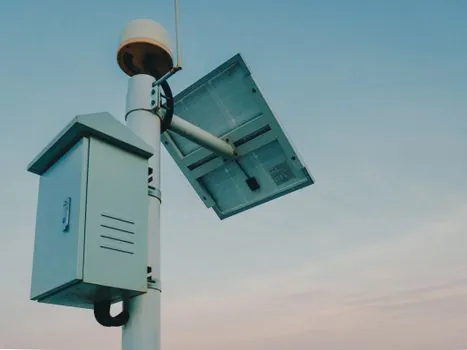
Wireless sensors are often built around MEMS devices because compact construction and low power consumption suit duty-cycled deployment; their performance can be limited at higher frequencies [S1]. Wired sensors commonly use piezoelectric IEPE or charge-output technology, which supports accurate high-frequency measurement where continuous acquisition is required [S1]. These are architectural tendencies, not exclusive rules, and sensor selection must follow the vibration band and diagnostic objective [S1][S7].
Temperature, speed, and radio environment can change the selection. Wired sensors are identified as suitable for extreme-temperature conditions and very low-speed assets because the physical connection supports stable data transmission [S6]. Power requirements should be matched to user expectations and the condition-monitoring application, while data throughput and measurement intervals affect power requirements such as battery life [S3].
For very low rotational speeds, vibration acceleration may not be the strongest diagnostic signal. The comparison with acoustic emission for slow-speed bearing monitoring should be completed before specifying either architecture, because the preferred transducer and frequency band can determine whether the wireless power budget remains workable [S6].
Installation, operating cost, and maintenance burden
Wired deployment has a higher installation burden because it requires conduit, cable pulls, terminations, and sometimes equipment modification, while adding each new measurement point requires another cable route [S5]. Wireless deployment reduces that civil and electrical work, but adds sensor mounting, battery installation or power tapping, gateway placement, firmware maintenance, and radio-environment monitoring [S5].
Those figures should not be treated as a complete installed-cost estimate because they do not establish identical sensor performance, channel counts, cabling distance, gateway requirements, or commissioning scope.
Wireless normally wins for a broad retrofit because its hardware can be mounted externally without internal machine access, while the cited system supports data intervals ranging from minutes to continuous operation [S5]. Wired wins where cable infrastructure already exists, permanent power removes battery servicing, and continuous streaming is already part of the protection architecture [S2]. The financial decision must compare total life-cycle burden, not sensor sticker price alone.
Security, reliability, and system integration
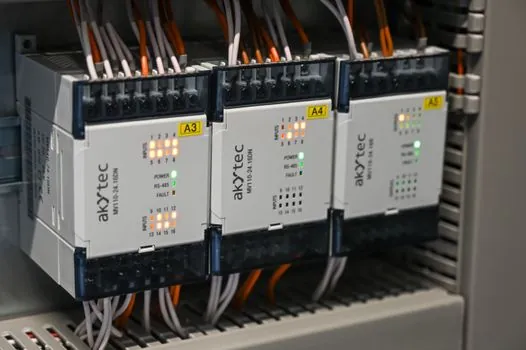
Wired systems provide a stable path for permanent data transport, while wireless depends on radio coverage, interference control, and frequency planning [S3][S5]. The cited comparison rates wired interference risk as low electrical risk with a greater exposure to mechanical cable damage, and wireless interference risk as moderate [S5]. Neither statement removes the need for installation quality: cable integrity, connector corrosion, junction boxes, and grounding can affect wired signal integrity [S3][S5].
Wireless equipment must also comply with local radio rules. In the United States, the cited application note identifies FCC requirements and recommends involving the end user's IT department during architecture selection [S3]. For wired data acquisition, the monitoring terminal must support the required channel count and signal conditioning; for wireless installations, gateway placement and radio survey become part of the measurement acceptance test [S3][S4].
Integration should follow the maintenance decision. Wireless gateways can feed alerts into SCADA, PLC, CMMS, email, or SMS workflows, but continuous acquisition is not required to provide that connectivity [S2]. Conversely, an online vibration analyzer is justified when the specification requires continuous data, FFT-based diagnosis, or simultaneous acquisition, because that is where wired throughput provides the clearest technical advantage [S1][S4].
Application-specific selection and procurement checks
Specify wireless where deployment speed, asset distribution, and low civil work dominate the business case. Specify wired where machine criticality, high-frequency transients, simultaneous channels, existing cable infrastructure, or permanent protection dominate the business case [S2][S4]. A mixed architecture is often the lowest-risk portfolio: wired systems on critical assets and wireless sensors on distributed or difficult-to-reach assets [S2][S4].
The comparison in procurement terms is clear. Wireless lowers installation disruption and scales across many assets, while wireless data frequency is configurable from minutes to continuous and maintenance shifts toward batteries and gateways. Wired installation is high complexity and expansion is difficult, while continuous streaming is possible and maintenance shifts toward cable integrity and terminations [S5].
Issue the purchase order only after defining measurement points, required bandwidth, acceptable event gaps, power source, radio range, environmental ratings, data destinations, and service intervals [S1][S3]. Confirm whether the proposed vibration sensor actually meets the fault frequencies and amplitude range, then verify battery duration under the specified collection interval rather than accepting a headline lifetime.
Use a wired signal-quality and installation check for permanent channels, and conduct an RF survey with the intended wireless system at the final measurement locations [S3]. Track three acceptance signals: continuous coverage without missing data for wired channels, measured radio availability at every point for wireless channels, and maintenance effort per asset after the first full battery or inspection cycle.