Working height on an aerial work truck is defined as platform height plus the assumed operator reach, typically 2 m, so a 18 m platform is quoted as 20 m of working height [S4]. Horizontal reach is the maximum straight-line distance the platform edge can extend from the boom's pivot, and the two figures are not proportional: a 26 m telescopic boom is commonly paired with only ~22 m of horizontal outreach [S4].
For bucket trucks, side reach is materially shorter: most light-duty units stop at 15-25 ft (4.6-7.6 m) of horizontal reach, while heavier aerial devices can extend 30 ft (~9.1 m) or more [S3]. Telephoto-class boom lifts cover the opposite end of the spectrum, with working heights up to 18-32 m matched to horizontal reaches of 10-20 m for typical truck-mounted configurations [S5].
How the Two Numbers Are Measured and Why They Diverge
Working height is a notional figure: OEM guidance for telescopic booms adds 2 m to platform height to account for a standing operator's upward reach [S4]. Horizontal reach is an actual geometric measurement from the boom's slewing axis to the platform edge at rated load, and it falls as the boom is raised, which is why reach charts plot outreach on the X axis against platform height on the Y axis [S7].
The divergence between the two metrics is structural. A bucket truck's boom is mounted on a road-going chassis with limited counterweight and tail-swing constraints, which physically caps side reach at the values cited above [S3]. A self-propelled telescopic boom lift sits on a wider, heavier carrier with outriggers, so it can push 22 m of outreach from a 26 m tower without tipping [S4]. Engineers reading a single brochure number should always treat working height and horizontal reach as independent variables, never as a 1:1 ratio.
Bucket Truck vs Boom Lift: Reach Profile by Class
Light-duty bucket trucks are built for roadside and overhead utility work where the work zone sits within a few metres of the vehicle; their reach profile tops out near 7.6 m horizontal, paired with platform heights of roughly 9-14 m [S3]. Mid-range telescopic bucket trucks ("squirt booms" or "stick booms") sacrifice articulation to gain horizontal reach, useful in limited-access areas [S2].
Articulating-telescopic bucket trucks add a knuckle joint to the stick, giving higher side reach at elevation while reducing tail swing on the opposite side of the truck [S2]. Overcenter variants push the platform beyond the truck's centreline, which extends side reach for forestry, utility, and construction work [S2]. Truck-mounted aerial work platforms in the export-build category cluster at 18-32 m working height, 10-20 m horizontal reach, and 200-400 kg platform capacity [S5].
Selection Criteria: Height, Reach, Terrain, and Mobility
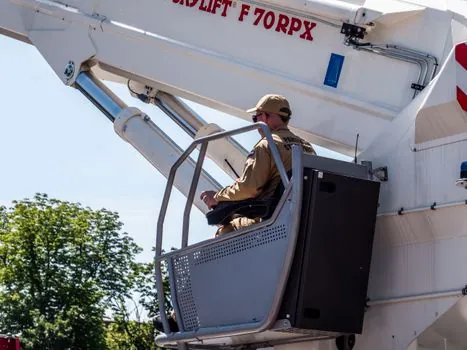
Four criteria drive the bucket truck vs boom lift decision: working height, horizontal reach, terrain capability, and site-to-site mobility. Boom lifts win on the first three, with some models reaching 180 ft (~55 m) of platform height and four-wheel-drive rough-terrain carriers for uneven ground [S1]. Bucket trucks win on the fourth, because the unit drives itself to the job under its own power at highway speed, no trailer or lowboy required [S1].
For obstacle-laden work, articulating booms bend at multiple joints to reach up, over, and around obstructions; telescopic booms extend straight out for maximum straight-line reach [S1]. For utility pole work and other linear right-of-way tasks, the standard bucket truck configuration with 4.6-7.6 m of side reach and a dielectric-rated boom typically beats a self-propelled boom lift on cost-per-job, because the truck chassis carries both crew and tools to the pole in one move [S3].
Who It Is For, and Who It Is Not For
Bucket trucks are built for utility linework, telecom, signage, streetlight service, and forestry crews who work directly above or immediately adjacent to the truck's parking position [S1]. Their limited horizontal reach restricts them to work areas above or closely adjacent to the vehicle, so they underperform on any task requiring the platform to clear a building edge, river, or setback [S1].
Telescopic boom lifts are built for industrial construction, bridge inspection, shipyard work, and high-rise facade access where both working height and horizontal outreach must clear obstacles [S4]. They are not the right tool for short-duration roadside calls, because mobilisation cost (trailer, escort vehicle, setup time) erases the productivity gain [S1]. Articulating booms are the right answer when the work point sits behind a fixed obstacle that a straight arm cannot clear, even at full extension.
Use Cases Mapped to Reach Class
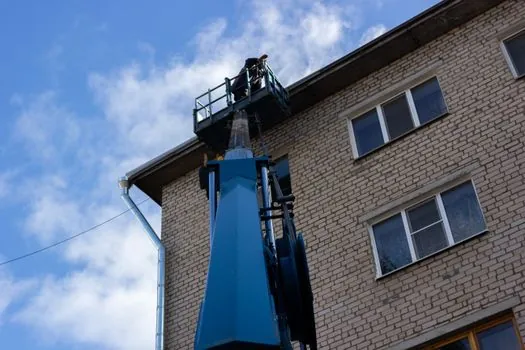
Telecom and streetlight maintenance typically needs 9-14 m of working height and under 7.6 m of side reach, the light-duty bucket truck envelope [S3]. Distribution-line utility work pushes into the 14-20 m working height band with 7.6-9.1 m of side reach, which is the articulating-telescopic or overcenter bucket truck class [S2][S3].
Building facade access and industrial plant turnaround work move into 18-32 m working height with 10-20 m horizontal reach, the truck-mounted aerial work platform range commonly exported for municipal and industrial service [S5]. Bridge inspection and shipyard work usually require a self-propelled telescopic boom, because the carrier must traverse uneven ground that a road-going truck chassis cannot handle [S1][S4].
Limitations, Failure Modes, and Sourcing Standards
Every reach number on a data plate assumes level ground, full outrigger deployment, and rated platform load; on a slope or with outriggers on soft ground, horizontal reach drops, and tip-over becomes the dominant failure mode [S4][S5]. Working height assumes a 2 m operator reach, so the actual platform floor sits 2 m below the quoted working height, a frequent source of under-spec'd platform selection [S4].
Compliance anchor points for this equipment class are ANSI A92.2 (vehicle-mounted aerial devices) and EN 280 (mobile elevating work platforms), both routinely cited in OEM selection guides for export buyers [S5]. For utility work near energised conductors, dielectric boom ratings and the corresponding test voltage on the boom insulation liner are the additional spec layer that decides whether a given bucket truck is legal for the line voltage on the job. For a deeper look at how reach classes line up against weekly rental cost in 2026, see Aerial Work Platform Weekly Rental Rate by Working Height: 2026 Benchmarks.
Component-Level Reach Behaviour
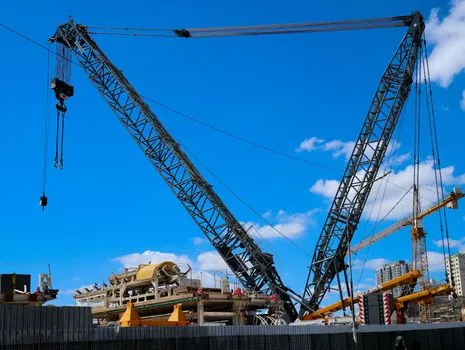
On truck-mounted booms, the aerial work truck chassis dictates tail swing and outrigger spread, which together set the worst-case horizontal reach at full elevation; the aerial work platform basket itself caps payload at 200-400 kg, and exceeding that limit derates both height and reach on the OEM load chart [S5].
The truck-mounted crane family shares slewing-axis geometry with the bucket truck but trades platform capacity for hook load, and its rated charts follow the same outreach-vs-height collapse curve that governs reach selection on an aerial device [S7]. When evaluating a used unit, the published horizontal reach is only valid at one specific boom angle on the chart, and any other angle gives a lower number that the OEM load chart will confirm.