Weekly aerial work platform rental rates in 2026 span roughly $310 to $2,400 per week across the common height classes, with a 13' slab electric scissor lift posting $310/week and a 40' electric scissor reaching $800–$1,250/week at Seattle metro benchmarks [S2][S3].
The dominant cost driver is platform working height, followed by power type (electric slab vs rough-terrain), deck width, and mobilization; national fleets (United Rentals, Sunbelt, Herc) and regional yards (Star, BigRentz) typically post daily rates between $205 and $230 for mid-range 26'–32' scissor classes in the Seattle window-installation market [S3]. For a deeper look at how each meter of working height translates to dollars, see the cost-driver breakdown per meter.
13'–19' Slab Electric Scissor Class: $310–$520 per Week
Compact indoor scissor lifts are the cheapest band on the rate card: a 13' slab electric scissor rents for $310/week and $440 per 4-week period, while the 13' micro electric variant is $320/week and $480/4 weeks at SitePro Rentals [S2]. The 15' vertical mast single-man lift lists at $400/week and $675/4 weeks, and the 15' all-electric vertical mast (hydraulic-fluid-free design) at $350/week and $550/4 weeks [S2]. A 19' slab electric scissor runs $350/week and $520/4 weeks, with the 19' all-electric version sitting in the same band [S2].
Seattle 2026 planning ranges for the 19' class land at $380–$520/week and $700–$950 per 4-week period, and the aerial work platform category is the entry-level spec for interior glazing, warehouse fit-out, and low-ceiling maintenance where doorway clearance is the binding constraint [S3]. Most units in this height class run on AGM batteries, fit standard 36"–48" door openings, and carry a 500 lb platform capacity rated for 2-person indoor use [S2].
26'–32' Electric Scissor Class: $430–$1,600 per Week
The mid-height working band is where most commercial construction and window-installation demand concentrates. A 26' electric narrow scissor lists at $430–$650/week and $850–$1,250 per 4 weeks in Seattle 2026 benchmarks; the 32' electric class steps up to $500–$750/week and $1,050–$1,600 per 4 weeks [S3]. SitePro's own card for 26'–32' class slab electric scissors falls inside these envelopes, confirming the national-fleet pricing is broadly consistent with regional yards [S2].
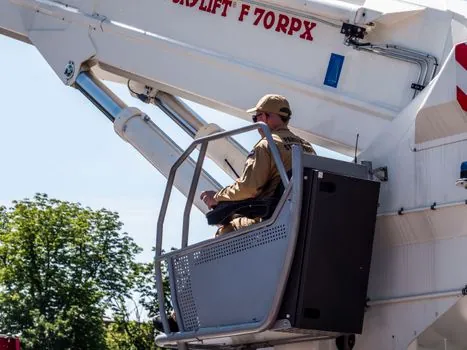
Vendor daily rate cards in the Seattle metro show United Rentals at $230/day and $690/week, Sunbelt at $225/$675, Herc at $220/$660, and the regional Star Rentals at $210/$630, with BigRentz at $205/$615 [S3]. These figures exclude taxes, damage waiver (12% allowance is typical in Seattle), and the delivery/pick-up pair which runs $600 allowance in the CBD on AM-window scheduling [S3]. The aerial work truck class overlaps at the lower end of this band for bucket-truck applications up to about 40' working height.
40'+ Scissor and Telescopic Boom: $800–$2,400+ per Week
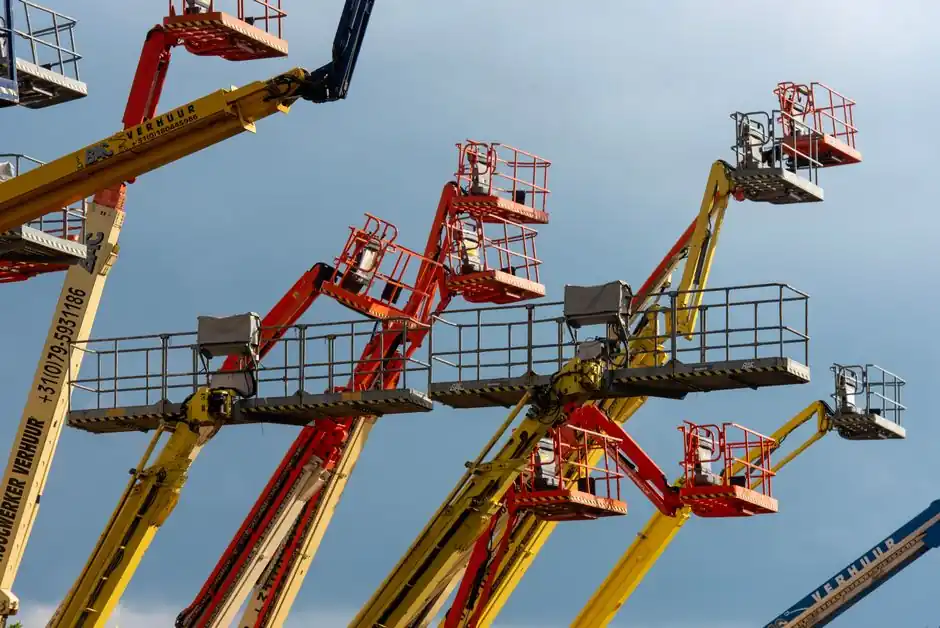
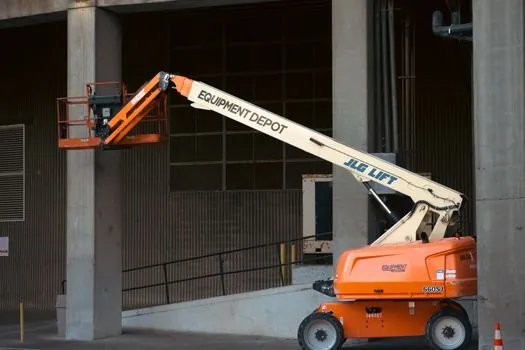
At 40' working height, the 2026 Seattle benchmark is $800–$1,250/week and $1,650–$2,400 per 4 weeks, with the band widening because availability thins and mobilization weight steps up materially [S3]. Above 40', the unit transitions to a boom lift: small articulating booms run roughly $300–$700/day (about $900–$2,100/week) and large telescopic booms exceed $1,000/day (about $3,000+/week) for high-rise construction [S4].
SitePro's fleet reaches up to 185' platform height for straight boom lifts, and the cost band continues to scale with outreach and platform capacity [S2]. My-Forklift's 2025 reference data confirms the $100–$300/day range for small electric units and the $200–$500/day range for medium scissors, with weekly discounts typically equivalent to 5–6 daily rates [S4]. For wind-sensitive work in this height range, the 28 mph design vs 20 mph OSHA trigger reference dictates when operations have to stop, which is a real scheduling risk that should be priced into longer boom rentals.
Weekly Discount Mechanics and Duration Pricing
Most US rental providers structure the discount curve so that one billed week equals approximately 5–6 daily rates, and a 4-week "month" typically prices between 2.5 and 3.0 single weeks rather than four [S3][S4]. Concrete examples from SitePro: the 13' slab scissor drops from $175/day to $310/week (1.77× daily rate) and $440/4 weeks (0.63× weekly rate); the 15' vertical mast single-man lift goes $222/day, $400/week (1.80× daily), $675/4 weeks (0.59× weekly) [S2].
The implication for project planners: any job exceeding 4–5 working days is almost always cheaper on the weekly card, and any job crossing the 3-week mark should be quoted on the 4-week rate plus a day-rate tail rather than stacked weeks [S3]. United Rentals' marketplace similarly groups scissor, boom, and single-man lifts into searchable categories, and Herc Rentals lists MEWPs as a parallel category for any application [S1][S7]. For projects that involve frequent repositioning, the drive-while-elevated speed limits reference constrains how fast a given class can be moved between set points, which feeds directly into the day-count.
Cost Adders: Mobilization, Damage Waiver, After-Hours
Base machine rate is only one of three budget layers; mobilization and jobsite-driven adders routinely add 30–60% to the headline figure. Seattle 2026 reference points note that mobilization covers delivery and pick-up, damage waiver and rental protection are jobsite-driven adders, and after-hours access is among the ancillary surcharges in the Seattle metro market [S3].
Floor protection mats, cleaning fees, and off-rent timing (early returns, late returns beyond the grace window) are the other common line items that flip a competitive quote into a painful one [S3]. For indoor work on finished slabs, the suspended platform class is the cheaper alternative only when the building has permanent davits installed; otherwise the slab scissor remains the default. My-Forklift's 2025 guidance also flags operator services and insurance as common inclusions to confirm before signing [S4].
Selection Criteria: Height Class vs Drive Configuration
Pick the smallest working height that clears the tallest task plus 1–2 m of overhead reach margin, then choose drive configuration by surface. A 19'–26' electric slab scissor is the right default for interior storefront glazing, warehouse fit-out, and any work on finished concrete; rough-terrain (RT) scissors (4WD, larger tires, higher ground clearance) are required for uneven grades, soft subgrade, or sloped approaches common in Seattle hillside work [S3].
Boom lifts (articulating or telescopic) are mandatory when the work envelope requires outreach beyond the scissor's vertical-only travel or when ground footprint constraints prevent scissor setup. A quick comparison: 13'–19' slab scissor at $310–$520/week suits interior work and fits standard doors; 26'–32' electric at $430–$1,600/week covers most retail and light-industrial envelope; 40' scissor at $800–$2,400/week handles taller curtainwall and atrium work; articulating/telescopic boom from $900/week up to $3,000+/week covers high-rise envelope and outreach work [S2][S3][S4]. For a side-by-side energy-cost comparison across machines with motors and hydraulics, the industrial filter TCO logic framework applies analogously to drive-train efficiency over the rental term.
2026 Trackable Signals for Rental Rate Movements

Watch Seattle metro weekly rate bands for the 40' class (currently $800–$1,250/week with the widest spread of any height band) for any tightening past $1,400/week, which would signal fleet contraction at the top of the scissor range [S3]. A second signal: the day-to-week ratio at the major national fleets; if any of United Rentals, Sunbelt, or Herc push the 26'–32' class above $250/day or $750/week sustained, that indicates regional capacity pressure worth re-quoting [S3]. A third, lower-frequency signal is the appearance of new electric scissor SKUs at the 19' class with hydraulic-fluid-free "all-electric" branding, which SitePro already lists at parity pricing ($350/week) with the hydraulic equivalent [S2].