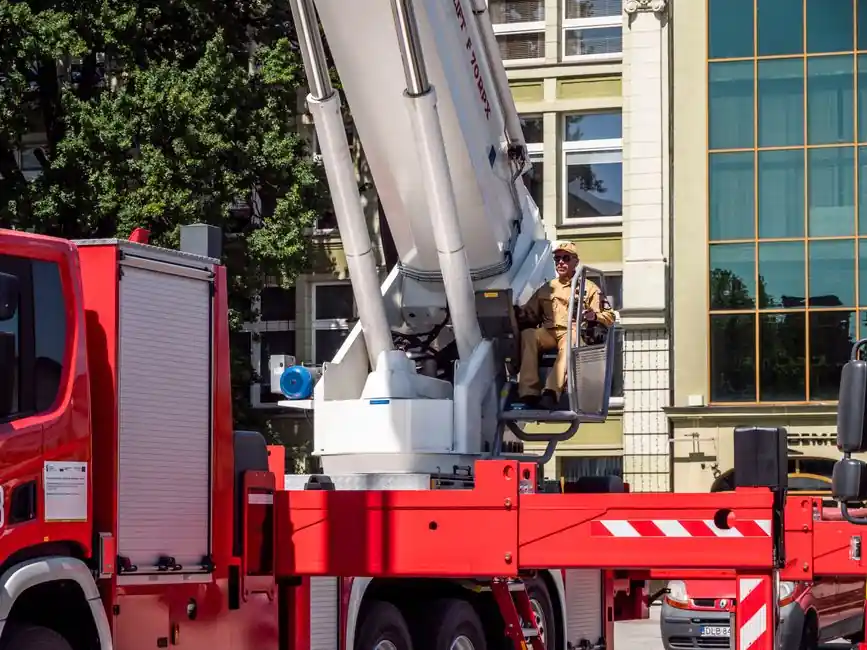
An A-frame outrigger is an out-and-down jack that typically protrudes only a couple of feet from the side of the chassis and deploys at a downward angle; an H-style outrigger rides a horizontal beam out and then drops to the ground, with industry spans reported from 12 to 19 ft or greater [S1][S2][S4].
The two geometries trade footprint for tip-load capacity, and the choice cascades into body length, compartment volume, grade capability, and how close the boom can rotate to a curb. This is a structural spec decision, not a marketing preference, and it is made before the first weld is burned on the aerial work platform subframe.
Geometry and where each style mounts on the chassis
The A-frame stabilizer (sometimes called the X style) extends outward at a downward angle from a fixed pivot point near the frame rail, with the jack beam usually protruding only a couple of feet beyond the body side [S1][S2]. Because the leg reaches out and down on a fixed angle, its ground footprint is small and it is fast to deploy, which is why A-frames dominate on smaller elevated waterway booms and articulating platforms [S1].
The H-style stabilizer rides a horizontal beam straight out from the chassis and then drops a vertical leg to the pad; the leg itself can be square or round tubing and the beam length sets the span [S2][S4]. H-style mounts are typically placed aft of the rear wheels, and on rear-mount aerials they are most often configured as a two-jack system on a single rear axle or as a four-jack system fore and aft on longer aerials [S1][S2]. On a 100 ft mid-ship aerial, a common hybrid is two jacks dropping straight down at the front, two at the rear, and one set of under-slung stabilizers under the turntable [S2].
Footprint, compartment space, and overall vehicle length
H-style outrigger spans vary widely across the industry and currently sit between 12 ft and 19 ft or greater in two-jack configurations, which is exactly the real estate departments worry about on a tight fireground or jobsite [S1]. That wider footprint buys stability but eats compartment space, so purchasers commonly extend the body to recover storage, which increases overall apparatus length [S1]. The trade is visible on the spec sheet: a longer wheelbase, a longer body, and a longer outrigger beam all travel together on an H-style build.
A-frames give up the long horizontal reach in exchange for a 2-3 ft side protrusion and a much smaller deployed envelope, which is why OEMs reach for them on urban aerials, narrow streets, congested apartment lots, and subdivision work [S1][S2]. The smaller envelope also lets the operator park closer to a curb or other obstacle without short-jacking the truck, an advantage that compounds on tight jobsites where the aerial work truck has to set up in a single lane.
Tip load capacity, lift height, and short-jacking behavior
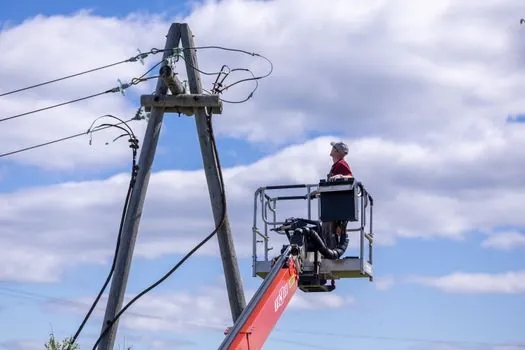
H-style stabilizers carry a higher outrigger strength-to-weight ratio than A-frame units, which lets designers use high-strength steel in lighter sections and lift heavier tip loads off the same chassis [S2]. On aerials greater than 75 ft, OEMs typically recommend four H-style stabilizers mounted fore and aft to spread the reaction loads over a wider base, while two rear outriggers are considered adequate for a 75 ft aerial on a single rear axle [S2]. Independent deployment of each H-style leg also gives the operator a clean short-jacking tool when the truck is parked on a slope, a capability the A-frame geometry cannot match because the jack angle is fixed at the frame [S2].
A-frame jacks run out of application when the aerial gets longer and the tip load climbs, unless they are paired with another stabilizer style [S1]. A common combined layout is A-frames at the front of a tractor-drawn aerial with H-style jacks at the rear, which front-loads the quick-deploy geometry and back-loads the heavy tip-load geometry [S1]. For grade work, A-frame/X-style systems can safely lift the truck up to 20 in. off the ground to level on irregular terrain, a useful ceiling when the alternative is refusing the job [S2].
Below-grade work, rotation envelope, and short-jacking limits
Mid-mount aerials carry a specific H-style penalty: when the jack is deployed, the boom cannot rotate over the jack at or below grade, so the lower arc of the turntable is effectively blocked on the jack side [S1]. A-frames partially sidestep this because the leg sits at an angle and the jack body is closer to the frame, but they trade that clearance for less vertical lift and a fixed geometry. Operators who routinely work pits, manholes, or below-grade facades on a mid-mount platform need to spec the jack mount location explicitly, not as a footnote.
Independent H-style deployment is also the practical answer to short-jacking: an operator can lift one corner of the truck, set the others to level, and still work, which is why the H-style is the more forgiving system on uneven ground [S2]. A-frame outriggers, by contrast, deploy as a pair at a fixed angle, so any leveling has to come from the suspension or from cribbing under the shoe, not from the outrigger geometry itself.
Comparison on the four criteria that drive a purchase decision
Lining the two styles up against the criteria that actually hit a purchasing committee: [S1]
1. Deployed footprint. A-frame: 2-3 ft side protrusion, narrow envelope. H-style: 12-19 ft or greater span per side in two-jack configuration [S1][S2].
2. Tip-load and reach. A-frame: best on elevated waterway booms, articulating platforms, and lighter tip loads; limited as sole stabilization for longer aerials [S1]. H-style: standard for mid- and rear-mount aerials, including 75 ft single-rear-axle builds and four-stabilizer fore/aft layouts on aerials above 75 ft [S1][S2].
3. Lift height and leveling. A-frame/X-style: up to 20 in. of truck lift for uneven terrain [S2]. H-style: independent per-leg deployment for short-jacking and grade compensation [S2].
4. Chassis impact. A-frame: minimal loss of compartment space, no body extension required [S1]. H-style: eats compartment volume and often forces a body length extension to recover storage, increasing overall vehicle length [S1].
On a 65 ft working-height truck-mounted unit such as the Elliott L65, the chassis and outrigger package is sized for a non-CDL platform with zero tailswing, which is only achievable because the stabilizer geometry was matched to the working envelope at the design stage [S5]. Pairing an undersized A-frame with a tip load the geometry cannot carry is the most common root cause of stabilizer complaints on retrofits.
Safety exposure: why the wrong style gets specified anyway
OSHA data attributed to industry reporting puts human error behind roughly 80% of crane tipping incidents, and more than 50% of those accidents trace back to improper outrigger use rather than outrigger failure [S4]. The dominant failure modes are operating beyond the load chart, setting up on ground that cannot carry the Ground Bearing Pressure, and short-jacking because the stabilizer geometry did not allow independent leveling [S4]. Each of those is amplified when an A-frame is asked to do an H-style job, or when an H-style is parked in a footprint the geometry cannot achieve.
Two pre-lift checks are non-negotiable regardless of style: confirm the ground bearing pressure with a penetrometer on asphalt, concrete, gravel, or soil, and confirm that the outrigger pad is larger than the outrigger foot, clean, level, and centered [S4]. Outrigger pads must be larger than the feet, kept clean, kept level, and have the foot centered on the pad, with the operator stopping the lift at the first sign of instability [S4]. These rules apply to both A-frame and H-style equally; the difference is how much margin the geometry gives the operator before those rules get tested.
Selection rules of thumb for a spec committee
Pick an A-frame when the working envelope is under 75 ft of aerial, the tip load is moderate, the operating area is urban or congested, and compartment space or overall vehicle length is a hard constraint [S1][S2]. Pair front A-frames with rear H-style jacks on tractor-drawn aerials with lighter tip loads, which is the most common hybrid on the market [S1]. Pick an H-style as the sole system when the aerial exceeds 75 ft, the tip load is heavy, the operating terrain is irregular, or the operator needs independent short-jacking on a slope [S1][S2].
For mid-mount platforms that have to rotate below grade, the jack mount location and the rotation envelope need to be drawn on the same sketch before the chassis is cut, not after; the boom cannot rotate over a deployed H-style jack, so any below-grade work has to be planned around that blocked arc [S1]. Operators who routinely set up near a curb should also favor the H-style's horizontal-then-down motion, which is a cleaner tool for avoiding close obstacles than the fixed-angle A-frame drop [S2].
Track for 2026: watch for hybrid A-frame plus H-style layouts on 100 ft mid-ship aerials, where two straight-down jacks front and rear plus under-slung stabilizers at the turntable are becoming a default urban spec [S2]. Watch also for higher-strength steel substitutions in H-style beams, which are how OEMs are reclaiming weight lost to longer spans on insulated material-handling aerials such as 125 ft class platforms [S2][S5].
Detailed specification references: dump truck.
See also our earlier report, Bladder vs Piston Accumulators on Die Casting Shot Ends.