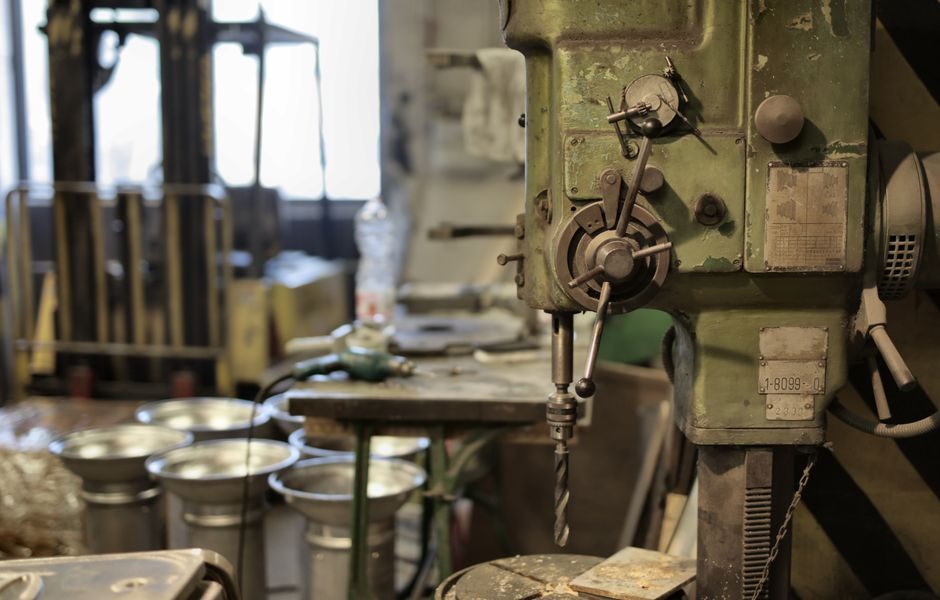
A new hot-chamber zinc die casting machine in the 25-90 ton clamping-force band lists at $10,000-$20,000 on the Chinese OEM channel, with a 25-ton J212 zinc-alloy unit at $10,000-$11,000 and a 38-40 ton hot-chamber lead/zinc model at $17,500-$20,000 [S3]. The capital line is the smallest number a process engineer will sign off on; the 10-year spend is dominated by energy, die steel, lubrication, scrap and floor space.
For plants already running zinc die casting machines alongside aluminum cells, the per-kg conversion cost of a hot-chamber zinc cell sits materially below cold-chamber aluminum because the melt stays inside the machine — no ladle, no shot-to-shot heat loss, no robotic extraction of a frozen slug. That is the engineering reason die casting machines of the hot-chamber type are still the default for zinc alloys under roughly 180 tons clamping force [S3].
Capital cost: where the 10-year TCO actually starts
Published OEM list prices on the Ningbo Dongfang channel as of mid-2026 put the J212 small-tonnage zinc-alloy hot-chamber unit at $10,000-$11,000 per set (MOQ 2) and a 25-ton zinc/lead machine at $13,500-$16,000 (MOQ 2) [S3]. The next tier — 38-40 ton hot-chamber for lead, zinc and Zamak — steps up to $17,500-$20,000, while an 80-ton aluminum-bodied machine crosses into the $17,000-$22,000 band and a 180-ton high-pressure aluminum unit runs $28,000-$32,000 [S3]. A 280-ton cold-chamber aluminum machine, included for reference because zinc plants often co-locate one, lists at $43,500-$50,000 [S3].
Spec engineers should treat these as FOB China baselines; US job-shop buyers typically see 1.4-1.8x multipliers once domestic representation, commissioning, UL-listed electrical panels and 480 V transformers are folded in — a real zinc die casting machine installation is rarely the bare machine price. The relevant TCO question is not "what is the machine" but "what does one good shot cost over the die's life".
Five cost lines that decide a 10-year spend
Energy is the line item most buyers underestimate. A 25-ton hot-chamber zinc cell idles at roughly 8-12 kW (heaters, hydraulic pump, controls) and peaks at 25-35 kW during a shot; a 90-ton unit roughly doubles those numbers. At $0.08-$0.12/kWh industrial tariff, electricity alone runs $5,000-$12,000 per machine per year on a single-shift pattern, and 2-3x that on a 24/7 campaign. That is the single largest variable cost on a hot-chamber zinc die casting machine over a decade, and it scales roughly linearly with clamping tonnage. [S3]
Die steel is the second line, and the easiest one to control. A four-cavity Zamak die for a 50-90 ton cell costs $8,000-$25,000 depending on slide count and core complexity; tool life in zinc commonly reaches 500,000-1,000,000 shots before re-cutting, versus 80,000-150,000 for aluminum in the same geometry because zinc pours ~80 °C cooler and does not solder to the steel. That thermal headroom is the reason zinc die casting outperforms aluminum on die-amortization per part, even at higher per-kg alloy cost [S2].
Scrap and rework — gate trim, blisters, cold shuts — sit at 1-3% of throughput value on a tuned process; on a struggling cell they can hit 8-12% and silently dominate TCO. Floor space is the line the spreadsheet forgets: a 25-ton hot-chamber plus its die-height tower and shot tank needs roughly 4 m × 4 m of floor with 1.5 m clearance, while a 90-ton cell wants 5 m × 6 m; at industrial rents of $40-$80/m²/month, that is $800-$2,900/yr per machine in space cost alone.
Hot-chamber vs cold-chamber vs gravity — when the choice changes the TCO

For alloys in the Zamak 2/3/5/7 family and ZA-8, hot-chamber is the only rational answer: the iron-soluble zinc attacks cold-chamber shot sleeves within weeks and contaminates the melt. Ningbo Dongfang's published line explicitly carves hot-chamber coverage from 16 ton up to 180 ton, with cold-chamber reserved for aluminum and brass from 25-280 ton [S3]. A gravity die casting machine — basically a tilting furnace and a steel mold on a moving platen — is the right comparator only for short-run, heavy-wall zinc parts where die cost recovery on a 200,000-shot hot-chamber die is impossible; its TCO wins on flexibility, loses on cycle time and per-shot energy.
For very high-tonnage zinc structural parts, a vacuum die casting machine is sometimes specified to cut porosity in thick sections, but the price premium over a conventional hot-chamber cell is 30-60% and the TCO only closes if the part is rejecting in porosity-critical applications (safety hardware, hermetic housings). A standard aluminum die casting machine is the wrong tool for zinc — different shot sleeve, different gooseneck metallurgy, different furnace strategy — and the OEM channel reflects that, with aluminum-bodied machines occupying separate listings from the J212 zinc-alloy line [S3].
Where the savings hide: 3 driver levers engineers actually pull
Sizing is the first lever. Stepping from a 90-ton cell to a 25-ton cell halves capital, halves idle energy, and roughly quarters die cost — but only if the projected part footprint fits the 25-ton platen and projected shot weight stays below ~1.5 kg. For multi-impression tooling on small connectors and hardware, the 25-ton J212-class unit at $10,000-$11,000 is almost always the lowest-TCO choice [S3]. For a 38-40 ton part that needs more clamp area but not the high end, the $17,500-$20,000 band is the practical sweet spot [S3].
Shift pattern and idle discipline is the second lever. A machine that idles with heaters on for 16 hours between shifts costs more in electricity than the depreciation on the machine; scheduling a 60-90 minute cooldown-and-reheat protocol on non-running shifts cuts 5-8% off annual energy. The third lever is die life: a zinc die maintained on a punch-and-die re-grind schedule at 200,000-shot intervals will run 800,000-1,000,000 shots before major re-cut, while a die that gets re-cut "whenever" usually dies at 300,000-400,000 shots and doubles the tooling share of TCO [S2].
Who this TCO is for — and who it isn't
This cost stack applies cleanly to: Tier-2 and Tier-3 job shops running 50,000-500,000 shots/year on hardware, fastener, lock and decorative zinc parts; captive cells inside a faucet, lock or window-fittings operation (the ASIA Products profile of door/window fittings and zinc faucet handles is a textbook case) [S1]; and contract manufacturers like Bardane (23 die casting machines, 93,000 sq ft, Jermyn PA) that mix aluminum and zinc cells under one roof [S4]. The same logic with much larger absolute numbers applies to a magnesium die casting machine TCO stack on the 10-year view.
It does not apply to: high-volume single-part programs above 2 million shots/year where dedicated automation cells and a vacuum die casting machine reset the cost math; prototype work where a gravity die casting machine or 3D-printed short-run tooling is cheaper; or any process where the buyer is locked into a single alloy and would not benefit from running a hot-chamber cell on Zamak 3 today and ZA-27 next quarter. The TCO lens on suppliers like NBI and Kenwalt is built around the assumption that one zinc cell serves multiple part families across its 10-year life, not a single SKU.
Trackable signals to watch next
Two numbers are worth refreshing each quarter: the published MOQ-1 FOB China price of a 25-ton hot-chamber zinc cell (currently $10,000-$11,000 on the Ningbo Dongfang channel) [S3], and the ratio of 38-40 ton hot-chamber to 25-ton hot-chamber list price, which is currently 1.75-1.80x and indicates how aggressive the OEM channel is on the mid-tonnage band. A move of that ratio toward 1.5x would signal a pricing war in the mid-tier and a near-term re-quote opportunity for any die casting machine buyer with a 2027 capex window.