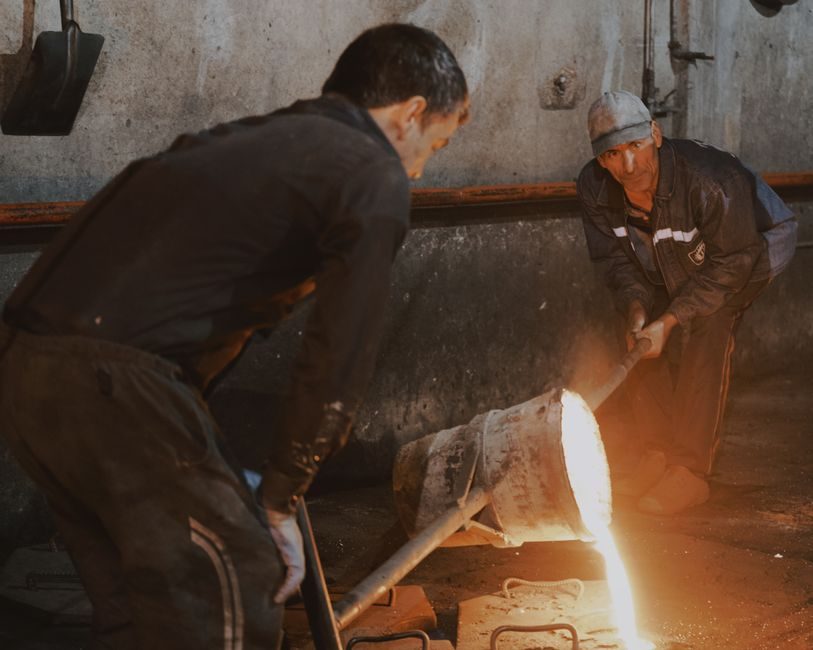
Zamak-family zinc alloys (Zamak 2, 3, 5, 7, plus ZA-8 and ZA-12) are cast in hot-chamber machines at injection pressures around 1,400–2,000 bar, making the process the lowest-melting (≈ 380–420 °C pour) high-volume die-casting route [S5]. The window where zinc is the correct answer is narrow but well-defined: thin walls (typically 0.8–1.5 mm), high cosmetic surface finish, part mass under ~3 kg, and run rates that justify a hot-chamber tool. For work-pieces above that mass, above 200 °C continuous service, or where corrosion to chloride or strong alkali is a concern, aluminium HPDC or gravity die casting replaces zinc.
The process competes directly with aluminium die casting machine cells and with magnesium, with the trade-off governed by density (zinc ≈ 7.1 g/cm³, aluminium ≈ 2.7 g/cm³), tensile strength (Zamak 3 ≈ 280 MPa as-cast vs. AlSi9Cu3 ≈ 240–330 MPa) and per-part price at the same volume. Chinese supply data shows FOB-China zinc-alloy die-cast parts in the US$ 0.18–10.00 per-piece range at MOQs from 1 piece to 1,000 pieces [S7][S8].
Alloy Selection: Zamak 2 / 3 / 5 / 7 vs. ZA-8 / ZA-12
Zamak 3 is the default "general-purpose" zinc die-casting alloy and accounts for the majority of decorative and hardware applications because of its dimensional stability and good plating response; Zamak 5 adds a small copper addition (≈ 1 % Cu) for higher creep resistance and modestly higher tensile strength, which is why it appears in door-and-window fittings and small structural components [S1].
For higher-strength, slower-cycle work the ZA family (ZA-8, ZA-12, ZA-27) steps in: ZA-8 is the only ZA grade that can still be run on conventional hot-chamber equipment, while ZA-12 and ZA-27 are restricted to cold-chamber dies because their pouring temperatures (≈ 480–600 °C) attack the iron goose-neck and plunger of standard hot-chamber machines. Choose ZA-8 over Zamak 3 when you need higher tensile strength and wear (≈ 240–280 MPa vs. 280 MPa — but with much better creep and bearing performance) on hardware that runs hot or under sustained load. A useful decision table, all values from the cited 2025-2026 supplier data and standard Zamak references:
* Alloy — typical pour temp, tensile strength, hot/cold chamber, best application band
* Zamak 3 — ≈ 420 °C, 280 MPa, hot-chamber, decorative + general hardware (default)
* Zamak 5 — ≈ 420 °C, 330 MPa, hot-chamber, door/window fittings, structural hardware
* Zamak 2 — ≈ 420 °C, 360 MPa, hot-chamber, highest-strength hot-chamber grade
* ZA-8 — ≈ 425 °C, 250–290 MPa, hot-chamber (limited), bearings, wear parts
* ZA-12 — ≈ 490 °C, 310–350 MPa, cold-chamber only, higher-temp structural
* ZA-27 — ≈ 600 °C, 400+ MPa, cold-chamber only, structural / replaces cast iron
Machine and Tool: Tonnage, Clamp Force and Die Materials
Hot-chamber zinc die casting machines cover the bulk of zinc work in the 20–160 t clamping-force band; cells above 250 t are uncommon for zinc and almost always indicate an aluminium or magnesium cold-chamber line being re-used. A workable rule of thumb: 1 t of clamp force per ≈ 10 cm² projected area at standard injection pressure, which for a 200 cm² part gives a 20 t nominal clamp and a 40 t recommended clamp for safety margin. Hot-chamber machines also deliver cycle times of 2–6 s per shot on small zinc parts, materially faster than cold-chamber aluminium at 4–12 s [S5].
The die casting die is typically H13 tool steel at 48–52 HRC for cavity and core, with a die life of 200,000–500,000 shots for zinc (versus 80,000–150,000 for aluminium on identical geometry) because zinc's lower pour temperature reduces thermal fatigue and solder attack. One Chinese supplier publicly states minimum moulding tolerance of 0.05–0.03 mm on its zinc and aluminium die-casting dies [S4], and that figure is consistent with industry practice for precision zinc hardware. For through-cosmetic surfaces, an SPI A-1 or A-2 finish on the die translates to a Ra 0.2–0.4 µm as-cast zinc surface that can go straight to electroplating with minimal polishing.
Wall Thickness, Draft, Radii and Tolerance
Zinc's high fluidity lets designers push walls thinner than aluminium: a practical minimum is 0.8 mm on small cosmetic parts, 1.0 mm as a general engineering floor, and 1.5 mm where the part carries mechanical load or threads. Maximum uniform wall should be kept under ≈ 4 mm to avoid centre-line shrinkage porosity; for thicker sections, ribbing or coring out is mandatory. Standard draft is 1°–2° per side on as-machined surfaces (drop to 0.5° on polished or textured draw faces), and fillet radii should be ≥ 0.5 × wall thickness to keep metal flow laminar and avoid hot-tear initiation. [S1]
Tolerances for zinc die castings (no draft or machining compensation) are typically ± 0.1 mm on the first 25 mm of dimension, plus ± 0.02 mm per additional 25 mm on small hardware — tighter than aluminium because zinc's lower thermal expansion shrinks predictably against the die steel. Supplier-published data for 2025 confirms minimum casting tolerances of 0.05–0.03 mm on Chinese zinc die-casting lines [S4], which is the working floor for precision connector, lock and electronics-housing hardware. Where ± 0.02 mm or better is required, the cast surface must be CNC-machined as a second op; CNC is the standard follow-up cell in most Chinese zinc foundries [S1].
Where Zinc Wins and Where It Is the Wrong Choice
Choose zinc when you need: (1) cosmetic chrome or nickel plating on a thin-wall housing — zinc's fine grain gives a Class-A plate; (2) net-shape or near-net-shape hardware with as-cast threads (zinc taps cleanly to M2 and above); (3) high production volume where hot-chamber's 2–6 s cycle pays back the die; (4) parts in the 5 g–3 kg band; (5) cast-in features that would otherwise need multi-slide steel stamping. Real consumer examples include door and window fittings, faucet handles, lock bodies, decorative trim, electronic connector shells, and small gear/housing assemblies — all visible in 2025-2026 Chinese supplier catalogues with US$ 0.18–10.00 FOB pricing and 1,000-piece MOQ [S1][S3][S4].
Reject zinc when: (1) the part runs above ≈ 120 °C continuously — zinc creeps and may lose dimensional stability, whereas aluminium HPDC and magnesium die casting tolerate higher service temperatures; (2) weight is a primary driver (zinc is 2.6× denser than aluminium); (3) the part sees strong acids, strong alkalis, or chloride-rich service — zinc is anodic and corrodes sacrificially; (4) the part must meet food-contact or potable-water standards with no plating barrier (bare zinc is not acceptable); (5) the geometry needs sections above ≈ 6 mm thick without internal coring, which aluminium and magnesium HPDC handle more reliably. A useful gating question: "does the part need to look like chrome and weigh like steel, or behave like aluminium at 1/3 the weight?" — the answer picks the alloy [S5][S6].
Cost, Lead Time and Sourcing Logic (2025-2026 data)

Per-piece pricing on Made-in-China and ECVV in May–July 2026 shows hot-chamber zinc-alloy die-cast parts in the US$ 0.18–10.00 range at MOQs from 1 to 1,000 pieces, with US$ 0.90–10.00 typical for 1-piece sample lots and US$ 0.18–0.36 for high-volume inside-corner extrusion connectors [S3][S4]. One Shenzhen supplier publishes a 15,000-piece-per-week capacity on the KENOS mini die-casting line [S2], giving a practical benchmark for a single hot-chamber cell's weekly output. Die costs for a small zinc die typically run US$ 3,000–15,000 for a single-cavity production die from a tier-2 Chinese toolmaker, and US$ 10,000–50,000+ for a multi-cavity, multi-slide zinc die — roughly 30–50% of an equivalent aluminium die because of the lower H13 stress state and longer die life.
Lead time benchmarks: 25–35 days for a simple single-cavity zinc die + samples, 40–60 days for a multi-cavity, multi-slide tool, and 10–20 days for production parts once tooling is signed off. One tier-1 Chinese supplier advertises 7 years of mould-making experience and ISO 9001:2000 certification on its zinc/aluminium/magnesium die-casting line [S4]; a second Zhejiang-based facility describes itself as a "specialised enterprise" for zinc, aluminium, gravity casting and high-precision mould development with a one-stop service from mould design through mechanical finishing to surface treatment [S3]. European competitors (REINER, Germany) compete on small-batch precision zinc and emphasise "customised solutions … specialise in small [parts]" as a differentiator against Chinese high-volume cells [S6].
Standards, Plating and Failure Modes
Zinc die castings are specified against ASTM B86 (US) and the EN 1774 / EN 12844 series (Europe) for chemical composition and mechanical properties, and against ISO 9001 for quality systems at the foundry [S3][S4]. For cosmetic plated parts the common stack is copper flash (8–15 µm) → nickel (10–25 µm, duplex or triplex) → chrome (0.1–0.3 µm decorative or 10–25 µm hard), giving > 240 h ASTM B117 salt-spray performance on properly prepared Zamak 3 or Zamak 5. Avoid plating on ZA-12 / ZA-27 in chloride service: the higher aluminium content in the ZA series raises surface oxide issues that need a dedicated zincate / pre-plate protocol.
The three dominant failure modes in production zinc die castings are: (1) cold-shuts and mis-runs at walls below 0.8 mm or at cold-die start-up below ≈ 150 °C die surface; (2) centre-line shrinkage in sections above 4 mm without feed — visible as internal voids under X-ray or CT, and (3) blistering under plating, almost always driven by subsurface porosity exposed by the pre-plate etch. Mitigation: preheat dies to 180–220 °C for thin-wall cosmetic parts, apply a 3-step (chrome / nickel / copper) plate to a properly vented, properly gated geometry, and run at 1,400–2,000 bar injection with vacuum assist on parts that require plating without prior machining. The same defect pattern is also seen on zinc die casting machine cells that have been re-allocated to aluminium — molten-aluminium attack on a hot-chamber goose-neck is a near-total loss event and must be excluded by process discipline.
Trackable signals for the next sourcing decision: (1) Chinese supplier 2025-2026 quote sheets continue to show Zamak 3 / 5 / 7 FOB pricing in the US$ 0.18–10.00 band, with multi-cavity dies landing in the US$ 10–50 k range for production volumes; (2) European precision zinc suppliers (REINER-type) hold a price premium of 2–4× over Chinese cells, but compete on tolerance and small-batch lead time [S6]; (3) new material developments are tracked through the Zamak 8 / ZA-fam extensions and via creep-data revisions in ASTM B86, with a 2025-2026 update on high-temperature Zamak 3 behaviour worth monitoring for automotive under-hood use [S5]. For an operator deciding between a new zinc hot-chamber cell, an aluminium cold-chamber cell, and a gravity die casting machine for short-run work, the rule is: zinc if the part is small, cosmetic and high-volume; aluminium if it is structural, mid-volume and weight-sensitive; gravity if it is low-volume, large and prototype-heavy.
For related coverage, see Hot Chamber Die Casting Machine Selection: Alloy, Tonnage and Cycle Gates.