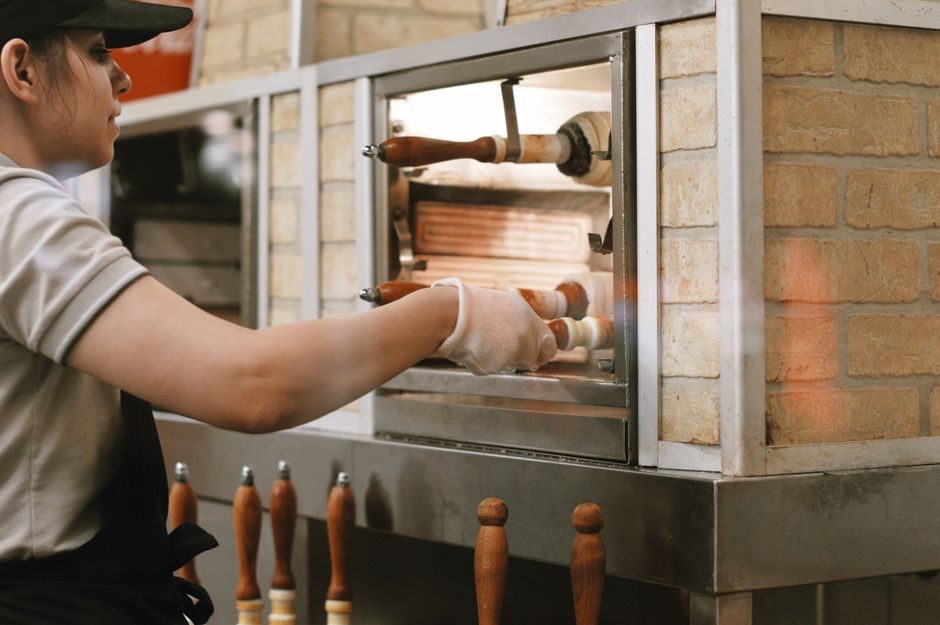
Industrial oven total landed cost in 2026 ranges from about USD 3,000 for a 200 L benchtop batch/convection oven up to USD 200,000+ for a continuous infrared tunnel line; the four cost drivers that explain roughly 80% of the spread are heat-source type (electric resistance vs. gas IR vs. diesel), chamber volume and conveyor class, temperature rating (200 °C vs. 400 °C vs. 700 °C+), and cleanroom/ATEX certification [S1].
The benchmark figures below are drawn from public supplier data published in 2025-2026 and are usable for first-pass budgeting only [S1].
Price Bands by Oven Family
Small batch/convection benchtop ovens (≈50–500 L, 200–300 °C) are the entry tier and typically list at USD 3,000–12,000 FOB, with most Asian OEM units clustering in the USD 3,000–6,000 band [S1]. Mid-size walk-in batch ovens (1–8 m³, 250 °C, electric) commonly fall in the USD 15,000–60,000 range; gas-fired walk-ins drop 20–30% on capex but add combustion-air skid costs. Continuous mesh-belt tunnel ovens start near USD 40,000 for a 2 m heated length and step up to USD 150,000+ at 10–15 m with full recirculation; bilateral and IR tunnel architectures are the premium configurations for coating and curing lines [S1].
For specialized duty — cleanroom drying, ATEX-rated solvent curing, or 700 °C+ high-temperature metallurgy — expect a 1.8–3.0× multiplier versus a comparable general-purpose unit, driven by stainless internal finishing, purge controls, and refractory stack-up [S1]. A useful sanity check: divide capex by heated chamber volume; values below USD 800/m³ usually indicate a stripped spec, above USD 5,000/m³ indicate a cleanroom/ATEX class.
Heat-Source Selection and Running Cost
Diesel-fired IR tunnels remain common in regions with cheap fuel and weak grid reliability, but face tightening particulate-emission rules. Hot-air circulation is the default convection architecture for tunnel ovens and is what most Chinese OEM tunnels specify [S1].
Chamber, Conveyor and Temperature Class
Continuous ovens split into four conveyor classes — mesh belt, roller, bilateral chain, and automatic rotor — and each carries its own price step: mesh belt is the baseline, roller +15–25% for heavier loads, bilateral chain +30–50% for two-sided coating/curing, and automatic rotor is a specialty for stator/rotor drying on small motors [S1].
Chamber volume scales sub-linearly with cost: doubling internal volume typically adds 50–70% to capex, not 100%, because the heating element count, fan power and control loops grow more slowly than the box. This is why a single 12 m³ walk-in is almost always cheaper per m³ than two 6 m³ walk-ins on the same duty cycle. Inner surface finish is the hidden multiplier — cold-rolled steel is baseline, SUS 304 adds 10–18%, SUS 316L adds 20–35%, and electropolished cleanroom interiors add 40–80% on top of the 304 price.
Standards, Certification and Compliance Cost
For solvent-bearing or powder-coating duty in the EU, ATEX 2014/34/EU zone classification is the dominant compliance driver, and an ATEX-rated tunnel oven will price 25–60% above a general-purpose equivalent depending on zone and gas group [S1]. In North America, NFPA 86 governs oven safety, while CE Machinery Directive 2006/42/EC plus EN 1539 (ovens for combustible atmospheres) covers European installations. Cleanroom-class ovens — typically ISO 7 / Class 10,000 — add HEPA-filtered recirculation and a positive-pressure envelope that can add 15–30% to capex [S1].
Buyers should verify that the OEM can actually ship the cited certification package: nameplate with notified-body number, ATEX/IECEx certificate copies, and a documented purge controller setpoint. If an "ATEX oven" quote is 5–10% above a non-ATEX equivalent, treat it as suspect — the certification content, not the box, is what you are paying for.
TCO Levers and Negotiation Anchors
Energy, refractory reline, and filter change are the three recurring cost lines that dominate the 10-year TCO model: electricity/gas at 30–45% of TCO, refractory and insulation at 8–15%, HEPA/filter change at 3–6% on cleanroom units, and labour at 20–30% depending on automation level [S1]. Selecting a thicker insulation pack at purchase time (e.g. 100 mm ceramic fiber vs.
For negotiation anchoring, the price/cost stack is the same shape as on a Forging Press Price and Cost Guide: drive type and frame size drive the biggest line items, and freight, installation, controls and training each add a single-digit percent that procurement routinely under-counts. Always request a priced line breakdown for oven body, heating module, conveyor, controls/PLC, freight, install/commissioning, and warranty extension — a 12% gap between the "machine price" and the "commissioned price" is normal.
Sourcing Map and Lead Times
Asian OEM tunnel-oven suppliers — concentrated in Guangdong, Jiangsu and Zhejiang — typically quote 25–40% below EU or North American list for equivalent heat-source and conveyor class, with lead times of 30–60 days for standard tunnels and 75–120 days for ATEX or bilateral configurations [S1]. A 2,300 m² plant exporting to 30+ countries is a reasonable scale benchmark for a credible mid-tier Chinese tunnel-oven supplier; the same vendor's automatic rotor oven and bilateral tunnel oven product lines are the indicators of in-house R&D depth versus simple assembly [S1].
Use the same checklist you would on a Hydraulic Press Selection Guide: confirm PLC/HMI platform, spare-parts list, on-site commissioning scope, and whether the warranty covers refractory and heating elements or only the frame. Two trackable signals to watch on your next RFQ: a 2026 quote where the seller breaks out energy consumption per kg of product at your setpoint, and a vendor that names a specific control platform (Siemens S7-1500, Omron NX, Beckhoff CX) rather than a generic "PLC" line — both correlate with lower TCO surprises after commissioning.
For component-level specifications, see linear guide, crossed roller guide, and industrial adhesive.