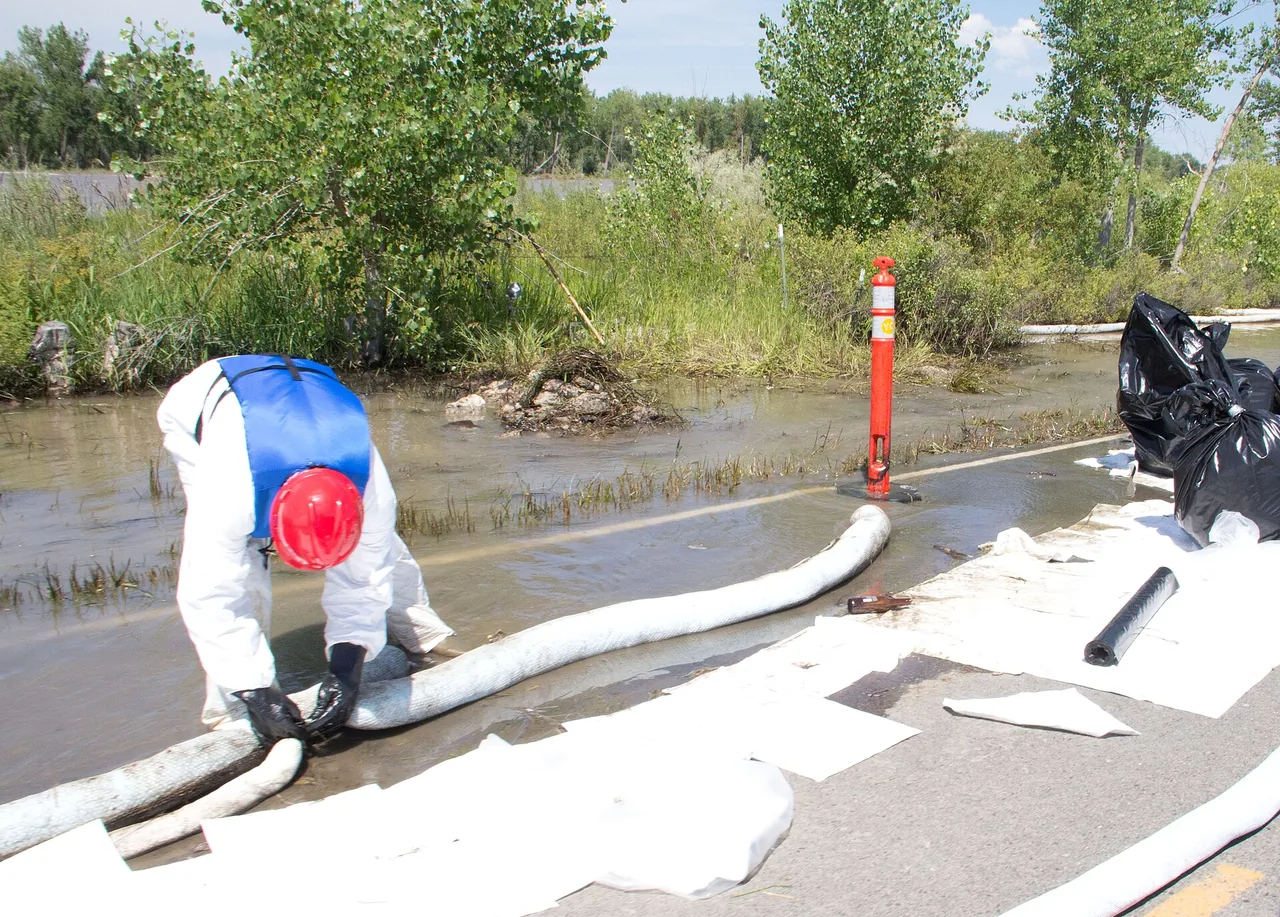
An absorbent mat is a flat sheet of bonded fiber, usually melt-blown polypropylene and sometimes cellulose or recycled fiber, laid under a machine, a drum, a hose connection or a vehicle to take in oil, coolant, solvent and water-based drips. It is bought as loose pads, as perforated rolls, as heavier matting for walkways and as barrier-backed mats whose underside will not let liquid through, and each piece is rated by how much liquid it holds. The mat is a consumable rather than a machine: nothing drives it, and its whole specification is the fiber, the construction and the capacity. Capacity figures on a datasheet belong to one test liquid, so they are read together with the grade before a pad is chosen.
The page is written for the engineer or buyer who has to keep a floor dry around a leak and is asked how many pads that will take and where the used ones go. The chapters explain how the fiber takes in and holds liquid, sort the grades and constructions, list the parameters on a pad datasheet with the standards and regulations behind them, give the selection arithmetic, and end with placement, inspection, disposal and purchase-order wording. Two questions run through every choice: which liquid the mat must take in, since an oil-only mat refuses water and a chemical mat is the only safe grade for acids and solvents, and where the used mat may go once it is saturated.
Four things decide an absorbent mat purchase. First the grade, because an oil-only mat under a coolant drip stays dry and a universal mat left in the rain fills with water. Second the capacity against the leak, stated per pad and per square foot, with the test that produced it. Third the construction, since a single-ply pad tears under foot traffic and only a barrier backing keeps liquid off the floor. Fourth the waste route, because a mat soaked with used oil, solvent or acid leaves the plant under different rules.
Chapter 1 / 06
What an Absorbent Mat Is and How It Works
A mat works by capillary action inside a bed of fine fibers. Melt-blown polypropylene is made by blowing molten polymer into very fine filaments and collecting them as a random, lofty web that is still warm enough to bond where the fibers touch. The web is mostly empty space, and that space is the capacity. When a droplet lands, it wets the fibers and is drawn by surface tension into the gaps between them, where it is held as a liquid. Nothing is dissolved and nothing reacts. That is absorption, the filling of pores inside a solid. Adsorption, in which molecules cling to the surface of a granular medium, is a different mechanism and plays no part here.
The same fiber, treated in different ways, gives the three grades. Untreated polypropylene has no appetite for water and a strong one for hydrocarbons, so a pad of it takes in oil, refuses water and floats. A wetting agent worked into the fiber lets water-based liquids enter the same pores, and the treated pad becomes the universal grade. The chemical grade is surfactant-treated polypropylene as well, described by the Brady SPC catalog as chemically inert, so that it will not react even with aggressive fluids. It is the grade for acids, bases and solvents. A mat takes on the character of whatever it has taken in, and it neither neutralizes an acid nor solidifies a solvent.
Construction is built around that absorbent core. A 1-ply pad is the bare web: economical and quick to wet through, but given to linting and tearing. A 2-ply pad adds a coverstock, a thin sheet of tougher fiber, on one face, and a 3-ply pad has coverstock on both faces; the catalog describes its standard universal pad as 3-ply melt-blown polypropylene. Dimples are pressed bond points that hold the layers together and add strength at the cost of some absorbent surface. Perforations let the user tear off the piece size the job needs. Where boots and wheels cross, the lofty web is replaced by a denser, needle-punched web, needled until the fibers tangle into a felt, and then backed.
What happens under a drip is a race between spreading and ponding. Liquid that lands wicks sideways through the web and reaches dry fiber, so a pad spreads a drip over much of its area before any spot is full. Once the pores in a region are filled, liquid stands on the surface, is squeezed out again by a boot or a wheel, and runs off the edge if more keeps arriving. A pad is spent when liquid reaching it can no longer be held, not when it has changed color. The catalog shows an under-saturated pad thrown away half used and an over-saturated pad that has stopped cleaning up the liquid. How fast this happens is the rate of uptake: it is set by fiber fineness, coverstock and the viscosity of the liquid, and is faster for a thin solvent than for a cold gear oil.
The mat sits at the bottom of a short drainage chain. Liquid leaves a leak point, runs or falls onto the mat and stays there until the mat is picked up. A sock, a flexible tube filled with the same fiber, is laid around the base of a machine or along a wall so that liquid cannot escape sideways. A pillow is put in a tight, heavy-drip space such as a sump or a catch basin under the equipment. A roll covers a walkway. A mat with an impermeable backing both takes in the liquid and stops it reaching the floor. None of these forms returns anything to the process; every one is handled as waste at the end.
Because the mat is bought repeatedly, its economics are set by capacity per pad and by the cost of getting rid of what is used. The Brady SPC catalog sets its pads against two older practices: clay granules, which it says have an absorbency ratio of roughly 1:1, and laundered rags, which lose some of their absorbency with every washing. Its pads, it states, absorb an average of 20 times their own weight. That ratio is why a light pad suits a drip and a heavy pad suits a leak, and buying by weight alone ignores it. The ratio also decides the bulk of the waste, since a pad that holds more per gram of fiber sends less fiber to disposal.
Chapter 2 / 06
Absorbent Mat Types and Structural Variants
Oil-only matting is the untreated, hydrophobic fiber, usually white. It takes in petroleum oils, hydraulic-system fluid, diesel, gasoline, cutting oil and oil-based solvents, and it refuses water. The Brady SPC catalog says these products float even when saturated with oil, and that they can be stored outdoors whatever the weather. That makes the grade the one for yards, outdoor drum storage and aprons under parked vehicles, where rain or wash-down water would fill a universal pad first. A wrung oil-only pad can go back to work, and one variant is treated to resist static build-up around flammable liquids. Under a coolant drip it is the wrong buy: the pad stays dry while the liquid runs past it.
Universal matting is fiber with a wetting agent, usually gray, and it takes in water-based and oil-based liquids alike; coolants, solvents, water, oils and latex paint all appear on the catalog's list for it. It is the grade for indoor maintenance, around machinery, under dripping valves and assembly lines, wherever the next liquid cannot be predicted. The gray color has a purpose, in the catalog's words: spills are masked and workers are less tempted to pick a pad up before it is full. The same openness is its weakness outdoors: rain, condensation and wash water are taken in as readily as oil, so capacity is spent on water and the pad is spent early.
Chemical matting, or hazmat absorbent, is polypropylene treated with surfactant and colored bright yellow or green, so that it stands out and cannot slip into the ordinary waste stream. The catalog lists acids and bases, sodium hydroxide, citric acid, solvents and unknown chemicals among the liquids it takes, and places the grade in laboratories, pharmaceutical plants and chemical manufacturing. Its chemical application guide sets a long list of liquids against four product families and marks the families each one suits; acetic acid, acetone, hydrochloric acid, sodium hydroxide and sulfuric acid all carry the mark for the chemical family. The guide assumes chemicals at ambient temperature and pressure, used pure, and asks the user to test a small sample.
Within each grade the builder chooses weight, surface and format. Light-, medium- and heavy-weight describe the mass of fiber per pad, and with it the capacity. The catalog advises a light or medium pad for small spills, so that a half-dry pad is not thrown away, and a heavy pad for continuous leaks. A dimpled surface is stronger and sheds less lint; a smooth pad offers more absorbent surface per square inch. Recycled matting is a laminate made mostly of natural cellulose fiber between coverstocks. The catalog's oil-only version absorbs more than 30 times its weight and carries a Class A fire retardant rating; its universal version is not intended for highly aggressive chemicals.
A backing turns a pad into a mat for traffic. An adhesive backing, permanent or semi-permanent, holds needle-punched polypropylene to the floor so that the mat cannot slide under a forklift; the catalog lists these in 15 x 100 ft and 30 x 100 ft rolls. A non-skid barrier backing is an impermeable layer that keeps liquid from reaching the floor underneath, fitted to heavier matting made for aisles and workstations, and a safety-printed version carries its warning on the surface. A 1-ply needle-punched rug serves moderate traffic, and heavier barrier matting with an ultraviolet-resistant top layer is made for outdoor use over ground that must stay clean.
Two boundaries keep the subject straight. Absorbent booms are floating belts of similar fiber that enclose a spill on water; this page is about the flat mat that catches liquid on a floor. A safety mat is a presence-sensing device that stops a machine when stepped on, and it absorbs nothing. Nor is a mat a container. An IBC tank or a drum belongs on a spill pallet or inside a bund sized for its contents; the mat is laid in addition, under the discharge valve or at the transfer point. Downstream, a mat keeps oil out of the oil-water separator and out of the sump a sump pump empties, and replaces neither. This page is not a spill response plan.
Chapter 3 / 06
Absorbent Mat Key Specification Parameters and Standards
A pad datasheet is short, and nearly everything on it falls into five groups. The first is the grade and the liquids it suits. The second is the format: pad length and width, roll width and length. The third is the weight class and the ply count, which together set durability and lint. The fourth is capacity, quoted in gallons per pad, per package or per roll, and sometimes as a multiple of the pad's own weight. The fifth is the backing. The table that follows gives the Brady SPC catalog's values for its universal pads and rolls, the per-pad and per-area figures worked out from them, and the limit that makes a used mat ignitable waste.
Every capacity figure has a test behind it, and a buyer should ask which one. The Brady SPC catalog states that its absorbency specification and its in-house test method follow the protocol of ASTM F726, with a medium-viscosity SAE20 non-detergent oil as the test liquid, and that the printed values are nominal. ASTM F726 itself is written for adsorbents that remove oil from the surface of water; its text says the tests are not appropriate for absorbent materials, which it leaves to ASTM F716. ASTM F716 covers the performance of absorbents, including their retention ability, on chemical and light hydrocarbon spills. A pad rated on an F726-pattern oil test therefore describes oil pickup; uptake of water-based liquid and retention under pressure, the squeeze of a boot or a wheel, are separate tests.
Regulations sit behind three datasheet lines rather than on them. The OSHA rule on walking-working surfaces, 29 CFR 1910.22, requires workroom floors to be kept clean and, so far as is feasible, dry, free of leaks and spills, inspected regularly, and guarded at once when a hazard cannot be corrected before the surface is used again. EPA's used oil management standards, 40 CFR part 279, apply to mats that still hold free-flowing used oil, and the hazardous waste rules of 40 CFR part 261 decide whether a mat soaked with solvent or acid is a hazardous waste. EPA's used oil guidance also notes that handlers may be subject to the Spill Prevention, Control and Countermeasure requirements in 40 CFR part 112.
Parameter
Typical value
What it decides
Grade
Oil-only, universal or chemical
Liquids taken in and waste stream joined
Weight class
Light, medium or heavy
Fiber per pad; pads consumed by a leak
Pad size
15 x 19 in (381 x 483 mm)
Area covered by one piece
Heavy-weight pad absorbency
0.26 gal (1 L) per pad
Pads a leak consumes per shift
Medium-weight pad absorbency
0.2 gal (0.76 L) per pad
Pads used on light drips
Heavy-weight absorbency per area
0.13 gal per sq ft (5 L per m2)
Roll length needed for an aisle
Roll size
15 x 150 ft or 30 x 150 ft
Area covered without joints
Heavy-weight roll capacity
49 gal (186 L) per 30 x 150 ft roll
When a laid roll must change
Package absorbency and count
13.5 to 41 gal; 50 to 150 pads
How long a package serves a point
Perforation spacing
7.5 in (191 mm) on pads; 15, 18 or 30 in along rolls, closer on some
Piece size torn off
Construction
1-ply, 2-ply or 3-ply; dimpled or smooth
Lint, tear strength, life under traffic
Backing
None, adhesive, non-skid or safety-printed barrier
Whether liquid reaches the floor; sliding
Reuse of a wrung oil-only pad
2 to 8 times
Fiber sent to disposal
Flash point making a used mat ignitable waste
below 60 degrees Celsius (140 F)
Whether the waste is hazardous waste D001
Chapter 4 / 06
Absorbent Mat Selection and Duty Calculations
Selecting an absorbent mat is settled by four questions taken in order: what liquid arrives, how much of it in what time, over what area and under what traffic, and where the used mat goes. The paragraphs below take them one at a time, with the arithmetic a buyer runs on the capacity figures.
The first question is what liquid arrives, and the answer comes from the safety data sheet of every product that can leak at the point. An industrial lubricant or a film of diesel calls for the oil-only grade unless water lands there as well. A water-based coolant, detergent solution or emulsion calls for the universal grade. An industrial solvent, a strong acid or base, or a chemical reagent whose label carries a hazard pictogram calls for the chemical grade, and the maker's compatibility guide should be checked for that liquid first. Where the liquid cannot be identified, the chemical grade is the safe default and the used pad is handled as hazardous waste until the liquid is known.
The second question is how much liquid arrives, and it turns the datasheet into a consumption figure. The arithmetic is division: liquid arriving in an interval, in gallons, divided by the capacity of one pad gives the pads used per interval. A heavy-weight roll 30 in wide and 150 ft long covers 375 sq ft (35 m2) and is rated at 49 gal (186 L), about 0.13 gal per sq ft. An aisle 3 ft wide and 50 ft long is 150 sq ft, and laid with that roll would hold about 20 gal before it needed changing. The same sum with 100 heavy pads rated at 26 gal (98 L) gives about 0.26 gal per pad.
The third question covers area and traffic, and it chooses the format. A point source takes pads from a dispenser box set beside it. A line source, such as a row of machines, takes a roll. A leak that spreads sideways takes a sock laid around its edge. Where forklifts cross, the format is a heavier mat with an adhesive or non-skid barrier backing, because an unbacked pad on smooth industrial flooring is pushed into a bundle within a shift. On a polished vinyl floor the same happens under foot traffic alone. Stock is kept at the point of need in a box that doubles as a dispenser. Shelf life is not a published figure for these products: polypropylene, impervious to rot and mildew, keeps for years in a dry store, and cellulose matting is bought in smaller lots.
The same question includes the environment at the point. Outdoors, the grade must be oil-only and the coverstock should resist ultraviolet light. Heat is a limit that no polypropylene mat meets: hot condensate, boiler blowdown and hot oil lines drip liquid that softens the fiber, and those points get a metal drip tray instead. Where solvents with a low flash point are handled, a pad treated against static is used and ignition sources are kept away from the used pad. Where the floor is painted or coated, a semi-permanent adhesive backing holds better than a loose mat and can still be stripped off without damaging the coating. A mat bought for a dry workshop does not transfer to a wash-bay.
The fourth question is where the used mat goes, and it feeds back into the three before it. The cost of a mat is its price divided by the liquid it actually holds, plus the cost of disposing of its weight, so a pad bought cheap that holds far less is the dearer pad. An oil-only pad that is wrung out and reused absorbs several charges before it is thrown away, which EPA puts at between 2 and 8 uses depending on the viscosity of the oil. Mixing grades at one point merges waste streams, and EPA's advice to keep used oil apart from all solvents and chemicals is the reason chemical pads get their own labeled container.
Decision factor
What to establish
What it decides
Leak liquid
Oil, water-based, chemical or mixed; read the safety data sheet
Oil-only, universal or chemical grade
Leak volume
Gallons arriving per shift
Pads per shift, from capacity per pad
Area and shape
Square feet to cover; point, line or aisle
Pad, roll, rug, sock or pillow
Traffic
Foot, trolleys or forklifts
Ply count; adhesive or barrier backing
Weather and washing
Outdoors, rain or hose-down
Oil-only grade; ultraviolet-resistant coverstock
Heat at the point
Condensate, hot water or hot oil
Metal drip tray instead of polypropylene
Flammable liquids
Low flash point, static risk, ignition sources
Static-resistant pad; closed metal waste can
Floor finish
Sealed, painted or polished
Adhesive or non-skid barrier backing
Waste route
Used oil, hazardous waste or solid waste
Grade color; labeled container at the point
Chapter 5 / 06
Absorbent Mat Installation, Maintenance and Failure Modes
An absorbent mat is installed by laying it down, and it fails by being in the wrong place, laid the wrong way up or left too long. What follows covers placement, change-out, disposal and the failures that a floor walk brings to light.
Placement follows the liquid, not the machine. The mat goes where the drop actually lands after it has run along a frame or fallen from a height. Under a machine it covers the base of the pump, the gearbox and the shaft where the oil seal weeps. Under a drum or an IBC tank on a pallet it lies on the deck beneath the tap, and a shaped cover goes on top of a drum in use. A leaking coupling on an industrial hose, a lube dispenser and a transfer point between two containers each get their own pad or sock. Other grades are stored in a covered place, since only oil-only absorbents are made for outdoor storage, whatever the weather.
Change-out is a short sequence. Stopping the leak at source comes first, since no number of pads keeps up with a running leak. The second habit is to clear the area, because loose debris and rags hide liquid on the floor. The third is to choose the grade before touching the liquid, not afterwards. A release that has reached a drain, or that involves a hazardous substance, is dealt with under the site's spill response procedure, and the person changing a mat soaked with a hazardous liquid wears the safety gloves, respirator and protective clothing its safety data sheet calls for, with an eye wash station and a first aid kit within reach and the area closed off with warning tape.
Stop the flow at source if it can be done safely; empty a container that keeps leaking into a sound one.
Clear away loose material, rags and debris around the leak.
Lay a mat of the chosen grade flat over the whole wetted area, backing down and overlapped at the joints; where liquid runs outward, lay a sock around the edge with its ends overlapped by about 5 in (127 mm).
Mark the area with a warning sign until the floor outside the mat is dry.
Inspect each shift, and replace the mat as soon as liquid pools on it or seeps out underneath.
Drain free-flowing oil from the used mat into the used-oil container, then bin the mat with its own waste stream.
A mat is replaced on evidence, not on a calendar. The signs are liquid standing on the surface, liquid seeping out from underneath, a wet edge on the floor and a mat gone heavy and stiff with its load. The Brady SPC catalog gives the same test for a sock: replace it when liquid begins to pool or seep underneath. The OSHA rule on walking-working surfaces requires floors to be inspected regularly and as necessary and kept free of leaks and spills, which in practice means a look at each mat on the shift walk and another after heavy rain outdoors. If the interval between changes does not settle into a pattern, the leak is getting worse and the repair has moved from planned to urgent.
Disposal is decided by what the mat holds, not by the mat. EPA's guidance says that cleanup materials containing free-flowing used oil follow the used oil management standards, and that the free oil should be removed first and managed as before. Once it is removed, the material is solid waste unless it shows a hazardous waste characteristic: ignitability, corrosivity, reactivity or toxicity. A mat still wet with a solvent of flash point below 60 degrees Celsius (140 F) is handled as ignitable waste D001; one soaked with liquid of pH 2 or lower, or 12.5 or higher, as corrosive waste D002. A spent solvent can also make the mat a listed hazardous waste: the F-list of 40 CFR 261.31 names spent xylene and acetone under F003. None of these mats goes out with ordinary waste; a drained mat that held only used oil is managed as solid waste.
Two hazards follow the mat itself. The first is slipping. A dry mat keeps a floor safe; a saturated one squeezes liquid out under a boot and becomes the hazard it was meant to remove, which is the argument for a barrier backing, a safety print on the surface and slip-resistant safety shoes for the people who work there. The second is fire. Polypropylene is a hydrocarbon polymer and burns readily, and a mat soaked in oil or solvent is a ready fuel. Used solvent pads go at once into a closed metal container kept away from ignition, a fire extinguisher rated for flammable liquids is kept at the solvent point, and mats wet with drying oils such as linseed oil are treated like painter's rags, because they can heat by themselves.
Observation
Likely cause
Action
Pad dry while liquid runs past
Oil-only grade under a water-based drip
Change to the universal grade
Liquid pooling or seeping out underneath
Mat saturated, or too light for the leak
Replace; step up one weight class
Mat slides or bunches under wheels
Unbacked pad on a smooth floor
Adhesive or non-skid barrier-backed mat
Floor wet although the mat looks dry
Liquid running in from outside the mat
Trace the leak; enlarge the mat; lay a sock
Lint and torn pieces on the floor
1-ply pad used for wiping or under traffic
3-ply pad with coverstock on both faces
Used pad drips while carried
Free oil not drained off
Drain into the used-oil container first
Pad changed while still mostly dry
Calendar replacement or oversize pieces
Replace on inspection; tear at the perforations
Wrong drum at the station
Grades mixed; container not labeled
Bright chemical grade; labeled separate containers
Cellulose matting damp on the shelf
Stored unwrapped in a damp store
Keep wrapped and dry; order smaller lots
Chapter 6 / 06
Absorbent Mat Industry Applications and Procurement Checks
Metalworking and machine repair are the home of the universal grade. A machine tool with a coolant distribution unit or a splash guard drips a mixture of coolant and slideway oil around its base, and lathes, grinders and presses are laid with gray pads or medium-weight rolls for that reason. Pumps and gearboxes are the other steady source: a weeping oil seal at the shaft, a gasket seeping at a flange or a sight glass left loose each produce drops that would otherwise be walked through. A sock around the base and a pad beneath the shaft keep the liquid in one place, and the pads are changed on the shift walk.
Warehouses and vehicle depots lay mats under whatever stands or moves on the apron. A manual pallet jack or an electric pallet truck with a weeping fitting on its lift circuit leaves a trail of oil across a picking aisle, and a vehicle in for a leaking shock absorber or oil seal drips on the workshop floor. A mat under each parked unit, and a heavier barrier-backed mat on the service bay, keep the apron dry and the oil out of the yard drain. Drums stored one above another on a rack drip onto the stock below, so a mat goes on the rack deck under each drum, and a drum on a pallet at a decanting station gets a mat and a sock.
Process plants, laboratories and utilities place mats where small leaks are routine and repairs wait for a shutdown. Drain valves on a knockout drum and sample points on process lines are typical; a drip from a flanged joint is a mat duty, while a spray from a gasket on a hot high-pressure joint is a repair that cannot wait. Blowing down a boiler yields water near boiling point, which belongs in a tundish and a drain rather than on a polypropylene mat. The Brady SPC catalog lists laboratories, hospitals, pharmaceutical plants, nuclear power plants and chemical manufacturing among the users of its chemical grade, and printing among the users of its universal grade.
A purchase order for absorbent mats should state what the datasheet can be checked against: the grade and its color; the format and its dimensions; the perforation spacing; the weight class; the ply count and the coverstock on one face or both; and the backing, whether none, adhesive or a non-skid barrier. The absorbency should be stated per pad and per unit area, together with the test method, the test liquid and its viscosity, and whether the figure is nominal or minimum. For the chemical grade the buyer asks for the compatibility guide and the full safety data sheet. Packaging is stated too: pieces per pack and the waste color. Lead time is usually shortest for stock pads and standard roll widths, and longer for backed mats cut to width. Before a standing order is placed, a sample pack is tried at the worst leak for a few shifts and the pads it consumed written down.
FAQ
How does an absorbent mat work?
An absorbent mat is a sheet of very fine polypropylene or cellulose fibers. When a drop of liquid lands, it wets the fibers and surface tension pulls it into the gaps between them, where it is held as a liquid. The mat neither neutralizes nor solidifies what it takes in, so a chemical pad is handled as the chemical it holds. Untreated polypropylene takes oil and repels water. Treating the fiber with a wetting agent lets the same web take in water-based liquids; that is the universal grade.
What types of absorbent mat are there?
Mats are sorted first by grade and then by construction. The grades are oil-only, which takes petroleum liquids and repels water; universal, which takes water-based and oil-based liquids and is usually gray; and chemical, a bright grade for acids, bases and solvents. The constructions are light-, medium- and heavy-weight webs with 1, 2 or 3 plies, dimpled or smooth. Formats run from a loose pad to a roll, a rug, a sock around a machine base and a pillow. Backings finish the range: none, an adhesive, or an impermeable non-skid barrier for walkways.
How much liquid does an absorbent pad hold?
Capacity is set by the weight of fiber in the pad, and makers state it per pad or per roll. One manufacturer's catalog rates 100 heavy-weight universal pads at 26 gal (98 L), about 0.26 gal (1 L) per pad, and 100 medium-weight pads at 20.5 gal, about 0.2 gal per pad. A heavy-weight roll 30 in wide and 150 ft long holds 49 gal (186 L) over 375 sq ft, roughly 0.13 gal per sq ft. These figures come from an oil test patterned on ASTM F726, so uptake of a water-based liquid can differ.
How do I choose the right absorbent mat?
Choose in four steps. Identify the liquid from the safety data sheet and take the grade from it: oil-only for oil where no water lands, universal for coolant and mixed drips, chemical for acids, bases and solvents. Estimate how much arrives per shift and divide it by the capacity per pad to get the pads per shift, then choose a weight class that suits it. Match the format to the area: a pad for a point, a roll for a line, a sock around a spreading leak, a pillow in a tight space. Add a barrier backing wherever forklifts cross.
How often should an absorbent mat be changed?
Change a mat on evidence, not on a fixed schedule. The signs are liquid pooling on top, a wet rim on the floor around the mat and a pad that has gone heavy and stiff. Inspect each mat on the shift walk, because the OSHA rule on walking-working surfaces requires floors to be kept free of leaks and spills and inspected regularly. If changes settle into a pattern, order stock to that pattern; if they speed up, the leak is worsening. Oil-only pads can be wrung out and used again, between 2 and 8 times according to EPA, depending on the oil's viscosity.
What affects the cost and lead time of absorbent mats?
Price alone says little; the working cost is the pad price divided by the liquid a pad really holds, plus the cost of disposing of its weight. A light pad is cheap per piece but is spent quickly under a steady leak, so a heavy pad often works out cheaper per gallon absorbed. Coverstock on both faces, a barrier or adhesive backing and a rug weight all cost more than a bare 1-ply pad. Lead time is shortest for stock pads and standard roll widths; backed mats and rugs are made in longer runs, so ask the supplier which it holds.
Can used absorbent mats go in the trash or a landfill?
It depends on what the mat holds. EPA's guidance says that mats containing free-flowing used oil are handled under the used oil management standards. Once the free oil is drained off, the mat is solid waste, as long as it shows no hazardous waste characteristic and is not bound for burning as fuel. A mat wet with solvent of flash point below 60 degrees Celsius (140 F) is ignitable hazardous waste, and one soaked with liquid of pH 2 or lower or 12.5 or higher is corrosive hazardous waste. A spent solvent named on the F-list, such as xylene, makes the mat a listed hazardous waste. None of those mats goes out with the ordinary trash.