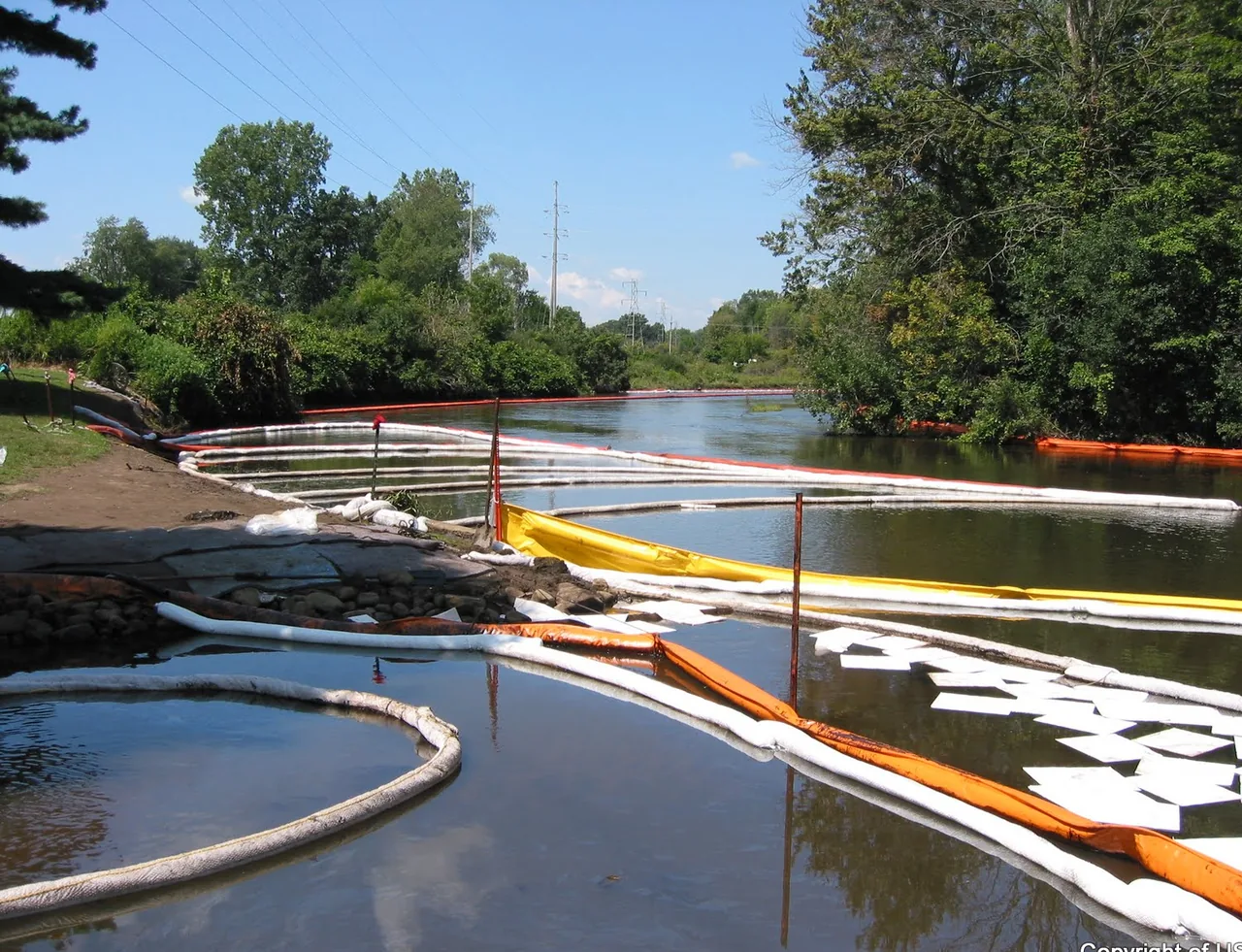
An absorbent boom is a long sleeve of sorbent material, joined end to end and handled by a rope or by the fittings at its ends, that is laid on water to hold and soak up spilled oil, or placed along a wall, around a machine or across a doorway to take up liquid on land. Most commercial booms are filled with meltblown polypropylene, a plastic that oil wets and water does not, so the fiber fills with oil while the boom keeps floating. It is the working end of a spill kit and the polishing tool of a shoreline clean-up: it recovers the last liters that skimmers and pumps leave behind, and it turns them into a solid waste that has to be carried away.
Two ideas run through this page. The first is that a boom is a consumable with a finite capacity, and that every liter it recovers becomes a bulky oily waste that must be retrieved, stored, transported and disposed of, often at greater cost than the sorbent itself. The second is that a laboratory rating overstates what a boom does in wind, waves and current. A buyer who sizes a stock from nameplate capacity alone will run short in a real event, and a crew that leaves booms in place too long will create a second pollution problem in the material they meant to use as a cure. Both ideas are quantified below, so that a plant engineer can turn the volume of the largest container on site into a number of booms and a disposal route.
Photo: USEPA Environmental-Protection-Agency, public domain, via Wikimedia Commons
Five things decide an absorbent boom purchase: the liquid to be recovered and whether it is oil or water-based; the state of the oil, from light diesel to weathered heavy fuel; the working capacity per boom, which is lower than the rated figure; the place where the boom will sit, in sheltered water, along a shoreline or on a factory floor; and the route for the used boom, because collection and disposal often cost more than the sorbent. Each has its place in the selection chapter.
Chapter 1 / 06
What an Absorbent Boom Is and How It Works
Sorbent is the general word for an insoluble solid that takes up a liquid, and a material can do this in two ways. An adsorbent holds the liquid on its external and internal surfaces. An absorbent draws the liquid into its body, swells with it and does not let it out under pressure. Most spill products, booms included, are adsorbents, although trade catalogs call them absorbent. A boom is one of four forms in which sorbent is sold, beside loose granules, material enclosed in netting as pillows or socks, and flat sheets, mats and rolls. The boom is the form chosen when the liquid is on water, or when a line on land has to be enclosed rather than covered.
The place of the boom in a response is narrow and specific. Response guidance puts sorbents to best use in the final stages of shoreline cleaning, in recovering small pools of oil that no other technique can reach, and in catching the oil that runs off rocks while they are washed. It rates them unsuitable for the open sea and less effective on viscous oils and on oils that have weathered and emulsified. A plant crew meets the everyday case: a ruptured gasket, a leaking mechanical seal, or an IBC tank that has put lubricating oil on a floor or into a ditch. For a volume of that size a boom is the fastest tool there is, and for a large slick at sea it is the slowest.
Uptake begins with wetting. A liquid spreads over a solid only when its surface tension is below the critical surface tension of that solid. Seawater has a surface tension of about 60 to 65 mN/m and oil about 20 mN/m. Polypropylene has a critical surface tension of 29 mN/m, which lies between the two: oil wets it and spreads into it, water does not. Polytetrafluoroethylene, at 18 mN/m, takes up neither. This one property, more than the shape of the fiber, explains why a boom left out in the rain still floats and why it can lift oil from the surface of water. It also explains the first rule of storage: anything that changes the surface of the fiber, detergent for example, changes the performance of the boom.
Wetting lets oil enter; capillary action moves it through the fiber network, and the viscosity of the oil sets the speed. Light crude penetrates in a matter of seconds. Heavy fuel oil, and oil that has weathered and emulsified at sea, take several hours or do not penetrate at all. A fine-pored structure takes low-viscosity oil quickly but clogs with thicker oil, while a coarse open structure works on viscous oil and cannot hold a light one. The boom on a plant shelf therefore has an oil it handles well and an oil it handles badly, and a store that holds only one size is making a bet on which oil will spill.
Rate and capacity both follow the exposed surface area. A homogeneous cylinder of meltblown fiber has a low surface-to-volume ratio, so oil reaches the outer skin and stops; cut open after use, such a boom often shows a dry core. A sleeve of loose strands, or of chopped filler held in netting, exposes more surface and takes oil deeper, at the cost of strength, because the structure is only as strong as its net. For the same reason a smaller diameter recovers a larger share of its filler: less material sits unused in the center. The choice between one thick boom and two thin ones is therefore a choice between easy handling and less waste per liter recovered.
A boom on water must float before it is full and after. Natural fibers such as straw and sawdust float well when dry, take up water over time and sink. Polypropylene stays afloat because it repels water, and suppliers state that their booms will not sink even when saturated with oil. Saturation is hard to see from outside and may require cutting the boom open. A full boom takes up nothing more and can release oil again, and a boom lifted carelessly loses oil too, because the weight of the liquid makes it sag and squeezes oil out of its pores. A line of booms is therefore watched, exchanged and recovered, and never left as a permanent fence.
Chapter 2 / 06
Absorbent Boom Types and Structural Variants
The standard article for water is the oil-only boom. A sock skin holds the filler, a strong mesh sleeve protects the skin, and the filler is polypropylene that repels water and takes up oil and other hydrocarbons. A nylon rope runs along the boom, and sturdy hardware at the ends lets booms be joined with overlap into a line of almost any length. One supplier lists a 5 in (127 mm) boom 10 ft (3 m) long, four to a package, made of a poly-blend filler in polyester netting with metal hardware, and rates it for short-term use. The same form is offered for wastewater troughs, loading docks, ponds and rivers. Its service is short-term by the supplier's own description.
Universal booms take up both oil-based and water-based liquids, which makes them the general-purpose article for machinery, production areas, warehouses, workshops and maintenance. They are usually gray, a color chosen to hide the oil and grease they have picked up. The price of that range is selectivity: a boom that takes up water has no place on a water surface, because it loads with water and loses both its buoyancy and its capacity for oil. On a factory floor the choice between the two types comes down to one question: is the liquid that can spill here oil, a coolant, a solvent, or a mixture of them. Where the answer is a mixture, the liquid is contained first and the water-based part is recovered with a universal product.
Suppliers group booms into three families: universal, oil-only and hazmat. The hazmat family is the one to look at where the liquid at risk is an acid, an alkali or a solvent rather than oil, because an oil-only boom depends on oil wetting its fiber and will not take up a water-based chemical. The same suppliers publish a chemical compatibility chart, and that chart, read against the liquids actually held on site, from a chemical reagent store to a plating line, is the document that settles whether a boom can be used on a given spill. A boom that softens in the liquid, or that releases what it has taken up, is worse than no boom at all.
Booms that enclose loose natural material in netting are the cheapest form. Straw, peat, sawdust, paper pulp, cork, wool and even chicken feathers are used, and improvised booms of straw in netting have given short-term protection where nothing else was at hand. These fillers expose a large surface, and the boom is simpler to deploy and to retrieve than loose granules. Their weaknesses are structural and physical. Strength is limited to the netting, which can burst in waves or on rocks and release its filling as a second pollutant. Organic filler takes up water and sinks, and left wet it ferments, which complicates recovery, storage and disposal. In cost per meter they win; in cost per liter recovered they rarely do.
The continuous synthetic boom is the form most plants buy. It is made of homogeneous melt-blown polypropylene, stores for long periods, deploys and retrieves with little effort, and can reach a high oil-to-sorbent ratio when it is used to capacity. In tests, synthetic sorbents have recovered up to 40 times their weight of oil, against about 10 times for organic products and as little as 2 times for inorganic mineral fillers. Its limits follow from the same dense structure: it is less effective on weathered and viscous oils, and it does not readily decompose, which narrows the disposal routes open to the used boom. A small-diameter continuous boom recovers a larger share of its filler and produces less waste for the same liter of oil.
The product this page is not is the containment boom: a floating barrier with a freeboard above the water and a skirt below it, built to hold oil in place for a skimmer and taking up none. Some makers combine the two ideas in a disposable sorbent boom with a ballasted skirt for harbours. For viscous oil, loose polypropylene fibers are tied into snare or pom-pom strands and strung along a rope as snare boom, which works by adhesion to a large surface rather than by penetration. Pads, rolls and pillows are flat or squat forms for surfaces, and a land sock is the same article used to steer a liquid away from a drain. Each has its use; this page follows the linked floating line.
Chapter 3 / 06
Key Specification Parameters and Standards
The specification that decides the most is the pair of diameter and length. A 5 in (127 mm) boom 10 ft (3 m) long is the stock size, an 8 in (203 mm) diameter is offered for larger volumes, and 20 ft (6 m) lengths are made to order. Rated capacity follows from them: one supplier gives up to 8 gal (30 L) per 5 in boom and up to 17 gal (64 L) per 8 in boom, which is 32 and 68 gal (121 and 257 L) for a package of four. The listing gives a weight of 22 lb (10 kg) for the smaller size and 32 lb (14.5 kg) for the larger without saying whether that is one boom or the package, which is one of the details an inquiry should settle before stock is carried to a remote shoreline or up a flight of stairs in a plant.
Rated capacity is a laboratory number. The maker of a competing material reports that oil enters a polypropylene boom at its surface and that the surface then blinds over, so the center never fills; in its comparison a 5 in polypropylene boom recovered 0.19 gal/ft (about 2.4 L per m) of thick crude, where the nameplate figure is near 0.8 gal/ft (10 L per m). Response specialists make the same point about sorbent tests in general: results obtained under laboratory or controlled field conditions mislead once wind, waves and current act on the boom. Working capacity should therefore be set below the rated figure, by a margin the buyer chooses and writes into the spill plan.
The laboratory method named for adsorbent ratings in the United States is ASTM F726. Its scope is laboratory tests that describe the performance of adsorbents in removing crude oils, non-emulsified oils and other floating, immiscible liquids from the surface of water. It states that it gives a basis for comparison of adsorbents in a consistent manner, and that it is not appropriate for absorbent materials, which are covered by ASTM F716. The standard expresses its values in SI units. When a supplier quotes a capacity, the buyer should ask which oil was used, at what viscosity, with what contact time, and whether the figure is uptake or oil still held after the boom has drained.
Parameter
Typical value or rating
What it decides
Diameter
5 to 8 in (127 to 203 mm)
How much filler can stay unused at the core
Length
10 ft (3 m); 20 ft (6 m) to order
Number of joints along a shoreline or wall
Rated capacity, 5 in boom
up to 8 gal (30 L) per boom
Quantity to hold against a spill volume
Rated capacity, 8 in boom
up to 17 gal (64 L) per boom
Fewer booms for a large pool
Package
4 booms; 32 or 68 gal (121 or 257 L)
Stock unit and shelf space
Listed weight
22 or 32 lb (10 or 14.5 kg)
Handling; ask whether it is per boom or per package
Critical surface tension
29 mN/m polypropylene; oil about 20; seawater 60 to 65
Oil wets the fiber, water does not
Penetration time
seconds (light crude) to hours (heavy fuel oil)
Contact time; which oils suit a boom
Oil-to-sorbent ratio by weight
up to 40:1 synthetic; 10:1 organic; 2:1 inorganic
Mass of waste per liter recovered
Measured uptake, thick crude
0.19 gal/ft (2.4 L per m), 5 in boom
Design margin below nameplate
Laboratory test
ASTM F726 for adsorbents on water
Comparability of two suppliers' ratings
Used boom, drained
No free-flowing oil; 40 CFR Part 279
Whether it is used oil or solid waste
Chapter 4 / 06
Selection and Duty Calculations
Selection runs in a fixed order: confirm that a sorbent is the right tool at all, match the type to the liquid, convert the spill volume into a number of booms using a working capacity below the nameplate rating, and check that the used boom can be taken out and disposed of.
The first question is whether a boom belongs in the plan at all. Guidance for marine spills discourages sorbents as a primary tool on a large slick at sea: the material is hard to place on the oil and hard to get back, it adds bulk to the waste, and the mixture of oil and sorbent hinders skimmers without doing anything for containment. Sorbents earn their place on sheltered water, along shorelines and on land. In a plant that means drip trays, loading docks, outfalls, ponds and the calm water of an interceptor, and it does not mean the cooling water outfall of a river in flood. A spill plan that puts booms first on open water has the order of its techniques reversed.
The state of the oil sets the form. Diesel, kerosene and light lubricating oil enter a standard boom in seconds, and a 5 in boom handles them well. Heavy fuel oil, bitumen and oil that has weathered and emulsified barely penetrate; for these a small-diameter boom or a snare boom works better, because more of the material actually sees the oil. Two other techniques conflict with sorbents. Dispersants lower both the oil-loving and the water-repelling properties of the fiber, so the boom takes up water instead of oil, and loose sorbent blocks weirs and pumps, while a boom set in the wrong place restricts the flow of oil into a skimmer.
Water and land call for different types. On water, with oil alone to recover, the oil-only boom is the only sensible choice: it floats, it works in rain, and it does not spend its capacity on water. Where the liquid is water-based, a coolant or a solvent on a floor, a universal boom is needed, and where it is corrosive the hazmat family is. A universal boom on water is a mistake that looks like success for a few minutes. Booms of natural filler suit calm, sheltered water for a short stay and places where industrial stock is far away; they do not belong in surf or against rocky shores, where the netting will open.
Sizing is a short calculation with one deliberate conservative step. Take the largest credible spill volume at the location, for example a 55 gal (208 L) drum. Divide it by the working capacity per boom, which is the rated capacity reduced for the oil and the conditions. At nameplate, a 5 in boom rated at 8 gal (30 L) would need 7 booms. At the measured uptake for thick crude, about 1.9 gal (7 L) per 10 ft boom, the same drum needs 29. A package of four therefore covers only a small leak, and a single drum is a several-package event on any realistic figure. The same arithmetic, with the largest container in each storage area, gives the stock list.
Deployment conditions narrow the choice further. The limits that currents, wind and sea state impose on a containment boom apply with more force to a sorbent boom, which is light when new and can be lifted by the wind unless it is lashed or anchored; some booms carry lashing points for this. Saturated booms are heavy to haul, so the retrieval path and the labour are planned before deployment, and booms are kept clear of pumps they could block. Every meter deployed becomes waste, so the cheapest choice per meter is rarely the cheapest per liter recovered: organic filler costs less to buy and needs several times the mass to do the same work.
Three checks close the calculation. The first is the waste volume: a boom that has taken up 40 times its weight is mostly oil by mass, and its bulk after draining decides how many bins and what size of bunded store the event will need. The second is labour: recovery is by hand, and the time for it is part of the response, not an afterthought. The third is the disposal route, which must exist before the boom is used, because a plant that recovers oil it cannot legally send anywhere has moved the problem from the floor to the yard. Running the three checks before the stock is bought is what turns a shelf of booms into a spill plan.
Condition on site
What it does to a boom
Practical decision
Light or medium oil, freshly spilled
Penetrates the fiber in seconds
Standard 5 in (127 mm) continuous boom
Heavy fuel oil, or weathered and emulsified oil
Penetration takes hours or fails
Small-diameter or snare boom; expect a partly dry core
Rain, or oil on standing water
Water must not load the boom
Oil-only polypropylene boom
Coolant, solvent or water-based liquid on a floor
Oil-only fiber will not take it up
Universal boom; hazmat boom if corrosive
Calm harbour or pond
Boom can drift or be lifted by wind
Lash or anchor; a ballasted-skirt type can also contain
Open water with a large slick
Retrieval is inefficient and waste grows
Containment boom and skimmers first; sorbent to polish
Shore being washed, or oil lifted on successive tides
Oil runs off and remobilises
Anchored boom line for passive cleaning
Dispersant use planned nearby
Fiber loses its selectivity
Keep the two techniques apart
Spill up to about 20 gal (76 L)
3 booms at nameplate; 11 at measured uptake
Keep at least one package of four within reach
Disposal route for oily waste is limited
Every boom used must go somewhere
Smallest workable diameter; drain before storage
Chapter 5 / 06
Installation, Maintenance, and Typical Failure Modes
Deployment takes minutes and recovery takes hours, so most of the planning belongs on the recovery side. The steps below follow published guidance for shoreline and sheltered-water use and the handling notes that suppliers print with their boom. Read them as a sequence; each one protects the next.
Confirm the liquid, its state and the wind and current before any boom is opened; a dispersant or a skimmer working nearby rules the boom out.
Join booms end to end with the overlap the hardware allows, so that no joint opens when the line is pulled.
Fix the rope at one end to a post, a stake or an anchor, and lead the line across the flow rather than along it.
Lay the line on the water from the windward or upstream side, so that oil drifts onto it, and secure the far end.
On land, lay the boom as a sock around the source, along the foot of a wall, or across a doorway or a drain opening.
Watch for saturation: lift a section to judge its weight, or cut a boom open when in doubt, and replace the line before oil passes.
Recover the line by its rope, support the full length while lifting, and let free oil drain into a container before the boom is bagged.
On land the boom is a guide and a small dam. It is laid around the base of a leaking machine, along the foot of a wall to stop oil reaching a doorway, and across the front of a floor drain, where a few seconds of work prevent a spill from becoming a sewer incident. A boom does not stop a flowing liquid. In a running ditch or a stream it has to be anchored behind a containment boom, and the guidance for such places is to use it to catch what the barrier lets through, not to hold the flow itself. Socks of smaller diameter follow the shape of a curb or a machine foot more closely than a stiff boom, and for that reason they stay where they are put.
Time in place is short by design. Suppliers describe oil-only boom as suited to short-term use, and response experience is that booms begin to degrade and fall apart within hours where wave action or abrasion on rocks works on them. In a netted boom the filler escapes as soon as the netting opens and becomes a second pollutant. In still indoor air a boom can stay around a machine as long as it is watched and exchanged before it is full. Stored stock has its own clock: ultraviolet light degrades synthetic fiber, so booms are kept in their packaging on a storage rack or under cover, and organic booms are kept dry against mildew, rodents and insects.
Recovery is manual and heavy. A saturated boom holds several times its own weight in liquid, and dragging it over rocks tears the skin. It is lifted by the rope with the length supported, and some oil is squeezed out as it leaves the water. Used boom is drained of free oil, compressed where that is possible to cut its bulk, and stored in an enclosed container; stacked in a heap, the lower booms leak oil that can contaminate a deck, a quay or the ground. A temporary store is bunded, with an HDPE geomembrane beneath it where the ground is not sealed. A sump pump or a diaphragm pump moves the drained liquid, kept clear of fibers by a strainer.
There is little to maintain on a disposable boom and a few decisions to make about it. Oil can be recovered from some synthetic sorbents by wringing, by centrifuge or by solvent extraction, and wringing is the practical one, although the number of cycles a boom endures before it tears is small. The routes for the used article are reuse, incineration, landfill and, for organic filler, biodegradation. Incineration of synthetic sorbent calls for high-temperature, closely controlled combustion so that dioxins, polyaromatic hydrocarbons and hydrogen chloride are not released. In some countries oiled sorbent is treated as hazardous waste and only a designated landfill may take it.
In the United States the used-oil rules draw a clear line. Material contaminated with used oil from which the oil has been drained as far as possible, so that no free-flowing oil remains, is not used oil and may be handled as solid waste unless it shows a hazardous waste characteristic. Material that is to be burned for energy recovery stays regulated as used oil, and the oil drained from the boom is regulated as used oil in any case. Many states add stricter rules of their own. Handling calls for safety gloves and safety glasses, protective clothing where the liquid is hot or corrosive, a respirator or a dust mask around loose fiber, and a gas detector where vapor can collect; an eye wash station, a fire extinguisher and a warning sign belong beside the store.
Failure mode
How it shows
What to do
Premature saturation
Sheen passes the line; boom stops taking oil
Exchange before the slick arrives; use more small booms
Blinded skin, dry core
Boom heavy outside, dry when cut open
Smaller diameter or snare boom; cut to judge saturation
Waterlogging and sinking
Boom sits low, then disappears
Oil-only polypropylene on water; keep organic booms on land
Skin or netting torn
Loose fiber on the water or floor
Recover early; avoid rocks, surf and rough handling
Drift or lift by wind and tow
Line moves off the oil or parts
Lash or anchor both ends; do not tow
Oil released on lifting
Drips and sagging sections
Support the length; drain over a container
Blocked pumps and skimmer weirs
Loss of suction or flow
Keep sorbent away from recovery intakes
Leachate from stored waste
Oil pooling under the heap
Enclosed, bunded store; drain first
Vapor and dust exposure
Irritation, flammable atmosphere
Safety glasses, gloves, respirator, gas detector
Chapter 6 / 06
Industry Applications and Procurement Checks
The uses cluster where small volumes meet something worth protecting. Industrial plants and warehouses keep booms for leaks at a mechanical seal or gland packing, at an expansion joint or a flexible metal hose, from the drain of a knockout drum or a slug catcher, and around drum and IBC tank stores. Power stations and factories with cooling water intakes hang snare boom across the mouth to keep floating oil off the screens. Ports, marinas and fishing harbours place a line around an industrial hose during bunkering, or around a fish cage in calm water. Shoreline teams anchor boom to catch the run-off from washing oiled rocks and the oil that tides lift out of salt marsh and rock armour.
Before an order, the buyer should fix six items. The type: oil-only, universal or hazmat, decided from the liquids on site and the chemical compatibility chart. The size: diameter and length that suit the shape of the areas to protect. The capacity and its basis: a rated figure with the test method, the oil and the contact time stated. The construction: sock skin, netting, rope and end hardware that join with overlap. The package: how many booms, how heavy, and how long the stock keeps in the store. And the end: which licensed route takes the used boom and what the plant has to do to it first. A supplier who cannot answer the last question has sold half a product.
For an inquiry, state the liquids that can spill at the site with their approximate volumes, and whether they are oils, water-based liquids or corrosive chemicals. State where the boom will be used: on sheltered or open water, along a shoreline, or indoors on a floor. Ask for the diameter and length offered, the number of booms per package and the package weight. Ask for the rated absorption capacity per boom, with the test method, the test oil and its viscosity, the contact time, and whether the figure is uptake or capacity retained after drainage. Ask what the filler, the skin and the netting are made of, how booms join, and whether the rope and the end hardware are included. Request the safety data sheet, any limit on storage life, and the storage conditions. For hazmat use, request the chemical compatibility chart. Finally ask how the used boom should be drained, stored and disposed of, and whether the supplier will take it back.
FAQ
How does an absorbent boom pick up oil?
Oil wets the fiber and is drawn into it. Polypropylene has a critical surface tension of 29 mN/m, below the surface tension of seawater at about 60 to 65 mN/m but above that of oil at about 20 mN/m, so oil spreads into the fiber and water does not. Capillary action then carries the oil through the network of pores: in seconds for a light oil, and over hours, or not at all, for a heavy or weathered oil. Most products hold the oil on their surfaces as adsorbents. The boom keeps floating because the water-repelling fiber takes up almost no water, even when it is full of oil.
What is the difference between oil-only and universal absorbent booms?
An oil-only boom is filled with polypropylene that repels water and takes up oil and other hydrocarbons, so it floats, works in rain and spends none of its capacity on water. A universal boom takes up both oil-based and water-based liquids, which suits coolants, solvents and mixtures on a factory floor, and its gray color hides what it has absorbed. The choice follows from the liquid and the place: oil on water calls for oil-only, a water-based liquid on land calls for universal, and an aggressive chemical calls for the hazmat family, chosen against a chemical compatibility chart.
How much oil does an absorbent boom hold?
Ratings depend on size. One supplier rates a 5 in (127 mm) boom 10 ft (3 m) long at up to 8 gal (30 L), and an 8 in (203 mm) boom at up to 17 gal (64 L). These are best-case laboratory figures. In one comparison with thick crude, a 5 in polypropylene boom took up about 0.19 gal/ft, near 1.9 gal (7 L) per boom, because oil entered only the outer layer and the core stayed dry. For planning, use a working capacity well below the rating: in that example about one quarter of it, and a lower share again for viscous or weathered oil. Ask the supplier for the test basis behind the figure.
Will an absorbent boom sink when it is full?
A polypropylene oil-only boom should not. Its fiber repels water, and suppliers state that the boom will not sink even when saturated with oil, which is lighter than water. Booms filled with natural material behave differently: straw and sawdust float well when dry, take up water over time and eventually sink, and a netted boom can burst in waves and lose its filler. A universal boom on water will also load with water and sit low. A boom that rides low in the water has taken on water or is overfull, and it should be recovered and replaced at once.
How long can an absorbent boom stay in the water?
Only as long as it takes to fill, and in most cases no more than hours. Suppliers describe oil-only boom as suited to short-term use. In waves or against rocks a boom can begin to degrade and fall apart within a matter of hours, and its netting can open and release the filler. Once saturated it recovers no more oil and can release what it holds, so it has to be removed promptly. In calm indoor use a boom can stay around a machine while it is watched. In storage, keep booms in their packaging and out of sunlight, because ultraviolet light degrades synthetic fiber over time.
How is a used absorbent boom disposed of?
Drain it first. Under the United States used-oil rules in 40 CFR Part 279, material contaminated with used oil is not used oil once the oil has been drained as far as possible and no free-flowing oil remains; it is then solid waste unless it shows a hazardous waste characteristic. Material burned for energy recovery stays regulated as used oil, as does the oil drained from it. Many states are stricter, and in some countries oiled sorbent is hazardous waste. The routes are controlled incineration, a licensed landfill, and biodegradation for organic fillers. Ask the disposal contractor how the boom is to be handled before it is used, not after.
Can absorbent booms be used at sea or with a containment boom?
Not as the main tool. Response guidance discourages sorbents as a primary response on the open sea: they are hard to place on a slick, hard to get back, and they add bulk to the waste while doing nothing to help containment. A sorbent boom also has no skirt and holds no depth of oil, and towing it to collect sheen usually tears it. It earns a place in sheltered water, along shorelines and around intakes, behind a containment boom or where nothing larger is needed. Some makers combine the two ideas in a disposable sorbent boom with a ballasted skirt, which helps in harbours for small spills.