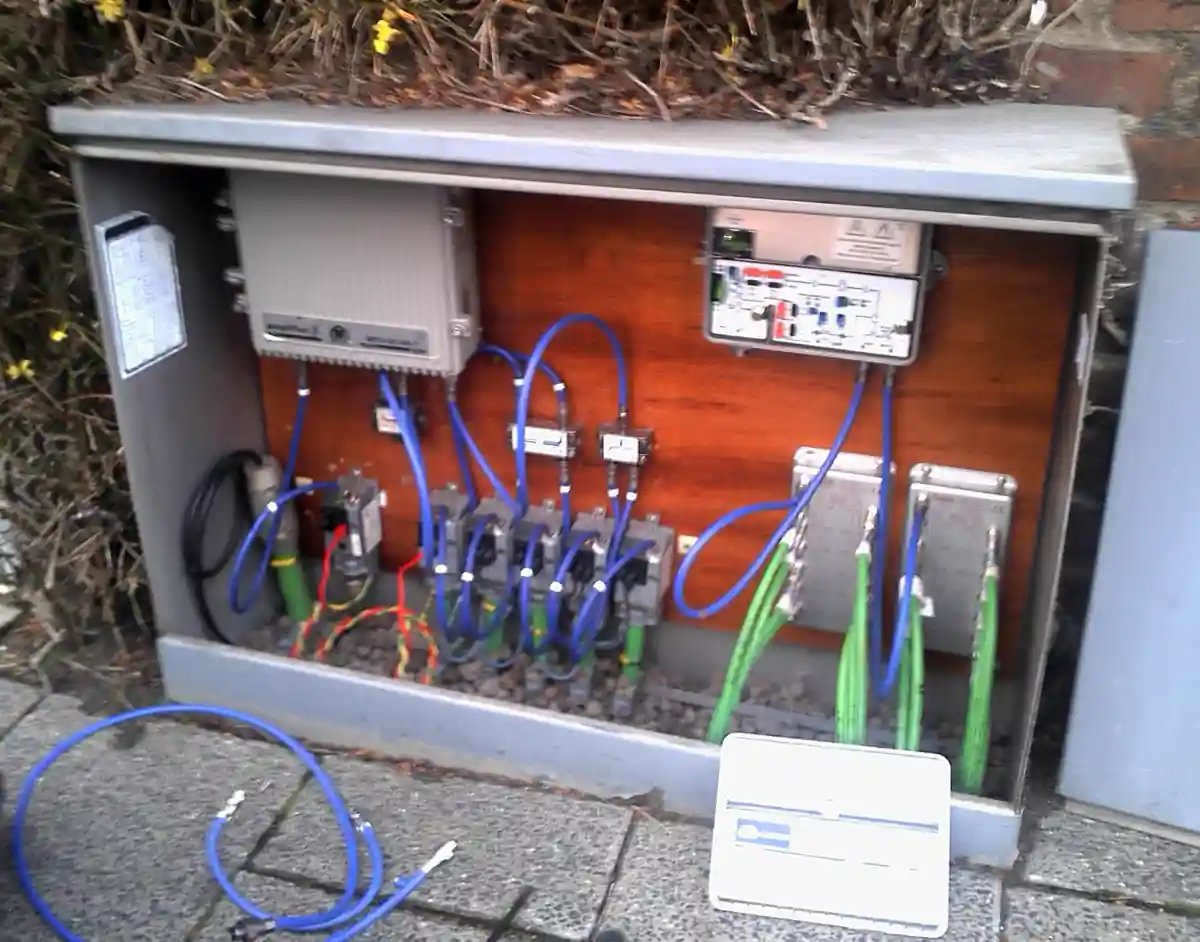
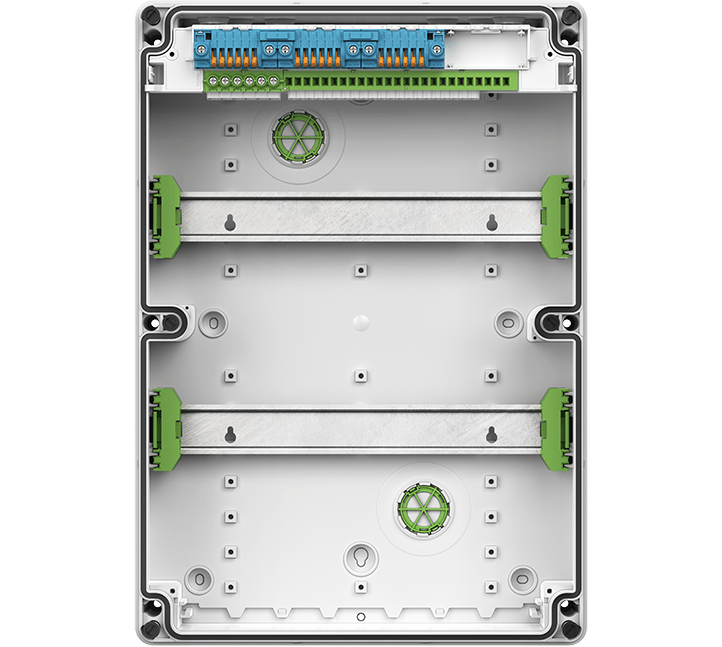
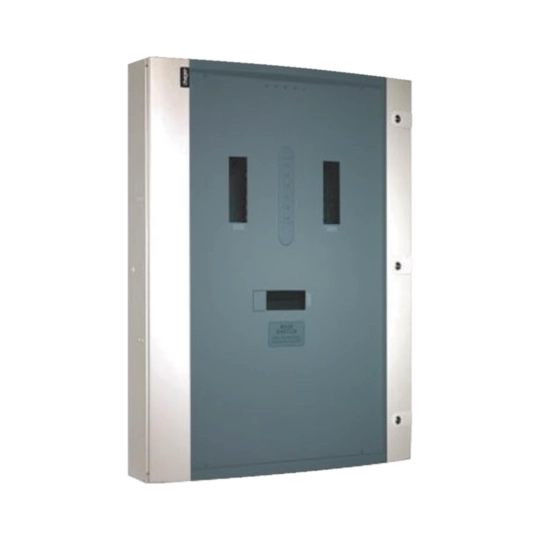
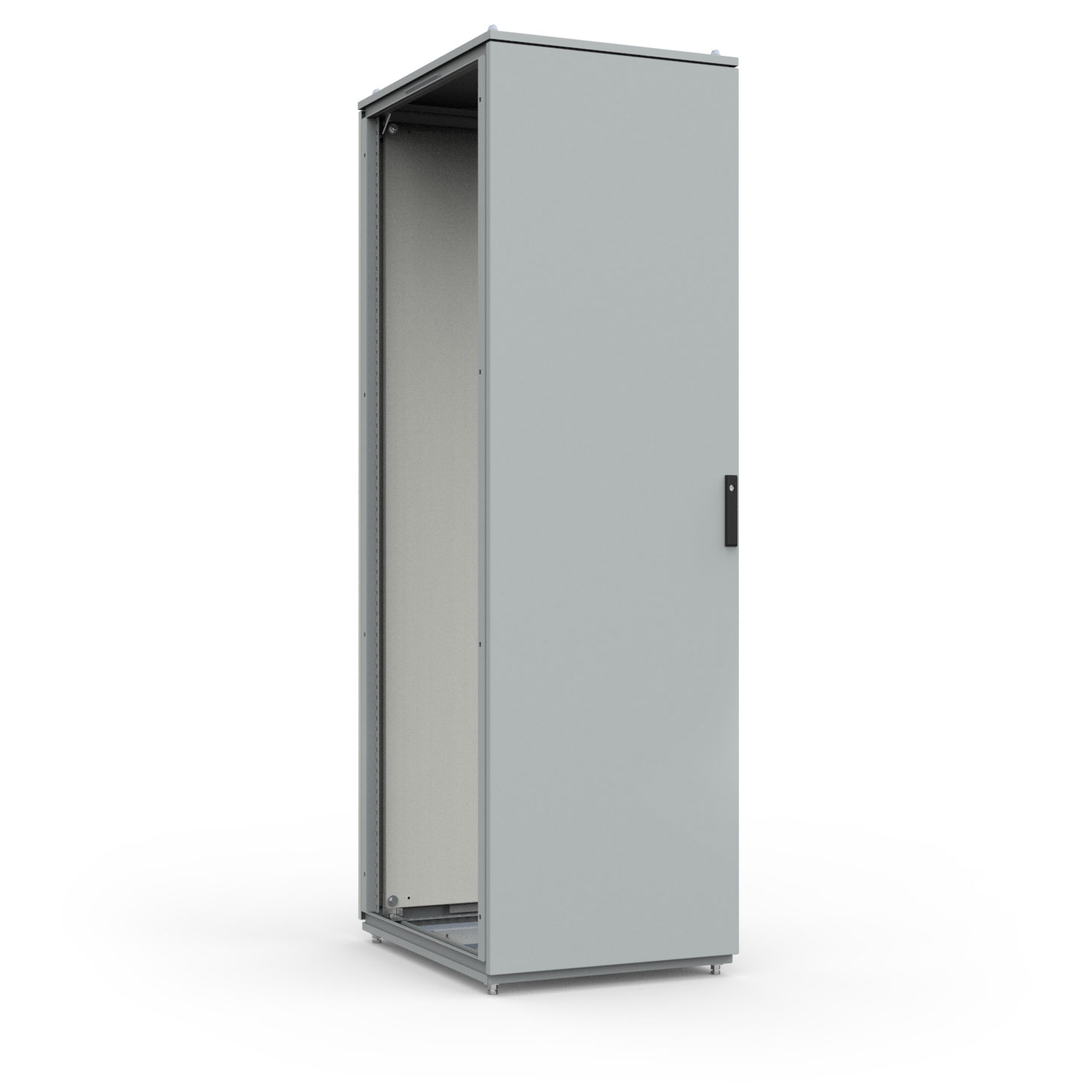
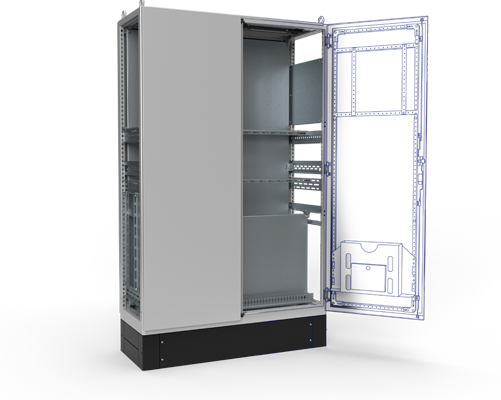
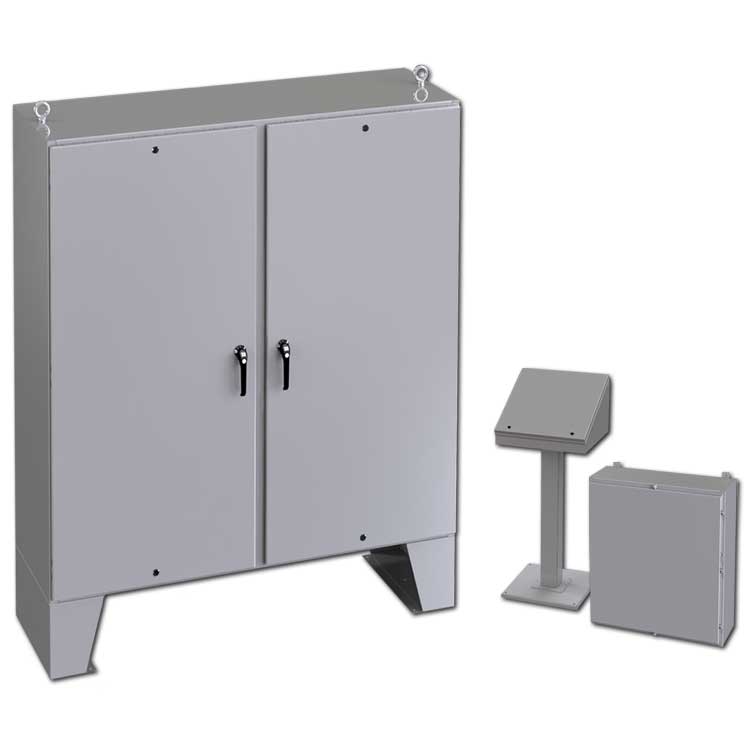
Cable distribution cabinets belong to the broader category of low-voltage switchgear and controlgear assemblies (PTTA or TTA), but they are distinguished by their public-network duty cycle, their outdoor siting in publicly accessible spaces, and by the dimensional standardization that allows different manufacturers' cabinets to be swapped on the same prepared foundation or wall recess. The term used by Chinese-language standards is 电缆分配柜 or 电缆分线箱 (cable distribution cabinet, CDC), and a related item defined in the same family is the substation cable distribution board (SCDB). The equipment falls under IEC 61439-5, with national implementations in Germany (DIN SPEC 43629 series, DIN VDE 0636-2) and in China (GB 7251.5).
Within a distribution network the cabinet is the point where a feeder cable from a transformer substation transitions into a multiplicity of service or branch circuits. Inside the enclosure, NH fuse rails, disconnectors, busbars, and cable terminations are arranged on a standardized footprint, and the enclosure provides the mechanical and ingress protection that allows the equipment to be touched, opened, or approached by members of the public with the appropriate degree of safety. Sizing is governed not only by the electrical rating of the in-and-out cabling but also by the dimensional grid that lets the cabinet mate with civil works prepared for the standard. ABB's Kabeldon Connect IT and CDCP-series product lines, both marketed under the Cable Distribution Cabinets heading, are representative vendor implementations of this standardized equipment class.
A cable distribution cabinet is a low-voltage switchgear assembly used in public power distribution networks to terminate, joint, fuse, and sectionalize service and feeder cables. It is a free-standing, floor- or wall-mounted enclosure sited in publicly accessible outdoor areas. Standards including DIN SPEC 43629-4 and GB 7251.5 govern its construction, dimensions, interchangeability, and type-testing.
Chapter 1 / 06
Fundamentals and Working Principle
A cable distribution cabinet is a piece of public-network distribution infrastructure. It is the boundary element in a low-voltage distribution system at which a feeder cable from a distribution transformer is split into a number of outgoing service or branch cables. The cabinet encloses the jointing, fusing, and disconnecting means required to perform that transition safely. Per the scope statement of DIN SPEC 43629-4:2017-09, the equipment is intended for public power supply and is installed in publicly accessible outdoor locations; the standard also accommodates variants installed in wall recesses or along fence lines, where the available construction depth is small.
Electrically, the cabinet does not transform voltage and does not perform any active function. It is a passive node in the network. The feeder cable enters through a gland or grommet at the base, is terminated onto an incoming busbar or terminal, and is then split across a number of outgoing ways. Each outgoing way is typically protected by an NH (low-voltage high-rupturing-capacity) fuse rail conforming to DIN VDE 0636-2, and may also pass through a disconnector or load-break switch so that the outgoing circuit can be isolated without disturbing the rest of the network. Because the cabinet is a passive assembly, its electrical performance is dominated by the busbar system, the fuse links, the cable terminations, and the cable cross-sections the cabinet is designed to accept.
Mechanically, the cabinet is a sheet-metal or glass-fibre-reinforced enclosure with a hinged or removable door, a locking system to deter unauthorized access, a plinth or base frame to mount the unit on a prepared foundation, and cable entry plates at the bottom that can be knocked out or cut to suit the cables being terminated. ABB's Kabeldon Connect IT system exemplifies the modular form: a busbar-based backplate carries prefitted fuse rails and disconnectors, and the cabinet is supplied in sizes that map to the dimensional grid of DIN 43629. The depth of the cabinet is the dimension that distinguishes the low-construction-depth variants covered by DIN SPEC 43629-4 from the standard-depth cabinets covered by the earlier parts of the DIN 43629 family.
From a system perspective, the cable distribution cabinet provides four services to the network operator. It provides sectionalizing points so that faulted sections of the low-voltage network can be isolated. It provides fusing so that a fault on a service cable does not propagate back into the feeder. It provides a convenient jointing location where new service connections can be added or where cables can be re-routed during network changes. And it provides an enclosure that allows all of the above to be carried out in a publicly accessible area while keeping live conductors inaccessible to the public and protected from weather, impact, and vegetation.
Passive low-voltage node at the feeder-to-service transition
Splits a single feeder cable into multiple outgoing circuits
Houses NH fuse rails, disconnectors, and cable terminations on a standardized footprint
Outdoor, publicly accessible siting in the standard configuration
Mechanical and ingress protection allow public access to the enclosure with live parts shielded
Chapter 2 / 06
Specifications and Key Parameters
Because the cable distribution cabinet is a passive, mechanically standardized assembly, its specification sheet is dominated by dimensional parameters, fuse-rail counts, enclosure ratings, and the cross-section ranges of cables it accepts, rather than by an electrical rating curve. The dimensional parameters are constrained by the interchangeability requirement that is the central purpose of the DIN 43629 family, so the same civil-works preparation can accept cabinets from any compliant manufacturer.
ABB offers its cable distribution cabinet range under the Kabeldon family, and groups its product literature under the heading Cable Distribution Cabinets. Two documented product lines are the Kabeldon Connect IT distribution boards and the CDCP-series, the latter being explicitly described in its product title as having a depth of 382 mm, a value that maps directly onto the low-construction-depth cabinets covered by DIN SPEC 43629-4. The fact that the CDCP-series is identified in the ABB product URL by its depth is itself evidence of how strongly the standard's depth grid governs the market.
Inside the enclosure, the busbar and fuse-rail arrangement is sized for NH fuse links of specific sizes, principally NH 00, NH 1, NH 2, and NH 3. The dimensions of the cabinet determine the minimum number of fuse rails that must be installable, and the standard therefore couples cabinet size to a minimum equipment count rather than to a maximum. Sizing also has to accommodate the cable cross-sections used in public low-voltage networks, which typically range from 35 mm² for service taps up to 240 mm² for the main feeder.
Enclosure ratings follow the IEC 60529 IP code, and cabinets for outdoor public siting are typically required to reach at least IP54, with higher ratings available for particularly exposed sites. Mechanical impact protection (IK code) is also relevant because of the public-siting requirement, and door-opening and locking arrangements are standardized to allow operation by utility staff with standardized tools while preventing public access. The same product family also includes variants with transparent or opaque doors, and with or without a meter panel, depending on whether the cabinet is used purely for distribution or for combined distribution and metering duties.
The parameters that recur in vendor datasheets are therefore: cabinet height, width, and depth; the size designation drawn from the DIN 43629 grid (commonly 00 C, 0 C, and 1 C in the low-depth series); the number of NH 00, NH 1, NH 2, or NH 3 fuse rails the cabinet can accept; the rated current of the busbar system; the rated voltage (400/230 V three-phase four-wire for public low-voltage distribution in Europe, with equivalent ratings in other regions); the IP and IK ratings of the enclosure; the material of the enclosure (typically hot-dip galvanized sheet steel, stainless steel, or glass-fibre-reinforced polyester); and the colour and surface finish of the cabinet. Each of these parameters is a contractual point between the utility and the manufacturer, and each is constrained by the relevant product standard.
Parameter
Value (source-verbatim)
Cabinet type (vendor line)
Connect IT (ABB Kabeldon distribution boards)
Cabinet type (vendor line)
CDCP-series, depth 382 mm (ABB Cable Distribution Cabinets)
Standard governing low construction depth
DIN SPEC 43629-4:2017-09 (low-construction-depth cable distribution cabinet)
Reference standards cited by DIN SPEC 43629-4
DIN EN 61439-5; DIN VDE 0636-2 (per S4)
Reference standards cited by DIN SPEC 43629-4
DIN 43629-1:1978; DIN 43629-2:1978; DIN 43629-3:1982; DIN EN 61439-5:2015; DIN VDE 0636-2:2014; HD 60269-2:2013 (per S5)
Switchgear-assembly standard
DIN EN 61439-5 (VDE 0660-600-5) per S4
Low-voltage fuse standard for NH fuse links
DIN VDE 0636-2:2014; HD 60269-2:2013 (per S5)
Cabinet sizes (low-depth series)
Size 00 C, 0 C, 1 C (per S4, S5)
NH fuse link sizes accommodated
NH 00, NH 2, NH 3 (per S5)
Chinese cable distribution cabinet (CDC) standard
GB 7251.5-2008 (per S7)
CDC definition per GB 7251.5-2008
Cable distribution cabinet (CDC) used in public networks for power distribution (per S7)
CDCP-series cabinet depth
382 mm (per S2 title)
Standard for assemblies for power distribution in public networks (CN)
GB 7251.5-2008, low-voltage switchgear and controlgear assemblies Part 5 (per S7)
Enclosure IP rating
varies by model
Busbar rated current
varies by model
Cabinet overall height, width, depth (mm)
varies by model
Number of outgoing ways
varies by model
Cable cross-section range (mm²)
varies by model
Chapter 3 / 06
Types and Configurations
Cable distribution cabinets are commonly classified by their depth, by their enclosure material, by their door arrangement, and by the type of switching and fusing equipment fitted inside. Each classification axis corresponds to a real engineering choice made at the design or procurement stage, and each is constrained by the standards that govern the product class.
The most fundamental classification is by construction depth. The DIN 43629 family has historically standardized the full-depth public-network cabinet, and DIN SPEC 43629-4:2017-09 was issued to add a low-construction-depth variant for situations where the cabinet has to fit into a wall recess, a fence line, or other confined space. The low-depth series is designated by sizes 00 C, 0 C, and 1 C, and the published ABB CDCP-series product is explicitly identified by its 382 mm depth, which falls within the low-depth envelope. A given civil works preparation can be set to the appropriate depth to accept either the standard or the low-depth cabinet, because the height of the cabinet is fixed and the depth is set by how deep the cabinet is set into the prepared base or wall.
The second classification is by enclosure material. Cabinets intended for outdoor public siting are most commonly built in hot-dip galvanized sheet steel, which gives a long service life under atmospheric exposure, or in glass-fibre-reinforced polyester (GRP), which is non-conductive and is preferred where additional safety against touch voltage is required or where the cabinet is sited in a corrosive environment such as near a coast. Stainless steel cabinets are also available for particularly demanding environments. The choice of material affects the IP rating that can be achieved, the colour stability under UV exposure, the weight of the cabinet, and the cost.
The third classification is by the fuse-rail size fitted inside. NH 00 fuse rails are used for smaller outgoing ways and service connections, while NH 1, NH 2, and NH 3 fuse rails are used for larger outgoing feeders. A cabinet designated as 00 C in the low-depth series will typically accommodate NH 00 fuse rails only, a 0 C cabinet will accommodate a mix including NH 2, and a 1 C cabinet will accommodate the full range up to NH 3. The number of ways the cabinet can carry is then set by the size of the cabinet and the size of the fuse rails.
A fourth classification is by door arrangement and switching equipment. Single-door cabinets are the most common. Two-door cabinets are used where the busbar and the outgoing ways need to be segregated, or where a meter panel is fitted on one side and a distribution panel on the other. Cabinets with transparent doors allow visual inspection of the fuse-rail status without opening the door, which is useful in public areas. Some variants integrate load-break switches or disconnectors so that outgoing ways can be operated without removing fuse links, which is increasingly specified by utilities that want to reduce the exposure of their staff to live parts during normal switching.
By construction depth: standard-depth vs low-construction-depth (DIN SPEC 43629-4 sizes 00 C, 0 C, 1 C)
By enclosure material: galvanized sheet steel, GRP, stainless steel
By fuse-rail size: NH 00, NH 1, NH 2, NH 3 (per DIN VDE 0636-2)
By door arrangement: single-door, two-door, transparent door
By internal equipment: fuse rails only, fuse rails plus disconnectors, fuse rails plus load-break switches
Chapter 4 / 06
Selection Criteria for Procurement
The procurement of a cable distribution cabinet is driven by the network duty, the available civil works, the standard that applies, and the operational practices of the purchasing utility. The decision is rarely about choosing a vendor; it is more often about selecting the right size within a vendor's standardized range so that the cabinet fits the prepared foundation, accommodates the cables that need to be terminated, and provides the right number of outgoing ways for the loads to be served.
The first criterion is dimensional conformance. The cabinet must be of a size and depth that fits the civil works already prepared, or that will be prepared, on the site. In markets where DIN 43629 governs, the sizes 00 C, 0 C, and 1 C in the low-depth series are the reference points, and the depth of 382 mm given for the ABB CDCP-series is a typical value to be checked against the available wall recess or foundation depth. The height of the cabinet is also standardized within the family, which means that different sizes line up visually on a street and can be installed alongside one another on a continuous foundation.
The second criterion is the number and size of outgoing ways. The procurement specification has to state the number of service or branch circuits that need to be supplied from the cabinet and the rating of each. From this, the size of the fuse rails (NH 00, NH 2, NH 3) and the size designation of the cabinet (00 C, 0 C, 1 C) follow. It is standard practice to specify some spare ways so that the cabinet has capacity for future load growth without requiring a replacement.
The third criterion is the enclosure specification. The IP rating, the IK rating, the enclosure material, the colour, the finish, and the door and lock arrangement all need to be called off. The lock in particular is operationally important: the utility will have a master-key system, and the cabinet must accept the lock cylinder or hasp that the utility uses, otherwise staff will not be able to open the cabinet with their standard keys. For publicly sited cabinets, anti-vandalism features such as reinforced hinges, three-point locking, and concealed hinges are commonly required.
The fourth criterion is the cable entry and termination arrangement. The cabinet has to accept the cable cross-sections and types used in the network, including the bending radii of the cables, and the gland plate at the base has to be appropriate for the number and diameter of cables that will enter. For sites with mixed cable types, for example a paper-insulated legacy feeder alongside a modern XLPE service cable, the cabinet must be able to terminate both, and this may require a specific gland plate or a separate adapter. The fifth criterion is compliance, which is covered in the next chapter.
Dimensional conformance to the prepared civil works and to the DIN 43629 size grid
Number and rating of outgoing ways, with provision for future spare ways
Enclosure IP and IK rating appropriate to the outdoor public siting
Enclosure material (galvanized steel, GRP, stainless steel) matched to environment
Door and lock arrangement compatible with the utility's keying system
Cable entry and termination arrangement matched to feeder and service cable types
Country-specific compliance (DIN EN 61439-5, DIN SPEC 43629-4, GB 7251.5)
Chapter 5 / 06
Standards, Compliance, and Testing
Cable distribution cabinets sit at the intersection of three families of standards: the general low-voltage switchgear and controlgear assembly standard (IEC 61439-5, implemented in Europe as DIN EN 61439-5 / VDE 0660-600-5 and in China as the equivalent GB standard), the product-specific standard for cable distribution cabinets (DIN 43629 family, including DIN SPEC 43629-4 for the low-depth variants, and GB 7251.5-2008 for the Chinese market), and the standard for the low-voltage fuses fitted inside the cabinet (IEC 60269 / HD 60269-2 / DIN VDE 0636-2).
The product-specific standard for cable distribution cabinets with low construction depth is DIN SPEC 43629-4:2017-09, which supersedes the 2017 and 2007 predecessors. Its scope statement is explicit: it applies to cable distribution cabinets for public power supply that are installed in publicly accessible outdoor locations, and it additionally ensures that cabinets installed in wall recesses or fence lines, where the available depth is small, are interchangeable. The interchangeability is the key feature: it means that a foundation or wall recess prepared for a 0 C cabinet, for example, will accept a 0 C cabinet from any manufacturer that complies with the standard, so the utility is not locked in to a single vendor.
DIN SPEC 43629-4:2017-09 references DIN EN 61439-5 (VDE 0660-600-5) and DIN VDE 0636-2 as the standards the cabinet must satisfy. The earlier version, DIN SPEC 43629-4:2017, listed a more detailed set of references, including DIN 43629-1:1978, DIN 43629-2:1978, and DIN 43629-3:1982 for the related parts of the dimensional family, DIN EN 61439-5:2015 for the parent switchgear standard, DIN VDE 0636-2:2014 for the NH fuse links, and HD 60269-2:2013 for the harmonized fuse standard. The fusion of these references shows that a compliant cabinet has to pass the type-testing of IEC 61439-5, the dimensional conformance of the DIN 43629 family, and the fuse-rail fit of DIN VDE 0636-2.
In the Chinese market, the equivalent product standard is GB 7251.5-2008, Low-voltage switchgear and controlgear assemblies Part 5: Particular requirements for assemblies for power distribution in public networks. The standard defines the cable distribution cabinet (cable distribution cabinet, CDC) and the related substation cable distribution board (SCDB) as fixed-installed, type-tested assemblies (TTA) for three-phase power distribution in public networks, and states that SCDBs and CDCs shall comply with GB 7251.1-2005 in addition to the specific requirements of GB 7251.5. The standard explicitly excludes open-type assemblies.
Testing under IEC 61439-5 covers verification of temperature-rise limits, dielectric properties, short-circuit withstand strength of the busbar system, mechanical operation of switching devices, the degree of protection of the enclosure (IP code), and the clearance and creepage distances. For cable distribution cabinets specifically, additional type-tests verify the dimensional interchangeability claimed under DIN 43629, the fit of the NH fuse rails under DIN VDE 0636-2, the mechanical strength of the door and locking system, and the resistance of the enclosure to environmental ageing. Routine tests at the factory cover continuity of protective circuits, insulation resistance, and functional checks of the switching and fusing equipment.
DIN SPEC 43629-4:2017-09 for low-construction-depth cable distribution cabinets
DIN EN 61439-5 (VDE 0660-600-5) for the parent low-voltage switchgear assembly standard
DIN VDE 0636-2 / HD 60269-2 for NH low-voltage high-rupturing-capacity fuse links
GB 7251.5-2008 for cable distribution cabinets (CDCs) in public networks in China
GB 7251.1-2005 as the parent standard for SCDBs and CDCs in the GB family
Interchangeability across manufacturers as a documented objective of the standard
The market for cable distribution cabinets is structurally a utility-procurement market, not a retail market. The end customers are distribution network operators, both municipal and regional, and the procurement is typically conducted through framework agreements under which the utility issues call-off orders against a pre-qualified supplier list. Because the equipment is governed by interchangeable dimensional standards, utilities can and do switch suppliers over the life of a framework, which keeps the market competitive at the level of price, delivery, and after-sales service rather than at the level of basic design.
On the supply side, the market includes large multinational low-voltage equipment manufacturers with established cable distribution cabinet ranges, regional panel builders, and local fabricators. ABB's Kabeldon family, marketed under the Cable Distribution Cabinets heading and including the Connect IT distribution boards and the CDCP-series at 382 mm depth, is a representative example of a major-vendor product line. Kabeldon is a long-established brand and the product range is documented in ABB's own product catalogue. Comparable product lines exist from other major low-voltage switchgear vendors, and a complete market review would have to draw on sources outside the present set.
The buying process for a utility procurement typically proceeds in four stages. In the first stage, the utility issues a technical specification that calls off the relevant standard (e.g. DIN SPEC 43629-4:2017-09 or GB 7251.5-2008), the size designation (00 C, 0 C, or 1 C), the enclosure material, the IP and IK ratings, the number and size of NH fuse rails, the cable entry arrangement, and the lock type. In the second stage, suppliers respond with a compliant offer, often accompanied by a type-test certificate and a dimensional drawing showing conformance to the standard. In the third stage, the utility evaluates the offers on price, delivery, after-sales support, and the supplier's track record. In the fourth stage, the utility places a call-off order under the framework agreement, and the supplier delivers the cabinets, typically in batches, against the agreed delivery schedule.
Two commercial points recur in the market. First, because the standards are dimensional rather than fully detailed, suppliers have latitude in the details of the busbar system, the cable terminations, the door furniture, and the finish, and these details are often the subject of negotiation. Second, the lead time for cable distribution cabinets is typically weeks rather than days, because the busbar system is built to order and the cabinet itself is often painted or coated to the utility's specification. Utilities therefore maintain a safety stock of cabinets or hold framework agreements with guaranteed delivery times, and procurement is rarely a one-off spot purchase.
The total cost of ownership for a cable distribution cabinet is dominated by the initial purchase price and the installation cost, with the maintenance cost being modest for a well-specified cabinet over a service life that typically exceeds 30 years. The most common causes of premature replacement are vehicle impact, vandalism, water ingress due to a degraded door seal, and corrosion of the enclosure in a particularly aggressive environment. Specifying a higher IK rating, a higher IP rating, or a more corrosion-resistant enclosure material at the time of purchase reduces the probability of each of these failure modes.
End customers are distribution network operators procuring under framework agreements
ABB Kabeldon (Connect IT, CDCP-series depth 382 mm) is a representative vendor product line
Buying process: technical specification, compliant offer, evaluation, call-off order
Suppliers have latitude in busbar, terminations, door furniture, and finish
Lead times are typically weeks because assembly is built to order
Service life typically exceeds 30 years when correctly specified
Most common failure modes: vehicle impact, vandalism, seal degradation, corrosion
FAQ
What is a cable distribution cabinet used for?
A cable distribution cabinet is a passive low-voltage switchgear assembly used in public power distribution networks. It terminates a feeder cable from a distribution transformer and splits it into multiple outgoing service or branch circuits, with NH fuse rails and disconnectors providing protection and isolation at a publicly accessible outdoor location.
What standards govern cable distribution cabinets?
Cable distribution cabinets are governed by the general low-voltage switchgear standard IEC 61439-5 (implemented as DIN EN 61439-5 / VDE 0660-600-5 in Germany and as part of the GB 7251 family in China), by the product-specific standard DIN 43629 (with DIN SPEC 43629-4:2017-09 covering low-construction-depth variants), and by GB 7251.5-2008 in the Chinese market. The NH fuse links fitted inside are governed by IEC 60269, implemented as DIN VDE 0636-2 / HD 60269-2.
What is the difference between a standard-depth and a low-construction-depth cable distribution cabinet?
The low-construction-depth variant is intended for installation in confined spaces such as wall recesses or along fence lines. It is covered by DIN SPEC 43629-4:2017-09, is designated by sizes 00 C, 0 C, and 1 C, and is exemplified by the ABB CDCP-series product line at a depth of 382 mm. The standard-depth cabinet has a larger installation depth and is covered by the earlier parts of the DIN 43629 family.
Why are cable distribution cabinets dimensionally standardized?
Dimensional standardization is the central purpose of the DIN 43629 family. It allows a foundation or wall recess prepared for a given size to accept a compliant cabinet from any manufacturer, so the utility is not locked in to a single vendor and can switch suppliers over the life of the installation.
What fuse-rail sizes are used inside cable distribution cabinets?
Cable distribution cabinets are typically fitted with NH (low-voltage high-rupturing-capacity) fuse rails to DIN VDE 0636-2. The most common sizes are NH 00 for smaller service circuits, and NH 1, NH 2, and NH 3 for larger outgoing feeders. The cabinet size designation (00 C, 0 C, 1 C) determines which fuse-rail sizes can be accommodated and the minimum number of fuse rails that must be installable.
What IP and IK ratings are typical for a cable distribution cabinet?
Because cable distribution cabinets are sited outdoors in publicly accessible areas, they are typically required to achieve at least IP54 under IEC 60529 for protection against dust and water ingress, and a meaningful IK rating under IEC 62262 for mechanical impact resistance. Higher IP and IK ratings are available for particularly exposed sites. The exact rating varies by model and is called off in the procurement specification.