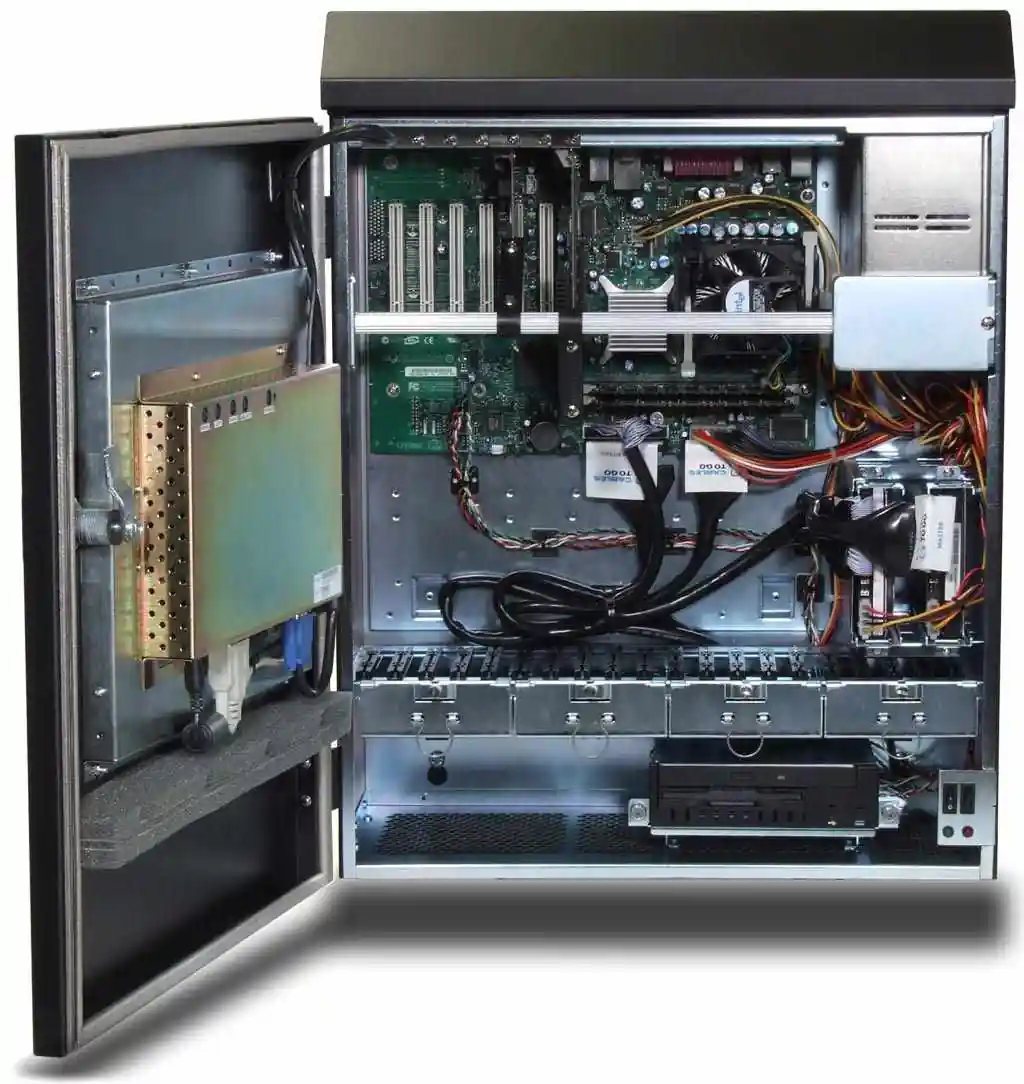
Within industrial automation, the acronym IPC most often denotes a hardened personal computer platform, typically a chassis plus backplane assembly that accepts an ATX or MicroATX motherboard, disk drive bays, a power supply, and managed cooling. Vendors such as Advantech publish detailed datasheets for these chassis, listing drive bay counts, fan models, dimensions, weight, and environmental limits. The relevant parameters come from real product documentation rather than from generic industry ranges.
The same three letters also identify the trade association, founded in 1957 and headquartered in Bannockburn, Illinois, that standardizes the assembly and production of electronic equipment. The association is accredited by the American National Standards Institute and publishes standards such as IPC-A-610 (Acceptability of Electronic Assemblies) and IPC-A-600 (Acceptability of Printed Boards). The remainder of this page treats the chassis category as the primary subject and references the standards body where the sources support it.
An Industrial PC, commonly abbreviated IPC, refers to a ruggedized computer platform designed for factory floors, control cabinets, and other harsh operating environments. In parallel, IPC is also a global trade association, formerly the Institute of Printed Circuits and now the Global Electronics Association, that publishes widely used acceptability and design standards for the electronics industry. This page covers both meanings where the source materials address them.
Chapter 1 / 06
Fundamentals and Working Principle
An Industrial PC chassis provides the mechanical and electrical framework for a computing node that lives outside the clean office environment. According to the Advantech IPC-7130 and IPC-7130L datasheet, the chassis family is described as a Desktop or Wallmount Chassis for ATX or MicroATX Motherboard with Dual Hot-Swap 3.5 inch Drive Bays. The chassis holds a motherboard, disk drives, a power supply, and cooling fans in a single enclosure designed to mount on a wall or sit on a workbench, with bidirectional mounting confirmed by the manufacturer.
The working principle rests on standard PC architecture, but with components selected for industrial use. The datasheet describes shockproof drive bays, a lockable front door that prevents unauthorized access, and LED indicators for system fault detection. The IPC-7130 variant includes a built-in Intelligent System Module that enables whole system fan control and hardware monitoring, while the IPC-7130L is a lower-cost variant with simplified LED and control indicators. Both versions are specified for low noise operation through PWM controlled fans.
Cooling and airflow are integral to the platform. The IPC-7130 specification lists one 12 cm fan at 82 CFM plus one 6 cm fan at 27.72 CFM, and the IPC-7130L uses a single 12 cm fan at 82 CFM. The chassis also supports front accessible USB 2.0 ports and includes an easy-to-maintain reusable fan filter. These design choices reflect the need to operate through elevated ambient temperatures, vibration, and particulate exposure typical of plant environments.
Internally, the chassis is built around an ATX or MicroATX motherboard, which means the system is functionally a conventional PC at the BIOS and operating system level. The differentiator is the surrounding enclosure: reinforced drive bays, a hold-down clamp, a lockable door, an alarm reset, and industrial-grade power supply options. The result is a node that drops into a control cabinet and exposes a familiar computing stack to operators and integrators.
Chapter 2 / 06
Specifications and Key Parameters
The most concrete specification values come from the Advantech IPC-7130 and IPC-7130L datasheet. The IPC-7130 has 1 external 5.25 inch bay, 1 internal 3.5 inch bay, and 2 hot-swap 3.5 inch trays. The IPC-7130L provides 1 external 5.25 inch bay and 1 internal 3.5 inch bay, and 2 SATA 3.5 inch device trays. Power and HDD LEDs are present on both, and the IPC-7130 adds power, fan, temperature, and HDD fault indicators along with alarm reset and system reset controls.
Cooling is defined by fan model and airflow. The IPC-7130 ships with one 12 cm fan rated at 82 CFM and one 6 cm fan rated at 27.72 CFM. The IPC-7130L uses a single 12 cm fan at 82 CFM. Both designs rely on PWM control for low noise operation and feature an easy-to-maintain reusable fan filter accessible from the front of the unit. Front accessible USB 2.0 is provided on both variants.
Environmental limits are explicitly stated. Operating temperature is 0 to 40 degrees Celsius (32 to 122 degrees Fahrenheit) and non-operating temperature is -20 to 60 degrees Celsius (-4 to 140 degrees Fahrenheit). Operating humidity is 10 to 85 percent at 40 degrees Celsius non-condensing, and non-operating humidity is 10 to 95 percent at 40 degrees Celsius non-condensing. Operating vibration from 5 to 500 Hz is 0.5 Grms, and non-operating vibration is 2 G. Operating shock is 10 G with 11 ms duration, half sine wave. Physical dimensions are 200 mm wide by 320 mm high by 480 mm deep, which equals 7.9 by 12.6 by 18.9 inches, and weight is 12.8 kg (28.2 lb).
Power supply options for the IPC-6608 and IPC-6606 series are documented in the Advantech IPC-6608 datasheet. The PS-250ATX-ZE is a 250 W ATX supply with PFC, AC 115 or 230 V selectable input, and outputs of +5 V at 27 A, +3.3 V at 20 A, +12 V at 13 A, -12 V at 0.8 A, -5 V at 0.3 A, and +5 Vsb at 2 A, with UL, TUV, CB, and CCC safety approval and an MTBF of 100,000 hours at 25 degrees Celsius. The PS-300ATX-ZBE is 300 W with AC 110 to 240 V full-range input and outputs of +5 V at 30 A, +3.3 V at 28 A, +12 V at 15 A, -12 V at 0.8 A, -5 V at 0.3 A, and +5 Vsb at 2 A. The RPS-300ATX-ZE is also 300 W, AC 100 to 240 V full-range, with +5 V at 25 A, +3.3 V at 18 A, +12 V at 16 A, -12 V at 0.5 A, -5 V at 0.5 A, and +5 Vsb at 2 A. All three carry 100,000 hour MTBF at 25 degrees Celsius and UL, TUV, CB, and CCC certification.
Parameter
Value (Advantech IPC-7130)
Value (Advantech IPC-7130L)
Form factor
Desktop or Wallmount chassis for ATX or MicroATX motherboard
Desktop or Wallmount chassis for ATX or MicroATX motherboard
5.25 inch external bay
1
1
3.5 inch internal bay
1
1
Hot-swap 3.5 inch trays
2
2 (SATA)
Cooling fans
1 x 12 cm at 82 CFM plus 1 x 6 cm at 27.72 CFM
1 x 12 cm at 82 CFM
Front I/O
2 x USB 2.0 (front accessible)
2 x USB 2.0 (front accessible)
LED indicators
Power, fan, temperature, HDD
Power, HDD
Controls
Power, alarm reset, system reset
Power, system reset
Intelligent System Module / hardware monitoring
Yes (CPU and system fan speed, CPU and system temperature, on supported Advantech motherboards)
Not enabled
Operating temperature
0 to 40 degrees C (32 to 122 degrees F)
0 to 40 degrees C (32 to 122 degrees F)
Non-operating temperature
-20 to 60 degrees C (-4 to 140 degrees F)
-20 to 60 degrees C (-4 to 140 degrees F)
Operating humidity
10 to 85 percent at 40 degrees C, non-condensing
10 to 85 percent at 40 degrees C, non-condensing
Non-operating humidity
10 to 95 percent at 40 degrees C, non-condensing
10 to 95 percent at 40 degrees C, non-condensing
Operating vibration (5 to 500 Hz)
0.5 Grms
0.5 Grms
Non-operating vibration
2 G
2 G
Operating shock
10 G, 11 ms duration, half sine wave
10 G, 11 ms duration, half sine wave
Dimensions W x H x D
200 x 320 x 480 mm (7.9 x 12.6 x 18.9 in)
200 x 320 x 480 mm (7.9 x 12.6 x 18.9 in)
Weight
12.8 kg (28.2 lb)
12.8 kg (28.2 lb)
Chapter 3 / 06
Types and Configurations
Industrial PC chassis come in several broad mechanical families. The Advantech IPC-7130 and IPC-7130L represent the desktop and wallmount family, with bidirectional mounting on a wall or workbench. A separate family documented at the vendor is the 4U rackmount chassis represented by the IPC-610-H, described in the source as a 4U rackmount chassis that supports LED indicators and audible alarm notification, accommodates up to 15 add-on cards, and provides shock resistant drive bays for 3 x 5.25 inch and 1 x 3.5 inch devices, with front accessible USB and PS/2 interfaces.
Within the desktop and wallmount family, the IPC-7130 and IPC-7130L differ in feature set. The IPC-7130 carries the Intelligent System Module for hardware monitoring and supports more LED and control functions, while the IPC-7130L is a simplified variant with a reduced LED set and no Intelligent System Module. Both share the same drive bay count and physical dimensions, so the choice is about feature set rather than mechanical fit.
Power supply and backplane options create a second axis of configuration. The IPC-6608 and IPC-6606 datasheet lists multiple ordering codes. The IPC-6608BP-00E ships without a power supply and supports AT or ATX. The IPC-6608BP-25ZE bundles the PS-250ATX-ZE 250 W supply and ships with CE marking. The IPC-6608BP-30ZE bundles the PS-300ATX-ZBE 300 W supply and also carries CE marking. The IPC-6606 family follows the same pattern with the IPC-6606BP-00XE, IPC-6606BP-25ZE, IPC-6606P3-25ZE (which adds the PCA-6106P3-0D2E backplane), and IPC-6606P3-30ZE variants. The 80 Plus Bronze grade is the specified efficiency tier for the IPC-7130 family options.
A third axis of variation is motherboard form factor. The chassis datasheet explicitly supports both ATX and MicroATX motherboards. The IPC-7130 Intelligent System Module feature, including CPU and system fan speed and temperature monitoring, is enabled only with specific Advantech motherboards such as the AIMB-78X series and PCE-51XX or PCE-71XX series mainboards. The IPC-610-H 4U rackmount form factor supports 80 plus single power supplies or redundant supplies up to 500 W, according to the source. Mounting depth and accessory options, such as rubber feet and GPU power cables, are documented as part numbers in the ordering information table of the IPC-7130 family.
Desktop or wallmount family (IPC-7130, IPC-7130L): bidirectional mounting, ATX or MicroATX, dual hot-swap 3.5 inch bays
4U rackmount family (IPC-610-H): up to 15 add-on cards, 3 x 5.25 inch plus 1 x 3.5 inch shock resistant bays, redundant power option up to 500 W
Backplane-equipped family (IPC-6606P3 variants): PCA-6106P3-0D2E backplane bundled for slot-card SBCs
Power supply tiers: PS-250ATX-ZE 250 W ATX with PFC, PS-300ATX-ZBE 300 W ATX with PFC, RPS-300ATX-ZE 300 W ATX with PFC
Ordering codes bundle or omit the power supply, set AT versus ATX, and add or omit CE marking
Chapter 4 / 06
Selection Criteria for Procurement
Procurement should begin with mechanical fit. The datasheet gives 200 x 320 x 480 mm dimensions and 12.8 kg weight, which defines the cabinet space, mounting surface, and load rating required. Bidirectional mounting gives the installer a choice between wall and workbench orientation, and the 4U rackmount IPC-610-H is the alternative when rack integration matters more than footprint.
Next, the integrator must match the motherboard form factor. The chassis accepts ATX or MicroATX boards, but the Intelligent System Module hardware monitoring features are only available with specific Advantech boards such as the AIMB-78X, PCE-51XX, or PCE-71XX mainboards. If centralized fan and temperature monitoring is required, the motherboard selection is constrained. If those features are not required, the IPC-7130L variant or a third party motherboard is acceptable.
Drive bay configuration drives storage architecture. The IPC-7130 provides 2 hot-swap 3.5 inch trays, while the IPC-7130L provides 2 SATA 3.5 inch device trays and is otherwise identical. Storage redundancy, hot-swap serviceability, and capacity targets should be mapped to these counts. The 1 external 5.25 inch and 1 internal 3.5 inch bay are shared, and they accommodate optical drives, removable media, or fixed internal storage depending on application.
Power and thermal budgets are the final filter. The 250 W and 300 W ATX options are documented with specific rail currents and MTBF, all at 100,000 hours at 25 degrees Celsius, and all carrying UL, TUV, CB, and CCC safety approvals. Operating temperature is 0 to 40 degrees Celsius, and operating vibration is 0.5 Grms from 5 to 500 Hz with 10 G, 11 ms half sine shock. If the deployment exceeds these limits, the chassis is not qualified, and a higher ruggedized platform must be selected. Accessories such as the GPU power cable kit (primary 4-pin to 6+2 pin PCIe and secondary B4P Molex to 6+2 pin PCIe) should be specified in parallel when graphics cards with one or two power connectors will be installed.
Verify cabinet dimensions, weight capacity, and wall versus rack mounting
Confirm ATX or MicroATX motherboard choice and Intelligent System Module compatibility
Match hot-swap 3.5 inch tray count to storage redundancy and serviceability goals
Select 250 W or 300 W ATX supply by rail current and confirm UL, TUV, CB, CCC approvals
Confirm operating temperature, humidity, vibration, and shock envelopes against site survey
Order accessories such as GPU power cables and rubber feet with the chassis
Chapter 5 / 06
Standards, Compliance, and Testing
In parallel with the hardware category, the IPC trade association is a major publisher of electronics standards. According to the Wikipedia article on IPC, the organization was founded in 1957 as the Institute of Printed Circuits, later became the Institute for Interconnecting and Packaging Electronic Circuits, and in 1999 adopted the IPC name with the tagline Association Connecting Electronics Industries. It is accredited by the American National Standards Institute (ANSI) as a standards developing organization, and it is the publisher of the most widely used acceptability standards in the electronics industry.
Two standards are repeatedly cited as the workhorses of electronics acceptance. IPC-A-610, Acceptability of Electronic Assemblies, is used worldwide by original equipment manufacturers and EMS companies, and there are more than 3,600 trainers worldwide certified to train and test on the standard. IPC-A-600, Acceptability of Printed Boards, covers bare board acceptance and is referenced as the primary source of visual support for bare board acceptability in PCB manufacturing history.
The standards portfolio is broad. The Wikipedia entry lists general documents such as IPC-T-50 (Terms and Definitions), design specifications such as IPC-2221 (Generic Standard on Printed Board Design) and IPC-7351B (Generic Requirements for Surface Mount Design and Land Pattern Standards), material specifications such as IPC-4101 (Laminate Prepreg Materials Standard for Printed Boards) and IPC-4562 (Metal Foil for Printed Wiring Applications), and performance and inspection documents such as IPC-A-600 and IPC-A-610. Repair standards are also published, for example IPC 7721 4.6.3-1998 for edge contact repair by plating method.
At the chassis level, the Advantech datasheet records specific compliance evidence. The PS-250ATX-ZE, PS-300ATX-ZBE, and RPS-300ATX-ZE power supplies are documented with UL, TUV, CB, and CCC safety approvals and an MTBF of 100,000 hours at 25 degrees Celsius. Certain IPC-6608 and IPC-6606 ordering codes carry CE marking, specifically the BP-25ZE and BP-30ZE variants. The chassis level environmental compliance is defined by the published operating and non-operating temperature, humidity, vibration, and shock curves, which serve as the test envelope for acceptance at the integrator level.
IPC-A-610: Acceptability of Electronic Assemblies, used worldwide by OEMs and EMS companies
IPC-A-600: Acceptability of Printed Boards, primary visual reference for bare board acceptance
IPC-2221: Generic Standard on Printed Board Design
IPC-7351B: Generic Requirements for Surface Mount Design and Land Pattern Standards
IPC-4101: Laminate Prepreg Materials Standard for Printed Boards
IPC-4562: Metal Foil for Printed Wiring Applications
The vendor landscape for industrial PC chassis is concentrated among a small number of specialists. The source materials document Advantech as a chassis manufacturer with a multi-family portfolio that includes the IPC-7130 desktop and wallmount family, the IPC-610-H 4U rackmount family, and the IPC-6608 and IPC-6606 backplane chassis with bundled power supply options. The same vendor publishes the AIMB and PCE motherboard lines referenced in the Intelligent System Module section. This narrow sourcing is consistent with the broader industrial PC market, but the supplied sources do not provide a market share breakdown and none should be inferred.
The buying process for these chassis is part number driven. The IPC-7130 series is ordered as IPC-7130-00B or IPC-7130-50B, and the IPC-7130L series as IPC-7130L-00B. The 80 Plus Bronze power supply option is the documented efficiency tier. The IPC-6608 and IPC-6606 chassis use ordering codes that bundle or omit the power supply, choose AT or ATX, and add or omit CE marking, allowing the buyer to standardize on a single SKU pattern across multiple sites.
Accessories are purchased against explicit part numbers. The Advantech source lists a GPU power cable for cards with a primary 4-pin 12 V to 6+2 pin PCIe connector and a secondary B4P Molex to 6+2 pin PCIe connector, four rubber feet, screws for the rubber feet, and fan filters sized 100 x 90 x 3 mm for the IPC-6606 and 127 x 127 x 5 mm for the IPC-6608. These accessories are listed as part numbers 1999806020 and 1999806030 for the fan filters, with the GPU cables referenced as 1700029268-01 and 1700024754-01 in the ordering notes.
Buyers should treat the datasheet as the authoritative specification and not extrapolate beyond it. The Advantech datasheet itself states that all product specifications are subject to change without notice, and that the Intelligent System Module CPU and system fan speed and temperature monitoring only functions with specific Advantech motherboards. For volume procurement, request a vendor confirmation against the current revision of the datasheet, and for hazardous or high-shock environments, request the actual test certificates that back the published 0.5 Grms operating vibration and 10 G, 11 ms operating shock ratings. The IPC-7130 family datasheet, the IPC-6608 and IPC-6606 datasheet, the IPC-610-H product page, and the IPC trade association Wikipedia article together form the documented basis for a defensible purchase.
Identify the mechanical family: desktop or wallmount, 4U rackmount, or backplane chassis
Select a part number with the correct power supply option and CE marking requirement
Confirm motherboard compatibility for Intelligent System Module features where required
Order accessories such as GPU power cables, rubber feet, and fan filters by part number
Request current revision of vendor datasheet and supporting test certificates before release
FAQ
What does IPC stand for in industrial computing?
In industrial computing, IPC is shorthand for Industrial PC, a ruggedized computer platform built around an ATX or MicroATX motherboard in a chassis designed for factory and cabinet environments. Examples in the Advantech catalog include the IPC-7130, IPC-7130L, IPC-610-H, IPC-6608, and IPC-6606.
What does IPC stand for as a standards body?
IPC is also a global trade association founded in 1957 as the Institute of Printed Circuits, later renamed the Institute for Interconnecting and Packaging Electronic Circuits, and known since 1999 as IPC with the tagline Association Connecting Electronics Industries. It is now branded as the Global Electronics Association and is accredited by ANSI as a standards developing organization.
What are the dimensions and weight of the Advantech IPC-7130?
The Advantech IPC-7130 and IPC-7130L share the same dimensions of 200 x 320 x 480 mm (7.9 x 12.6 x 18.9 inches) and a weight of 12.8 kg (28.2 lb). The two variants differ in features rather than mechanical size.
What operating temperature and vibration can the IPC-7130 withstand?
The IPC-7130 is rated for 0 to 40 degrees Celsius operating and -20 to 60 degrees Celsius non-operating, with operating humidity of 10 to 85 percent at 40 degrees Celsius non-condensing. Vibration is 0.5 Grms from 5 to 500 Hz operating and 2 G non-operating, and operating shock is 10 G with 11 ms duration, half sine wave.
What power supply options are available for the IPC-6608 family?
The IPC-6608 and IPC-6606 support three documented supplies. The PS-250ATX-ZE is 250 W with selectable AC 115 or 230 V input, the PS-300ATX-ZBE is 300 W with AC 110 to 240 V full-range input, and the RPS-300ATX-ZE is 300 W with AC 100 to 240 V full-range input. All three carry UL, TUV, CB, and CCC safety approvals and 100,000 hour MTBF at 25 degrees Celsius.
What is IPC-A-610 used for?
IPC-A-610, Acceptability of Electronic Assemblies, is the most widely used acceptability standard in the electronics industry and is used worldwide by OEMs and EMS companies. The IPC trade association reports more than 3,600 certified trainers worldwide who teach and test against the standard.
Does the IPC-7130 require a specific motherboard?
The chassis supports ATX or MicroATX motherboards in general, but the Intelligent System Module hardware monitoring features, including CPU and system fan speed and temperature monitoring, are only enabled when paired with specific Advantech mainboards such as the AIMB-78X series and PCE-51XX or PCE-71XX series. The IPC-7130L does not enable the Intelligent System Module at all.