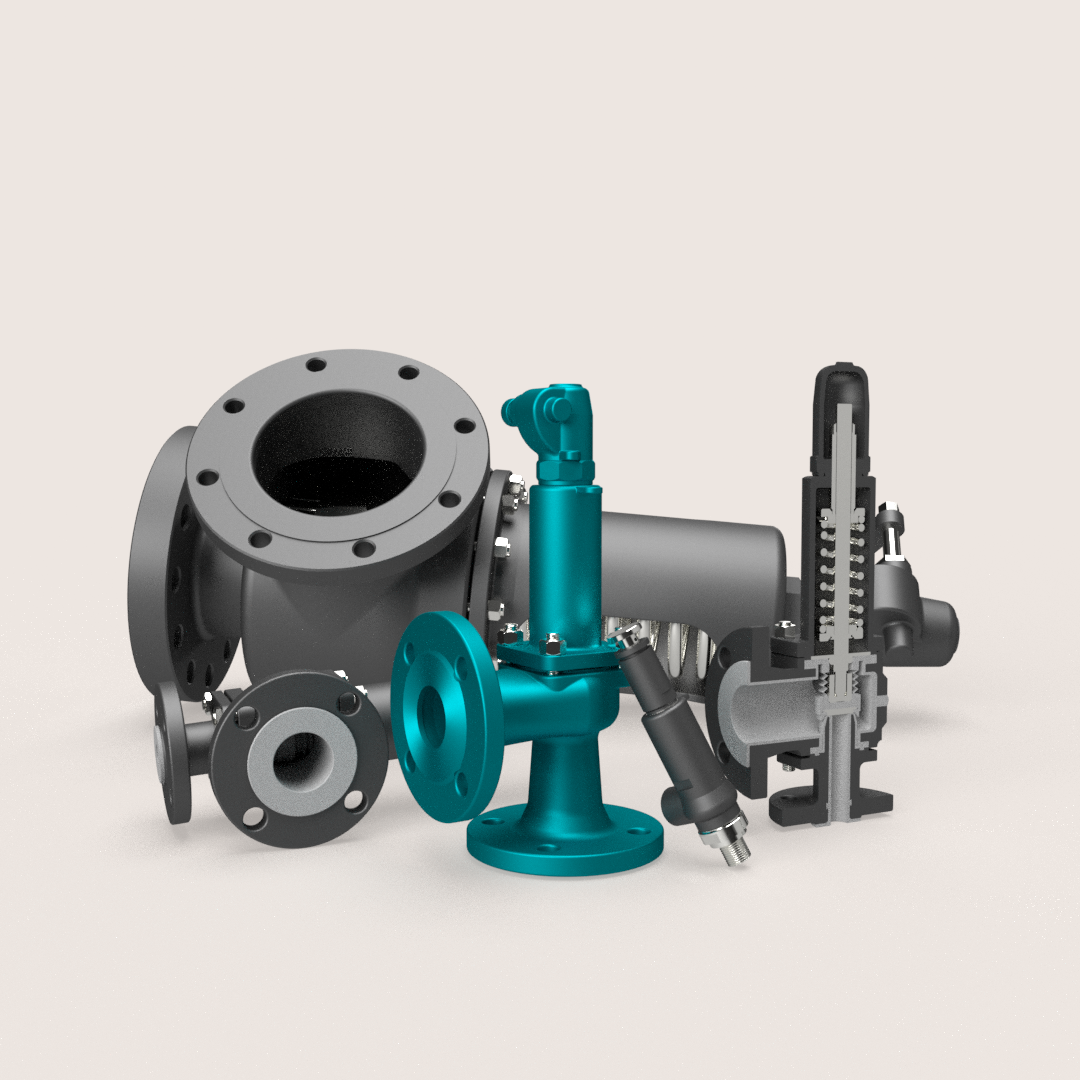
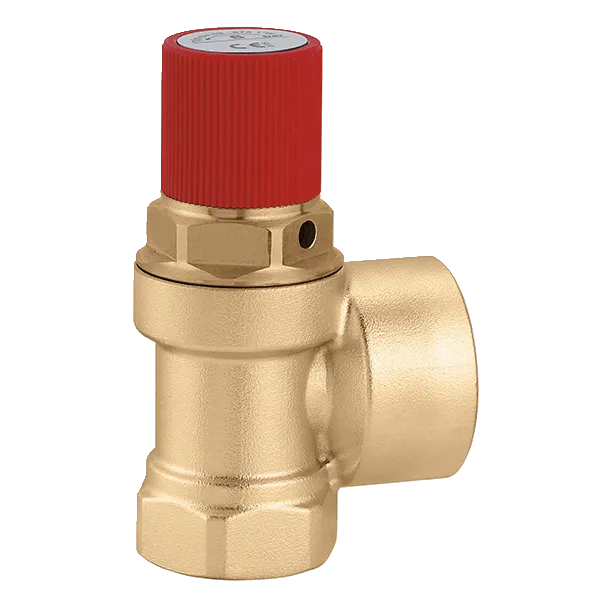
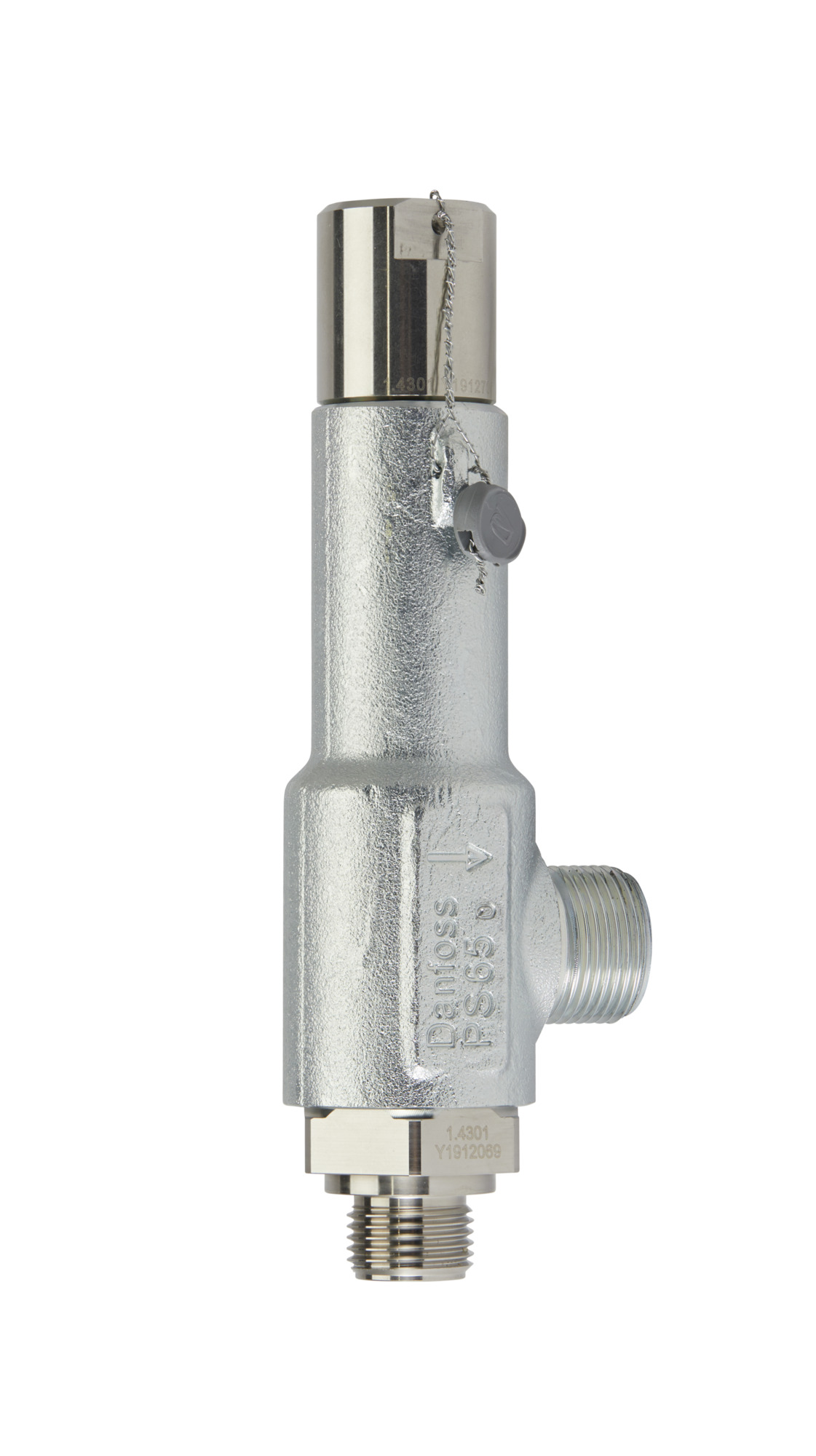
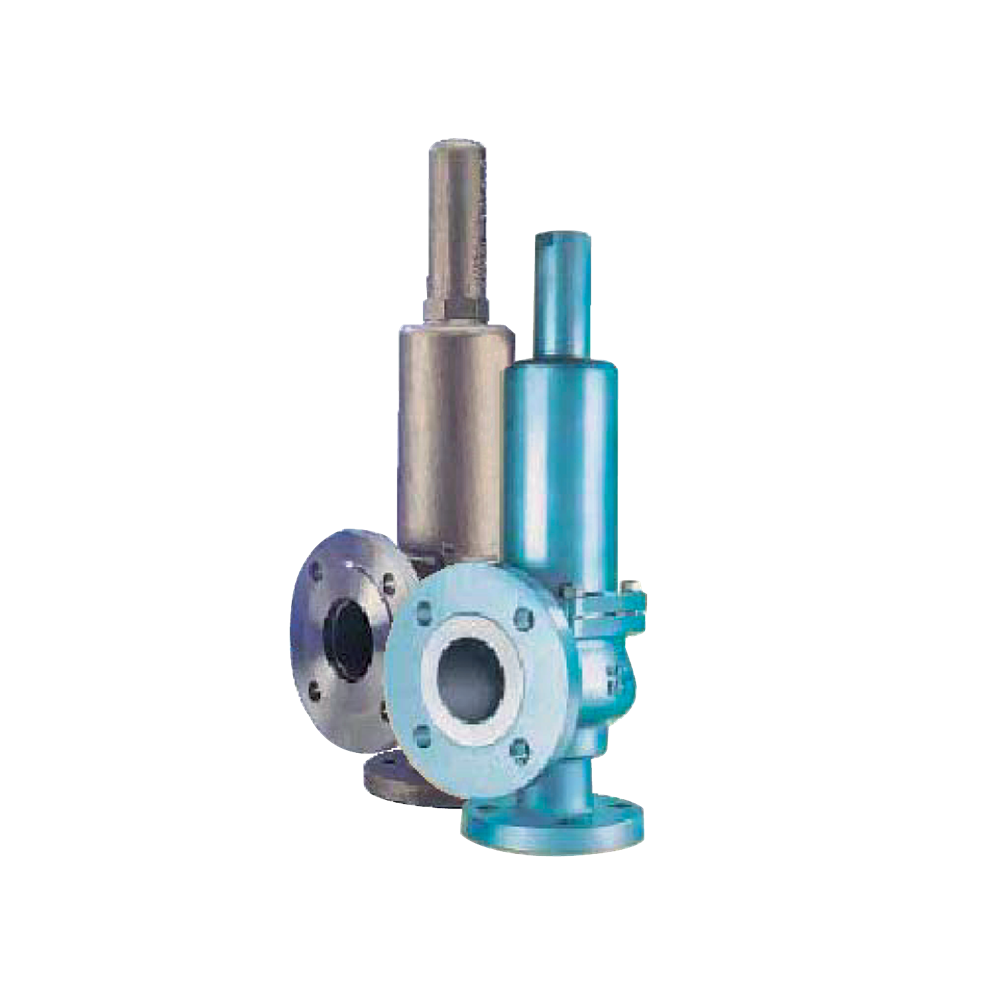
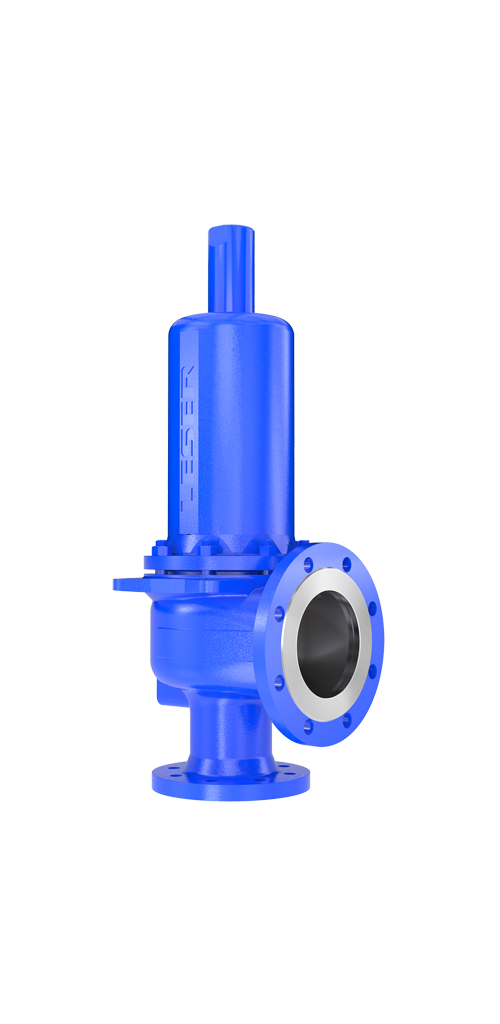
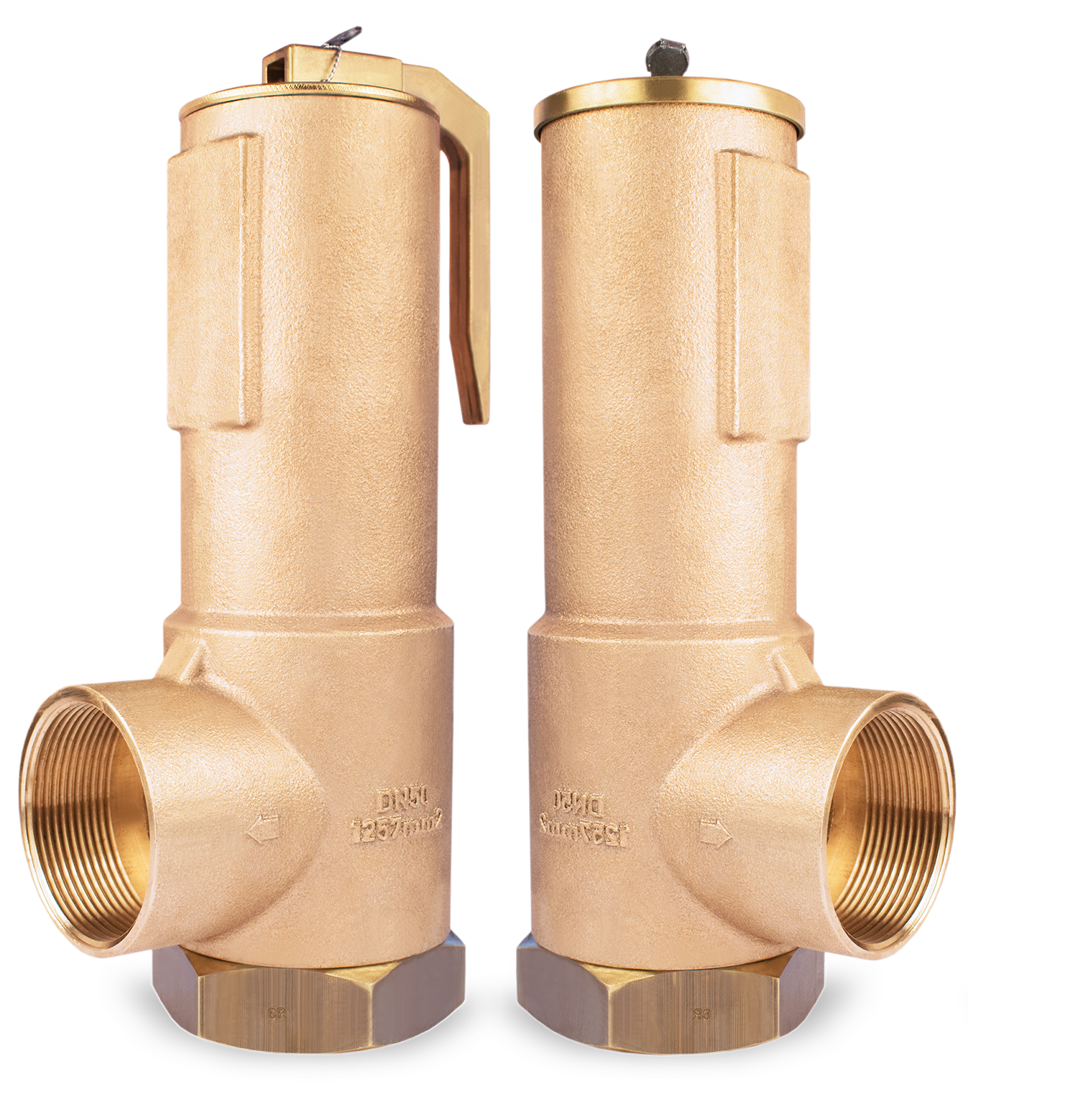
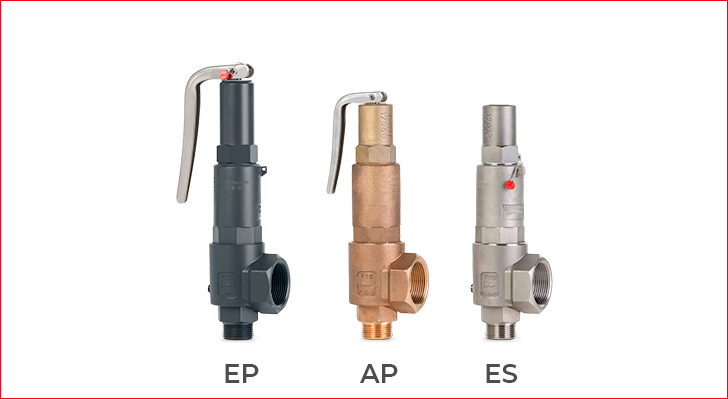
A safety relief valve is the last line of mechanical defense on any pressurized vessel, pipeline, or boiler. It opens automatically when inlet pressure reaches a preset value, discharges enough fluid to arrest the pressure rise, and reseats once the system returns to a safe level, all without external power, instrumentation, or operator action. Unlike a control valve or a pressure-reducing valve, it does nothing during normal operation; its entire value is realized in the seconds of an upset, which is why its design, sizing, and certification are governed by some of the strictest codes in process engineering.
This guide separates three terms that are routinely confused on purchase orders: safety valve (snap-acting, for steam and gas), relief valve (proportional, for liquids), and safety relief valve (a combination device suitable for either). All three are sized and certified under the API 520, API 526, and ASME Boiler and Pressure Vessel Code framework explained below.
Photo: CEphoto, Uwe Aranas, CC BY-SA 3.0, via Wikimedia Commons
This guide is aimed at industrial purchasing engineers and design engineers. It covers 6 chapters from device definition, valve classification, operating principles, body and trim materials, to spec-sheet decoding and selection decisions, with 7 selection FAQs and manufacturer comparisons. All parameters reference the ASME Boiler and Pressure Vessel Code (Section I and Section VIII), API 520 (sizing), API 526 (flanged steel valves), API 527 (seat tightness), and the EU Pressure Equipment Directive PED 2014/68/EU.
Chapter 1 / 06
What is a Safety Relief Valve
A safety relief valve is a self-actuated pressure-relieving device that protects a vessel, boiler, heat exchanger, or pipeline from exceeding its maximum allowable working pressure (MAWP). A spring (or, in pilot designs, process pressure itself) holds a disc against a nozzle seat. When inlet pressure rises to the set value, the upward force on the disc overcomes the spring preload, the disc lifts, and fluid discharges through the nozzle until the pressure source is relieved. The device then reseats and isolates the system again. Because it requires no electricity, no air supply, and no signal from a control room, it remains effective during the exact failures (power loss, instrument failure, fire) that most often cause overpressure.
It is essential to distinguish the relief valve from upstream protection layers. A pressure switch or pressure transmitter can trip an interlock, and a control valve or pressure-reducing valve can throttle flow, but all of these depend on power and instruments. The safety relief valve is the final, code-mandated mechanical layer that must function when everything else has failed. For this reason, regulators in essentially every jurisdiction require a code-stamped relief device on any vessel above a threshold pressure and volume.
Three terms appear interchangeably but carry precise meanings. A safety valve opens with a rapid full-lift snap, called pop action, produced by a huddling chamber that captures the escaping fluid and adds lifting force the instant the disc cracks open; this suits compressible media (steam, air, gas) where a partial opening would chatter. A relief valve opens gradually in proportion to the overpressure and suits incompressible liquids, where the relieved volume is small and a proportional opening is stable. A safety relief valve is a single device that, by changing its trim, can serve either duty, and is the workhorse of refineries and chemical plants.
Industrially, the discipline traces to the steam age. Early boilers used dead-weight and lever-and-weight valves that operators could (and did) overload, contributing to nineteenth-century boiler explosions. The spring-loaded, code-certified safety valve and the formation of the ASME Boiler and Pressure Vessel Code in 1915 transformed pressure equipment from a leading cause of industrial fatalities into a controlled risk. Today the same family of devices protects everything from a 0.35 bar storage tank to a 690 bar (10,000 psi) hydrogen system, spanning more than three orders of magnitude in pressure.
Four engineering attributes determine whether a relief valve will actually perform when called upon: correct set pressure relative to MAWP, sufficient certified relieving capacity for the worst-case scenario, seat tightness so the valve does not leak product during normal operation, and material compatibility so the trim does not corrode or seize between the rare events when it must open. A valve that is mechanically present but undersized, mis-set, or corroded shut offers a false sense of protection that is arguably more dangerous than no valve at all.
Chapter 2 / 06
Valve Types and Classification
Pressure-relief devices divide first by actuation principle into spring-loaded direct-acting valves and pilot-operated valves, and the spring-loaded family subdivides into conventional and balanced-bellows designs. A separate family of non-reclosing devices (rupture discs) is used either alone or in series with a valve. The table below compares the three reclosing valve types that dominate process service, focusing on the back-pressure capability and operating-margin behavior that usually drive the choice.
Type
Opening Action
Back-Pressure Tolerance
Operating Margin
Typical Service
Conventional spring
Snap or proportional
< ~10% of set
~90% of set
Atmospheric or low fixed discharge
Balanced bellows
Snap or proportional
~30 to 50% of set
~90% of set
Shared flare or closed header
Pilot-operated
Very fast, full lift
up to ~70% of set
~95 to 98% of set
High-capacity gas, tight set margin
Conventional spring-loaded valves are the default and least expensive design. The spring bonnet either vents to atmosphere or to the discharge side. Their weakness is back pressure: superimposed and built-up back pressure act on the disc and shift the effective set pressure, so they are reliable only when total back pressure stays below roughly 10 percent of set. They are ideal for valves that discharge straight to atmosphere or to a short tail pipe.
Balanced-bellows valves add a metal bellows that seals the back of the disc and exposes it to the bonnet, which is vented to atmosphere. The bellows effective area equals the seat area, so back-pressure force on the disc is canceled and the set pressure stays stable even as header pressure swings. This lets a single valve tie into a common flare or closed relief header where back pressure may reach 30 to 50 percent of set. The trade-off is a bellows that must be periodically inspected for fatigue cracking, since a ruptured bellows can let toxic media escape through the bonnet vent.
Pilot-operated valves use process pressure itself, routed through a small pilot, to load the main valve closed; this means seat-loading force increases with system pressure, giving outstanding seat tightness right up to set point and an operating margin as high as 95 to 98 percent of set. They handle high relieving capacity, tolerate back pressure up to about 70 percent of set, and open very fast. The cost is added complexity: the pilot tubing is sensitive to dirty, polymerizing, or freezing media, and pilot maintenance is more demanding than a simple spring valve.
Rupture discs (bursting discs) are non-reclosing: a thin metal or graphite membrane bursts at a set pressure and does not reseat, so the system must be shut down and the disc replaced afterward. They offer zero leakage and very fast opening, and are often installed under a relief valve to protect the valve trim from corrosive or fouling media, or in parallel as a secondary fire-case device. The combination is governed by the same ASME and API rules but adds a burst-tolerance and capacity-derating calculation.
Chapter 3 / 06
Operating Principle and Pressure Terms
Almost every selection error and nuisance-discharge complaint stems from confusing the four core pressure terms. They describe distinct points on the pressure-versus-lift curve, and the ASME and API codes assign each a numeric allowance. The table below fixes the definitions and the typical Section VIII values; commit these before reading any datasheet.
Term
Definition
Typical Value (ASME VIII)
Set pressure
Inlet pressure at which the valve starts to open
At or below MAWP
Overpressure
Rise above set needed to reach rated lift and full capacity
10% (single valve)
Accumulation
Pressure rise above MAWP during the relieving event
10% single / 16% multiple / 21% fire
Blowdown
Difference between set pressure and reseat pressure
7 to 10% gas/steam, up to 20% liquid
Superimposed back pressure
Outlet pressure present before the valve opens
From other header equipment
Built-up back pressure
Outlet pressure generated by the valve's own discharge flow
From tailpipe friction loss
Set pressure is the gauge pressure at the valve inlet at which the disc starts to lift. It is set at or below MAWP. The set-pressure tolerance under ASME Section VIII is plus or minus 2 psi for set pressures up to and including 70 psi (about 4.8 bar), and plus or minus 3 percent above 70 psi. The valve is set and stamped on a test stand using the same medium it will see in service.
Overpressure is the additional pressure, above set, required for the valve to reach full rated lift and deliver its certified capacity. A single Section VIII valve is allowed 10 percent overpressure; that is why the relieving pressure used in sizing is set pressure times 1.10 plus atmospheric. A Section I boiler valve, by contrast, must reach full capacity within 3 percent overpressure, which demands a more aggressive full-lift design and is the central reason a Section VIII valve must never be used on a boiler.
Accumulation is the pressure rise above MAWP that the protected vessel is permitted to experience during the event. For a single relief device the allowable accumulation is 10 percent; with multiple valves it rises to 16 percent; and for an external fire exposure case it rises to 21 percent, because fire is a low-probability scenario and the higher accumulation permits a smaller, more economical valve. These allowances are how the code reconciles equipment cost against an acceptably low residual risk.
Blowdown is how far below set pressure the system must fall before the disc reseats. A larger blowdown prevents the valve from chattering open and shut around the set point, but wastes more product before reseating. Gas and steam valves typically blow down 7 to 10 percent; liquid valves may need up to 20 percent. Back pressure splits into superimposed (present at the outlet before the valve opens, from other equipment on a shared header) and built-up (generated by the valve's own discharge through the tailpipe). Their sum is what dictates whether a conventional, bellows, or pilot valve is required, as shown in Chapter 2.
Chapter 4 / 06
Body, Trim, and Sizing Standards
Once the relieving scenario is defined, the engineer sizes the valve in two stages. First, API 520 Part I gives the flow equations (for vapor, steam, liquid, and two-phase service, with back-pressure and viscosity correction factors) to calculate the required effective discharge area. Second, that area is rounded up to the next standard API 526 orifice letter. The API 526 letter ladder, shared by every compliant manufacturer, is the single most important table in relief-valve selection because it makes valves from different brands dimensionally interchangeable.
API 526 Orifice Letter
Effective Area (in²)
Effective Area (mm²)
Typical Body Size (in × out)
D
0.110
71
1 × 2
E
0.196
126
1.5 × 2.5
F
0.307
198
1.5 × 2.5
G
0.503
325
1.5 × 2.5
H
0.785
506
2 × 3
J
1.287
830
3 × 4
K
1.838
1,186
3 × 4
L
2.853
1,840
4 × 6
M
3.600
2,323
4 × 6
N
4.340
2,800
4 × 6
P
6.380
4,116
6 × 8
Q
11.045
7,126
6 × 10
R
16.00
10,323
8 × 10
T
26.00
16,774
10 × 16
Note that a manufacturer's physical bore is often larger than the API 526 nominal area, but sizing must always use the certified effective area, never the measured bore. The certified discharge coefficient, derived under ASME UG-131 and explained in Chapter 5, ties the two together.
Body and trim material is the second half of the specification. The wetted body must resist the process media at relieving temperature, and the nozzle and disc (the trim) must hold seat tightness across thousands of thermal and pressure cycles. The standard API 526 body castings are carbon steel WCB for general service, low-temperature LCC for cold climates and refrigeration, chrome-molybdenum WC6 for high-temperature steam and hydrogen, and stainless CF8M (cast 316) for corrosive and cryogenic duties. Trim is normally 316 stainless steel or, for aggressive media, a nickel alloy such as Alloy 20, Hastelloy, or Monel.
Seat tightness is verified to API 527, which sets the maximum allowable leakage rate for both metal-seated and soft-seated valves over set pressures from 15 psig (103 kPa) to 6,000 psig (41,379 kPa), tested with the same medium (air, steam, or water) used to set the valve. Soft seats (PTFE or FKM inserts) give tighter shutoff near set pressure and suit clean gas service; metal seats tolerate higher temperatures and dirtier media. The table below maps common media classes to a starting material recommendation; always confirm against the manufacturer corrosion chart at the specific concentration, temperature, and relief temperature before issuing the purchase order.
Service / Media
Recommended Body
Recommended Trim / Seat
General steam, air, water, hydrocarbons
Carbon steel WCB
316 SS metal seat
Cold service, LPG, refrigeration
Low-temp LCC
316 SS metal seat
High-temp steam, hydrogen, hot oil
Cr-Mo WC6
Stellite-faced metal seat
Corrosive and cryogenic process
Stainless CF8M
316 SS or alloy trim
Clean gas, tight shutoff near set
Carbon steel WCB
Soft (PTFE / FKM) seat
Strong acids, wet chlorine
Stainless CF8M
Hastelloy / Monel trim
Chapter 5 / 06
Key Specification Parameters
A relief-valve datasheet can list thirty fields, but eight govern whether the valve will protect the equipment and pass inspection: set pressure and tolerance, certified capacity and discharge coefficient, orifice and body size, back-pressure rating, blowdown, temperature and material class, code stamp, and end connection rating. Each is explained below.
Set pressure and tolerance fix the opening point. Confirm it is at or below MAWP and that the stamped tolerance (plus or minus 2 psi up to 70 psi, plus or minus 3 percent above) is acceptable for the process margin. The valve is set on the test bench with the same medium it will see, because steam, air, and water give slightly different effective set points.
Certified capacity and discharge coefficient are the heart of the specification. ASME UG-131 certifies capacity by flow-testing nine valves, three each of three sizes at three set pressures, to derive the actual coefficient of discharge Kd. For sizing, the certified coefficient is derated to 90 percent, giving the effective coefficient (Kd times 0.9) that is applied to the API 526 effective area. The resulting National Board certified flow, not a calculated theoretical flow, is what must equal or exceed the worst-case relieving rate.
Back-pressure rating ties directly to the type choice in Chapter 2. Calculate superimposed plus built-up back pressure as a fraction of set pressure: under roughly 10 percent allows a conventional valve; 30 to 50 percent requires a balanced bellows; up to 70 percent may need a pilot-operated valve. Underestimating back pressure is a frequent cause of a valve that opens late or chatters.
Code stamp and certification must match the protected equipment. The mainstream marks are:
ASME V: fired and high-temperature water power boilers under Section I; full capacity within 3 percent overpressure, accumulation 6 percent. (Heating boilers under Section IV carry the separate HV designator.)
National Board capacity certification: the registered, flow-tested capacity that accompanies the UV or V stamp.
PED 2014/68/EU CE marking: mandatory for relief devices placed on the European market; a relief valve is a category IV safety accessory.
API 527 seat tightness: the leak-test acceptance criterion, reported on the test certificate.
Blowdown, temperature class, and end connections round out the sheet. Confirm the blowdown (7 to 10 percent gas/steam, up to 20 percent liquid) is acceptable for product loss; confirm the body material and seat type cover the relieving temperature; and confirm the flange rating (ANSI Class 150 through 2500, or PN ratings) matches the connecting piping. A J-orifice valve, for example, typically uses a 3-inch Class 300 inlet and a 4-inch Class 150 outlet, but ratings climb with set pressure.
Chapter 6 / 06
Selection Decision Factors
Translate the preceding chapters into a model number by following the ordered sequence below. Most selection errors come not from a single wrong value but from deciding a downstream detail (brand, material) before an upstream one (relieving scenario, capacity) is locked. These eight steps double as a fixed RFQ template.
Define the relieving scenario and code: identify the worst credible upset (blocked outlet, fire, thermal expansion, control failure), then confirm whether the equipment is registered under ASME Section I (boiler, V stamp) or Section VIII (vessel, UV stamp). This decides the overpressure and accumulation allowances.
Fix set pressure against MAWP: set at or below MAWP, and verify the set-pressure tolerance (plus or minus 2 psi up to 70 psi, plus or minus 3 percent above) leaves enough operating margin above the normal operating pressure to avoid simmer.
Calculate required area and pick the orifice letter: use API 520 Part I flow equations for the relieving fluid, apply the effective discharge coefficient, then round up to the next API 526 letter (D through T). Verify the certified National Board capacity meets the worst-case rate.
Determine back pressure and select the type: sum superimposed and built-up back pressure as a fraction of set, then choose conventional (under ~10 percent), balanced bellows (30 to 50 percent), or pilot-operated (up to ~70 percent).
Specify body and trim materials: WCB, LCC, WC6, or CF8M body to suit media and relieving temperature; metal, Stellite-faced, or soft seat to balance tightness against temperature; alloy trim for corrosive service per the Chapter 4 table.
Set blowdown and seat-tightness requirement: choose a blowdown that prevents chatter without excessive product loss, and specify the API 527 leakage class (metal vs soft seat) appropriate to the medium.
Confirm connections and ratings: flange class (ANSI 150 to 2500 or PN equivalent), face-to-face per API 526, inlet and outlet sizes, and bonnet style (closed, open, or bellows-vented) for the discharge arrangement.
Lock certifications and total cost of ownership: require the matching UV or V stamp, National Board registration, PED CE mark where applicable, and a test certificate. Then weigh purchase price against testing, the mandatory periodic shop overhaul, and the cost of a spurious release or a failure to open.
One dimension is routinely underestimated: serviceability and periodic re-certification. Relief valves must be removed, bench-tested, overhauled, and re-stamped on a regulated interval (commonly every 1 to 5 years depending on jurisdiction and service severity), so local repair-shop authorization, spare-parts availability, and lead time matter more than the initial price. Established API 526 manufacturers with global service networks include Emerson Crosby (J-series JOS-E and JBS-E), Emerson Anderson Greenwood (pilot-operated series 200/400/500/700/800), Baker Hughes Consolidated (1900 series), Curtiss-Wright Farris (2600 series), and LESER (Type 526). Because all comply with the same API 526 letter ladder and face-to-face dimensions, a correctly specified valve can usually be cross-sourced without piping changes, which protects the project against single-supplier lead-time risk.
FAQ
What is the difference between a safety valve, a relief valve, and a safety relief valve?
A safety valve opens fully with a rapid snap (pop) action and is intended for compressible fluids such as steam, gas, and vapor, where a fast full-lift discharge is needed. A relief valve opens gradually in proportion to the pressure rise above set point and is intended for incompressible liquids, where excess volume is small. A safety relief valve is a combination device that can be applied to either service depending on its trim, popping on gas or steam and opening proportionally on liquid. In refinery and petrochemical practice the three terms are often used loosely, but the API and ASME definitions are distinct and govern how capacity is certified.
What do set pressure, overpressure, accumulation, and blowdown mean?
Set pressure is the inlet gauge pressure at which the valve starts to open, normally at or below the equipment maximum allowable working pressure (MAWP). Overpressure is the rise above set pressure needed to reach rated lift and full certified capacity, typically 10 percent for a single ASME Section VIII valve. Accumulation is the pressure rise above MAWP during the relieving event, 10 percent for a single valve, 16 percent for multiple valves, and 21 percent for an external fire case. Blowdown is the difference between set pressure and the lower reseat pressure, usually 7 to 10 percent for gas and steam and up to about 20 percent for liquid service. Confusing these four terms is the most common cause of nuisance chatter and lost product.
How do I read an API 526 orifice letter, and how big is each one?
API 526 defines a fixed ladder of effective orifice areas identified by letters D through T: D is 0.110 in2 (71 mm2), E 0.196, F 0.307, G 0.503, H 0.785, J 1.287, K 1.838, L 2.853, M 3.600, N 4.340, P 6.380, Q 11.045, R 16.00, and T 26.00 in2 (16,774 mm2). The engineer first calculates the required effective discharge area per API 520 Part I, then rounds up to the next standard letter. Because every API 526 maker shares the same letter ladder and face-to-face dimensions, a J-orifice valve from one brand is dimensionally interchangeable with a J from another, which simplifies spare-parts standardization.
When should I choose a balanced bellows or pilot-operated valve instead of a conventional one?
Choose a conventional spring-loaded valve when discharge is to atmosphere or a low, stable header and superimposed plus built-up back pressure stays under about 10 percent of set pressure. Choose a balanced bellows valve when the valve discharges into a shared flare or closed header where back pressure varies and can reach 30 to 50 percent of set pressure, because the bellows isolates the disc from back-pressure effects on set point. Choose a pilot-operated valve for high-capacity gas service, for back pressure up to roughly 70 percent of set, or where you need operation close to set pressure (up to about 95 to 98 percent) without simmer, accepting more sensitivity to dirty or freezing media in the pilot tubing.
What is the difference between an ASME Section I valve and an ASME Section VIII valve?
Section I valves protect fired power boilers and carry the ASME V stamp (the separate HV designator covers Section IV heating boilers). They must reach full rated capacity within 3 percent overpressure and limit accumulation to 6 percent, which demands a more aggressive full-lift snap design. Section VIII valves protect unfired pressure vessels and carry the UV stamp; a single valve may use 10 percent overpressure and 10 percent accumulation. Because a Section VIII valve does not guarantee full flow at only 3 percent overpressure, it must never be substituted on an ASME Section I boiler. Always confirm the stamp matches the code under which the protected equipment was registered.
How is relieving capacity certified, and what is the discharge coefficient Kd?
ASME UG-131 certifies capacity, most commonly by the coefficient of discharge method: nine valves, three each of three sizes at three set pressures, are flow-tested and the measured flow is compared with the theoretical flow to derive the actual discharge coefficient Kd. For ASME sizing the certified coefficient is derated to 90 percent of Kd, giving the effective coefficient Kd times 0.9, used with the API 526 effective orifice area. The certified valve then receives the National Board capacity certification and is stamped UV or V. Manufacturer actual orifice areas may exceed the API 526 nominal area, but sizing must use the certified effective area, not the physical bore.
What seat-tightness and material standards apply, and which manufacturers are common?
Seat tightness is verified to API 527, which sets maximum allowable leakage for metal-seated and soft-seated valves with set pressures from 15 psig (103 kPa) to 6000 psig (41,379 kPa), tested with the same medium (air, steam, or water) used to set the valve. Standard API 526 bodies are carbon steel WCB, low-temperature LCC, chrome-moly WC6, or stainless CF8M, with trim in 316 stainless or higher alloys. Established API 526 makers include Emerson Crosby (J-series JOS-E and JBS-E), Emerson Anderson Greenwood (pilot-operated series 200/400/500/700/800), Baker Hughes Consolidated (1900 series), Curtiss-Wright Farris (2600 series), and LESER (Type 526). Match the body material to media and temperature, then confirm UV stamp and PED or local pressure-equipment compliance.
Safety Relief Valve Manufacturers
Source-backed product routes. Open a company dossier for procurement scope and cited evidence.