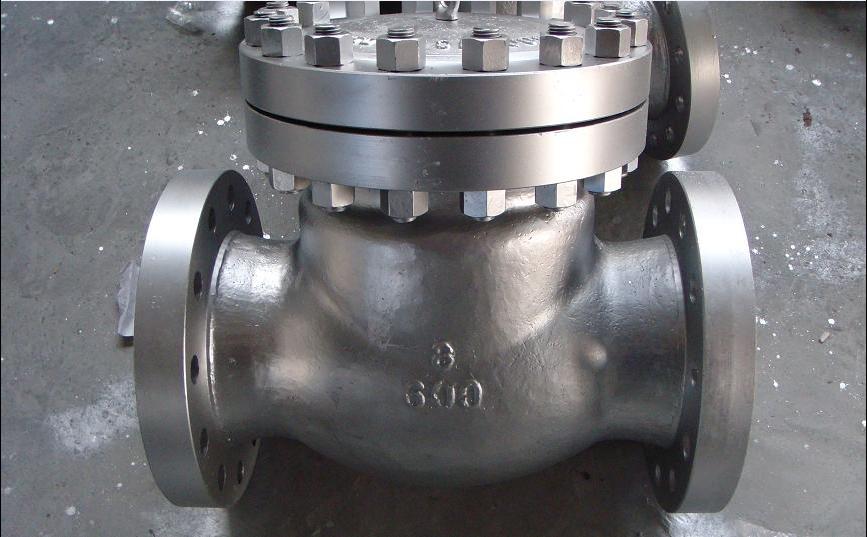
A check valve, also called a non-return valve (NRV), one-way valve, or reflux valve, is a self-actuated device that allows fluid to flow in one direction and closes automatically against reverse flow. It has no handle, stem, or external actuator: the closing element is moved only by the fluid itself and by gravity or a spring. Check valves protect pumps and compressors from backspin, prevent drain-down of elevated piping, stop backflow contamination, and keep boiler feed and condensate systems flowing the right way.
Despite their mechanical simplicity, check valves are among the most commonly mis-selected components in a piping system. The wrong type or an oversized body causes disc flutter, seat wear, and the violent pressure surge known as check valve slam. This guide decodes the four mainstream mechanisms, the governing standards, and the parameters that separate a quiet, long-lived valve from a noisy liability.
Photo: Heather Smith, CC BY 3.0, via Wikimedia Commons
This guide is written for procurement engineers and design engineers selecting check valves before a capital purchase. It covers 6 chapters from working principle, type classification, slam and dynamic behavior, body materials and standards, to spec-sheet decoding and selection decisions, with 7 selection FAQs and manufacturer comparisons. All parameters reference the API 6D and API 594 valve standards, BS 1868 and BS 5153, EN 12334, ASME B16.34 pressure-temperature ratings, and API 598 inspection and test criteria.
Chapter 1 / 06
What is a Check Valve
A check valve is a flow control device that permits fluid (liquid or gas) to move through it in only one direction. It is an automatic valve: there is no handwheel, lever, or powered actuator. The pressure of the fluid itself pushes the closing element (a disc, ball, plate, or piston) open in the forward direction, and gravity, a spring, or the back pressure of reverse flow pushes it closed when forward flow stops or reverses. Because it operates with no operator and no signal, the check valve is the simplest and most numerous valve type in most process plants, pump stations, and pipelines.
The single most important operating concept is cracking pressure: the minimum forward pressure differential between the inlet and outlet at which the first indication of flow occurs. In a gravity swing check, cracking pressure is set only by the weight of the disc and is close to zero. In a spring-loaded lift or nozzle check, cracking pressure is set by the spring and is commonly specified between 0.07 and 0.7 bar (1 to 10 psi). Cracking pressure is a permanent parasitic head loss the upstream pump must overcome on every cycle, so it is never a free parameter.
Closely paired with cracking pressure is reseal (or reseat) pressure: the back pressure required to close the valve tightly enough that flow is no longer detectable, often described as a bubble-tight seal. The two are inversely related in spring designs. A spring check with cracking pressure above roughly 0.2 to 0.35 bar (3 to 5 psi) usually reseats bubble-tight on spring force alone, in which case rated reseal pressure is lower than cracking pressure. A check with cracking pressure below that band typically needs a little system back pressure to seal, so its reseal pressure can exceed its cracking pressure. Selecting the spring is therefore always a compromise between forward head loss and reverse sealing.
Historically, one-way flow control is ancient, but the modern patented check valve appears in the early twentieth century: Frank P. Cotter received U.S. patent 865,631 for a simple check valve in 1907, and Nikola Tesla patented his no-moving-parts valvular conduit (U.S. patent 1,329,559) in 1920. Industrial cast-steel swing checks to British and American specifications became standard mid-century, with BS 1868 covering steel check valves and the API 6D and API 594 frameworks formalizing pipeline and wafer designs respectively.
In terms of scale and duty, check valves span an enormous range: from sub-millimeter elastomer duckbill and reed valves in respirators, syringes, and two-stroke engines, to full-bore swing and axial nozzle checks more than 1 metre (DN1000 and larger) in pipeline and cooling-water service rated to ASME Class 2500 and API 15000. No single mechanism covers that range. As with every valve family, correct engineering selection is a matter of mapping the specific service (media, flow profile, transient severity, orientation) onto the right mechanism and material, not buying the cheapest body that matches the line size.
Chapter 2 / 06
Check Valve Types
By closing mechanism, industrial check valves fall into a handful of mainstream families: swing, tilting-disc, lift (piston), ball, dual-plate (wafer), and nozzle (axial). Smaller specialty types (diaphragm, duckbill, reed, in-line spring) serve OEM and low-pressure duties. Each family trades off pressure drop, closing speed, orientation freedom, dirt tolerance, and cost. The table below compares the six industrial families on the dimensions that drive selection.
Type
Closing Element
Pressure Drop
Slam Risk
Typical Applications
Swing
Hinged disc
Low
High
Pump discharge, general process, dirty media
Tilting-disc
Rocker-mounted disc
Very low
Medium
Cooling water, district heating, large mains
Lift / piston
Guided disc / piston
Medium-high
Low
High-pressure steam, small-bore process
Ball
Free or spring ball
Medium
Low
Viscous fluids, slurry, dosing pumps
Dual-plate
Two spring plates
Low
Low
Compact wafer service, HVAC, pump discharge
Nozzle / axial
Spring disc, axial
Very low
Very low
Compressors, gas pipelines, fast-reversing systems
Swing check valves use a disc on a hinge pin that swings clear of the bore on forward flow and swings back onto the seat when flow stops. The full-bore design gives a low pressure drop and tolerates suspended solids well, making it the workhorse of pump discharge and general process lines and the design covered by BS 1868 and many API 6D pipeline checks. Its weakness is slam: the disc travels a long arc, so it closes slowly relative to flow reversal and can shut hard enough to hammer the pipe on a pump trip. Most gravity swing checks are restricted to horizontal lines or vertical-up flow.
Tilting-disc check valves mount the disc on an offset rocker axis rather than a top hinge. At full open the disc sits at roughly 25 degrees to the flow axis, presenting a streamlined low-restriction path with a flow coefficient typically 15 to 25 percent higher than a comparable swing check. The shorter stroke and balanced center of gravity let the disc close faster and more smoothly, reducing water hammer, which is why tilting-disc checks are common on cooling-water pump discharges, district-heating returns, and large raw-water mains where pumping head is expensive.
Lift and piston check valves use a disc or piston that lifts vertically off its seat, guided by a cage or stem, and drops back under gravity or a spring. The guided short stroke gives tight, repeatable sealing and suits high-pressure and small-bore service such as steam and instrument lines, at the cost of a higher pressure drop from the tortuous flow path. Ball check valves use a free or spring-loaded ball that rolls or lifts off a conical seat; the self-cleaning rolling action suits viscous fluids, slurries, and reciprocating dosing pumps.
Dual-plate (wafer) check valves split the disc into two spring-loaded half-plates hinged on a central pin, closed by a torsion spring (often Inconel) rather than by reverse flow. They close quickly with little water hammer, fit in a very short face-to-face wafer or lug body between standard flanges, and are the compact general-purpose answer covered by API 594. Nozzle or axial check valves place a spring-loaded disc that moves axially within a venturi-shaped body; the ultra-short spring-assisted stroke closes the valve before damaging reverse velocity develops, giving the lowest pressure drop and the best non-slam performance, which is why Crane NOZ-CHEK and Mokveld axial checks dominate compressor and fast-reversing gas-pipeline duty rated to API 15000 or ASME Class 4500.
Chapter 3 / 06
Slam, Water Hammer, and Dynamic Behavior
Check valve slam is the dominant failure and nuisance mode in pumped systems, and it is a dynamic problem that a static catalog comparison cannot capture. When a pump trips, forward flow decelerates and reverses. If the disc has not yet seated when reverse flow arrives, the reverse column slams it onto the seat, generating a pressure surge (water hammer) that can crack flanges, burst gaskets, and destroy the seat. The governing quantity is not the steady flow rate but the reverse velocity that has developed at the instant of closure.
Field experience and valve-dynamics literature give usable thresholds. A water hammer in the range of 15 to 30 metres (50 to 100 ft) of head, corresponding to a reverse velocity of about 0.15 to 0.3 m/s (0.5 to 1.0 ft/s), is a mild slam that most piping can tolerate. Every 0.3 m/s (1.0 ft/s) of reverse velocity corresponds to roughly 30 metres (100 ft) of head, about 3 bar (43 psi). Surges above this band are extremely loud and damaging and must be eliminated by choosing a faster-closing valve, adding heavier springs, or fitting hydraulic dashpots.
Each valve type has a characteristic dynamic curve that plots maximum reverse velocity against the rate of flow deceleration (dv/dt) of the system. The flatter the curve, the more non-slam the valve. The table below ranks the mainstream types by closing speed and the resulting slam tendency, which should drive type choice on any high-transient pump-discharge or compressor service.
Type
Closing Mechanism
Reverse Flow Before Closure
Slam Tendency
Swing (long arc)
Gravity
High
Severe
Tilting-disc
Gravity, short rocker
Medium
Moderate
Dual-plate
Torsion spring
Low
Low
Nozzle / axial
Axial spring, short stroke
Very low
Negligible
Nozzle (axial) check valves are the reference solution for fast-reversing systems. The ultra-short spring-loaded axial stroke means the disc is already moving toward the seat as forward flow decays, so it seats before significant reverse velocity builds, something a long-arc swing check physically cannot do because of its arc length and disc inertia. The venturi body also gives the lowest pressure drop of any type, so the non-slam benefit comes without a pumping-energy penalty.
Dampers and dashpots are the retrofit answer when an existing swing or tilting-disc check slams. An external hydraulic damper or oil dashpot decelerates the final portion of disc travel, cutting slam pressure spikes by 60 to 80 percent on pump-trip events. Heavier or counterweighted hinge arrangements and lever-and-weight or lever-and-spring options on swing checks similarly trade a slightly higher cracking pressure for a faster, controlled closure. Where transients are severe and unavoidable, the correct path is to specify a nozzle or dual-plate check from the start rather than to damp a slam-prone swing check after the fact.
One subtle dynamic failure is the opposite of slam: disc flutter on an oversized valve. If forward velocity is too low to hold the disc firmly against its full-open stop, the disc oscillates against the seat, hammering the hinge pin and wearing the seat until it leaks. This is why check valves are sized for flow, not simply matched to the line, a point developed in Chapter 6.
Chapter 4 / 06
Body Materials and Governing Standards
A check valve sits in the pressure boundary of the piping, so its body and trim materials must match the line material, the media, and the temperature, and its design and testing must conform to a recognized standard. The body alloy is usually selected to match the connecting pipe class, while the seat and disc trim are selected for sealing and corrosion. The table below maps common body materials to their service window and typical specification.
ASTM A216 WCB cast carbon steel is the default body for water, oil, steam, and non-corrosive process at ambient and elevated temperature, and the most common choice across ASME Class 150 to 2500. ASTM A352 LCB and LCC are low-temperature carbon steels qualified by impact testing for cold service down to minus 46 degrees Celsius, used on LPG, refrigeration, and cold climates. ASTM A351 CF8 and CF8M (the cast equivalents of 304 and 316 stainless) cover corrosive, sanitary, and cryogenic-adjacent duties; for seawater, chloride brine, or wet chlorine the trim moves up to duplex, Monel, or nickel alloy.
Seat design divides into soft and metal. Soft seats (PTFE, NBR, EPDM, FKM/Viton) give bubble-tight shutoff at lower temperature and are graded to the tightest API 598 resilient-seat leakage classes. Metal seats handle high temperature, abrasives, and fire-safe duty but allow a small permitted leakage per API 598 metal-seat classes. The choice follows the media temperature and the required tightness, not the body alloy.
The governing standards define design, dimensions, ratings, and testing, and naming the right one on the datasheet is half of correct procurement. The table below summarizes the standards a buyer encounters most often.
Standard
Scope
Applies To
API 6D
Pipeline valves
Full-bore swing / piston checks, main-line oil and gas
API 594
Wafer / dual-plate checks
Type A short pattern, Type B long-pattern swing, CL150 to 2500
BS 1868
Steel check valves
Flanged and butt-weld swing checks, petrochemical
BS 5153
Cast iron check valves
General-purpose water and utility service
ASME B16.34
Pressure-temperature ratings
Materials, ratings, dimensions, marking for checks
ASME B16.10
Face-to-face / end-to-end
Dimensional interchangeability of valve bodies
API 598
Inspection and test
Shell and seat leakage acceptance criteria
For pipeline and main-line service, API 6D governs full-bore swing and piston checks with emphasis on through-conduit bore, piggability, and high-pressure ratings. For compact in-plant service, API 594 governs Type A short-pattern wafer, lug, and double-flanged checks (single-plate, dual-plate, or swing disc) and Type B long-pattern bolted-cover swing checks in Classes 150 to 2500. BS 1868 (steel) and BS 5153 (cast iron), and the European EN 12334 for cast-iron non-return valves, remain in use in many light-industrial and utility specifications. ASME B16.34 sets the pressure-temperature rating tables that every steel check must satisfy, and API 598 defines the shell and seat leakage acceptance criteria the valve is hydrostatically tested against before shipment.
Chapter 5 / 06
Key Specification Parameters
A check valve datasheet may list 15 or more line items, but only a handful truly drive the selection decision. Reading them correctly, and knowing which are derived from the standard versus quoted by the maker, is a core procurement skill. The parameters that matter most are size and end connection, pressure class, cracking pressure, minimum full-open velocity, flow coefficient, seat leakage class, and temperature limit. Each is explained below.
Nominal size and end connection set the physical interface: DN or NPS size and the end type (flanged to ASME B16.5 raised face, butt-weld, threaded NPT, wafer, or lug). Wafer and lug bodies to API 594 give the shortest face-to-face dimension and the lightest weight, which matters in tight skids and on large mains; flanged and butt-weld bodies suit higher pressure and pipeline service. Always confirm the face-to-face against ASME B16.10 so the valve drops into the existing spool.
Pressure class and rating follow ASME B16.34 pressure-temperature tables. Industrial checks span Class 150 to Class 2500 (and PN16 to PN420), and the allowable working pressure falls as temperature rises, so a Class 300 WCB body rated near 50 bar at ambient is derated at 425 degrees Celsius. Pipeline service to API 6D and severe nozzle checks reach far higher, up to API 15000 or Class 4500 for forged axial designs. The valve class must equal or exceed the line class at the design temperature, never just at ambient.
Cracking pressure (Chapter 1) is the forward differential needed to open the valve, near zero for gravity swing checks and commonly 0.07 to 0.7 bar (1 to 10 psi) for spring designs. It is a permanent head loss the pump must supply at minimum flow, and it is tied to reseal behavior, so it is never specified in isolation. For spring checks request both cracking and reseal pressure.
Minimum full-open velocity and the flow coefficient (Cv or Kv) together govern correct sizing. Disc-type checks need a minimum forward velocity, often 1 to 3 m/s for water depending on type, to hold the disc against its full-open stop and stop flutter; spring and nozzle checks tolerate lower and more variable flow because the spring removes flutter. Use the maker flow-coefficient curve and the minimum-full-open-velocity figure, not the line size, to choose the body.
Seat leakage class per API 598 states the permitted shutoff leakage. Resilient (soft) seats are graded to the tightest, effectively bubble-tight classes; metal seats permit a small leakage that scales with size and pressure. Match the class to the consequence of backflow: zero-tolerance backflow contamination or compressor protection demands a soft seat or a tested tight metal seat, while general non-return service accepts a standard metal-seat class.
Other parameters round out the spec sheet:
Temperature limit: set by the body material and the seat. Soft seats cap out around +200 to +230 degrees Celsius (FKM) or lower (NBR, EPDM); metal seats and WCB or stainless bodies reach +425 to +538 degrees Celsius.
Installable orientation: horizontal only, vertical-up only, or any orientation. Gravity swing and lift checks are orientation-restricted; spring, nozzle, and dual-plate checks can be qualified for vertical-down.
Fire-safe and fugitive emission: API 607 / API 6FA fire-test certification and retainerless bodies that eliminate threaded plugs and external leak paths, required on hydrocarbon service.
Flow direction marking: a cast arrow on the body; installing a check backwards is a classic field error that holds the line permanently shut or permanently open.
Disc and hinge material: stainless, Stellite-faced, or Inconel-sprung for wear and corrosion resistance on the moving parts that fail first.
Chapter 6 / 06
Selection Decision Factors
To turn the preceding five chapters into a specific model, follow the decision sequence below. Most check valve failures trace not to a single wrong number but to skipping the dynamic and sizing steps and matching the valve to the line size by reflex. These eight steps work as a fixed RFQ template.
Define the service and media: fluid, temperature, pressure, suspended solids or abrasives, and whether backflow contamination or compressor protection is safety-critical. This sets the body and trim material per Chapter 4 and the required seat leakage class.
Characterize the transient: is this a pump-discharge or compressor line subject to trips and fast flow reversal? If yes, the dynamic ranking in Chapter 3 drives the type: nozzle or dual-plate for severe transients, tilting-disc or dashpot-equipped swing for moderate, plain swing only for benign low-transient service.
Choose the type: swing for dirty, low-transient general process; tilting-disc for low-pressure-drop large water mains; lift or piston for high-pressure small bore; ball for viscous and dosing; dual-plate for compact wafer duty; nozzle for fast-reversing gas and compressor service.
Size for flow, not line size: use the maker flow-coefficient curve and minimum-full-open velocity so normal flow holds the disc fully open. On low-velocity service the correct check is often one size smaller than the line; confirm the disc reaches its full-open stop.
Fix the pressure class and end connection: Class 150 to 2500 (or PN16 to PN420) per ASME B16.34 at the design temperature, with flanged, butt-weld, threaded, wafer, or lug ends and a face-to-face that matches ASME B16.10.
Confirm cracking and reseal pressure: verify the pump can supply the cracking pressure at minimum flow, and that the spring or disc gives a bubble-tight reseal at the available back pressure. Specify both figures for spring designs.
Check orientation and standard: confirm the valve is qualified for the planned installation (horizontal, vertical-up, or vertical-down) and name the governing standard explicitly: API 6D, API 594, BS 1868, BS 5153, EN 12334, with ASME B16.34 ratings and API 598 test acceptance.
Specify certifications and total cost of ownership: fire-safe (API 607 / 6FA), fugitive-emission retainerless body, NACE MR0175 for sour service where required, then weigh purchase price against the cost of slam damage, seat wear from flutter, and the downtime of a mis-selected check.
One last dimension that buyers routinely overlook is serviceability and maintainability. A check valve has few parts, but the disc, hinge pin, springs, and seat are exactly the parts that wear, and on a slam-prone or fluttering valve they wear fast. Confirm that spare hinge pins, springs, and seat rings are stocked, that the body can be opened and reseated in line where the design allows, and that the maker has local technical support. Crane ChemPharma and Energy, Mokveld, Velan, Goodwin International, Emerson, Flowserve, Bray, and Cameron maintain documented spares and service in major markets; verified domestic suppliers such as Neway, CNNC, and ZECO offer API-certified bodies at lower cost for non-critical loops. Whichever you choose, the certified datasheet (series number, class, ends, standard) is the contract, not the catalog page.
FAQ
What is the difference between a check valve and a non-return valve?
There is no functional difference: check valve, non-return valve (NRV), one-way valve, and reflux valve are regional and industry synonyms for the same device, a valve that permits flow in one direction and closes automatically against reverse flow. North American and oil-and-gas specifications favor check valve, while European, marine, and water-utility documents often write non-return valve. The closing element is moved only by the fluid itself and by gravity or a spring, with no external actuator. When you see these terms on a datasheet or piping line list, treat them as identical for selection purposes and read the type designation (swing, lift, dual-plate, nozzle) to know the actual mechanism.
What is cracking pressure and why does it matter?
Cracking pressure is the minimum forward pressure differential across the inlet and outlet at which the first flow is detected, in other words the pressure needed to lift the disc, ball, or plate off its seat. A gravity swing check has a near-zero cracking pressure set only by disc weight, while a spring-loaded lift or nozzle check is typically specified from 0.07 to 0.7 bar (1 to 10 psi). It matters because cracking pressure is a permanent parasitic head loss the pump must overcome, and it is inversely linked to reseal behavior: a spring check with cracking pressure above roughly 0.2 to 0.35 bar (3 to 5 psi) usually reseats bubble-tight on spring force alone, whereas a lower setting may need back pressure to seal. Always confirm the pump can supply the cracking pressure at minimum flow.
How do I prevent check valve slam and water hammer?
Slam is caused by the disc closing after significant reverse flow has already developed, so the cure is faster closure relative to flow reversal. Field experience treats reverse velocity up to about 0.3 m/s (1.0 ft/s) as a mild, tolerable slam, while higher reverse velocities produce loud, damaging surges. Non-slam options in order of effectiveness: nozzle (axial) check valves whose ultra-short spring-loaded stroke closes before reverse flow builds; dual-plate spring-assisted check valves; and tilting-disc checks whose short rocker stroke and external hydraulic dampers cut slam spikes by 60 to 80 percent on pump-trip. Long-arc swing checks are the most slam-prone and should be avoided on high-transient pump-discharge service unless dashpot-equipped.
What is the difference between API 6D and API 594 check valves?
API 6D is the pipeline valve standard covering full-bore swing and other check valves for main-line oil and gas transmission service, emphasizing through-conduit bore, piggability, and high-pressure ratings up to Class 2500 and beyond. API 594 covers compact check valves in two patterns by face-to-face length: Type A short-pattern wafer, lug, and double-flanged designs (single-plate, dual-plate, or swing disc) and Type B long-pattern bolted-cover swing checks, fitting between or onto pipe flanges in Classes 150 to 2500, used on pump discharge, HVAC, and general process service. In short, API 6D is for long-distance pipelines and full-bore checks; API 594 is for shorter face-to-face wafer, dual-plate, and bolted-cover checks. Other references include BS 1868 (steel swing checks), BS 5153 (cast iron checks), EN 12334, and ASME B16.34 for pressure-temperature ratings.
Can a check valve be installed vertically?
It depends on the type and flow direction. Gravity-closed swing and lift check valves rely on the disc weight to seat, so most are restricted to horizontal lines or to vertical lines with upward flow only; downward vertical flow holds the disc open and defeats the valve. Spring-loaded designs, nozzle (axial) checks, dual-plate checks, and in-line spring lift checks can be specified for any orientation including vertical-down because the spring, not gravity, provides closing force. Always confirm the installable orientation on the datasheet and respect the body flow-direction arrow. Horizontal swing checks should also have the cap or hinge pin at the top so the disc swings freely.
Which body material should I choose for a check valve?
Match the body and trim to the line material and media. ASTM A216 WCB cast carbon steel is the default for water, oil, steam, and non-corrosive process at ambient and high temperature, the most common Class 150 to 2500 choice. ASTM A352 LCB or LCC low-temperature carbon steel covers cold service down to minus 46 degrees Celsius. ASTM A351 CF8 (304) and CF8M (316) stainless cover corrosive, sanitary, and cryogenic-adjacent duties. Bronze and gunmetal suit small bore water and HVAC. For seawater, chloride brine, or wet chlorine, move to duplex, Monel, or nickel-alloy trim. Soft seats (PTFE, NBR, EPDM, FKM) give bubble-tight shutoff at lower temperature, while metal seats handle high temperature and abrasives per API 598 leakage classes.
How do I size a check valve so it stays fully open?
A check valve must be sized for flow, not simply matched to the line size. Swing and disc checks need a minimum forward velocity to hold the disc fully open and stable; an oversized valve runs partly open, fluttering against the seat and causing premature wear, noise, and seat damage. As a rule of thumb, size so normal flow keeps the disc against its full-open stop, often meaning the check is one size smaller than the line on low-velocity service. Use the manufacturer flow coefficient (Cv or Kv) and minimum-full-open velocity curve, typically 1 to 3 m/s for water depending on type. Nozzle and spring checks tolerate lower velocities because the spring removes flutter, which is one reason they suit low and variable flow.