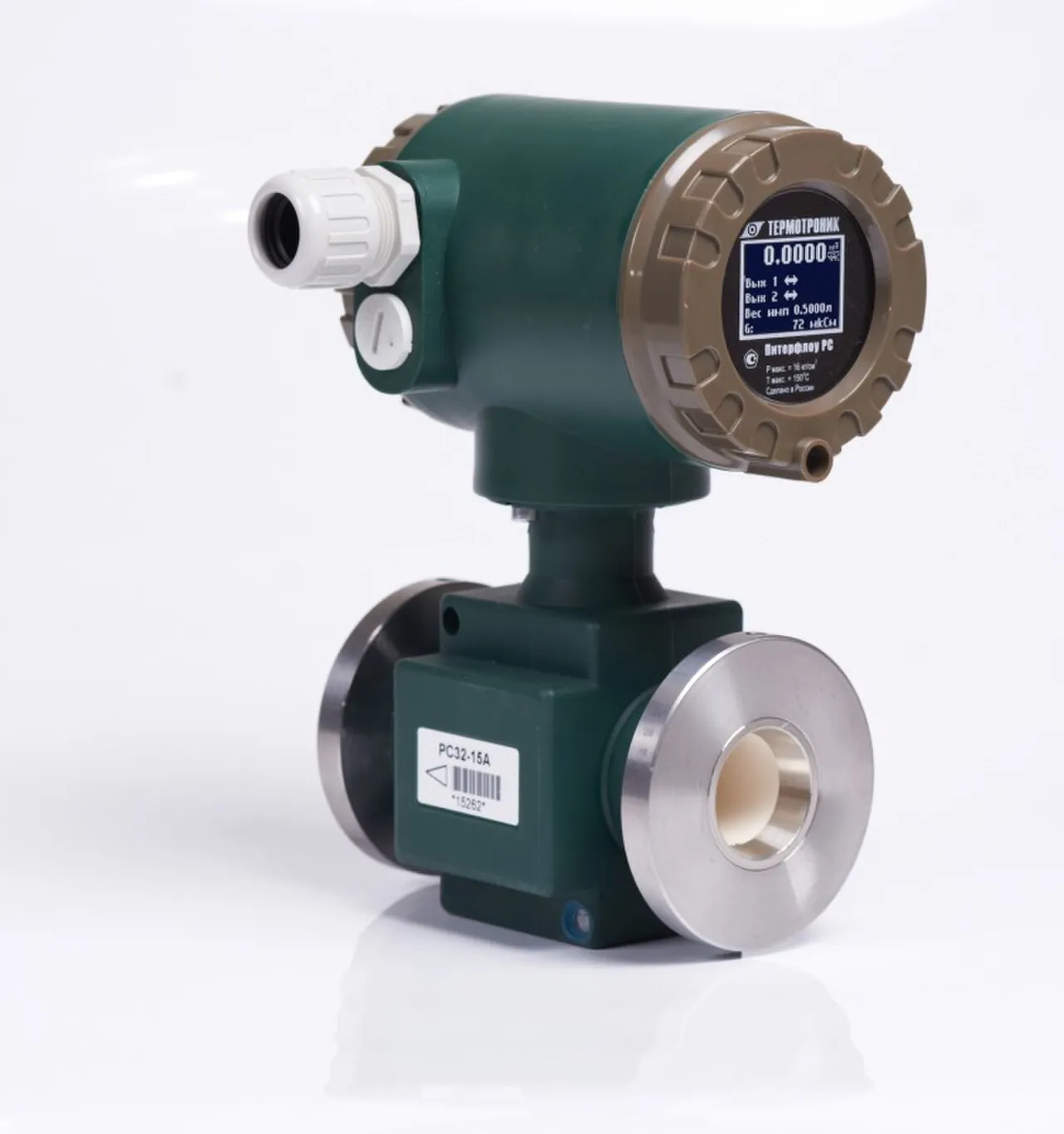
An oval gear flow meter is a positive displacement meter: two meshed oval rotors, geared to each other and sealed inside a measuring chamber, are driven around by the fluid itself, and every revolution transports a fixed, machined volume of liquid through the chamber, so counting revolutions counts volume directly. The measurement is volumetric arithmetic rather than inferred physics, which is why the technology holds roughly 0.5 percent of reading accuracy on oils, fuels, resins, solvents, syrups, and additives across enormous viscosity windows, does not care about upstream pipe geometry because there is no velocity profile to assume, and remains the metering backbone of fuel distribution, chemical dosing, lubrication skids, and batch filling wherever the liquid is valuable, viscous, or non-conductive.
Specifying one is four linked decisions: the wetted materials and clearances against the liquid's chemistry, lubricity, and cleanliness, because the meter is a precision gear pump running backwards and dirty or dry service is how it dies; the size against the flow range, where positive displacement meters excel at turndown, commonly 10 to 1 and often 100 to 1 on viscous liquids, but slam shut at both ends, a minimum below which slip dominates and a maximum above which pressure loss and rotor speed destroy accuracy and bearings; the output chain, pulse pickup, totalizer display, 4 to 20 milliampere conversion, or a full batch controller with valve sequencing; and the calibration and legal framework, whether the duty is internal process metering or custody-adjacent fuel transfer under OIML or weights-and-measures approval. This page works each decision with catalog numbers and closes with the RFQ lines that make oval gear quotes comparable at engineering level.
This page treats the oval gear flow meter as a calibrated volume in motion: rotor cavity arithmetic, viscosity and slip physics, accuracy classes and turndown honesty, solids and dry-run limits, pulse and batch output chains, and the RFQ lines that carry the whole specification.
Chapter 1 / 06
What an Oval Gear Flow Meter Is and What Is Being Decided
The mechanics define the metrology. Inside the chamber, the two oval rotors mesh without metal contact, held in phase by external timing gears on most designs, and the pressure difference across the meter, typically under 1 bar in normal service, is the only driver: liquid entering fills the crescent cavity beside a rotor, torques it around, and the mesh hands the volume to the outlet side. Each rotor turns four cavity volumes per revolution in the classical arrangement, so pulses per liter is a machined constant of the instrument, and the meter's accuracy is the accuracy of a machined volume plus the small slip that leaks backward through the running clearances. Nothing in the chain depends on Reynolds number, conductivity, or velocity profile, which is the technology's structural advantage over every inferential meter family.
What is being decided at purchase is whether the liquid and the duty suit a precision gear machine, and then its hardware. First, the liquid contract: viscosity across the temperature range, because low-viscosity liquids below roughly 2 centistokes raise slip and soften accuracy while viscous liquids to hundreds of thousands of centistokes actually improve sealing and rangeability, provided the pressure loss stays acceptable and heated jackets hold the liquid pumpable; lubricity, because the rotors ride on the measured liquid as their own lubricant and dry, non-lubricating solvents need special executions or different technology; and particulate content, because the clearances are tens of micrometers and solids are teeth-killers. Second, the size: minimum continuous flow against slip, maximum against rotor speed and wear, with catalogs quoting ranges like 0.5 to 120 cubic meters per hour across the family. Third, the output chain: reed or Hall pulse pickup, NPN or PNP, totalizer display, 4 to 20 milliampere or Modbus converters, and the batch controller that turns a meter into a filling machine. Fourth, the legal frame: internal metering accepts maker calibration; fuel custody accepts OIML R117-class approvals with the certificate and the sealed adjustment.
The competitive frame keeps the selection honest. Against the coriolis flowmeter, the oval gear meter prices at a third to a tenth and measures volume, not mass: the coriolis wins where mass is the contractual quantity, where the liquid is two-phase or aerated beyond forgiveness, and on the ultimate accuracy line, roughly 0.1 to 0.2 percent against 0.5; the oval gear wins the economy of every ordinary volumetric duty. Against the turbine flowmeter, the oval gear wins on viscous liquids, where turbines drown in viscosity errors, on lubricating liquids generally, and on turndown; the turbine wins on clean low-viscosity liquids at high flow where its bearings live and its price drops. Against the electromagnetic flowmeter, the oval gear wins on non-conductive liquids, the entire oil and solvent and fuel world where the magmeter has no signal at all; the electromagnetic flowmeter wins on slurries and water duty where its obstructionless tube is unbeatable. Against the ultrasonic flowmeter, the oval gear wins on price at small sizes and on accuracy against clamp-on street practice; the ultrasonic wins where no penetration is allowed. Against the vortex flowmeter, the oval gear wins on low flows and viscous liquids, both below the vortex floor. Against the thermal mass flowmeter, the two families split by phase: thermal belongs to gas, where its heated element reads mass velocity directly, and the oval gear to liquid, where heat is irrelevant and cavity arithmetic rules; the crossover at clean dry gas favors thermal, and everything liquid favors the gears. Against the variable area flowmeter, the oval gear wins on transmitted accuracy and batch totals, the rotameter on a local indication at a tenth of the price. And the kinship is real: the gear pump and lobe pump pages describe the same positive displacement family running as actuators, pumping liquid instead of counting it, and the reader who understands one understands the leakage physics of all.
One positioning note: this page is the single-product page for the oval rotor meter. The coriolis, electromagnetic, ultrasonic, vortex, turbine, and variable area families each have their own pages, as does the general flow meter survey; here the assumption is a volumetric duty on a liquid that lubricates, and every number that follows is chosen for that world.
Chapter 2 / 06
How Oval Gears Measure Volume Directly
The arithmetic is the instrument. A meter of a given size displaces a fixed volume per rotor revolution, and the pickup, sensing each rotor tooth or a marker gear, produces pulses at a fixed count per liter: catalog values run from tens of pulses per liter on small meters to a fraction on large ones, and the figure is the calibration. Flow rate is pulse frequency over the pulses-per-liter constant; total is pulse count over the same constant; and a batch controller closing a valve at a preset count is a filling machine accurate to the valve's stopping volume plus the meter's own error. The meter therefore reads truest as a totalizer, where accuracy classes of 0.5 percent of reading are standard and 0.2 to 0.3 available on premium executions, and repeatability, the number that batch filling actually lives on, runs at 0.05 to 0.1 percent, which is why every filling line in the solvent and lubricant world counts oval gear pulses for a living.
Slip is the error physics. A small film of liquid leaks backward through the running clearances between rotors and chamber, rotor tips and end plates, and the slip volume per unit time scales with the pressure drop across the meter and the third power of the clearance, and inversely with viscosity: hot thin liquid slips more, cold thick liquid slips less, and the meter reads low by the slip fraction. The practical consequences are the datasheet's shape: accuracy holds at 0.5 percent of reading from about 10 to 100 percent of maximum flow on liquids above a few centistokes; below the minimum flow the percentage error grows as slip becomes a growing share of a shrinking throughput; and the minimum flow line improves dramatically with viscosity, some catalogs quoting minimum flows a fifth as low on oil as on water-like liquids. The correction lever is temperature: viscosity is a temperature statement, and a meter calibrated on liquid at 20 deg C reading liquid at 60 deg C carries both a slip change and a thermal expansion of the chamber, which is why calibration certificates state the liquid and its viscosity, and why temperature-compensated executions exist for fuel duty where liters must convert to standard liters or mass.
Pressure loss is the hydraulic price. The meter presents a fixed restriction, and the loss rises with viscosity and flow: catalogs quote fractions of a bar on thin liquids and several bar at the top of viscous ranges, and the system must supply that loss as pump head. The levers are size, one size up halves the loss for the same flow, and temperature, heating a heavy liquid from 50 to 80 deg C can cut its viscosity by an order of magnitude and the loss with it; hence heated and jacketed executions for bitumen and heavy fuel duty. Maximum pressure ratings run to PN40 or Class 150 as standard, with high-pressure executions to 100 bar for injection and test stand duty; the meter holds full pressure but dislikes pressure shock, and a slam-closing valve upstream of an air-filled line is the classic chamber-cracker.
The output chain turns pulses into information. The basic pickup is a reed or Hall sensor reading the rotor magnets through the chamber wall, tens to thousands of pulses per liter by size, intrinsically safe executions for hazardous areas; the display totalizer adds resettable batch counts; converters emit 4 to 20 milliampere proportional to flow rate or digital Modbus and similar; and the batch controller integrates the valve sequence, prewarn slowdown, final shutoff, and totals per recipe. Pulsation is inherent, each cavity handoff is a small flow ripple, and on short hydraulic systems an air-filled damper downstream of the meter smooths both the ripple and the controller's job. Nothing in the chain needs more maintenance than the battery in a totalizer, which is why a quarter century-old oval gear meters with their third pickup still run filling lines their manufacturers have left the business.
Chapter 3 / 06
Types, Construction, and Duty Boundaries
Construction divides by wetted materials and by the execution the liquid demands. Aluminum bodies and rotors serve fuels and oils where the liquid itself lubricates and compatibility is simple: the economy of the fuel-distribution world. Stainless steel, 316 or duplex, serves chemicals, food, and pharmaceutical-adjacent duty, with polished executions and food-contact certificates for syrup and edible oil metering. PFA and PTFE-lined bodies with ceramic or PEEK rotors remove metal from the wetted path entirely for high-purity and corrosive duty, at a price. Bodies come threaded BSP or NPT to about DN50, flanged above and where piping class demands, and jacketed for heated service; rotors run on the measured liquid's film on most designs, with some small meters using sealed external bearings for thin solvents. End-plate and cover designs determine whether the chamber is field-serviceable, and the service kit with rotors, gears, and seals is the meter's second life.
Executions ladder by application. The plain industrial meter with pulse output is the process workhorse. The fuel meter adds the legal-for-trade option, OIML or national approval, with sealed calibration and temperature compensation converting indicated volume toward standard conditions. The chemical meter adds PTFE execution, and the food meter adds polish and certificates. The batch version integrates the controller and the valve-driving logic. High-viscosity executions carry jacketing, larger clearances, or lower-speed rotor sets to move resin and bitumen at all. High-pressure executions serve injection skids and test benches. Small sanitary executions meter flavor dosing at liters per hour. Every execution is the same machine with different materials and paper, and the RFQ's job is to buy the paper with the hardware.
Execution
Typical envelope
Duty where it wins
Hard boundary
Aluminum, industrial pulse
DN10 to DN80, to about 60 m3/h
Fuel and oil process metering
Corrosives, food legality
Stainless, polished, certificated
DN10 to DN100
Chemical, syrup, edible oil
Price on large sizes
PFA or PTFE non-metallic wetted
small sizes
High purity, strong chemistry
Pressure and temperature ceilings
Legal-for-trade fuel
with OIML and compensation
Custody fuel transfer
Sealed adjustment regime
Jacketed high viscosity
with trace heating
Bitumen, resin, heavy fuel
Startup heating discipline
Batch controller integrated
preset, prewarn, shutoff
Filling and dosing lines
Valve stopping volume sets the floor
Duty boundaries, sentence by sentence. Fuels, lubricants, hydraulic fluids, additives: the oval gear meter owns the duty, accuracy at price, with the custody approvals where trade law requires. Solvents and thin chemicals: viable with low-slip executions and honestly derated minimum flows, but the coriolis or a PD sibling with sealed bearings reads better below 1 centistoke. Water and water-like conductive liquids: the electromagnetic flowmeter wins on obstructionless tube and no wear; buying an oval gear for clean water is paying for accuracy the duty cannot use and wearing a precision machine in an abrasive-free but irrelevant role. Abrasive and solids-bearing liquids: no positive displacement meter survives; the magmeter or a loss-in-weight system owns the duty. Steam and gas: wrong physics entirely, the vortex and thermal families own those pages. High-temperature polymer service with solidification risk: jacketed executions with flush arrangements, and even then the startup and shutdown discipline, keep it liquid or purge it, is the meter's survival contract. Sanitary micro-dosing: viable and excellent when the liquid lubricates; water-like flavor carry goes to a coriolis or a dedicated micro-meter. Every boundary follows from one sentence: the meter is a gear machine whose measured liquid is also its bearing lubricant, its seal fluid, and its enemy when dirty.
Chapter 4 / 06
Key Specification Parameters
The decode table is the datasheet skeleton. Every row is an RFQ line, and the two right columns are what each row decides and what it costs to leave blank.
Parameter
Typical catalog spread
What it decides
Size and flow range
DN10 to DN100, 0.5 L/h to 120 m3/h family-wide
Turndown placement between slip floor and wear ceiling
Accuracy and repeatability
0.5 percent of reading, repeatability 0.05 to 0.1
Batch honesty and blending tolerance
Viscosity window
0.5 to 1,000,000 cSt by execution
Slip behavior and minimum-flow derating
Wetted materials
aluminum, 316 stainless, PFA or PTFE, PEEK, ceramic
Chemistry, food contact, purity
Pressure rating and loss
PN10 to PN40 standard, to 100 bar special
System head budget and envelope
Temperature range
minus 30 to plus 80 deg C, higher with jackets
Viscosity control and seal life
Pulse output
reed, Hall, NPN or PNP, IS options
Controller compatibility and resolution
Display and conversion
totalizer, rate, 4 to 20 mA, Modbus
Integration scope delivered
Connections
thread to DN50, flanged above, jacketed bodies
Piping match and heating provision
Approvals
OIML R117, ATEX or IECEx, food contact
Legal install in trade and hazardous areas
The flow-range row is the one that separates a meter from a complaint. State the minimum and maximum operating flows, not the nominal line size, and check both against the catalog curve at your viscosity: the minimum flow line on water-like liquid can be three to five times higher than on oil, and a meter selected on the oil curve then run on warm solvent reads a slip error the datasheet never promised. The turndown arithmetic follows: positive displacement turndown of 10 to 1 is conservative and 50 to 1 realistic on viscous service, and quoting the family's best turndown for a thin-liquid duty is the vendor's favorite elasticity. Fill the row with both extreme flows at both extreme temperatures, because winter fuel and summer fuel are two different liquids to a gear meter.
The materials row is the one that decides the decade. Aluminum on compatible fuel is economy; the same body on a mildly corrosive additive is a corrosion cell with a totalizer. Stainless serves chemistry and food; the polish and certificate lines belong on the RFQ when auditors will read them; and the non-metallic executions buy purity at a pressure-temperature ceiling. The seals and rotor materials must be listed, not summarized: FKM, PTFE, and PEEK elastomers each draw their own chemistry map, and the phrase "stainless steel wetted parts" without a seal list has bought many a swollen gasket. The compatibility statement from the maker against your liquid list is a free document the RFQ should demand.
The output row prices the system truthfully. The pulse value, pulses per liter, sets the batch resolution and the controller's counting speed; the pickup type sets the hazardous-area path, with intrinsically safe barriers where the zone demands; the display and converter options decide whether the electrician or the instrument engineer owns commissioning. The batch controller line item, presets, prewarn, valve outputs, and totals, converts the meter into a filling station and prices accordingly; buying it integrated with the meter keeps the warranty in one place, and buying it separately keeps the options open at the cost of an interface argument. The certificate stack, calibration at stated viscosity, approval certificates where trade, and the food-contact declarations where audited, closes the delivery ticket; a quote missing the stack is not cheaper, it is later.
Chapter 5 / 06
Selection Decision Factors and RFQ Language
The decision sequence runs from the liquid outward, because every later step prices the earlier one.
Write the liquid contract first: full chemistry, viscosity at minimum and maximum temperature, lubricity class, solids content and size, and the duty's legal standing, internal, trade, or audited food.
Choose the measurement duty: totalization, rate, or batch, and the accuracy class each demands; batch filling lives on repeatability and buys 0.05 to 0.1 percent without paying for absolute class twice.
Place the flow window: minimum and maximum flows at both temperature extremes against the maker's curve at your viscosity, one size up if the loss budget or the slip floor demands it.
Fix materials and execution: body and rotor metallurgy or non-metallic, seal list, jacketing for heated liquids, pressure class against the pump's real head, and the polish and certificates the auditors will read.
Specify the output chain: pickup type and pulse value, hazardous-area path, display, converter or bus, and the batch controller with its presets if the duty is filling.
Plan the installation: upstream strainer, typically 60 to 100 mesh, air removal where the line entrains gas, straight piping not required but support and valve sequencing are, and the startup and purge procedure for solidifying liquids.
Close with the commercial lines: calibration certificate at stated liquid, spares and rotor service kit pricing, delivery with the approval paperwork, and the recalibration interval the maker will stand behind.
The cost comparison is honest because the family's economics are structural. Against a coriolis at three to ten times the price, the oval gear meter reads volume at half the accuracy class on liquids that behave, and the mass question, when contractual, is answered by a density input rather than a coriolis invoice. Against a turbine at similar money, the oval gear wins the viscous and lubricating range outright and loses the clean thin high-flow duty to the turbine's bearings. Against the electromagnetic family, the comparison is not economic but physical: no conductivity, no magmeter, and the entire hydrocarbon world is oval gear territory by default. The maintenance economics favor the family when the liquid is clean: a rotor service kit at a fraction of a new meter restores calibration, and a meter fleet on a five-year verification cycle prices its accuracy in kit costs, not replacements. Table the decision on cost per accurate liter over the decade, including the strainer upstream and the kit at midlife, and the boundary writes itself.
Duty
Configuration to specify
Watch line
Fuel oil transfer, internal
Aluminum, pulse, strainer
viscosity at winter temperature
Custody fuel loading
OIML approved, temperature compensation
sealed calibration regime
Additive and dosing skids
Stainless or PFA, batch controller
repeatability and pulse resolution
Syrup and edible oil
Polished stainless, food certificates
cleaning regime compatibility
Resin, bitumen, heavy fuel
Jacketed, trace heated, flush
startup and purge discipline
Lubrication and test stands
High pressure execution
pressure shock protection
The RFQ language that makes quotes comparable, written as the datasheet lines a vendor must answer with numbers: size and flow range at the declared viscosity and temperature; accuracy class and repeatability; pulses per liter by size and pickup; wetted materials including every seal; pressure rating and pressure loss at maximum flow and viscosity; temperature window and jacket provision; connections; output chain and hazardous-area options; calibration certificate with the liquid stated; approvals delivered; the strainer specified as part of the metering package; and the service kit part numbers with the recommended verification interval. A quotation answering those lines is a measuring system with a price; anything else is a gear box with hope attached.
Chapter 6 / 06
Installation, Standards, Failure Modes, and Maintenance
Installation protects a precision gear machine from an industrial world. Fit the strainer immediately upstream, the mesh the maker states, commonly 60 to 100, because the meter's clearances are finer than any particle a plant considers normal; the strainer is not optional plumbing, it is the meter's insurance policy and its differential gauge is the maintenance signal. Ensure the line is liquid-full and air-free: entrained gas reads as liquid it is not, and a meter running dry at pump startup wears its rotors in seconds; air separators or a floodable startup procedure belong on fuel skids. Support the meter on its piping, not hanging from its connections; provide valves for isolation and a bypass so verification does not stop the plant; and on heated executions, bring the body to temperature before the liquid arrives, because cold resin is a chisel. Orientation follows the maker's drawing, horizontal with the dial upright the common default, and the pickup wiring routed away from power cables with its screen grounded per the instrument standard.
The standards frame names the accuracy and the legality. Meter performance statements align with the positive displacement practice of API Manual of Petroleum Measurement Standards chapter 5 in the petroleum world and with OIML R117 and its national implementations, the approval that makes a fuel meter legal for trade with temperature compensation toward standard volume; hazardous-area pickups carry ATEX or IECEx intrinsic safety certification; food executions answer the contact-material regulations of the jurisdiction, with polish and drainability statements in the file. Calibration practice rides on gravimetric or master-meter comparison at a stated viscosity, the certificate states liquid and temperature, and the verification interval, commonly one to five years by duty, belongs in the maintenance system with the certificate attached. None of this is exotic; the failure mode is a meter bought without its paper and discovered at the first audit or the first dispute.
Failure modes arrive in a predictable order, and each has a specification answer. Rotor wear from solids shows as calibration drift downward over months, the meter reading less than reality: the answer is the strainer maintained, the liquid's solids honestly stated at purchase, and the calibration check interval set by drift history. Dry-run damage at commissioning shows as instant scoring or a locked rotor: the answer is flood-start procedures, check the line before the pump, and air removal where the system entrains. Cold-start overload on heated liquids shows as a stalled rotor against solid product, bent shafts and a cracked chamber: the answer is the heat-then-flow interlock in the control logic, purge arrangements on shutdown, and the jacket spec written by the liquid's data sheet. Bearing and gear wear on thin non-lubricating liquids shows as rising friction then slip: the answer is the sealed-bearing execution specified when the liquid list demanded it. Pressure shock from slam valves shows as chamber and cover damage: the answer is slow-closing valves, surge relief, and the startup sequence that keeps liquid between the valve and the meter. Pickup failure shows as lost pulses on an otherwise healthy meter: the answer is the spare pickup in the stores kit and the totalizer cross-check against tank levels that catches the silent lie.
Maintenance is a strainer-and-certificate calendar. Monthly: strainer differential checked and cleaned on schedule, seal weeps inspected, pickup wiring verified. Annually or by the verification interval: the meter proved against a master or gravimetric standard at operating viscosity, the totalizer compared with tank inventories, and the certificate renewed or the meter re-zeroed per its adjustment regime, sealed where the approval requires. The rotor service kit at midlife, rotors, timing gears, seals, bearings, restores the machined clearances that are the calibration; the kit price and the service exchange program belong in the purchase file, because the second decade's economics are decided at the first purchase. Keep one complete spare for critical single-meter services; a filling line stopped on a meter is a shift lost for a courier.
The commissioning record closes the loop: as-built piping with the strainer and air provisions, liquid and viscosity at calibration, pulse value verified against the controller, batch accuracy proven over ten real batches with the valve stopping volume measured, and the verification interval booked. One page per meter, kept with the loop file. Plants that keep it argue with vendors from evidence; plants that do not argue with vendors from memory, and memory does not hold 0.5 percent of anything.
FAQ
What liquids suit an oval gear flow meter best?
Clean, lubricating liquids across a huge viscosity window: fuels, lubricating and hydraulic oils, resins, additives, syrups, and solvents above roughly 2 centistokes. The measured liquid is also the rotor bearing lubricant, so thin, dry, non-lubricating liquids degrade accuracy and wear; abrasive solids are disqualifying entirely. Water and conductive liquids are better served by an electromagnetic flowmeter, and mass-contractual duties by a coriolis flowmeter.
How accurate is the meter at low flow?
Accuracy holds around 0.5 percent of reading from about 10 percent of maximum flow upward on viscous liquids, but the floor rises as viscosity falls: slip through the running clearances becomes a growing share of throughput, so the minimum flow on a water-like solvent can be three to five times the minimum on oil. Read the catalog curve at your actual viscosity and both temperature extremes, and state both extreme flows in the RFQ.
Does the meter need straight pipe upstream?
No. Positive displacement measurement counts machined volumes and does not depend on velocity profile, Reynolds number, or conductivity, so no straight-run requirement and no flow conditioning apply. What it does need is a strainer immediately upstream, a liquid-full line without entrained air, and protection from pressure shock, none of which straight pipe would fix.
Can it handle bitumen and heavy fuel oil?
Yes, in jacketed executions with trace heating: catalogs extend to around one million centistokes with heat, and heating the liquid is usually the enabling act, cutting viscosity by an order of magnitude and pressure loss with it. The survival contract is procedural: heat the body before the liquid arrives, keep it liquid or purge it on shutdown, and interlock flow behind temperature, or the first cold start is the meter's last.
Oval gear or coriolis for a dosing skid?
If the contract quantity is volume and the liquid is clean and lubricating, the oval gear meter prices at a third to a tenth of a coriolis with 0.5 percent accuracy and 0.05 to 0.1 percent repeatability, which batch filling lives on. If the contract quantity is mass, the liquid is aerated or two-phase, or the duty demands 0.1 to 0.2 percent absolute, the coriolis flowmeter earns its invoice. Density compensation on an oval gear total is the middle path.
What approvals does a fuel transfer meter need?
For legal trade in fuel, the meter needs pattern approval under OIML R117 or its national implementation, with temperature compensation toward standard volume, a sealed calibration adjustment regime, and periodic verification by the weights-and-measures authority. Internal process metering needs none of that, only the maker's calibration certificate at a stated viscosity. Hazardous-area installations add ATEX or IECEx intrinsic safety on the pickup and barrier.
What maintenance does the meter need?
A strainer and certificate calendar: the upstream strainer checked and cleaned monthly, because its clog is the meter's death warrant; seals and pickup inspected; and a verification against a master meter or scale at the stated interval, commonly one to five years by duty. At midlife the rotor service kit, rotors, gears, and seals, restores the machined clearances that are the calibration, at a fraction of a new meter. Keep one spare for critical single-meter services.