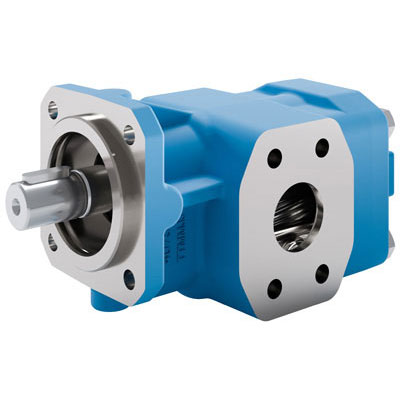
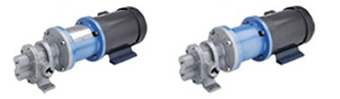
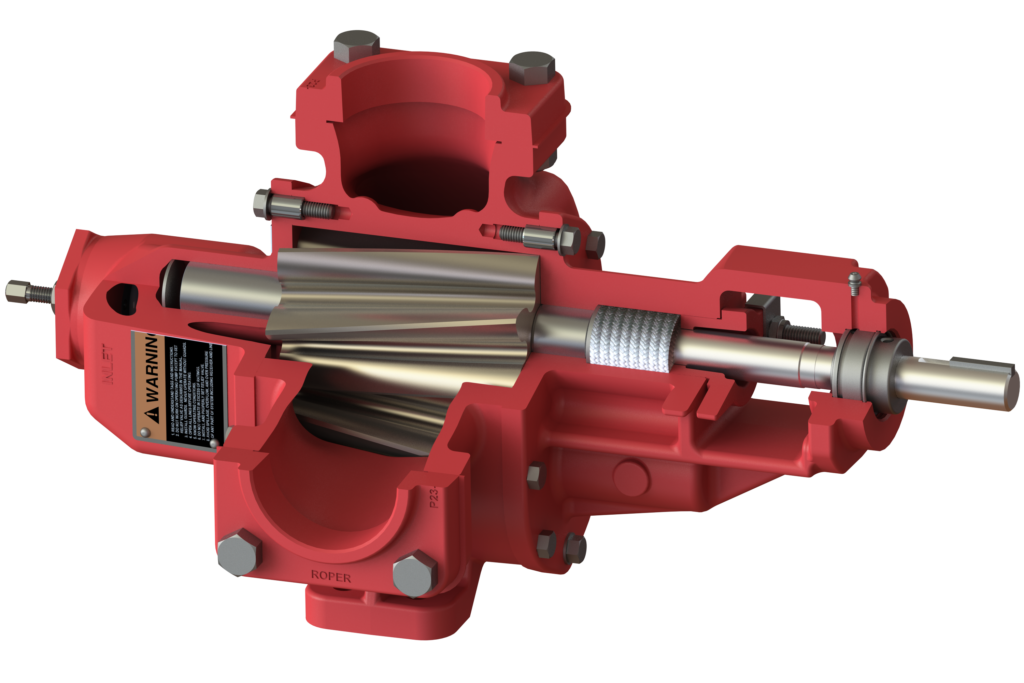
A gear pump is a rotary positive-displacement pump that moves fluid by trapping it in the cavities between meshing gear teeth and the casing wall, then forcing it out as the teeth re-mesh at the discharge. Because a fixed volume is carried per revolution, flow stays nearly constant as discharge pressure changes and rises only with shaft speed, the defining behavior that separates a gear pump from a centrifugal pump.
Two architectures dominate: the external gear pump, with two meshing externally toothed gears, prized for compact high-pressure hydraulic and lube duty; and the internal gear pump, with an idler nested inside a rotor and a crescent partition, prized for smooth, high-viscosity transfer of oils, bitumen, resins, and polymer melts.
Photo: S.J. de Waard, CC BY 2.5, via Wikimedia Commons
This guide is written for industrial purchasing engineers and design engineers. It covers six chapters, from working principle and history through types, port-and-gear design, materials and standards, spec-sheet decoding, and the selection decision, with seven selection FAQs and manufacturer references. All parameters reference public standards including ISO 4391, ISO 8426, ISO 4409, ISO 3019-1, SAE J744, DIN 51524, and API 676.
Chapter 1 / 06
What is a Gear Pump
A gear pump is a positive-displacement (PD) pump that transfers fluid by repeatedly enclosing a fixed volume between interlocking gear teeth and the pump casing, then carrying that volume from the inlet to the outlet by mechanical action. Unlike a centrifugal pump, which adds velocity energy with a spinning impeller and converts it to pressure, a gear pump physically traps and pushes the fluid. The consequence is fundamental: delivered flow is set by displacement and speed, not by the downstream pressure, so a gear pump produces an almost vertical flow-versus-pressure characteristic and will continue to build pressure until something in the system gives way.
In an external gear pump, a driven gear meshes with a driven idler gear. As the teeth come out of mesh near the inlet, they create an expanding cavity and a partial vacuum that draws fluid in. The fluid fills the spaces between the teeth and the casing bore, is carried around the outside of each gear toward the outlet, and is then squeezed out as the two gears re-mesh and the teeth occupy the cavities. In an internal gear pump, a smaller externally toothed idler turns inside a larger internally toothed rotor; a stationary crescent-shaped partition separates the suction side from the discharge side, and the fluid is carried in the chambers between the two gear sets before the re-meshing teeth expel it.
Because the design relies on close running clearances of only a few microns rather than on valves, a gear pump has no separate inlet or outlet check valves, self-primes readily, runs in either direction on many models, and handles viscous fluids that would defeat a centrifugal pump. Those same tight clearances make it intolerant of abrasive particles and dry running, which are the leading causes of premature wear.
Gear pumps are among the oldest rotary pump types, with practical designs dating to the nineteenth century, and they remain ubiquitous because the geometry is simple, robust, and cheap to manufacture at scale. They appear as charge and main pumps in hydraulic power units, as lubrication and fuel pumps in engines and machine tools, as transfer pumps for chemicals, fuels, and food products, and as precision metering and polymer-melt pumps in plastics extrusion, where the constant volume per revolution makes flow directly proportional to a measured shaft speed.
Four engineering metrics dominate gear pump quality and total cost of ownership: displacement (volume per revolution), maximum continuous working pressure, volumetric efficiency at that pressure, and the viscosity and cleanliness window of the fluid. A pump that is cheap to buy but loses volumetric efficiency quickly as clearances wear, or that is run outside its viscosity and filtration window, costs far more over a production lifetime in lost output, recalibration, and downtime than a correctly specified unit.
Chapter 2 / 06
Gear Pump Types and Classification
Gear pumps split first by gear arrangement (external versus internal), then by sub-geometry (spur, helical, or herringbone gears on external pumps; crescent or gerotor/trochoidal on internal pumps), and finally by drive and sealing method (packed gland, mechanical seal, or sealless magnetic drive). Choosing the wrong family is the most common selection error: an external gear pump forced onto a high-viscosity polymer will starve and cavitate, while an internal gear pump applied to a compact 250 bar hydraulic circuit is unnecessarily large and costly. The table below compares the core families.
Type
Geometry
Best-fit Viscosity
Typical Duty
External gear
Two meshing external gears
~1 to a few thousand cSt
Hydraulics, lube, fuel, clean oils
Internal gear (crescent)
Idler inside rotor + crescent
~1 cP to 1,000,000+ cP
Bitumen, resins, polymers, transfer
Gerotor / trochoidal
Internal, no crescent
Low to medium
Lube and charge pumps, engines
Magnetic-drive (sealless)
Internal gear + mag coupling
Low to very high
Hazardous, leak-free chemical duty
External gear pumps are the most widely produced family. Two equal-sized gears mesh at the casing centerline, one on the drive shaft and one freely turning. The tight tooth-tip and side-plate clearances and high allowable speed (commonly up to 3,000 rpm, and up to about 3,600 rpm on some hydraulic models) give a compact, high-pressure-density unit. The trade-off is that the same tight clearances and speed make external gear pumps less tolerant of high viscosity, abrasives, and entrained solids; they are at their best on clean, filtered hydraulic and lubricating oils.
Internal gear pumps place a smaller externally toothed idler inside a larger internally toothed rotor, with a fixed crescent partition sealing suction from discharge. Fewer contact points, larger fill ports, and lower running speed let internal gear pumps fill well at high viscosity and deliver notably smoother, lower-pulsation flow. Manufacturer data shows internal gear pumps handling fluids from roughly 1 cP up to well over 1,000,000 cP, including bitumen, tar, wax, resins, chocolate, and shear-sensitive polymer melts, while still pumping thin liquids such as propane and ammonia. This versatility makes them the standard for viscous transfer and polymer processing.
Gerotor (trochoidal) pumps are internal gear pumps without a crescent; the idler has one fewer tooth than the rotor and the meshing profile itself forms the sealing line. They are compact, quiet, and inexpensive, which is why they dominate engine oil pumps, transmission charge pumps, and small lube circuits. Magnetic-drive (sealless) gear pumps replace the shaft seal with a magnetic coupling, so the wetted chamber is hermetically closed. They eliminate seal leakage and emissions, making them the preferred choice for volatile, toxic, or high-purity chemicals where any leak is unacceptable.
Chapter 3 / 06
Port, Gear, and Sealing Design
Within each family, three design choices set the noise, pulsation, pressure capability, and serviceability of a gear pump: the gear tooth form, the way side clearance is controlled at pressure, and the shaft sealing method. Engineers who only read the headline displacement and pressure figures often miss these, yet they decide whether the pump is quiet enough for an indoor machine and whether it survives years of duty. The table below summarizes the gear tooth forms used on external pumps.
Gear Form
Flow Pulsation
Axial Thrust
Reversible Flow
Spur
Higher
None
Yes
Helical
Lower
Yes (one direction)
No
Herringbone (double helical)
Lowest
Cancelled
No
Spur gears are the default on hydraulic external gear pumps. They are simple, generate no net axial thrust, and allow reversible rotation, but each tooth meshing event produces a flow pulse, so spur-gear pumps are the noisiest of the three forms. Helical gears mesh gradually, which lowers pulsation and noise and helps with viscous fluids, but they generate axial thrust in one direction and lose the ability to reverse flow. Herringbone (double-helical) gears combine two opposed helices so the axial thrust cancels while keeping the smooth, low-pulsation meshing; they are favored for particularly viscous fluids and quiet duty, again at the cost of reversibility.
Pulsation matters because every gear pump delivers a slightly rippled flow rather than a perfectly steady stream; the ripple frequency equals tooth count times shaft speed, and its amplitude drives audible whine, pressure-ripple-induced pipe vibration, and downstream metering error. Higher tooth counts and helical or herringbone forms smooth the ripple. Internal gear and gerotor designs are inherently smoother than external spur designs, which is one reason internal gear pumps are chosen for shear-sensitive and metering service.
At pressure, the side faces of the gears must be sealed against the casing to limit slip. Low-cost pumps use fixed bushings, while medium and high-pressure hydraulic pumps use pressure-loaded side plates (also called wear plates or thrust plates) that are pushed against the gear faces by a controlled fraction of discharge pressure. This pressure-balanced design keeps the axial clearance small as pressure rises, sustaining volumetric efficiency across the working range and through wear life. It is the single most important reason a quality external gear pump holds high efficiency at 250 bar while a cheaper unit does not.
Shaft sealing is the third design axis. Packed gland seals are cheap and field-repackable but weep slightly by design and suit non-hazardous service. Single or double mechanical seals give low leakage for chemicals and fuels. Magnetic couplings eliminate the dynamic seal entirely for sealless, zero-emission duty. The seal choice, more than the gears, usually dictates which fluids and safety classifications a given pump can serve.
Chapter 4 / 06
Materials, Media, and Standards
Material selection for a gear pump covers two distinct sets of parts: the wetted parts that contact the fluid (casing, gears, shafts, bushings, seals) and the gear materials that must resist wear at the meshing and tip contact. The medium drives both. For clean hydraulic and lube oils, cast iron casings with hardened steel gears are standard and economical. For corrosive or sanitary fluids, the wetted set moves to stainless steel, and for the most aggressive media to nickel alloys or special coatings. The table below is an initial-selection lookup; always confirm against the maker corrosion chart for the exact concentration, temperature, and velocity.
Medium
Typical Wetted Material
Notes
Hydraulic / lube oil
Cast iron + hardened steel gears
Filter to maker ISO 4406 class
Fuels (diesel, light oils)
Cast iron or steel
Check seal compatibility
Mild chemicals / solvents
316 / 316L stainless steel
Mechanical or mag-drive seal
Strong acids / chlorides
Hastelloy or special alloy
Avoid plain 316L on chlorides
Polymer melt / resin (hot)
Hardened tool / nitrided steel
Heated/jacketed pump body
Food / pharma (CIP)
316L electropolished
3-A / EHEDG hygienic design
Cast iron with hardened steel gears is the workhorse of hydraulic and lubrication service. It is strong, dimensionally stable, and cheap, and it tolerates the high contact stress at the gear mesh. Bosch Rexroth, for example, specifies operation with mineral oil to DIN 51524 parts 1 to 3, and recommends at least HLP-grade oil under higher load. The limiting factor is corrosion, so cast iron is not used for water-based or chemically aggressive fluids.
Stainless steel (316 / 316L) moves the wetted set into chemical, fuel-handling, and sanitary duty. 316L resists a wide range of organics and dilute acids, but it is vulnerable to chloride pitting and stress-corrosion cracking, so chloride-bearing media call for higher alloys. For the most aggressive acids and wet chlorine, nickel alloys such as Hastelloy are specified at a multiple of the cost. For abrasive or high-purity service, hardened, nitrided, or coated gears resist tip wear while preserving the close clearances that volumetric efficiency depends on.
On the standards side, hydraulic gear pumps are defined and tested under a coherent ISO framework. ISO 4391 establishes the parameter definitions and letter symbols. ISO 8426 specifies how to determine derived capacity, the experimentally measured displacement per revolution, which underpins every real efficiency calculation. ISO 4409 defines the procedure for measuring volumetric, mechanical, and overall efficiency across the manufacturer operating range. ISO 3019-1 and the dimensionally aligned SAE J744 standardize the mounting flanges and shaft ends so pumps from different makers interchange on a given drive. Fluid grade and cleanliness reference DIN 51524 and the ISO 4406 contamination code.
For process and petroleum service, API 676 sets the minimum requirements for rotary positive-displacement pumps, including gear pumps. It addresses materials, integral and external relief-valve protection, NPSH and NPIP suction guidance, and mandatory performance, hydrostatic, vibration, and noise testing. Sanitary gear pumps additionally follow 3-A sanitary standards and EHEDG hygienic-design guidance, which dictate surface finish, drainability, and crevice-free construction for clean-in-place food and pharmaceutical lines.
Chapter 5 / 06
Key Specification Parameters
A gear pump datasheet lists many figures, but only a handful drive the selection decision. The table below lists the core parameters with representative ranges drawn from mainstream hydraulic and process gear pump datasheets; the text that follows explains how to read each one. Exact values always come from the specific model datasheet, not from a category range.
Parameter
Typical Range
What It Decides
Displacement
~1 to 250+ cm3/rev
Flow per revolution; pump size
Max working pressure
~16 to 280 bar
Pressure rating and gear/seal load
Shaft speed
~600 to 3,600 rpm
Flow scaling; viscosity limit
Volumetric efficiency
~85 to 98%
Slip; delivered vs theoretical flow
Viscosity window
~1 to 1,000,000+ cP
Fill quality; family selection
Inlet pressure / NPSH
Per datasheet
Cavitation margin
Displacement (derived capacity) is the theoretical volume per shaft revolution, in cm3/rev or in3/rev, determined by the ISO 8426 method. Hydraulic external gear pump families span a wide range: Bosch Rexroth external series run from roughly 1.0 to 28 cm3/rev across their smaller B and F frames and larger on the N and G frames, while Parker PGP cast-iron and aluminium series cover roughly 2 to over 100 cm3/rev across frame sizes. Theoretical flow equals displacement times speed; a 28 cm3/rev pump at 1,500 rpm gives 42 L/min before slip.
Maximum continuous working pressure sets the gear, bearing, and side-plate loading. Compact hydraulic external gear pumps commonly reach 250 to 280 bar continuous (the Bosch Rexroth AZPF series is rated up to 280 bar), and Parker PGP frames operate to about 241 bar (3,500 psi). Process and transfer internal gear pumps usually run at far lower pressures, often well under 25 bar, because their job is viscous transfer rather than power transmission. Always separate continuous rating from intermittent peak rating on the datasheet.
Volumetric efficiency is the ratio of delivered flow to theoretical flow, and it captures internal leakage (slip) past the tooth tips and side plates. It falls as pressure rises (slip increases with the pressure that drives fluid back across clearances) and as fluid thins. Good hydraulic external gear pumps hold 85 to 95 percent at rated pressure, and well-designed units reach up to about 98 percent at favorable conditions. A measured efficiency below the datasheet value in service is the clearest sign of clearance wear.
Shaft speed scales flow linearly but is bounded at both ends. Too high a speed on a viscous fluid starves the inlet, the chambers cannot fill in the time available, and the pump cavitates; this is why viscous-duty internal gear pumps run slowly, typically a few hundred to roughly 1,500 rpm, while thin-oil hydraulic pumps run to 3,000 rpm or more. Inlet pressure and NPSH margin guard against cavitation: the fluid must arrive with enough head, above the NPSH-required value, to fill the expanding suction cavities without flashing. API 676 provides explicit NPSH/NPIP guidance for process duty.
Mechanical and overall efficiency, the fluid viscosity window, the temperature limit (which sets whether a heated or jacketed body is needed for polymers and bitumen), the seal type, and the integral relief-valve option round out the decisive parameters. Read each against the application before comparing prices, because two pumps with identical displacement can differ greatly in pressure rating, efficiency, and fluid compatibility.
Chapter 6 / 06
Selection Decision Factors
To convert the preceding chapters into a specific model, work through the ordered sequence below. Most selection failures come not from one wrong number but from deciding the family and speed before the fluid and pressure are pinned down. These steps double as a fixed RFQ template.
Define the fluid first: viscosity (at operating temperature, not at 20 degrees C), abrasiveness, shear sensitivity, corrosivity, lubricity, and temperature. Viscosity and abrasiveness alone usually decide external versus internal, and whether a heated or jacketed body is needed.
Set flow and pressure: required delivered flow (L/min or gpm) at the actual discharge pressure, plus any intermittent peak. Derive displacement from flow and a sensible shaft speed, then confirm the pressure rating covers continuous and peak duty with margin.
Choose the family and gear form: external spur for compact high-pressure hydraulics; internal crescent for viscous, shear-sensitive, or metering transfer; gerotor for small lube and charge duty; helical or herringbone where low noise and pulsation matter. Magnetic drive where leakage is unacceptable.
Select wetted materials: cast iron and steel for oils, 316/316L for mild chemicals and sanitary, nickel alloys for aggressive acids and chlorides, hardened or nitrided gears for abrasive or polymer service. Match seals (gland, mechanical, or sealless) to the medium and hazard class.
Check suction and NPSH: verify available NPSH exceeds NPSH-required at the chosen speed and viscosity; reduce speed or enlarge the inlet for viscous fluids to avoid cavitation and the erosion it causes.
Specify mounting and drive: flange and shaft per ISO 3019-1 / SAE J744 so the pump fits the motor or PTO; confirm rotation direction, mounting orientation, and porting.
Add overpressure protection: always provide a relief or bypass valve set above maximum working pressure. Treat any integral cover relief as last-resort protection only; for continuous duty fit a full-flow external relief in the discharge line, as API 676 expects.
Apply standards and certifications: hydraulic duty to ISO 4391 / 8426 / 4409; process and petroleum duty to API 676; sanitary duty to 3-A / EHEDG; hazardous areas to the relevant Ex scheme. Filter and condition the fluid to the maker ISO 4406 cleanliness class.
A final, commonly overlooked dimension is serviceability over the pump life: the availability of repair kits (gears, bushings, side plates, seals), the ease of restoring clearances, local technical support, and spare-parts lead time. Gear pumps wear gradually at the clearances, so a model with field-serviceable wear parts and stocked kits often beats a sealed-for-life unit on total cost. Mainstream hydraulic makers such as Bosch Rexroth, Parker, Casappa, and Marzocchi, and process and high-viscosity specialists such as Viking, DESMI ROTAN, and Maag, all maintain spare-parts and service networks, which is why they are reliable choices for long-running plant equipment.
Recent Industry Developments
· Foreign-Trade Zone (FTZ) 39, Notification of Proposed Production Activity; Abbott Laboratories; (Diagnostic Medical Devices); Irving, Texas (federalregister.gov)
FAQ
What is the difference between an external gear pump and an internal gear pump?
An external gear pump uses two identical, externally toothed gears that mesh at the center of the casing; one is driven and turns the other. Its tight clearances and high running speeds (up to 3,000 to 3,600 rpm) make it compact, inexpensive, and well suited to clean, low-to-medium viscosity hydraulic and lube oils. An internal gear pump nests a smaller externally toothed idler inside a larger internally toothed rotor, with a crescent-shaped partition sealing suction from discharge. It runs slower, fills better at high viscosity, and delivers smoother, lower-pulsation flow, which is why it dominates polymer, bitumen, resin, and shear-sensitive fluid transfer. Same positive-displacement principle, different geometry and duty envelope.
How is gear pump displacement related to flow rate?
Displacement, also called derived capacity, is the theoretical volume of fluid moved per shaft revolution, expressed in cm3/rev (cc/rev) or in3/rev. ISO 8426 defines the test method for determining it. Theoretical flow equals displacement multiplied by shaft speed: a 28 cm3/rev pump at 1,500 rpm gives 28 x 1,500 = 42,000 cm3/min, or 42 L/min. Actual delivered flow is lower because of internal leakage (slip) past the gear tips and side plates, captured by volumetric efficiency. At rated pressure a good external gear pump holds 85 to 95 percent volumetric efficiency, so the 42 L/min theoretical figure delivers roughly 36 to 40 L/min at the port.
What viscosity range can a gear pump handle?
Gear pumps cover an exceptionally wide viscosity band, but the two architectures split the work. External gear pumps suit thin to medium fluids, roughly 1 to a few thousand cSt; their tight tooth-tip clearances leak badly on very thin liquids and shear high-viscosity fluids. Internal gear pumps are the high-viscosity workhorse: published manufacturer data shows them handling fluids from about 1 cP up to well over 1,000,000 cP, including bitumen, tar, wax, resins, chocolate, and polymer melts, while also pumping thin liquids such as propane or ammonia. As viscosity rises, you reduce shaft speed to give the chambers time to fill and to keep inlet losses and NPSH demand manageable.
What standards govern industrial gear pumps?
For hydraulic gear pumps, ISO 4391 defines the parameters and letter symbols, ISO 8426 specifies how to determine derived capacity (displacement), and ISO 4409 covers volumetric, mechanical, and overall efficiency testing. Mounting and drive interfaces follow ISO 3019-1 and the dimensionally aligned SAE J744 flange and shaft series. Fluid cleanliness and grade reference DIN 51524 (HL/HLP mineral oil) and ISO 4406 contamination classes. For process and petroleum service, API 676 sets the minimum requirements for rotary positive-displacement pumps, including materials, integral relief valves, NPSH/NPIP guidance, and performance, hydrostatic, and vibration testing. Sanitary gear pumps additionally reference 3-A and EHEDG hygienic design.
Why does a gear pump need a relief valve, and where should it go?
A gear pump is a positive-displacement machine: it moves a fixed volume per revolution regardless of downstream pressure. If a downstream valve closes or a line blocks, the pump keeps displacing fluid into a dead-ended system and pressure climbs until something fails, the motor stalls, the shaft shears, or the casing cracks. Protection is therefore mandatory through a pressure relief or bypass valve set above the maximum working pressure. An integral relief built into the pump cover protects only against brief, infrequent overpressure and is not a flow-control device; API 676 and most makers require a separate, full-flow external relief valve in the discharge line for continuous protection. Never run a gear pump against a fully closed discharge.
What causes gear pump wear and how do I extend service life?
The dominant wear mechanisms are abrasion from entrained solids, cavitation erosion from inadequate suction conditions, corrosion from incompatible media, and metal-to-metal contact during dry running. Because gear pumps rely on close running clearances of a few microns, even fine particles enlarge tip and side-plate gaps and raise slip, lowering volumetric efficiency. To extend life: filter the fluid to the ISO 4406 cleanliness class the maker specifies, keep inlet pressure above NPSH-required so the chambers fill without cavitation, never run dry (seals and bushings overheat in seconds), hold viscosity within the recommended window, and match wetted materials to the medium. Monitor delivered flow and discharge ripple; a measurable flow drop at constant speed signals clearance wear.
What is the difference between a gear pump and a centrifugal pump?
A centrifugal pump is a rotodynamic machine that adds kinetic energy with an impeller and converts velocity to pressure; its flow falls as discharge pressure rises, following a head-capacity curve, and it cannot self-prime or build pressure against thick fluids. A gear pump is a positive-displacement machine that traps and carries a fixed volume per revolution, so flow stays nearly constant as pressure changes and rises only with speed. Gear pumps self-prime, handle high viscosity and high pressure, and give smooth metered flow, but tolerate far less abrasion and must be protected by a relief valve. Choose centrifugal for high-flow, low-viscosity, low-to-moderate-head water-like duties; choose gear for viscous, high-pressure, or accurately metered service.
Gear Pump Manufacturers
Source-backed product routes. Open a company dossier for procurement scope and cited evidence.
KRACHT GmbH is a Werdohl, Germany pump-technology company with a documented external gear-pump range.
Published product fact
KRACHT external gear transfer pumps, including modular KF gear pumps with stated 0.5–3,150 cm³/rev displacement, -40–200 °C range and maximum pressure up to 25 bar.