
A 0.01% accuracy decade resistance box from IET Labs covers 0.01 Ω to 11.1111 MΩ across six decades with a terminal accuracy of ±(0.01% + 2 mΩ) and high-performance solid silver-alloy switch contacts [S1]. The same vendor's HARS series reaches 1 mΩ to 111 MΩ on 100 ppm (0.01%) models and ships in 1-decade through 11-decade configurations, with a double-power HARS-X2 variant available for higher dissipation [S1].
Time Electronics' 1051, a compact 8-decade metal-film unit running 0.01 Ω to 1 MΩ, targets general lab and Pt100 simulation work and is rated for 250 V DC / 176 V AC RMS operation [S2]. Guildline's 9340, distributed by Evolution Measurement, pushes the upper end to 10 TΩ with temperature coefficients ≤5 ppm and 12-month stability ≤10 ppm, the tightest combination cited in the 2026 catalogue set [S3].
What "0.01% Accuracy" Actually Means at the Terminals
Manufacturer accuracy on a decade resistance box is a reading-percent term plus a fixed floor expressed in milliohms, not a single percent figure [S1]. IET specifies ±(0.01% + 2 mΩ) for its GenRad 1433, meaning a 100 Ω dial position carries roughly ±12 mΩ of total allowable error, of which 2 mΩ is the irreducible contact-and-zero-resistance floor [S1].
Evolution Measurement summarises the same point numerically: a 0.01% error at the 1 Ω decade gives a 100 µΩ total error, twenty times tighter than a competitor's 2 mΩ floor-only spec [S3]. Maxwell India's 2026-01-05 reference article breaks tolerance into four classes, ultra-precision ±0.001% to ±0.005%, precision ±0.01%, laboratory ±0.02% to ±0.05%, and industrial ±0.1% to ±0.5% (2025-08) [S5].
The 1051 shows a typical graduated dial: 0.01 Ω and 0.1 Ω decades are ±10% and ±5%, tightening to ±0.1% by the 100 Ω decade, because absolute milliohm errors become vanishingly small as the decade value rises [S2]. Buyers should expect a step accuracy curve, not a flat spec sheet number, when they size an instrument for a 4-wire kelvin measurement.
Resistance Range, Decades, and Resolution
Range and number of decades vary more than accuracy class: IET's 1433 ships in 36 models from 3 to 11 dials, covering 1 mΩ to 111.11111111 MΩ; the HARS series spans 1 mΩ to 111 MΩ on the same switch family [S1]. Cropico RBB units from Seaward combine 0.001 Ω to 11 MΩ in one enclosure using gold-plated switches to keep the low-ohm decades honest [S6].
At the resistance floor, the question is no longer range but absolute error: 0.01 Ω steps are standard on 8-decade boxes like the 1051, while the 1433 reaches 1 mΩ resolution on its lowest decade [S1][S2]. Guildline's 9340 is the outlier, trading decade resolution for an upper limit of 10 TΩ used in high-resistance calibration rather than low-ohm work [S3].
For RTD simulation specifically, see the RTD PT100 encyclopedia entry for the Callendar-Van Dusen coefficients a 0.01% box must reproduce across 18.52 Ω to 390.48 Ω. The 1051 is explicitly marketed as suitable for Pt100 simulation because its 0.01 Ω and 0.1 Ω decades align with the 0.385 Ω/°C nominal slope [S2].
Resistor Technology, TCR, and Long-Term Stability
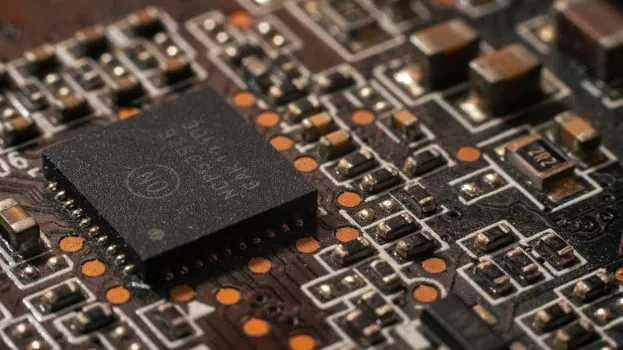
Three resistor families dominate 0.01% boxes: metal film, wirewound, and bulk-metal foil. Time Electronics builds the 1051 around high-stability metal-film resistors with low temperature coefficient; IET's GenRad 1433 uses precision wirewound elements; and high-stability bulk-foil elements appear in the Guildline 9340 and in IET's PRS-330 programmable box, where the spec sheet quotes 70 ppm + 1 mΩ lab-grade accuracy [S1][S2].
TCR is the second axis: the 1051 line and most IET precision units publish 50 ppm/°C (0.005%/°C) as a typical figure, while the Guildline 9340 advertises ≤5 ppm/°C, an order of magnitude tighter [S3]. Government-tender specifications, such as the GeM India bid document, codify 50 ppm/°C and ±0.05% decade accuracy as the minimum bar for procurement-grade decade boxes [S7].
Twelve-month stability is the third leg of the stool: the 9340 specifies ≤10 ppm drift over a year, while 1% educational boxes rarely publish a stability figure because their resistors are selected to 1% and drift is dominated by switch contact wear [S3][S5]. A buyer comparing two 0.01% units at the same price should look at TCR × expected temperature swing first, stability second, and terminal accuracy last.
Voltage, Power, and Switch Contact Design
Voltage rating is usually 250 V DC / 176 V AC RMS for bench-top units like the 1051 and GeM-spec boxes; pushing past 2 kV requires IET's HRRS series, which goes to 5 kV or 10 kV for Megger calibration work [S1][S2][S7]. Current ratings are inverse to resistance: the 1051 datasheet lists 1 A on the 0.1 Ω decade and 5 A on the 0.01 Ω decade, before derating for switch contact heating [S2].
Power per resistor is 1 W on the 1051 and most lab units, rising to 225 W/decade and 250 W maximum on IET's HPRS high-power resistance decade box, a different product class aimed at load-bank substitution rather than metrology [S1][S7]. For high-voltage and high-resistance work, IET's VRS-100 series delivers fixed values from 1 kΩ to 10 TΩ at up to 5 kV with 20 ppm accuracy, a common reference for insulation tester calibration; see the insulation resistance tester page for the test voltages those standards demand.
Switch contact material sets the floor resistance: the 1433 uses silver-alloy contacts, the 1051 uses a multi-finger gold contact arrangement designed to keep operating even if one finger fails, and the Cropico RBB uses gold plating for the same reason [S1][S2][S6]. Guildline's datasheet is explicit that the switch zero position does not need to be added to the dial setting, a claim that holds only when the contact resistance is below the published floor-resistance spec [S8].
How 0.01% Compares to 0.1% and Educational Classes
The same decade architecture is sold at three accuracy tiers, and a 0.1% box is mechanically identical to a 0.01% box, the difference is in resistor selection and burn-in [S1][S4]. IET's RS-series substitution boxes ship at 0.1% to 1% accuracy, the HARS at 0.01% or 0.1% depending on the resistor set chosen, and the 1433 at the 0.01% precision tier [S1].
A practical decision matrix lines up four options against four criteria:
- Educational (1%): cheap, no stability spec, rotary switches, intended for teaching labs and Ohm's-law demos [S5].<br>- Industrial (0.1%): moderate cost, 50 ppm/°C typical, used on production floors for sensor simulation and insulation resistance tester spot checks [S1][S5].<br>- Precision (0.01%): 50 ppm/°C, ±(0.01% + 2 mΩ) terminal accuracy, used in calibration labs and Pt100 simulation per the RTD PT100 Callendar-Van Dusen tables [S1][S2].<br>- Ultra-precision (≤0.005% or 20 ppm): bulk-foil or wirewound, ≤5 ppm/°C, used as a transfer standard against national references [S3][S5].
EEVblog forum builds from January 2022 show a hobbyist path of selecting 1% resistors into networks to hit sub-0.1% network accuracy, but the contact-resistance and TCR limits of a hand-wired rotary switch still dominate below 1 Ω, the same physics that puts a 2 mΩ floor on commercial units [S4].
Selection Rules for a 0.01% Lab Box
Match the box to the application in three steps: define the resistance range needed, then the accuracy at the lowest decade that matters, then the voltage and power [S1][S5]. For Pt100 work, a 0.01 Ω resolution decade with 0.01% to 0.1% accuracy above 100 Ω is sufficient, and the 1051 fits, while sub-milliohm contact-resistance work demands the 1433's silver-alloy switches and a 4-wire kelvin connection [S1][S2].
For high-resistance calibration, the 9340 and VRS-100 are the only units in the 2026 catalogue set that combine ≤10 ppm stability with 10 GΩ to 10 TΩ upper limits; buyers should treat those as transfer standards with traceable calibration certificates rather than working instruments [S1][S3]. For field work, the 1051's rubber boot, safety terminals compatible with 4 mm shrouded plugs, and 1 MΩ range cover most process-loop troubleshooting without dragging a calibration lab onto the plant floor [S2].
For a deeper comparison of the 0.01% and 0.1% accuracy classes side by side, see Decade Resistance Box: 0.01% vs 0.1% Accuracy Class Compared. One watch-out: the 1051 spec sheet shows ±10% on the 0.01 Ω decade, a useful reminder that a "0.01%" headline figure refers to the reading, not the floor [S2].
Two trackable signals to watch: any 2026 Q4 datasheet revision for the PRS-330 programmable line, which is currently the only 70 ppm + 1 mΩ programmable unit in IET's catalogue with USB, Ethernet, and IEEE-488 as standard interfaces [S1]; and the next crop of GeM tender specifications, since the January 2026 document set the 50 ppm/°C and ±0.05% floor that Indian government calibration labs are now procuring against [S7].