
A standard rear-discharge concrete mixer truck loaded with 10 cubic yards (≈7.6 m³) of ready-mix concrete weighs 66,000–72,000 lb (29,940–32,660 kg) gross vehicle weight (GVW), with the concrete payload alone accounting for roughly 40,000 lb at 4,050–4,056 lb/yd³ [S1][S3][S4][S5].
The chassis-plus-drum tare sits between 24,000 and 31,000 lb (10,900–14,000 kg), meaning a 10 yd³ load pushes total mass to within 8,000–18,000 lb of typical U.S. federal bridge-formula limits for a three-axle configuration [S2][S6]. For a deeper look at how the drum itself handles payload mass, see the concrete mixer truck reference page.
What the 66,000–72,000 lb number actually breaks down into
The headline figure is a sum of three independent weights: the chassis and drivetrain, the mixing drum and hydraulic drive, and the wet concrete payload. Sany's 2026 selection guide puts a 10 yd³ truck's chassis at roughly 26,000 lb and the concrete at 40,000 lb for a 66,000 lb total, while EPDAS and AllConcreteCalculator converge on a 25,000–30,000 kg (55,000–66,000 lb) range for a fully loaded standard mixer in metric terms [S1][S2][S5].
Manufacturer data pushes the upper end higher: the Salmon Bay Sand & Gravel spec sheet for a Kenworth 10 yard mixer lists 72,000 lb fully loaded, 12 ft 3 in hopper height, 9 ft 7 in width at the mirrors, and an overall length of 35 ft 3 in [S4]. The 4,056 lb/yd³ figure that drives these payloads is the wet density of normal-weight ready-mix, not lightweight or pervious variants [S3].
Empty weight by chassis and brand
Empty mass (no concrete, drum empty) ranges from 11,000 kg to 14,000 kg across mainstream North American and European chassis, depending on drivetrain and cab spec [S2]. Six representative platforms from the same dataset: Mack Granite 12,000–14,000 kg (26,500–31,000 lb), Peterbilt 567 around 12,500 kg (27,500 lb), Kenworth T880 roughly 13,000 kg (28,700 lb), Volvo FMX about 13,500 kg (29,760 lb), Mercedes-Benz Arocs 3240 12,800–14,000 kg (28,200–31,000 lb), and Liebherr HTM 905 around 11,500 kg (25,350 lb) [S2].
The chassis alone accounts for 7,000–9,000 kg on a standard steel frame or 6,000–8,000 kg on an aluminum-intensive frame; the steel mixing drum adds another 2,000–5,000 kg (4,400–11,000 lb), and a small-to-medium diesel engine 500–1,200 kg [S2]. For projects that need a higher concrete payload on a given GVW, lightweight aluminum chassis components are the single most effective tare-reduction lever in this dataset.
Why regulatory GVW caps the practical load
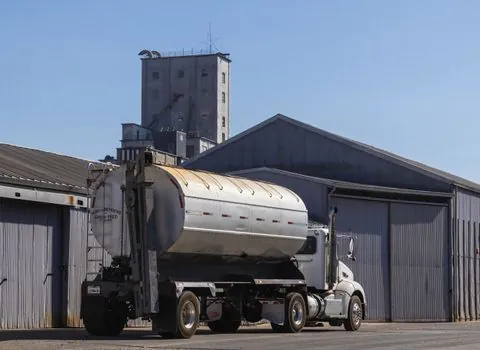
The U.S. federal bridge formula caps a three-axle ready-mix truck at roughly 48,000 lb GVW, of which only 18,000 lb can sit on the steering axle under the standard tire/axle-load assumptions used by the cement industry [S6]. That limit is why North American mixers rarely carry more than 10 yd³ on public highways, and why the Supamix 4-axle UK configuration targets around 18 t (39,700 lb) gross to stay inside the UK Construction & Use Regulations envelope for that wheel count [S7].
Exceeding the axle or gross rating is not a soft limit: it triggers bridge-inspection penalties, accelerates pavement wear, and on soft subgrade or temporary site roads can collapse a mat, so payload planning must start from the lightest legal axle, not from drum capacity [S1]. In practice, that means a 10 yd³ truck is only a 10 yd³ truck when the concrete is normal-weight, the chassis is at the lower end of its tare range, and the route is below the 48,000 lb/18,000 lb split.
Front-discharge and higher-capacity outliers
The ADVANCE FDB7000 front-discharge mixer in the AMIX Systems dataset is rated at 11 yd³ (≈8.4 m³) and pushes the fully loaded figure past the 72,000 lb Kenworth baseline, because front-discharge layouts add a secondary operator cab and a front-mounted discharge conveyor to the standard tare [S3]. That extra equipment is the trade for not needing a chute and for letting the driver place concrete without a chute tender on tight pours.
Specialist units, such as the Heidelberg Materials UK Supamix, deliberately run a lighter payload target of about 18 t gross to suit urban delivery where bridge ratings, residential streets, and maneuverability dominate over per-trip volume [S7]. The 10 yd³ / 66,000 lb U.S. number is therefore a North American highway-rear-discharge benchmark, not a universal figure for every market or every drum layout. Related transport equipment, including the truck-mounted concrete pump class, is rated on its own GVW envelope and is not directly comparable.
Concrete density: where the 40,000 lb payload comes from
Normal-weight ready-mix is assumed at 4,050–4,056 lb/yd³ (≈2,419 kg/m³) across the U.S. ready-mix industry; Sany's selection guide rounds to 4,000 lb/yd³ for a 10 yd³ payload of 40,000 lb, and the AllConcreteCalculator short-load math uses 4,050 lb/yd³ as its default for converting volume to mass [S1][S3][S5]. Lightweight concrete drops to roughly 3,000 lb/yd³, structural lightweight to about 3,500 lb/yd³, and heavyweight (e.g. magnetite or barite aggregate for radiation shielding) climbs above 4,500 lb/yd³, so the same drum can carry 20–25% less or more mass on a different mix design [S1].
That sensitivity is why site tickets quote volume, not mass: a 10 yd³ load of normal-weight concrete is ≈40,000 lb, the same 10 yd³ of structural lightweight is ≈30,000 lb, and a heavyweight radiation-shielding mix can push the same drum past 45,000 lb of payload before the truck even adds its tare [S1]. Engineers sizing crane picks, hoist ramps, or dump truck shuttles around the pour should always confirm the mix design, not the drum rating.
How to pick the right truck for a 10 m³-class pour
Selection is a four-step check, not a single number: (1) confirm the mix design and density, (2) compute payload mass from 4,050 lb/yd³ as a working point, (3) add chassis tare from the specific OEM data sheet, and (4) verify that neither gross nor per-axle ratings are exceeded on the haul route [S1][S2][S6]. On a Kenworth T880-class chassis at 13,000 kg tare, 10 yd³ of normal-weight concrete lands near 31,100 kg (68,600 lb) GVW, inside the U.S. envelope but tight on the steering axle.
For pours larger than the truck's rated capacity, the answer is more trucks, not a heavier load: a 30 m³ deck pour typically runs three 10 yd³ trucks sequenced, because a partial-load "short pour" below 75–80% of drum capacity often triggers a $50–$300 short-load fee on top of the standard $100–$150/yd³ material rate in U.S. ready-mix contracts [S5]. When a single pour exceeds a truck's daily cycle, a concrete pump truck on a separate chassis is the usual path, since it decouples placement rate from haul capacity.
Failure modes and limits that decide real-world payload
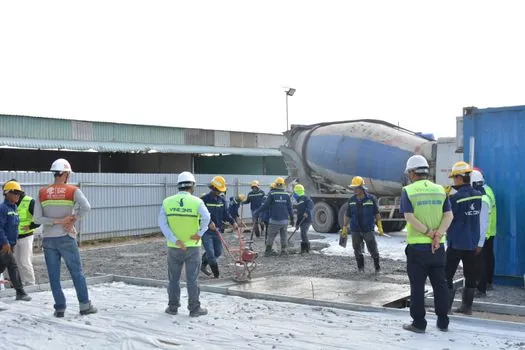
Three failure modes dominate: (1) bridge-formula overload on a three-axle truck above ~48,000 lb GVW in the U.S., (2) steering-axle overload above ~18,000 lb on the same configuration, and (3) soft-ground collapse on temporary site roads or matting when a fully loaded 30 t+ truck parks off the prepared crane pad [S1][S6]. Each one is a hard stop, not a design margin, and the practical payload on any given day is the lowest of the three.
Operational limits compound these: drum charge retention (a truck arrives with residual concrete from the prior load), wash-out water added at the plant, and admixture slumping in hot weather can each push the live payload 500–2,000 lb above the ticket weight, which is why the 66,000 lb figure should be treated as a wet-loaded minimum, not an upper bound, for bridge and pavement checks [S1][S3]. For a side-by-side view of the concrete pump truck and concrete mixer truck weight envelopes, those two equipment categories sit in different GVW classes and cannot be interchanged on a pour plan.
Track these two signals before specifying: the U.S. federal bridge-formula review (currently anchored to a 48,000 lb / 18,000 lb split for three-axle ready-mix) and the OEM tare-data sheet for the specific chassis, since a 1,000 kg tare swing on an aluminum-intensive cab can recover roughly 1 m³ of payload on the same axle ratings [S1][S2][S6].
For related coverage, see Pneumatic Cylinder Wear Parts: Seals, Bearings, and What Actually Defines Service Life.