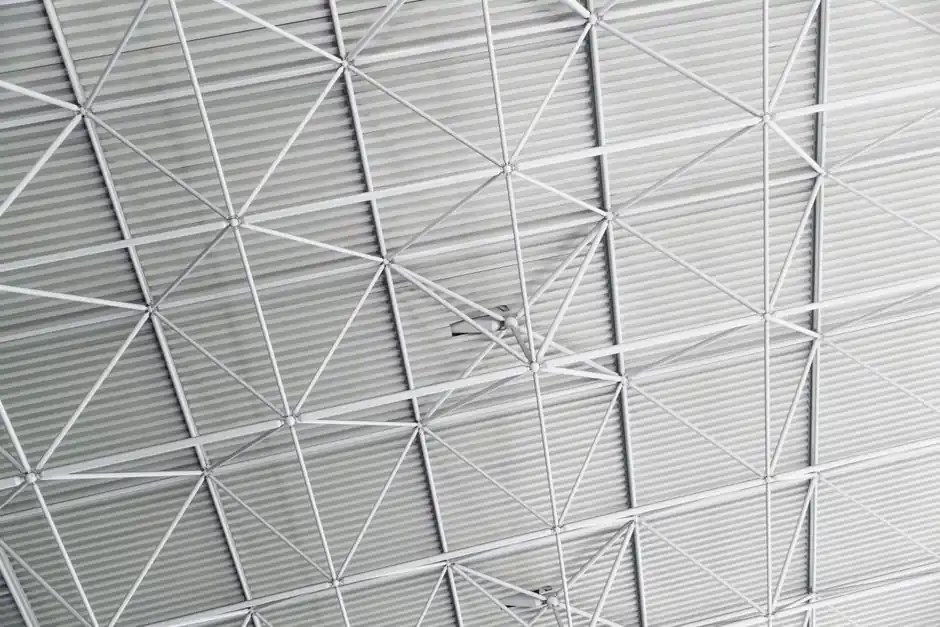
Underslung single girder cranes are under-running bridge cranes whose end trucks and trolleys ride the lower flange of an inverted-T track or the internal flange of an enclosed track, with standard SWL coverage from 1 t to 10 t in the light-duty class and up to 32 t on heavier under-running builds [S1][S3][S4].
The track profile is the structural member, runway beam, and running surface rolled into one component. Because every load path, every wheel reaction, and every building-interface hanger terminates on that tee section, the rail selection drives span, headroom, and capacity together rather than independently [S5].
Patented Track vs Enclosed Track: Which Standard Applies
MMA ANSI MH27.1 governs patented track underhung cranes and monorail systems whose end trucks run on the lower flange of an inverted-T profile, and covers curves, switches, transfer devices, trolleys, lift and drop sections, and the supporting components [S5]. MMA ANSI MH27.2 governs enclosed track underhung cranes and monorail systems whose end trucks run on the internal flange of an enclosed track section, and it is also the standard applied to trolleys operating on single-track monorail systems [S5].
The two standards share scope, definitions, and a duty service classification regime driven by service conditions, load distribution, work distribution, starts and stops, and hazardous-location exposure, but they are physically incompatible: a MH27.1 inverted-T wheel set cannot be retrofitted onto a MH27.2 enclosed track, and vice versa [S5]. For facility owners who need a quick orientation, a single girder crane configured as underhung picks up the same end-truck geometry regardless of whether the runway is I-beam, patented tee, or enclosed.
Track Profile Geometry: Inverted-T vs V-Profile vs Enclosed
Patented-track inverted-T sections (TC/American 200, 325, 400, 450 series) use a flat-bottom tee ranging from 2 in web depth on the 200 series to 4-1/2 in web depth on the 450 series, with the trolley flange riding the underside of the lower flange [S2]. TC/American's 325 line splits into 7/16 in thick "L" tee and 11/16 in thick "H" tee variants, with standard rail depths available from 8 in to 40 in to match load and span [S2].
Enclosed track monorail systems use a closed-section profile (commonly a "V" or modified V) where machined internal flanges guide the trolley wheels. The V-shaped profile aligns the trolleys and end truck while also shedding dust and debris from the running surface, which is why these systems are widely used in paint shops, foundries, and other dirty-process areas [S7]. Enclosed track also tends to be the geometry of choice for stacker crane aisles in AS/RS where the rail doubles as a structural tie between uprights.
For lighter-duty workstations, KBK-style modular rail uses cold-rolled steel or aluminum alloy track sections with lifting capacities in the 0.125–2 t band and a duty class range of A2–A4, configured for straight runs, curves, and switches on a single girder [S3].
Capacity and Wheel Load: Tee Section Selection Table
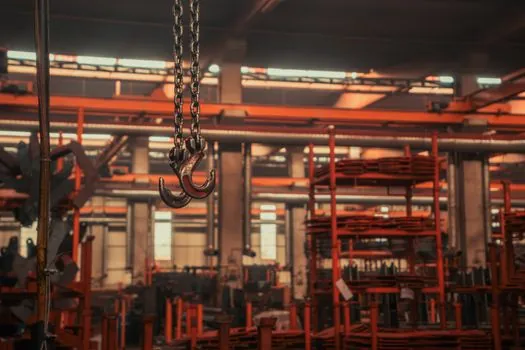
Two-wheel trolley load is the controlling rating for patented-track underslung single girders, because end-truck wheel reactions on an inverted-T tee concentrate the load into two flanges per truck rather than distributing it across a wide running surface [S2].
Comparison of the standard patented-track profiles offered by one major North American rail builder:
200 Series (2 in tee): two-wheel trolley load 2,000 lb. Suited to light-duty cranes and monorails up to 2 t, with a long history in laundries and gravity-powered slope runs [S2]. 325L (7/16 in tee): 5,500 lb two-wheel load. 325H (11/16 in tee): 10,000 lb two-wheel load. Both span 500 lb light-duty up to 20 t single-girder cranes with rail depths from 8 in to 40 in [S2]. 400 Series (4 in tee): 5,200 lb standard, 6,600 lb with tension strip, a drop-in replacement rail for legacy Twin City R-1 and American Monorail MD-1 wide-flange systems [S2]. 450 Series (4-1/2 in tee, 1 in thick): 18,000 lb two-wheel load, supporting 4-wheel trolleys up to 30,000 lb and standard single girder cranes up to 15 t [S2].
Standard rail lengths ship up to 60 ft at list price, with 90 ft and longer available on special order; runways, switches, and curves share the same tee profile so capacity stays consistent at every transition [S2].
Building Interface: Span, Headroom, and Hanger Spacing
Underslung single girder cranes are selected specifically when the building does not allow a top-running crane with its own support columns. The runway beam is supported from the building's existing roof structure or from dedicated brackets, and the load-bearing parts hang directly on the rail track so the entire crane operates below the runway [S4]. On low-ceiling builds this is the only way to recover usable hook path; a low-headroom hoist and trolley arrangement maximises hook height when every centimetre of lift counts [S4].
Typical technical envelope for one European under-running single girder line: SWL 1 t to 32 t, span 6 m to 30 m, lifting height 1 m to 100 m, FEM group 1m to 4m, ISO duty M4 to M8, lifting speed 1 to 12 m/min, with VFD control on all motions and supply at 400 V 50 Hz or 460 V 60 Hz [S4]. The lighter Street Crane underhung single girder line is published at up to 10 t SWL, sized to maximise floor space and improve access in busy production cells [S1].
For larger free-standing yards where headroom is not constrained, a gantry crane on a ground-level rail will typically beat an underslung design on span and installed cost, but loses the ability to drop the runway off the building structure. When a facility's process flow is a single fixed loop, a mobile crane on rails can sometimes substitute, but only if the operating envelope tolerates rubber-tyre or rail-borne ground traffic.
Duty Class, Service Factors, and When the Tee Profile Has to Grow
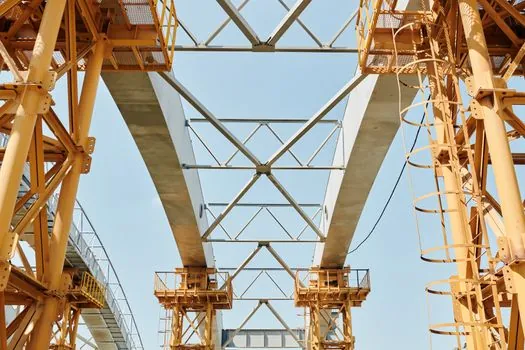
Both MH27.1 and MH27.2 assign duty service classifications from the same six inputs: service conditions, load distribution, work distribution, number of starts and stops, and hazardous-location exposure [S5]. A monorail in a clean assembly line at 4 starts/hour and 50% of rated load will sit in a light duty band and may ride a 325L tee for the life of the system; the same monorail in a steel-coil handling bay with 20 starts/hour and frequent full-load lifts will be reclassified into a heavier band and the same span will need a 325H or 450 tee to keep wheel and flange stresses inside the standard [S5].
The standards are also the gate for any hazardous-area underslung installation. For European builds, ATEX-rated underslung hoists and motors are typically required in zones 1 and 2, and the track profile is unchanged from the standard build; only the electrification, hoist enclosure, and trolley are specified for the gas or dust group [S4]. For weights verification on the lifted load, an integrated crane scale on the hoist is common and does not change the track selection.
Track Layout: Straights, Curves, Switches, and Drop Sections
A monorail crane system is a stationary overhead track on which trolleys travel to carry loads from one place to another in a facility, with the travel path commonly a mix of straight, curved, and switch sections chosen to follow process flow [S6]. Underhung single girder monorails add lift and drop sections where the trolley has to clear a process obstacle, lower a part onto a fixture, or interface with a floor-level conveyor [S5].
Curves and switches are the geometry where patented and enclosed tracks diverge most. Patented inverted-T tracks use swept curves with a defined minimum radius set by the tee depth, while enclosed tracks accept tighter radii because the internal flange is continuous around the bend [S5][S7]. Hand-pushed or motor-driven 200 series systems are routinely installed with a slight slope so the trolley is "gravity powered," a configuration documented since the pre-World War II era and still in service in laundries and light assembly [S2].
What Underslung Single Girder Is, and Is Not, the Right Choice For
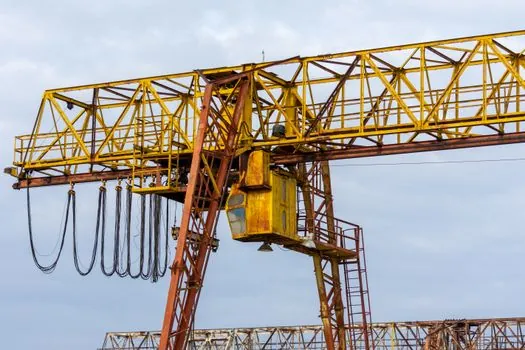
Underslung single girder suspension on a monorail track profile is the right call when the building has limited headroom, the load is in the 1 t to 10 t band (with 32 t possible on heavy-duty under-running builds), and the load path is a fixed route that benefits from a single beam doing structural duty and trolley running duty at once [S1][S3][S4]. It is the wrong call when the facility needs a high hook height with heavy capacity, where a top-running double girder typically wins on wheel loading and vertical clearance; when the process is outdoor and exposed, where wind and temperature swing drive the spec toward a crawler crane or mobile crane; or when the load has to be picked up at random floor locations rather than a fixed rail, which is jib crane or forklift territory [S3].
Trackable signals to watch: MMA confirmed in 2023 that both MH27.1 and MH27.2 are under active revision, with user input channelled through MHI's Director of Standards; any specifier working on a 2026 underslung build should request the latest revision status from the manufacturer before locking the tee section [S5].
For related coverage, see Hard-Bearing Balancer: Direct Force Measurement at the Supports.