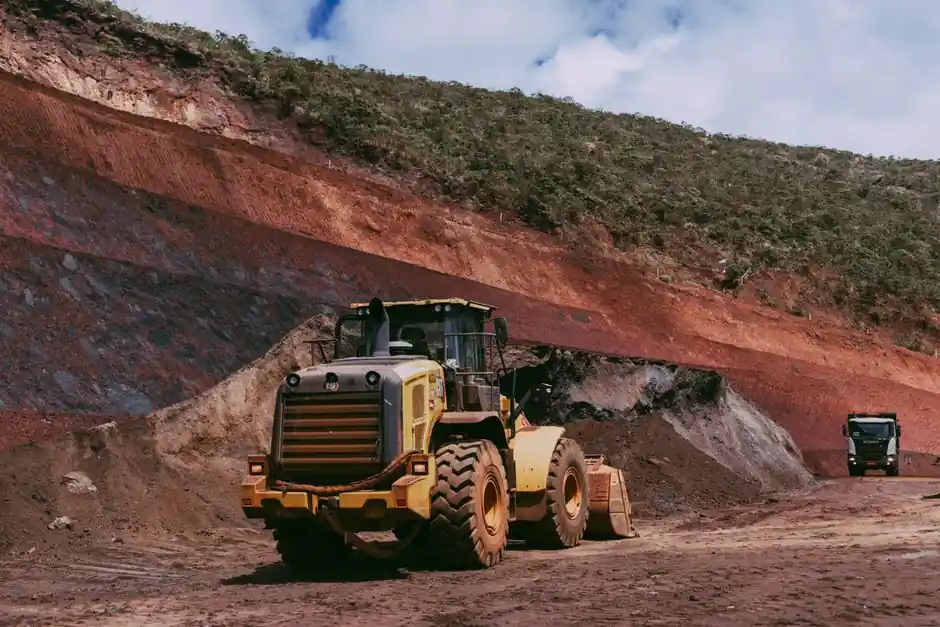
The 100-130 metric ton operating-weight class is the narrow band where quarry and hard-rock mining duty begins to overlap with heavy infrastructure excavation, typically served by purpose-built mining excavators from Cat, Komatsu, Hitachi, Liebherr and XCMG [S3][S2].
These machines sit well above the 77,000 lb (~35 t) lower bound of Cat's "large" frame range and well below the 800-1,000 t ultra-class mining shovels such as the Liebherr R 9800 and Cat 6090 FS [S5][S4][S3]. For background on how these machines fit into the broader heavy-equipment family, the excavator size and class reference covers the full weight spectrum from compact to mining class.
Where the 100-130 Ton Class Fits in the Mining Lineup
Mining excavator lines typically break into three bands: 100-130 t production-class machines for medium-scale quarry and hard-rock duty, 200-400 t heavy-production models, and 800-1,000 t ultra-class hydraulic shovels paired with 240-400 t mining dump trucks [S3][S4].
Liebherr draws the mining threshold at "more than 100 t" operating weight, below which the same chassis is sold as a construction crawler and above which it is configured with reinforced booms, larger buckets and mine-spec undercarriages [S3]. The Dozr spec guide flags XCMG's XE950G as a 100-ton example purpose-built for "heavy-duty projects like mining and quarries" [S2]. Cat's own "Large" excavator class runs from 77,000 lb up to 207,300 lb (~94 t) for the largest currently in production, which is the boundary just under the mining-class tier [S5].
Representative Models and Their Operating Weights
Concrete examples in or just outside the 100-130 t window include the Cat 374 (~74 t production-class lower bound, 374F L at ~74 t), Cat 390F at ~94 t, Komatsu PC850-11 at ~84 t, Hitachi EX1200-7 at ~120 t, and XCMG XE950G at 100 t [S2][S5].
Within a single OEM portfolio, the jump from a 90 t construction-crawler to a 120 t mining-class excavator is engineered rather than cosmetic: the uppercarriage, boom, stick, swing ring and final drives are uprated, the track gauge widens, and ground pressure drops to roughly 80-100 kPa to suit blasted-rock bench floors [S3]. For comparison, an ultra-class mining dump truck such as the Cat 793F (240 t payload class) is typically loaded in 4-5 passes by a 1,000 t shovel, but a 100-130 t excavator is matched to 40-60 t rigid haulers or 30-45 t articulated trucks [S4].
Engine Power, Bucket Capacity and Hydraulic Limits
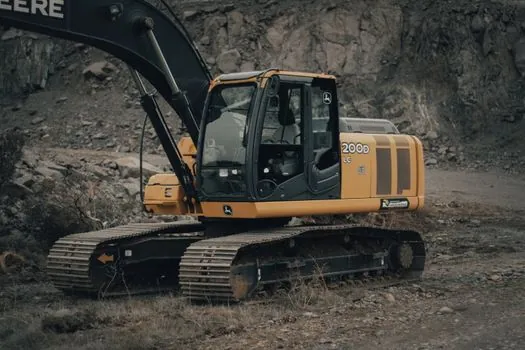
Engine output in the 100-130 t band typically lands between 600 and 900 hp (447-671 kW), with bucket ratings from roughly 4.5 to 8.0 m³ in rock-density configurations and hydraulic system pressures in the 31-35 MPa range [S2].
At the ultra-class end, the Cat 6090 FS shows what the upper boundary of the same engineering looks like: 4,500 hp from twin engines, ~13,058 L of hydraulic oil, ~25.8 N/cm² (37.4 psi) ground pressure, and a ~93.6 t shovel payload that fills a Cat 793F in four passes [S4]. The 100-130 t class is a roughly 8-10x scale-down in mass, which translates to about 15-20% of the ultra-class swing torque and bucket breakout force. Dozr's spec data shows the "large" envelope topping out near 2,000 hp only for the heaviest mining models, with 300-600 hp common in the 80-130 t range [S2].
Selection Criteria: Who Needs 100-130 t and Who Does Not
The 100-130 t class fits mid-tier hard-rock quarries, large aggregate pits, and mine-pre stripping where a 50 t machine is under-utilised and a 200+ t ultra-class unit is capital-prohibitive; it is the wrong choice for soft-soil trenching, urban demolition, or bulk ore handling at primary crusher faces [S3][S2].
A practical decision rule: if annual material movement is below ~1.5 million bank cubic metres, a 100-130 t excavator paired with three to four 40 t articulated haulers is typically more cost-efficient than a single 250 t mining shovel with two 90 t rigid trucks. Above ~4 million bcm/year, the math flips toward ultra-class shovels matched to 240 t trucks. The Cat "Large" frame range cited at 77,000 lb to 207,300 lb is the same envelope as Komatsu's PC650-PC1250 production-class series, so buyers should compare breakout force (kN), swing speed (rpm), and bucket-cylinder bore (mm) before comparing operating weight alone [S5].
Undercarriage, Ground Pressure and Site Constraints
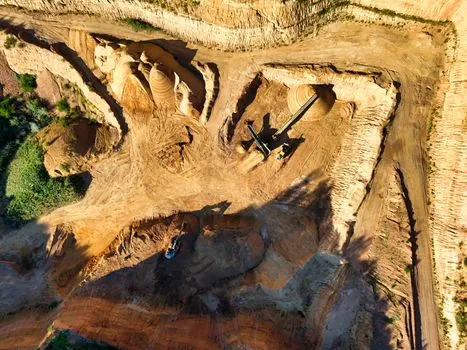
Ground pressure for 100-130 t mining-class excavators typically lands between 90 and 120 kPa with standard 600 mm track shoes, versus 25.8 N/cm² (258 kPa) for the Cat 6090 FS on its ~2,000 mm shoes, illustrating why ultra-class machines need prepared haul roads and 100-130 t units can still work on rough bench floors [S4].
Track gauge, shoe width, and overall shipping weight are the three numbers that decide whether a 100-130 t machine can be walked onto a site or must be disassembled for transport. Most OEMs in this class design the uppercarriage to stay within ~3.5 m transport width to fit standard low-bed trailers, while the booms and sticks ship separately. For OEM-agnostic guidance on how operating mass correlates with undercarriage loads, the excavator engineering overview outlines the uppercarriage-swing ring-undercarriage load path that defines the 100 t threshold.
Standards, Telematics and Maintenance Intervals
Mining-class excavators in the 100-130 t band are typically delivered with ISO 6015 metric operating-weight certification, ISO 12100 risk-assessment documentation, and engine emissions compliance to EPA Tier 4 Final / EU Stage V; cab structures are commonly ROPS/FOPS certified to ISO 12117 [S1].
Telematics on these machines record operating weight, fuel burn, idle time, hydraulic-oil temperature and payload per pass, with service intervals for hydraulic oil at ~5,000 hours, engine oil at ~500 hours, and undercarriage inspection at 1,000-hour walking checks. Buyers comparing brands should verify the telematics API supports ISO 15143 (AEMP 2.0) for mixed-fleet data export, since that has become the de-facto format for fleet management systems integrating excavators with mining dump trucks and ancillary equipment.
Common Failure Modes and Engineering Trade-offs
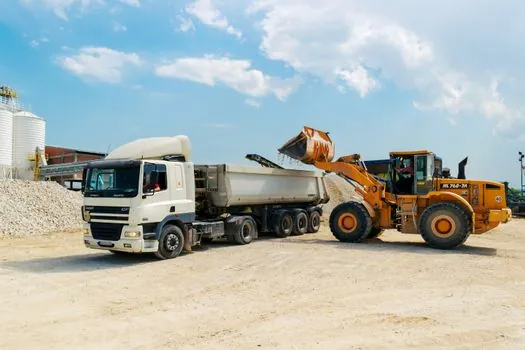
The three dominant failure modes in 100-130 t mining excavators are boom-foot cracking from side-load shock loading, final-drive planetary gear wear from high-duty-cycle swing, and hydraulic-cylinder seal failure from sustained 31-35 MPa pressure cycles [S3].
Boom-foot cracking is mitigated by selecting high-tensile steel castings (typically 690-890 MPa yield) and avoiding side-load lifting beyond the rated swing radius. Final-drive life is governed by swing torque vs. swing speed curves; buyers should ask for the rated swing torque in kN·m at 0 rpm stall. Hydraulic seal life is most often limited by oil cleanliness, so OEM filter micron ratings and standard ISO 4406 cleanliness targets (typically 18/16/13 or better) belong on the spec sheet. None of these failure modes are specific to one brand; they are class-level engineering trade-offs that scale with operating weight.
Trackable signals to watch in the 100-130 t class over the next two quarters: OEM release of 800-volt electric-drive prototypes in this weight band, rollout of Tier 4 Final Stage V retrofit kits for older Stage IV units still in quarry service, and the first commercial deployments of autonomous haul loading matched to 40-60 t trucks. For a deeper cross-industry look at procurement decisions in 2026, the 5-axis vs 3-axis CNC lead-time decision framework covers parallel risk-management thinking applicable to any high-capex equipment buy.
Spec-level background on the components involved: pressure transmitter.