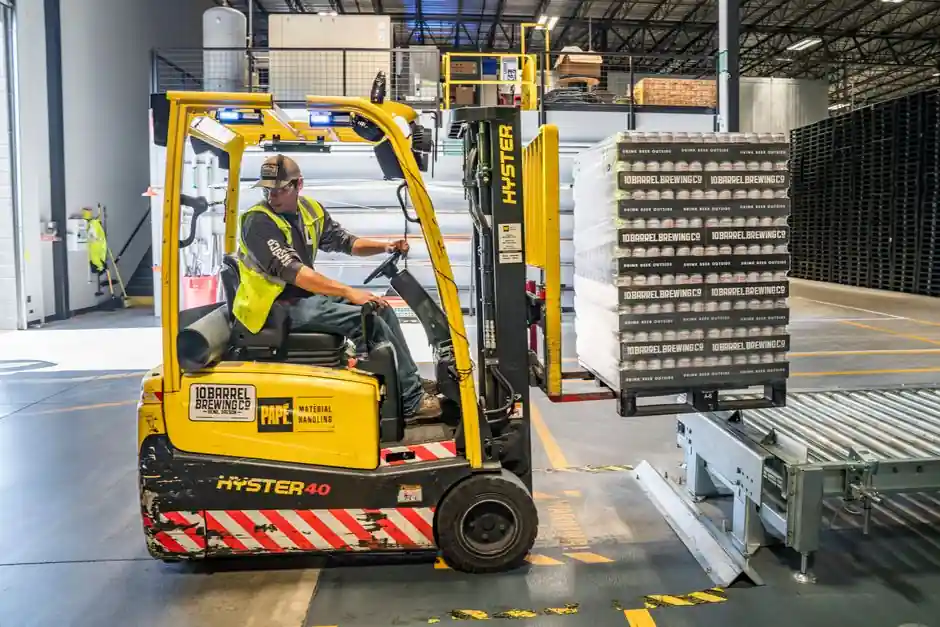
ISO 22915 is the multi-part series that defines how to verify industrial-truck stability on a tilting platform, with Part 1 setting the general test criteria, Part 2 covering counterbalanced trucks with mast-mounted lifters, and Part 15 (2020) addressing counterbalanced trucks with articulated steering [S2][S4].
On 11 November 2025, Italian notified body ECM publicly documented a tilt-platform test campaign on a counterbalanced lift truck against UNI ISO 22915-1:2020 and UNI ISO 22915-2:2020, confirming the protocol is still the routine compliance path for CE marking [S3]. A new ISO/DIS 22915-8 (Part 8, edition 3) is also in drafting to cover the additional condition of stacking with the mast tilted forward [S1].
Why a tilt table, and what the test actually measures
Calculated stability values derived from weight distribution, wheelbase, and load-center geometry are useful for class-level screening, but only a tilting platform test verifies that a specific truck design holds its line at the angles the standard demands before production release [S5].
OSHA recognises the underlying "stability triangle" concept: for a four-wheel sit-down rider truck, the three contact points are the two front wheels and the midpoint of the rear axle (or, on a three-wheel truck, the single rear steer wheel), and any test must reproduce worst-case load shifts within that triangle [S5]. Stability is governed by weight distribution, truck mass, wheelbase, tread, suspension type, tyre and mast deflection under load, and travel speed, so the platform test is configured to exercise the dominant combination rather than each variable in isolation [S5].
ISO 22915 part map: which part applies to which truck
ISO 22915-1 (ISO/FDIS 22915-1 circulated for vote 19 March to 14 May 2024) is the umbrella document, defining the general test criteria and verification procedure for all industrial trucks covered by the series [S4].
ISO 22915-2:2020 specifies the tests for counterbalanced trucks equipped with lifters and load-handling accessories, and is the document ECM cited when running a recent platform test on a lift truck [S3]. ISO 22915-15:2020 (second edition, April 2020) adds the rules for counterbalanced trucks with articulating steering and mast, including fork-position configurations, and breaks the platform work into a numbered sequence (Tests 1, 2, 3, 4, 5) keyed to load and rear-axle conditions [S2].
ISO/DIS 22915-8 (edition 3) is a draft addition that covers the special operating condition of stacking with the mast tilted forward, a configuration the existing parts do not fully address [S1]. Together, the four parts above form the working set that a notified body or in-house lab will pull from depending on truck class, mast geometry, and steering type.
Inside the test: truck position, load cases, tilt sequence
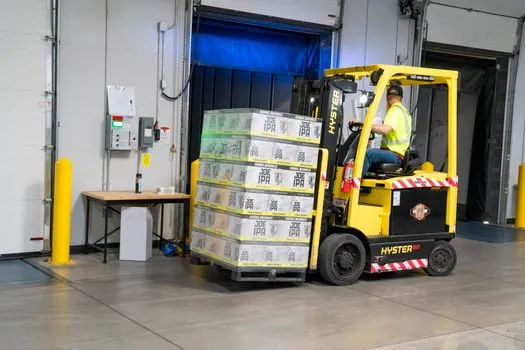
Part 15 lays out the position of the truck on the tilt table in a dedicated clause, separating "load and rear axles" geometry from the individual test definitions, because each numbered test (Test 1, Test 2, Tests 3-5) is a distinct platform configuration with its own load case and direction of inclination [S2].
Part 1 defines the four-stage flow that all parts inherit: a general section, a test-procedure section, a verification-procedure section, and a reporting section, with the platform tilt angle stepped progressively until the truck either holds or the first instability event is recorded [S4]. The lab's role, as ECM demonstrated, is to drive the platform through the angle sequence at maximum rated load, log the result, and issue a Test Report that the OEM then attaches to the technical file used for placing the truck on the market [S3].
Comparison: when a tilt table is the right tool, and when it is not
Decision criterion 1, regulatory acceptance: a tilt-table pass against ISO 22915-1 plus the relevant Part 2, 8, or 15 is what a notified body needs to issue a stability compliance opinion for CE marking under the Machinery Directive, whereas pure calculation alone is generally not accepted as a substitute for a specific design [S3][S5].
Decision criterion 2, configuration coverage: Part 1 plus Part 2 covers a conventional sit-down counterbalanced rider, Part 15 is mandatory for the articulating-steer variant, and the Part 8 draft closes the gap for forward-tilt-mast stacking, so the parts are complementary rather than interchangeable [S1][S2][S4].
Decision criterion 3, field use: ISO 22915 governs design verification, not in-service inspection; for daily operation, the operator-level reference is the OSHA load-capacity calculation (rated load center divided by actual load center, multiplied by stated capacity), and the ITSSAR/RTITB operator theory test sets a transport-tilt envelope that is separate from the design-time platform test [S5][S6]. A buyer who only needs to confirm ongoing operator compliance does not need a new ISO 22915 run; an OEM introducing a new model or a substantive mast/steering change does.
Failure modes the test is designed to catch
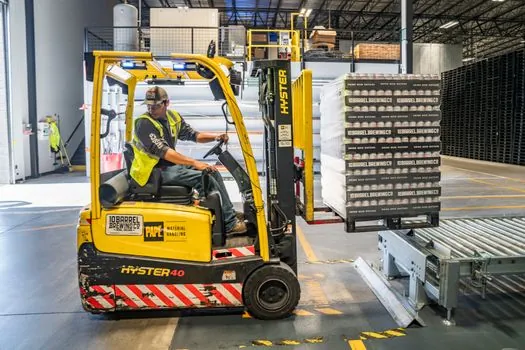
Tip-over during laden travel is the headline failure mode, and OSHA's class breakdown shows why: Class I electric rider trucks and Class IV/V internal-combustion rider trucks lift loads high enough that a falling load or a forward tip is a realistic event, while Class III hand trucks and Class VI tractors present a different hazard profile that the relevant parts of ISO 22915 address separately [S5].
The platform test is also the catch-net for mast deflection under load: if the mast bows past the rated geometry, the load center moves forward of the front-axle line and the rear axle unloads before the rated capacity is reached, an event that a calculation based on nominal dimensions can miss [S5]. For the forward-tilt stacking condition that the Part 8 draft adds, the specific risk being tested is rearward instability when the load is committed to the rack with the mast raked forward, a state the existing Part 2 tests do not cover in the same form [S1].
Linking the test to type approval and to real trucks
For a forklift entering the European market, the practical chain is: select the applicable ISO 22915 part(s) based on truck class, steering type, and mast configuration; run the tilt-platform test sequence at the rated load and load center; record the angles at which the truck remains stable; and attach the resulting Test Report, together with the stability calculation, to the technical file that supports the Declaration of Conformity [S3][S4].
For non-standard operating environments, the same protocol is reused with adapted conditions; a rough-terrain forklift (OSHA Class VII) still routes through the ISO 22915 framework for stability verification, with platform angles and load cases set by the relevant part rather than by site-specific rules [S5]. Buyers evaluating a used unit can ask for the original Test Report and confirm the part-number(s) cited, since that list alone tells them which configurations the manufacturer actually verified, and which remain on the user's responsibility.
Trackable signals to watch next
Two signals are worth monitoring. First, the ISO/DIS 22915-8 (Part 8, edition 3) ballot outcome: when this draft is published as a finished International Standard it will formalise the forward-tilt stacking test that is currently only a draft requirement, and OEMs marketing reach trucks or high-mast warehouse models will need to add it to their test matrix [S1]. Second, the publication of ISO 22915-1 from its 2024 FDIS stage, which will set the general criteria all later parts reference, so any change in its verification procedure will cascade into Parts 2, 8, and 15 compliance work [S4]. Labs running tilt-platform campaigns, such as the November 2025 ECM session, are the visible signal that this standard family is still the active compliance path rather than a legacy one [S3].
Component reference pages worth checking: tilt sensor.
See also our earlier report, Robotic Aseptic Fill-Finish Cells Move From Pilot to Production Under Annex 1.