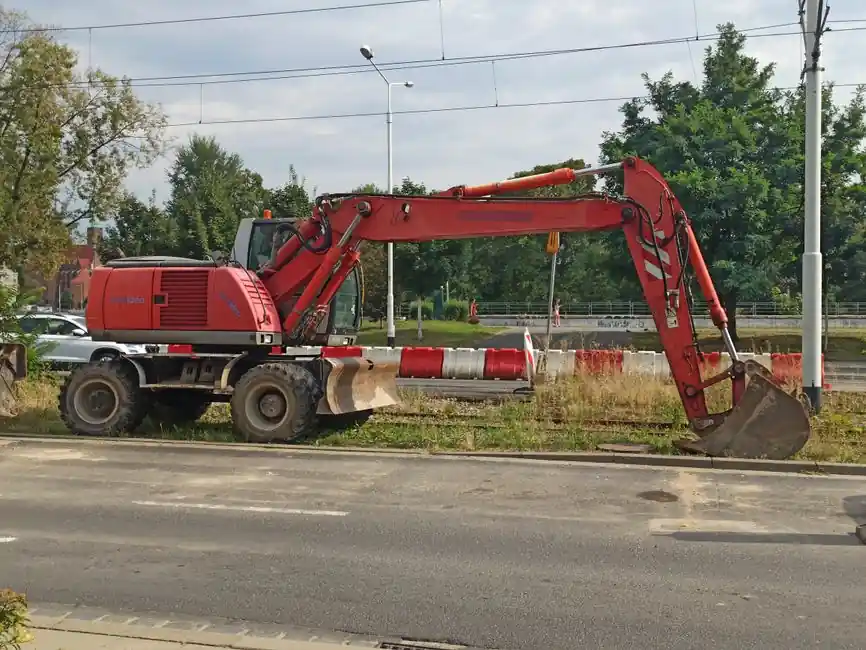
ISO 6015:2006, titled "Earth-moving machinery, Hydraulic excavators and backhoe loaders, Methods of determining tool forces", was published 2006-02-15 and remains the current international reference for measuring attachment break-out and tear-out forces on hydraulic excavators and backhoe loaders [S1][S5].
The second edition consolidated the 1986 two-part series (ISO 6015-1:1986 covering tool-force measurement) and the 1989 single-part ISO 6015:1989, both of which were formally withdrawn on 2006-02-27 in favour of the 2006 revision [S2][S3]. The standard sits under ISO/TC 127/SC 1, the earth-moving machinery sub-committee that also owns ISO 6165 (the parent machine-type vocabulary cited as a normative reference) [S2].
Scope, Machine Coverage, and Why the 2006 Edition Matters
ISO 6015:2006 covers "all types of hydraulic excavators, crawler or wheeled, with or without outriggers", and in the 2006 revision was widened to also include backhoe loaders, a category that was not explicitly inside the 1989 scope [S1][S2][S5]. Scope clause 1 limits the document to measurement and calculation of the tool forces of "earth-moving attachments fitted to hydraulic excavators and backhoe loaders", so it defines a test procedure, not a market or performance class.
Because the 1989 edition is the only one of the two predecessors still cited in the ISO catalogue life-cycle, engineers verifying a nameplate need to read the document carefully: the 1989 PDF on iso.org is marked "Withdrawn (Edition 1, 1989)" with stage code 95.99 and a withdrawal date of 2006-02-27 [S2]. The 1986 two-part predecessor is also listed as withdrawn, meaning any spec sheet or QA procedure that still references "ISO 6011-1" or the bare "ISO 6015" without a year is, on the ISO catalogue, pointing at a dead document [S3].
Test Apparatus, Pivot Geometry, and the Force Definitions
Clause 4 of ISO 6015:2006 ("Measurement methods") is the operational core and breaks into seven sub-clauses: 4.1 test site and general, 4.2 test apparatus, 4.3 preparation for testing, 4.4 requirements during testing, 4.5 limit conditions, 4.6 pivot positions, and 4.7 outriggers [S5]. Clause 4.6 ("Pivot positions") is where the standard fixes the kinematic reference points whose geometry converts cylinder pressure readings into the published break-out force, so any non-ISO claim of "digging force at the tooth tip" is only comparable to another ISO 6015 value if the pivot position and bucket-cylinder pressure were logged under the same conditions.
Force calculations in clause 4 rely on the cylinder bore area, the measured hydraulic pressure, and the lever arm between cylinder pivot and bucket tooth tip, so a force figure that ignores pivot position is not reproducible across machines. The standard's apparatus clause (4.2) is also where load cells or pressure transducers are specified for the lift- and tilt-cylinder lines; the same pressure-transducer family that shows up in stationary process plant pressure sensor is the typical instrument class for these short-duration, high-cycle bench tests.
What the Standard Is For, and What It Is Not For
ISO 6015:2006 is for OEM test cells, certification labs, and engineering reviewers who need a reproducible, geometry-traceable number for the bucket-cylinder break-out force and the stick tear-out force at a defined tooth-tip pivot, under controlled cylinder pressure and machine attitude [S1][S5]. It is not a jobsite productivity rating, not a duty-cycle rating, and not a fuel- or emissions-related figure; those are governed by other ISO 6014-series and ISO 9249 documents outside this standard's scope.
It is also not the right reference for comparing machines measured against different editions, because the 2006 edition broadened scope to backhoe loaders, and the 1989 edition applied to hydraulic excavators only [S1][S2]. Buyers comparing, for example, a current Caterpillar 6015 hydraulic mining shovel against a 1990s competitor must confirm both numbers were taken under ISO 6015:2006, not the older 1989 issue, otherwise the break-out-force column mixes different test geometries.
Comparison: ISO 6015 vs SAE J1179 vs OEM "Rated" Force
The 2006 edition's force definitions align with the long-standing SAE J1179 / ISO 6015 dual-rating practice that most major OEMs publish on the same nameplate. Caterpillar's 6015 hydraulic mining shovel data sheet is a clean example: the same machine lists "Bucket Digging Force, SAE" at 501 kN (112,600 lbf) and "Bucket Digging Force, ISO" at 538 kN (120,947 lbf), with ISO stick digging force at 466 kN (104,761 lbf) [S8].
The decision matrix a buyer or specifier works against is therefore: (1) test geometry, ISO 6015:2006 pivot positions vs SAE J1179; (2) machine class, hydraulic excavator only (1989) vs excavator plus backhoe loader (2006); (3) load cell class, pressure transducer accuracy at the bucket cylinder vs external load pin at the tooth tip; and (4) limiting condition, ISO 6015:2006 clause 4.5 limit conditions (hydraulic relief setting, machine on level ground, outriggers deployed where fitted) vs a manufacturer's relaxed bench set-up. Two nameplates with the same "kN at tooth" number can still fail to compare if only one of them tracked clause 4.5 and 4.6.
Failure Modes and Limits Engineers Hit on the Bench

The 2006 edition's clause 4.5 "Limit conditions" is the section that gets violated most often in informal OEM marketing: it pins the machine to its relief-valve setting and to defined outrigger / dozer-blade positions, so a "rated" force taken with the relief turned up, or with the machine on uneven ground, will read higher than an ISO 6015 value and is not comparable [S5].
Outrigger position is the second silent variable: clause 4.7 forces a defined outrigger state, and a wheeled excavator measured with stabilisers down versus up will show different stick tear-out figures even at the same cylinder pressure. The reproduction-related failure mode is when a test cell logs only the pressure reading and not the pivot geometry from clause 4.6, in which case the calculated force cannot be re-checked by a second lab, because the lever arm itself was never recorded.
Sourcing, Standards Hierarchy, and Where the Document Sits
ISO 6015:2006 is the second edition, reference number ISO 6015:2006(E), with English and French titles on the title page ("Engins de terrassement, Pelles hydrauliques et chargeuses-pelleteuses, Méthodes de détermination des forces de l'outil") [S5]. The catalogue page for the withdrawn 1989 edition still shows the full ISO life-cycle, including stage 90.92 (decision to revise) dated 1994-10-24 and the formal publication of the 2006 successor on 2006-02-15, which is useful provenance when a QA system needs to justify why the 2006 edition is the controlled copy on file [S2].
For engineers building out a complete earth-moving test plan, ISO 6015:2006 sits next to ISO 6165 (machine-type definitions, normative reference) and the wider ISO 6014 family covering other performance ratings. Adjacent measurement practice for general load cells and pressure transducers follows the same calibration and uncertainty logic as force gauge bench work and the weighing force chain that flows from it, while the flow-side instrumentation that supports hydraulic test stands (cooler flow, return-line flow) is covered under the flow meter category. For an external sanity check, the published Caterpillar 6015 numbers are the most cited real-machine reference: 538 kN ISO bucket digging force, 466 kN ISO stick digging force, 501 kN SAE bucket digging force [S8].
The 2006-02-15 publication date is the anchor: any procurement document written before that date that cites "ISO 6015" without a year is, on the ISO catalogue, pointing at the withdrawn 1989 edition and should be re-issued against ISO 6015:2006 before the next calibration cycle. Watch the ISO/TC 127/SC 1 work programme for a possible third edition, and confirm on the next re-calibration that the test cell's pressure transducer class still satisfies the apparatus clause of ISO 6015:2006, since that is the clause most often flagged during ISO 9001-linked audits of excavator test facilities.
See also our earlier report, PPR Pipe Price Per Meter by PN Rating and Diameter.