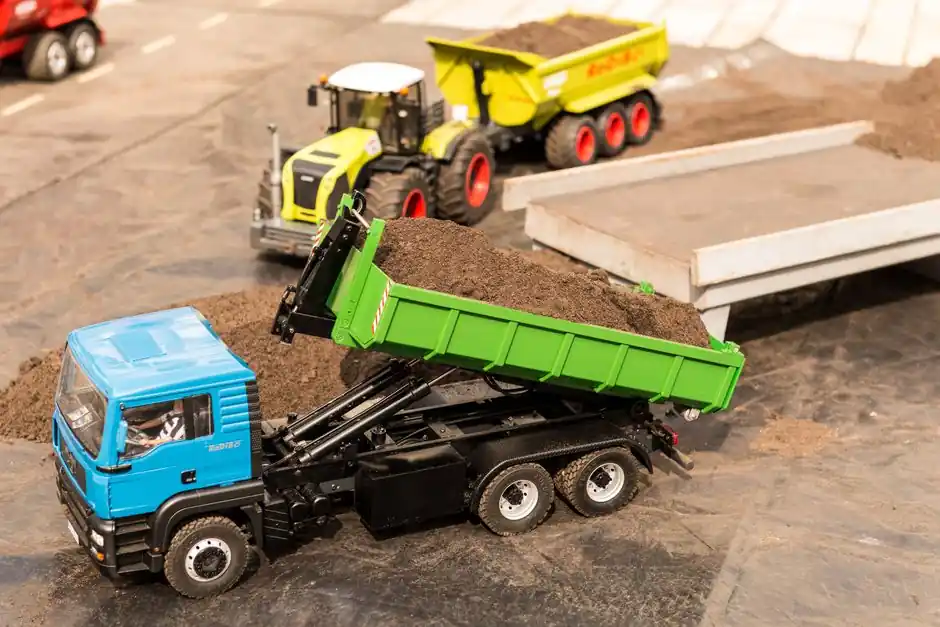
A 14 cubic yard dump truck typically carries about 17.5 to 21 tons of loose gravel, because dry gravel weighs 2,500 to 3,000 lb per cubic yard and the legal payload ceiling is set by GVWR plus state bridge laws, not by box volume [S1][S4].
For a tandem-axle chassis in the 33,000 to 44,000 lb GVWR band, the 14 yd³ box will usually fill to roughly 75 to 90 percent of legal payload when handling #57 stone or pea gravel, leaving headroom for moisture and axle distribution [S4][S7].
Why the box size and the legal weight answer two different questions
Gravel density sits between 1.3 and 1.7 tons per cubic yard depending on stone type, gradation, and moisture, so a 14 yd³ box represents 18.2 to 23.8 tons of stone by volume alone [S1]. Federal bridge law caps a single axle near 20,000 lb and a tandem near 34,000 lb, and most U.S. states enforce those limits with small variations, which is why published payloads for 14 yd³ trucks cluster in the 15 to 22 ton range rather than matching the volumetric maximum [S2][S4]. A loaded tandem-axle truck with body, fuel, and driver typically weighs 16,000 to 18,000 lb, so the difference between that tare and the GVWR sets the legal payload window [S6].
Wet, clay-bearing gravel can push past 3,000 lb per cubic yard, which is the failure mode that catches contractors: the box looks underfilled but the scale reads over, triggering brake wear, suspension sag, and roadside citations [S4]. This is also why fleet operators spec a 14 yd³ body on tri-axle chassis when they actually need 18 to 25 tons per trip, since the extra axle legally carries another 8,000 to 10,000 lb [S4].
Side-by-side: 10, 12, and 14 yard dump trucks on the same material
Using gravel at 2,800 lb per cubic yard as the baseline, the comparison below shows why payload, not box size, drives fleet decisions: [S4]
10 yd³ box on a single-rear-axle chassis: about 14 tons of gravel by volume, but legal payload commonly lands at 5 to 10 tons on Class 5 to 6 trucks, so the box is rarely heaped [S4]. 12 yd³ box on a tandem-axle Class 6 to 7 chassis: about 16.8 tons by volume, 10 to 16 tons legal, the most common municipal and contractor setup [S2][S4]. 14 yd³ box on a Class 7 to 8 tandem or tri-axle: about 19.6 tons by volume, 17.5 to 22 tons legal, where a dump truck buyer is paying for axle count rather than steel [S4][S7].
For operations running dense, wet aggregate or heavy crushed stone, moving from a 12 to 14 yd³ body without adding an axle usually means accepting a lower fill level rather than gaining payload, since GVWR is the binding constraint [S4]. Tri-axle versions of the 14 yd³ truck are the workhorse of larger mining dump truck support loops and contractor road base hauls, where 18 to 25 tons per load is routine [S4].
Material type shifts the answer by 20 percent or more
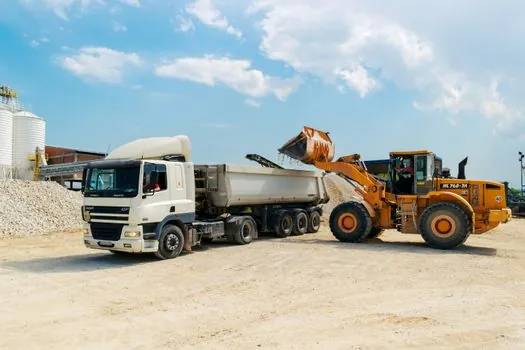
Standard crushed limestone and washed #57 stone come in around 2,500 to 2,700 lb per cubic yard, which is the lower bound of published gravel weights, so a 14 yd³ load of clean stone lands near 17.5 tons [S1][S4]. Pea gravel is denser at roughly 2,800 to 3,000 lb per cubic yard because of tighter packing and smaller voids, pushing the same 14 yd³ box toward 19.5 to 21 tons [S4][S5]. Crusher run and road base are even heavier once moisture is absorbed, sometimes reaching 3,200 lb per cubic yard, which is exactly the condition that puts a 14 yd³ load into the 22 ton range and right at the upper end of a tandem legal payload [S4].
Decorative river rock and drain rock run lighter in big sizes because of void space between rounded stones, so a 14 yd³ box of 1.5 to 3 inch river rock can come in under 17 tons by weight even when visually heaped [S2]. Knowing the material lets the hauler set the target tonnage instead of guessing from the box, which is the practical reason aggregate haulers buy by the ton rather than by the yard [S2].
Where 14 yard dump trucks fit, and where they don't
A 14 yd³ tandem is well suited to residential driveways, small commercial pads, shed bases, and single-day landscaping deliveries of 17.5 to 21 tons per trip, which covers most homeowner and small-contractor orders in the 10 to 15 ton range [S1][S2]. It is also a common spec for road base delivery, drainage rock, and #57 stone on subdivisions where tri-axles cannot maneuver tight corners. The same truck is the wrong tool for major roadwork, agricultural bulk haul, or quarry transfer, where concrete mixer truck support vehicles and belly dumps move 25 to 32 yd³ per load and beat a 14 yd³ truck on per-ton cost [S1][S2].
Buyers who are actually after the 22 to 25 ton payload range are usually shopping a tri-axle 14 to 16 yd³ truck, not a tandem 14 yd³, because the legal payload is gated by axle count, not by box size [S4]. Treating box size as the spec is the most common specification error and shows up as chronic underloading on the hauler side, and overloading fines on the operator side.
How DOT and bridge law set the real ceiling
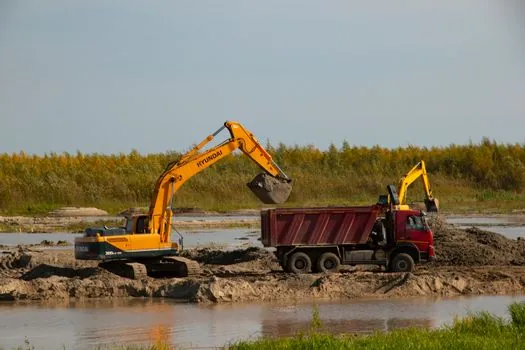
Federal weight limits in the U.S. allow 20,000 lb on a single axle, 34,000 lb on a tandem, and a gross vehicle weight of 80,000 lb on the interstate system, with state-specific bridge formulas that often tighten those numbers on local roads [S4]. A typical tandem dump with a 14 yd³ body, empty, runs 15,000 to 18,000 lb, which leaves roughly 15 to 19 tons of payload before any state-specific reduction kicks in [S6].
State enforcement varies: some states use the federal formula straight, others apply stricter inner-group and outer-bridge limits that can drop a tandem's legal payload by 2,000 to 4,000 lb in spring thaw postings [S4]. This is why the same 14 yd³ truck can legally carry 19 tons of gravel in one state and only 16 tons in another on the same day, and why scale tickets matter more than the box size printed on the door. Buyers who ignore the formula end up either running light and losing margin, or pushing over the limit and eating citation costs.
Verifying the load: scale tickets and density checks
The only reliable way to confirm how many tons a 14 yd³ truck is hauling is to weigh the loaded truck on a certified truck scale and subtract the tare, since visual loading is unreliable across material types and moisture levels [S2]. Standard crushed limestone at 2,500 to 2,700 lb per cubic yard will consistently come in at 17.5 to 18.9 tons for a 14 yd³ load, while wet crusher run can spike to 22 tons on the same truck [S4].
For a contractor, the practical spec is: confirm material density with the supplier, set target payload at 80 to 90 percent of legal GVWR, and use a tri-axle chassis whenever the load regularly exceeds 18 tons of dense aggregate [S4]. That avoids the underfill-overweight failure mode and keeps cycle times predictable on soft yards and wet weather days. For a wider look at how similar chassis decisions are made on adjacent equipment classes, see Truck Crane Working Radius: Measured From Center of Rotation, which covers the same load-and-geometry trade-offs on a different truck platform.