
A 60 m³/h placement target at a 90-minute full cycle and 8 m³ usable per drum works out to 11.25 working vehicles, which rounds up to 12 concrete mixer trucks in steady state [S1]. That number is a planning approximation, not a dispatch guarantee, because the usable drum volume, the cycle time, and the pour rate all move together.
Conventional ready-mix trucks in North America and China cluster in the 8–10 yd³ (≈6.1–7.6 m³) range, with some fleet operators rating drums to 10 yd³ (≈7.65 m³) as the most common legal load [S2][S5]. A Chinese-market fleet reference puts the common usable payload at 8 m³ on a single chassis, and that is the figure used in the worked example below [S1].
The fleet-sizing formula and the 60 m³/h result
Working fleet = (required hourly volume × cycle time in hours) ÷ usable volume per truck. Using the three named inputs: 60 m³/h × 1.5 h ÷ 8 m³ = 11.25, which a dispatcher rounds up to 12 vehicles [S1]. Drop the cycle to 60 minutes and the same arithmetic gives 60 × 1 ÷ 8 = 7.5, rounded to 8 trucks, but only if the plant, the route, and the chute can all complete a round trip in an hour. Stretch the cycle to 120 minutes and the count climbs to 15 trucks, because the denominator is fixed while the numerator doubles [S1].
That 12-truck number is sensitive to two non-obvious inputs. First, "usable volume" is not the same as drum geometry: a 10 yd³ drum rated for 8 m³ in one market may only legally carry 6 m³ in another once axle-load rules and concrete density (about 2,405 kg/m³ for standard mixes, equivalent to roughly 4,056 lb/yd³) are applied [S2][S5]. Second, cycle time is the variable that drives most of the swing: a 30-minute change at 60 m³/h moves the working fleet by about 3.75 trucks in either direction.
Usable drum volume vs nominal drum volume
Most standard mixer trucks in the global ready-mix fleet carry 8–10 yd³ (≈6.1–7.6 m³) per load under normal legal payload limits, with smaller units down at 1–6 yd³ (≈0.76–4.6 m³) and larger specialty chassis up to 10–12 yd³ (≈7.6–9.2 m³) [S2]. In metric terms, 8–10 yd³ converts to roughly 6.1–7.6 m³, and 10–12 yd³ to roughly 7.6–9.2 m³, using the 1 yd³ = 0.7646 m³ conversion [S2].
Rated mixing capacity is not the same as geometric drum volume, and that distinction decides fleet size before any truck rolls [S2]. Drum geometry, axle configuration, concrete mass, operating tare, and local road limits all compress the legal load, so the planner should request the permitted payload for the finished vehicle in its operating market, not the brochure drum size [S1][S2]. A truck that can hold 10 yd³ on paper may only be permitted to haul 8 yd³ (≈6.1 m³) once the local bridge formula is applied.
Cycle-time components that move the answer

A "cycle" covers batching and loading, outbound travel, site queuing, positioning, discharge, any washout, and the return leg, not just driving distance [S1]. For a typical 60 m³/h pour inside a 30-minute plant radius, the published worked example uses 90 minutes as a defensible middle-case cycle; congested urban pours commonly run to 120 minutes, and dedicated plant-to-site hauls on a controlled route can finish in 45–60 minutes [S1].
The site end usually decides whether the fleet math holds. If chute reach is short and pump placement is the only option, the 60 m³/h target is shared between the pump's rated output and the truck arrival rate, so a pump rated below 60 m³/h caps the whole operation regardless of how many mixers are queued. The fleet calculation also assumes a uniform pour: a concrete placement boom only buys cycle time if the discharge end can accept concrete at the rate trucks deliver it.
Comparison: standard mixers vs volumetric mixers for the same pour
Standard drum mixers and volumetric concrete mixers solve the 60 m³/h problem differently. Drum mixers move pre-batched concrete; volumetric units meter cement, aggregate, water, and admixtures on site and mix on demand, which removes the return-trip drum-washout step and the short-load fee structure [S3][S5].
On a 60 m³/h continuous pour, a single high-output volumetric mixer with on-board metered batching can substitute for several drum trucks, because its limiting factor is the discharge rate at the chute, not the loaded drum weight, and it carries raw materials rather than a finite mixed batch [S3]. For drum-mixer fleets, the comparison is the worked example in the previous section: 12 trucks at 8 m³ usable per load on a 90-minute cycle, with discharge equipment matched to that 60 m³/h arrival rate. A side-by-side read for a planner looks like this:
Option A, standard drum fleet: 8 m³ usable per load, 90-minute cycle, 12 working trucks, needs 12 drivers and a standby vehicle, fixed short-load fees under typical 5 yd³ minimums, and quality depends on discharge time kept within spec [S1][S5]. Option B, volumetric mixer: on-demand batching eliminates the short-load fee and the washout return step, suited to continuous pours and odd-access sites, but raw-material compartments cap the run length between re-stock and the unit still needs a comparable discharge setup to sustain 60 m³/h [S3][S5].
Adding standby, access margin, and pump-side limits
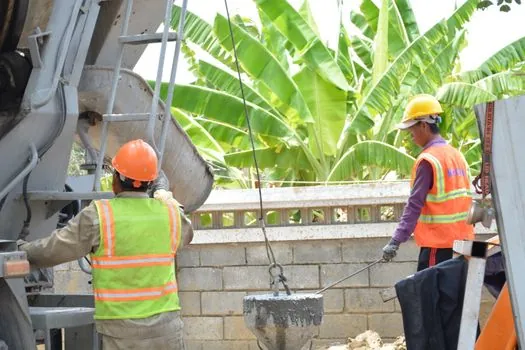
The 12-truck baseline is the working fleet, not the ordered fleet. A practical rule is to add one standby vehicle per 6–8 working trucks so a single mechanical failure or traffic delay does not collapse the pour rate, which lifts 12 working trucks to roughly 14 ordered trucks [S1]. If site access is restricted to one-way entry, or if the approach road is steep or unpaved, an extra margin is applied at the cycle-time input rather than the truck count, because queuing more vehicles at a constrained site usually makes output worse [S1].
The pour rate itself is bounded above by what the receiving equipment can place. A truck-mounted boom pump at 50 m³/h and a 60 m³/h truck arrival rate creates a 10 m³/h surplus that has nowhere to go, so the fleet target is the lesser of the two. Reverse it and the same logic holds: a 70 m³/h pump with 60 m³/h of truck arrivals starves the line and shows up as cold joints. Fleet sizing is therefore a three-way fit between plant output, truck cycle, and placement capacity, and a 60 m³/h pour only works when all three converge on the same number.
Common failure modes in fleet sizing
Three patterns show up repeatedly on 60 m³/h pours that come in short. The first is overcounting drum volume: planners quote 10 m³ nominal drums without checking the legal payload, and the actual fleet ends up at 14 m³ of nameplate capacity for 12 m³ of working capacity, which costs two trucks [S1][S2]. The second is undercounting cycle time: a 60-minute assumed cycle that turns into 90 minutes on pour day moves the working fleet from 8 to 12 vehicles, and those 4 missing trucks have to be sourced in real time or the pour rate drops.
The third is treating the pour rate as fixed: concrete temperature, slump retention, and approved discharge-window constraints on the mix can pull the effective rate below 60 m³/h even when trucks are queued, so the receiving end becomes the bottleneck instead of the truck end. Watch the queue length at the pump, the average drum return temperature, and the time from batch to final discharge on the first three trucks; if any of those drift, the 12-truck plan needs to be re-run before the rest of the fleet arrives.
For adjacent equipment context, shaft key sizing on a mixer truck's gearbox input follows the same cycle-driven logic, and the brake resistor duty cycle on a VFD-driven mixer drum is another cycle-time-driven calc worth running before the pour starts. A live confirmation point: the mix design's approved discharge window, the pump's rated m³/h at the boom reach in use, and the plant's confirmed 60-minute batch output are the three numbers that decide whether 12 trucks is enough, too few, or wasteful on pour day.
For component-level specifications, see power mixer, and sand mixer.